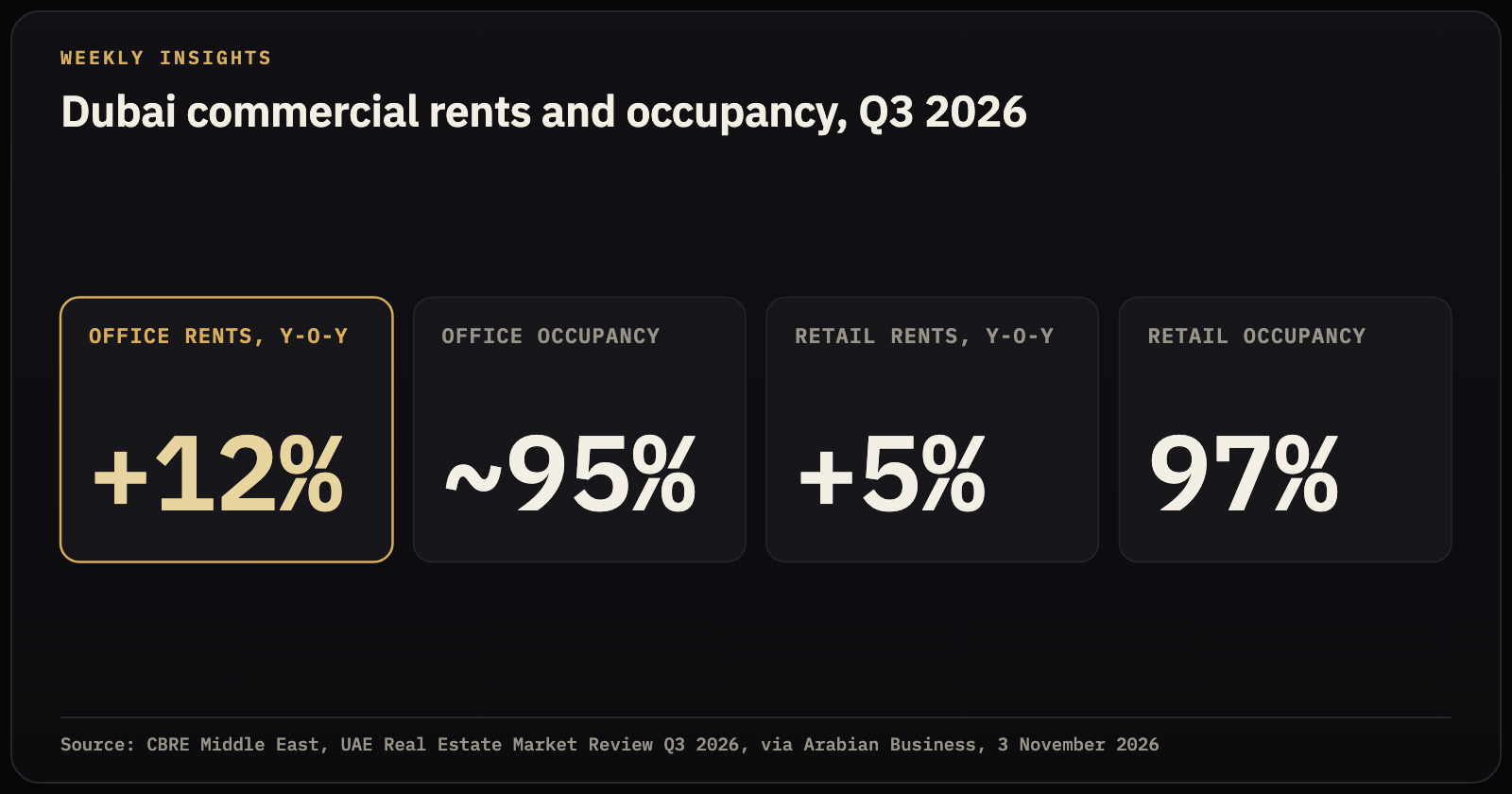
Commercial space is where Dubai's rent growth is. CBRE's third-quarter review puts average Dubai office rents 12% higher year-on-year, with occupancy at about 95%. It describes office property as among the UAE's strongest-performing real estate sectors in the quarter, supported by demand for high-quality workspace and limited Grade A supply. Retail rents rose 5% at 97% occupancy, and industrial rents 12%.
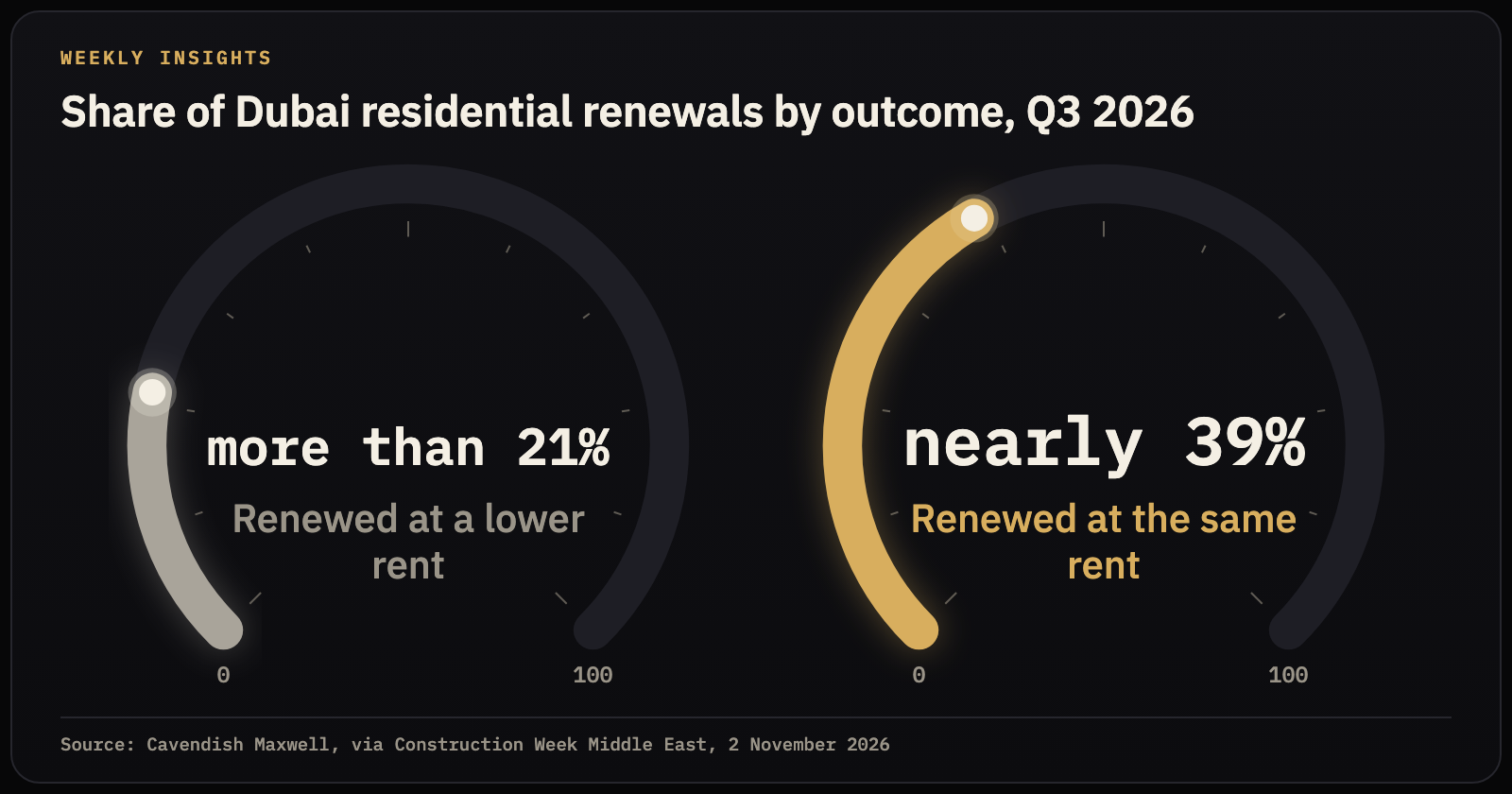
Residential moved the other way. The same CBRE review puts average Dubai residential rents 7% lower year-on-year, while Cavendish Maxwell counts 38,000 new homes delivered between January and September and 24,000 more scheduled before year-end. Among Q3 renewals it tracked, more than 21% took a rent reduction and nearly 39% renewed at the same price.
For an investor buying income rather than a home, that is the week in one line: the segments with rent growth and near-full occupancy are the commercial ones. The cost of money is the other half of it. After Friday's stronger-than-expected US jobs report, markets moved to price a December rise in US rates at 78%, up from 70%.
If you're weighing entry points while this market reprices, I can show you where the risk-adjusted opportunities are emerging. Click here to speak with me directly.
UAE commercial and hospitality markets, Q3 2026 year-on-year (CBRE Middle East, via Arabian Business, 3 November 2026)
| Figure | |
|---|---|
| Dubai office rents | +12%; occupancy ~95% |
| Abu Dhabi office rents | +20%; occupancy 96% |
| Dubai retail rents | +5%; occupancy 97% |
| Abu Dhabi retail rents | +1%; occupancy 96% |
| Industrial rents, Dubai / Abu Dhabi | +12% / +6% |
| UAE hotel occupancy, year-to-date | ~24 percentage points lower (H1: 28 points) |
| UAE average daily rate / RevPAR | −8% / −30% |
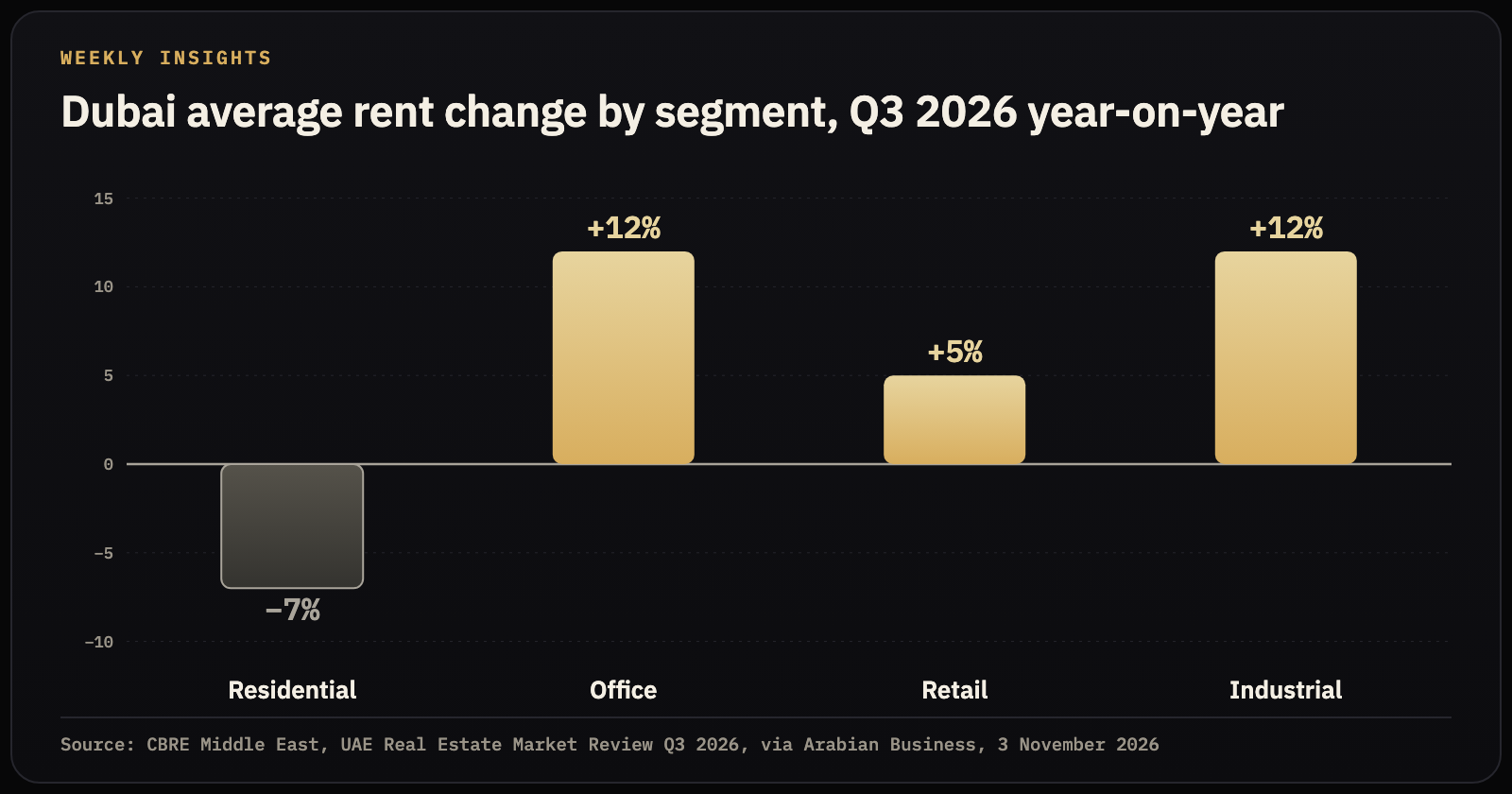
CBRE names DIFC, Business Bay and Dubai Internet City among the submarkets recording strong leasing activity, driven by financial services, professional services and technology businesses. The constraint it identifies is supply: limited Grade A stock. Hospitality is the soft segment, though CBRE reports conditions improving through Q3 as air connectivity and visitor arrivals recovered.
Two things follow for an income buyer. The first is that occupancy at or above about 95% across Dubai offices and retail means a vacancy assumption built for the residential market is too conservative here. The second is the discipline that goes with it: rent growth of this size is usually already in the asking price. Test whether it is, and judge the purchase on the yield at today's price rather than on last year's rent growth.
CBRE's 7% fall sits beside Cavendish Maxwell's average rent of AED77.3 per square foot, up 5.5% year-on-year, with gross yields averaging 6.6% for apartments and 4.9% for villas. The two readings point in opposite directions. I report both with their sources and do not reconcile them.
The renewal data is more specific, and it is a share of renewals rather than a fall in rent. In Q3, more than 21% of renewals recorded a rent reduction and nearly 39% renewed at the same price. As I noted in the September 26 edition, new-lease rents had already moved well below renewal rents; the Q3 figures suggest that pressure is now reaching sitting tenants too.
If you are valuing a tenanted residential unit, treat the passing rent as a ceiling rather than a floor. Budget the next renewal at today's rent or below.
Dubai residential market, 2026 (Cavendish Maxwell, via Construction Week Middle East, 2 November 2026)
| Figure | |
|---|---|
| Units delivered, Jan–Sep | 38,000 (+41% year-on-year) |
| Units delivered, Q3 | ~12,400 |
| Scheduled, rest of 2026 | 24,000 (83% apartments) |
| Pipeline, 2027 | ~136,100 |
| Q3 sales | AED72.6bn, 33,900 transactions (−13% and −2% vs Q2; −47% and −38% y-o-y) |
| Average price, September | AED1,644 psf (−2.2% y-o-y); Q3 prices +0.3% q-o-q |
| Q3 mortgages | AED21.8bn, 10,000 loans (quarterly record) |
| Off-plan share, Q3 | 72%+ of transactions |
According to Cavendish Maxwell, deliveries this year are on track to pass 2025's 40,000. On sales, AGBI separately reports that Dubai's third-quarter sales values almost halved to AED92.9 billion — a different source from Cavendish Maxwell's AED72.6 billion, so I report both and do not combine them. CBRE describes Dubai sales prices as broadly stable despite a decline of approximately 1% year-on-year.
Apartments make up 83% of the year's remaining deliveries. Landlords in handover-heavy communities should price first-year rent for more competition.
Abu Dhabi real estate, January–September 2026 (Abu Dhabi Real Estate Centre, via The National, 7 November 2026)
| Figure | |
|---|---|
| Transaction value | Dh171.26bn (+76%+ year-on-year) |
| Transactions | 38,483 |
| Sales | Nearly Dh120bn, 23,749 transactions |
| Mortgage activity | ~Dh46bn (+30%+) |
| Foreign investment in investment zones | Dh86.11bn (+131%; 81% of total) |
| Non-resident individual FDI | Dh17.22bn (full-year 2025: Dh8.2bn) |
ADREC said on Saturday that transactions worth Dh171.26 billion were recorded to the end of September. By value, Al Reem Island led at Dh29.86 billion, ahead of Al Hudayriyat Island at Dh28.62 billion.
October continued the pattern. Arabian Business, reporting an analysis of Abu Dhabi Real Estate Centre data, counts 2,809 homes sold for AED12.97 billion, 30% more by value than September. CBRE puts Abu Dhabi apartment prices 13% higher year-on-year in Q3.
ADREC announced in July that residential, commercial and industrial rents would not increase until further notice, apart from ADGM-managed communities. An Abu Dhabi purchase today is therefore a capital-growth position: with rents not increasing until further notice, any return above the passing rent has to come from price.
Dubai Municipality has updated Al Satwa's planning regulations, Construction Week Middle East reported this week. Plots of at least 1,000 square metres can now carry a ground floor and eight additional floors, with a floor area ratio of up to 3.5 — built floor area up to three and a half times the plot area. Owners can reach the minimum size by combining neighbouring plots, subject to approval. Along internal roads, the rules allow a ground floor and two additional floors; along external roads, additional commercial and residential uses are allowed. Applications go through Build in Dubai.
The value of a smaller Satwa plot now depends partly on assembly: one that can be combined with its neighbours to reach 1,000 square metres gains the higher density, one confined to an internal road does not.
On 2 November the Dubai Land Department launched an enhanced Ejari service through the DubaiNow app, so tenants and landlords can register, renew and cancel contracts on one platform, with the certificate issued as soon as the contract is approved and the Dewa deposit handled in the same process. On 5 November, Emirates 24|7 reported that DLD had launched "Rent Now, Pay Later", letting eligible residential tenants spread annual rent over six or 12 months on Emirates NBD credit cards while the landlord receives the agreed amount upfront.
It is narrower than its name suggests: open only to individual tenants of residential properties, excluding the security deposit and subject to Emirates NBD's credit assessment. DLD says Emirates NBD charges 1% of the transaction value and Noqodi 1.5%, both borne by the tenant.
Commercial leases sit outside the scheme, so office and retail rent collection is unchanged. For residential landlords, the instalment risk on approved tenancies moves to the bank.
Still reading
Need expert help on this subject?
S&P Global's UAE PMI, reported by AGBI, stood at 54.8 in October, down slightly on the month and still above the 50 mark that separates growth from contraction. Selling prices rose at the fastest rate since the survey began in August 2009, and input costs at the sharpest pace in four years, with firms citing raw materials, fuel, energy and freight. S&P Global Market Intelligence economist David Owen said: "The unprecedented rise reflected efforts to pass cost burdens on to customers."
Landlords face the same rises in maintenance and energy, so budget service charges higher before assuming net yield holds.
On 6 November, Economy Middle East reported that October's US employment report showed nonfarm payrolls up more than expected and the unemployment rate down to 4.1%. Traders responded by raising the implied probability of a Federal Reserve increase next month to 78%, from 70%.
The link to Dubai is my own analysis. Because the dirham is pegged to the US dollar, UAE borrowing costs tend to follow the Fed, and Dubai mortgage lending reached a quarterly record in Q3. If you hold variable-rate debt, run your numbers on a December rise rather than a hold.
Brent settled at $98.32 on Friday and WTI at $90.83, The National reports. Brent's weekly fall of more than 13% was its steepest since the start of the Covid pandemic. Both benchmarks fell more than 8% on Wednesday, after US midterm results in which the Democrats won both chambers and, AGBI adds, Tehran's signal that it was willing to resolve the conflict through diplomacy.
The shipping incidents continued. AGBI, citing Iran's IRNA, reports that two oil tankers and a tugboat caught fire in the Strait of Hormuz on Thursday; The National reports that Tehran said three more ships had been struck. AGBI, citing Reuters, reports ANZ senior commodity strategist Daniel Hynes as saying that overall flows through Hormuz are under 60 per cent of capacity.
With flows still under 60% of capacity on that estimate, I would not read one week's fall in oil as a resolution. Keep acquisition timetables flexible enough to absorb swings of this size.
In closing
Final View for Dubai Property Investors
The week's clearest signal is the gap between the two halves of the market. Dubai offices let at 12% higher rents and about 95% occupancy; residential rents are 7% lower on CBRE's reading, with 24,000 more homes due before year-end and more than a fifth of renewals already signed at a lower rent.
I would make four changes. First, for income, weight commercial over residential on this quarter's evidence — but buy on the yield at today's price, not on last year's rent growth, because 12% is already in most asking prices. Second, residential landlords should underwrite renewals at today's rent or below, and treat the new instalment scheme as a way to keep a good tenant. Third, stress-test variable-rate borrowing for a December Fed increase. Fourth, treat Abu Dhabi as a capital-growth market for as long as its cap on rent increases holds.
The Emaar Development offer is a proposal, and oil can move 13% in a week. Neither is a reason to rush, and both are reasons to keep financing flexible.
Next step
Let’s Talk
If you’d like to unpack where the most resilient opportunities are emerging — in stabilised residential areas or income-generating commercial zones — I’d be happy to share a focused, data-driven shortlist based on your investment goals.
📞 No pressure, no sales pitch—just a focused, informed conversation about your investment goals.
Next step
Ask us about this

Published 7 November 2026 by Stephen James Mitchell MBA. Market figures quoted reflect the data available at that date.