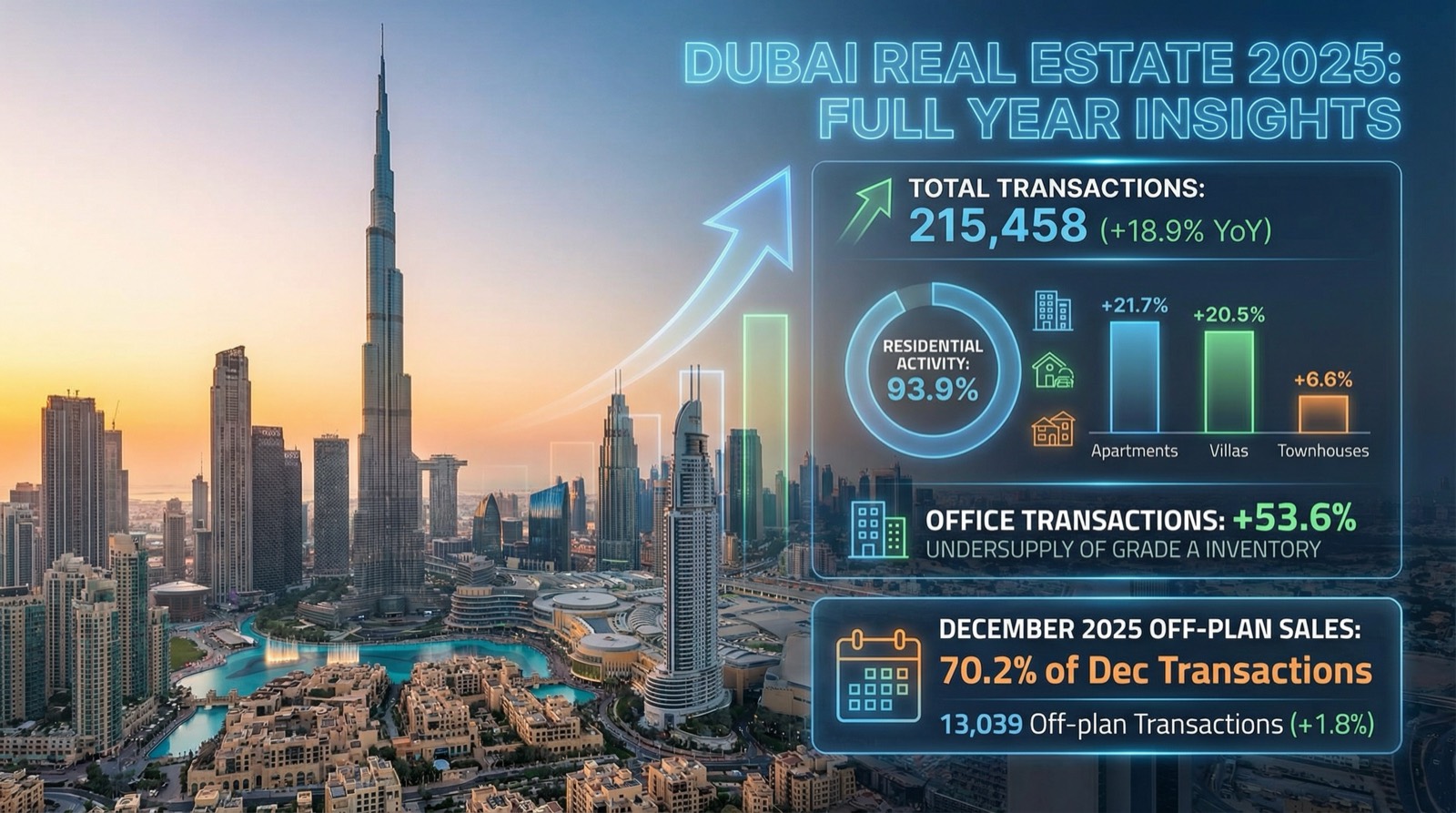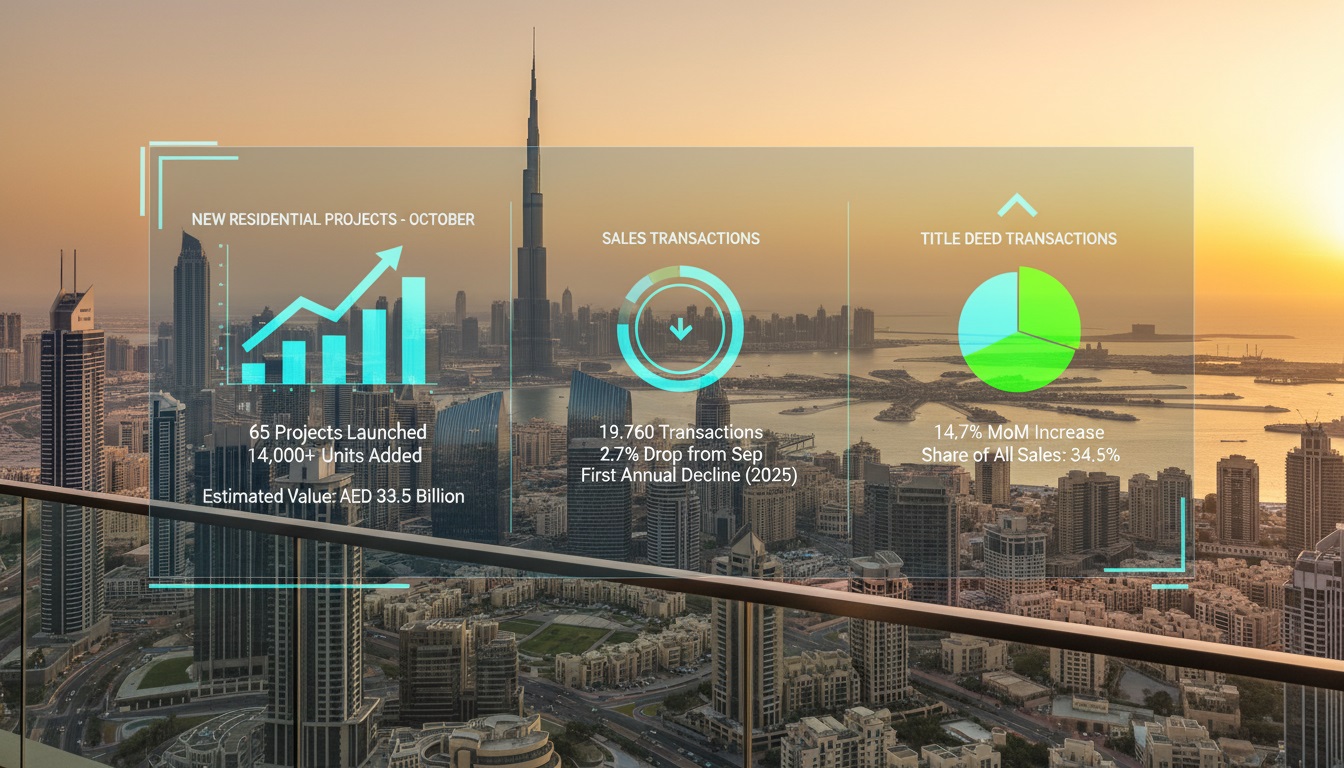
Dubai’s property market showed signs of cooling in October 2025, marking the first month this year without a new record. Yet, activity remained historically strong, with nearly 20,000 transactions and steady price growth.
The latest Property Monitor Report offers a detailed look at shifting buyer behavior, developer momentum, and financing trends—revealing a market transitioning from rapid expansion to sustainable growth. Here's what investors need to know.
In October 2025, price increases in Dubai’s residential real estate market slowed to a modest +0.13%, compared with more aggressive gains in August and September. However, when viewed over a longer horizon, this modest growth forms part of a sustained upward climb: the average price, according to the Property Monitor Dynamic Price Index (DPI), stood at AED 1,683 per square foot — more than double the October 2020 low.
Furthermore, this level comfortably exceeds the previous historical high set in 2014. The data suggests that while monthly spikes might be moderating, the broader trend of value appreciation remains firmly intact, underpinned by strong fundamentals.
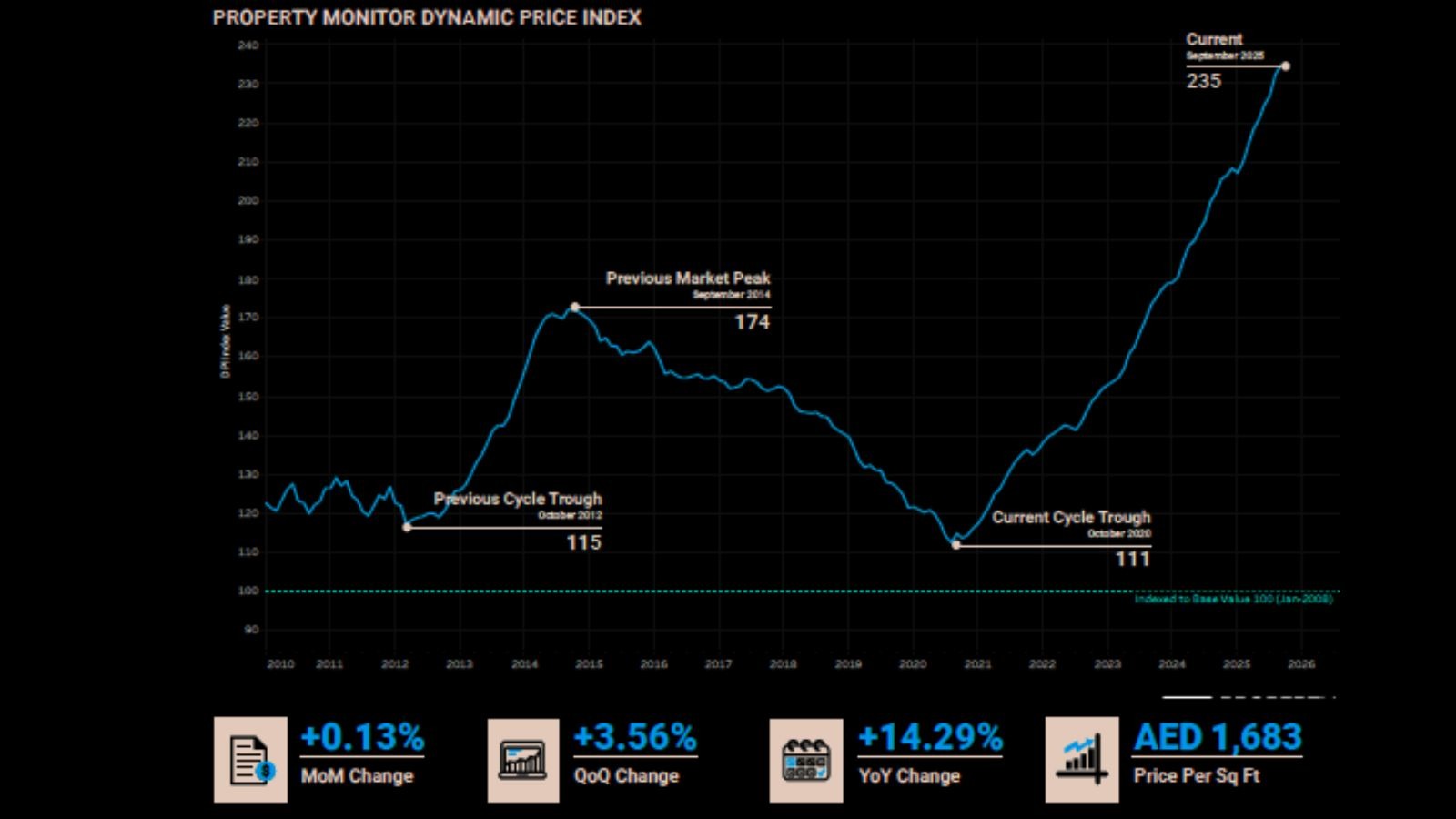
Image Credit: Property Monitor
This deceleration can be interpreted not as a market downturn, but as a phase of measured consolidation — signaling a shift from rapid speculative growth toward a steadier, more stable valuation curve.
Wondering what this price shift means for your investment plans? Let’s connect for a quick, no-pressure chat tailored to your goals. Click here to speak with me directly.
October recorded 19,760 sales transactions, representing a 2.7% drop from September and a 4.9% drop year-over-year — the first annual decline during 2025. Despite this, October remains the second-most active October ever on record, second only to October 2024. The drop thus appears more about the high comparison base set by last year than a meaningful slowdown in demand.
Residential properties (apartments, townhouses, villas) dominated the market, accounting for 93.5% of transactions (about 18,466 deals). Commercial properties—such as offices, retail units, and land—made up the remainder.
On a year-to-date basis, total transactions have neared 178,000, marking a 17.4% increase over the same period in 2024. With only two months this year falling below 15,000 transactions, monthly volume has remained consistently strong, averaging around 17,300 deals.
If this momentum continues through December, annual transactions could surpass 212,000, setting an all-time record and prolonging the city’s bullish streak for a third straight year.
October's transaction data reveals a notable adjustment in the balance between off‑plan and completed property sales. While off‑plan demand remains dominant, signs of recalibration are emerging in both volume and buyer behavior.
Off‑Plan (Oqood) Registrations and Adjusted Market Share
In October, off‑plan (Oqood) registrations stood at 12,947 transactions, a sharp 9.9% drop from September. Consequently, the off‑plan share of total sales fell from 70%+ levels in prior months to 65.5%. On the surface, this suggests off‑plan demand is cooling.
However, when the technical classification gap is addressed — notably, many projects that are functionally off‑plan are registered via Title Deed rather than Oqood — the true off‑plan share rises to roughly 70.6%. This indicates that new-development demand remains robust; buyers are still prioritizing pre-completion units, albeit with a shift in how they complete registration.
Title Deed Sales & Resale Transactions: What’s Changing
October saw a 14.7% month-on-month increase in Title Deed transactions, raising their share to 34.5% of all sales. This was driven largely by a pickup in completed-apartment sales.
Resale moves (where a property changes hands after an initial sale, whether off-plan or completed) achieved 5,956 transactions, up 4.6% month-on-month and forming 30.1% of total sales. Off‑plan resales (i.e. early reoffs- plan purchases) contributed 21.7% of that resale volume.
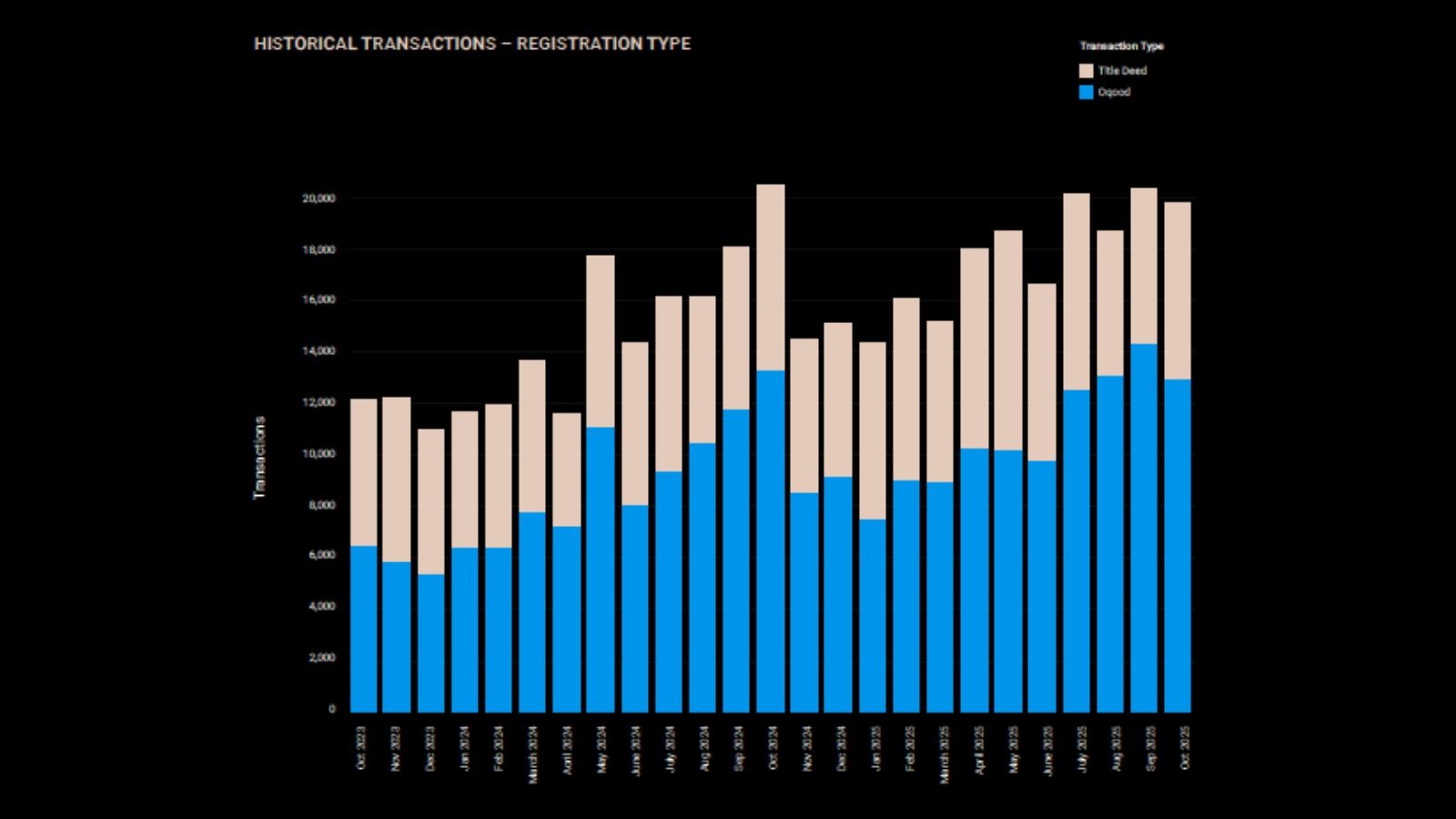
Image Credit: Property Monitor
It's notable that the 12‑month rolling average for off‑plan resales has dropped to 25.1%, down from a peak over 33% in April. This shift suggests that while early resales continue, their intensity is waning — a sign that many original buyers are now holding rather than flipping quickly, possibly anticipating furcomther long-term gains.
October’s data highlights an aggressive ramp-up in supply, with developers responding to strong market momentum by accelerating launches. The volume and diversity of new projects signal growing confidence—but also heighten the importance of selectivity for investors.
Project Launch Volume and Property Mix
October witnessed the launch of 65 new residential projects, adding over 14,000 units worth an estimated AED 33.5 billion to the market. On a year-to-date basis, 532 projects have been introduced, yielding around 131,504 units — a pace far beyond a typical full-year total in previous cycles.
Breaking down the 2025 supply mix: apartments dominate with 91.2%, while townhouses and villas comprise only 4.8% and 4.0%, respectively. October’s launches followed this trend: apartments represented 99% of new units, with only 144 townhouses/villas added. Despite this skew, a notable pivot is on the horizon — the planned release of several low-density, villa-rich communities by major developers (e.g., phases in The Valley, DAMAC Islands 2, and other projects).
Implications of Increased Developer Participation
The number of developers launching projects in 2025 has risen to 228, compared with 163 over the same period in 2024. This broader participation signals deepening confidence — and competition — in Dubai’s development landscape.
Such a surge in supply typically reflects a belief among developers that demand will persist. For investors, more project choices mean more opportunities — but also greater responsibility to select carefully. With hundreds of new players entering the field and supply expanding rapidly, price competition, features, quality, and location will matter more than ever.
October marked a sharp resurgence in mortgage activity, driven by improved sentiment and favorable rate adjustments. Both individual buyers and institutional investors re-entered the market, signaling renewed confidence and pent-up financing demand.
Purchase Mortgages, Loan‑to‑Value, and Borrower Profiles
Mortgage activity rebounded strongly in October, with 4,885 new loans — a 28.9% month-over-month increase — reaching levels previously seen in Q2 2025. Purchase mortgages accounted for 58.3%, up 7.4 percentage points from September. The average loan amount was AED 1.79 million, with an average loan-to-value (LTV) ratio of 73.6%.
This suggests that many buyers are still leveraging finance rather than paying cash — a healthy sign for demand sustainability. Bulk of these loans likely went toward apartments and medium-size units typically favored by end-users rather than high-net-worth cash buyers.
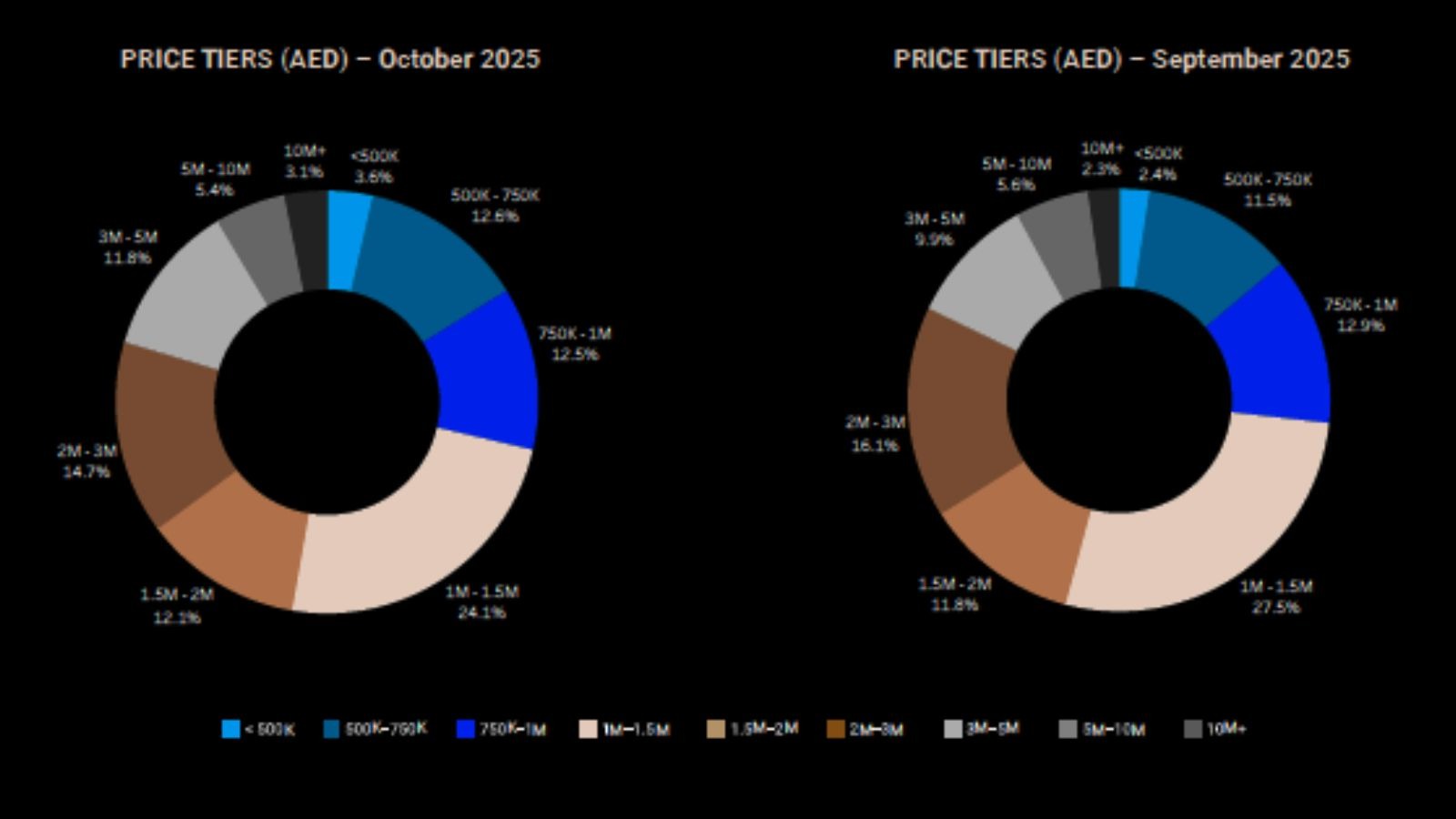
Image Credit: Property Monitor
Bulk Financing: Institutional Investors & Deferred Deals Released
Bulk or portfolio mortgages — often used by institutional buyers or developers buying/financing multiple units — rose to 21.6% of total mortgage activity. Notable bulk activity includes projects such as Ayat Parkview, Florus Residence (Al Furjan West), Salim 1 (Arjan), AB South Residence (Dubai South), La Perla Blanca (Jumeirah Village Circle), and Shakespeare Tower (Living Legends).
The spike reflects several factors: many buyers and developers earlier held off financing in anticipation of interest-rate reductions. The recent 25 basis-point cut appears to have triggered a wave of previously delayed deals. For institutional investors and developers, this was likely the trigger to finalize purchases or refinance.
Still reading
Need expert help on this subject?
October's figures point to a real estate market entering a new phase—less driven by record-breaking highs and more by long-term stability. The trends in the October 2025 Property Monitor Report suggest a healthy shift toward fundamentals, creating a more predictable environment for investors.
Signs of Market Maturation and Normalization
The data from October 2025 suggests that the Dubai real estate market is transitioning from a high-velocity growth phase to a more stable, mature, and sustainable footing.
Price growth has eased but remains positive. Transaction volumes are robust even if slightly down compared to last year’s peak. Mortgage activity is rebounding — which reinforces demand from end-users.
Such a transition tends to filter out speculative frenzy and reward fundamentals: location, quality, rental demand, and long-term value appreciation.
Demand‑Supply Balance: Where the Market Might Head Next
On the demand side, population inflows, strong economic indicators, and investment interest continue to fuel demand. On the supply side, the brisk pace of new launches points to a future increase in choice — but also growing inventory.
If supply ramps up faster than demand, price growth may slow further or plateau. Alternatively, if developers release quality stock in in-demand areas and absorption keeps pace with launch volumes, the market could continue modest appreciation or stability.
Overall, it appears Dubai is moving toward a more balanced market — less bubbles and spikes, more steady value creation.
Source: Property Monitor
Here are some practical strategies — based on October’s data — tailored to different investor profiles:
Residential Buyers – Prioritize End‑Use Value and Long‑Term Stability

- Choose completed or near-completion apartments in stable communities. With Title Deed sales rising and off‑plan share slightly easing, completed stock offers faster occupancy and lower risk of project delays.
- Focus on properties with steady rental demand. Mid-sized units in well-connected, family-friendly areas present good value for those targeting long-term rental income.
- Leverage favorable mortgage conditions. With average LTV at 73% and financing activity rebounding, end-users can access attractive borrowing terms that enhance ROI versus buying with cash.
Yield‑Oriented Investors – Focus on Location, Timing, and Rental Demand
- Target low-density villa/townhouse clusters in early development phases. As supply of these product types remains constrained, early entry may offer appreciation potential as these communities mature.
- Be selective with new launches. Not all 130,000+ new units will perform equally. Prioritize developers with a track record, and projects with strong infrastructure, amenities, and rental potential.
- Track absorption closely. High launch volumes can lead to inventory buildup. Focus on zones with proven demand rather than speculative growth corridors.
Institutional / Bulk Buyers – Leverage Rate Environment and Bulk Deals
- Take advantage of renewed bulk-financing activity. With October showing a 15.7% rise in bulk loans, conditions are favorable for institutional-scale purchases—especially as delayed deals are now moving.
- Balance between completed and off‑plan units. A split approach may deliver immediate rental returns alongside future value growth as new developments progress.
- Explore refinancing and capital restructuring. October’s spike in mortgage issuance suggests favorable terms—ideal for optimizing existing portfolios and freeing up capital.
Commercial Property Investors – Navigate Strategic Niches Amid Rising Activity
- Prioritize office space in established business zones. While commercial accounted for just 6.5% of total October sales, office transactions led the segment. Prime-located offices with high occupancy potential remain attractive in a hybrid work environment.
- Watch for growth in retail and logistics real estate. With continued population growth and consumption trends, select retail units in high-footfall areas or logistics hubs near infrastructure corridors may offer above-average returns.
- Monitor land acquisition opportunities. With new supply rising, strategic land investments—especially near planned villa and townhouse communities—can offer long-term upside through redevelopment or resale.
Explore commercial listings and insights at Mitchell’s Commercial Realty — featuring premium office and retail properties across Dubai, along with market intelligence to help you identify emerging trends.
Oversupply Risk from Continuous Off‑Plan Launches
The supply pipeline is extensive — with over 130,000 units launched in 2025 and low-density villa projects on the way. If absorption slows, some projects could face downward pressure on price and rental returns, especially in less desirable locations.
Interest Rate Uncertainty and Mortgage Demand Sensitivity
While the recent rate cut spurred a rebound in mortgage activity, further rate shifts — in either direction — can significantly impact demand. A rise in interest rates could dampen affordability and slow transaction volumes.
Macro and Regulatory Variables That Could Shift Dynamics
External factors — global economic conditions, changes in immigration policy, or regulatory tightening — could affect investor confidence, foreign demand, and overall economic inflows.
In closing
Conclusion: Balanced Outlook Heading into 2026
The October 2025 report from Property Monitor paints a picture of a real estate market in transition. Growth remains, but the pace is moderating. Transaction volumes remain historically high. Financing is active again. New supply is entering the market at an aggressive pace.
For investors, this environment offers opportunity — but demands prudence. The edge will go to those who align purchase decisions with demand fundamentals, focus on quality over hype, and weigh financing, rental prospects, and community factors carefully.
As Dubai heads into 2026, the real estate landscape looks more mature, balanced, and grounded than during the rapid expansion phases of the recent past. For well-informed investors, that promises potential — but only for those prepared to think long-term and act strategically.
Next step
Let’s Talk
If you're looking to identify high-potential opportunities—whether in emerging villa communities, resilient rental zones, or commercial pockets with real yield—I can help cut through the noise with a clear, data-backed approach tailored to your investment goals.
📞 No pressure, no sales pitch—just a focused, informed conversation about your investment goals. Let’s talk.
Published 3 December 2025 by Stephen James Mitchell MBA. Market figures quoted reflect the data available at that date.