Abu Dhabi recorded AED 142 billion of real estate transactions in 2025, and AED 66 billion in the first quarter of 2026 alone. Three things sit underneath those numbers. The population is growing at 7.5% a year. The non-oil economy now makes 54% of what the emirate produces. And there is a large pool of capital looking for somewhere to go. All three are measured and published by the Abu Dhabi government.
This matters because a lot of what is written about Abu Dhabi comes from people selling property there. The figures below are from the Abu Dhabi Real Estate Centre and the Statistics Centre – Abu Dhabi. Where the picture is less flattering, that is in here too.
2025 was a record year. The Abu Dhabi Real Estate Centre recorded AED 142 billion across 42,814 transactions, a 44% rise in value and a 52% rise in volume on 2024. Sales accounted for AED 99.4 billion and mortgages for AED 42.7 billion.
Residential sales reached AED 76 billion, up from around AED 19 billion in 2022. Foreign investment made up 72% of all real estate investment, rising 65% to AED 54.13 billion from AED 32.89 billion the year before. Buyers came from more than 100 nationalities.
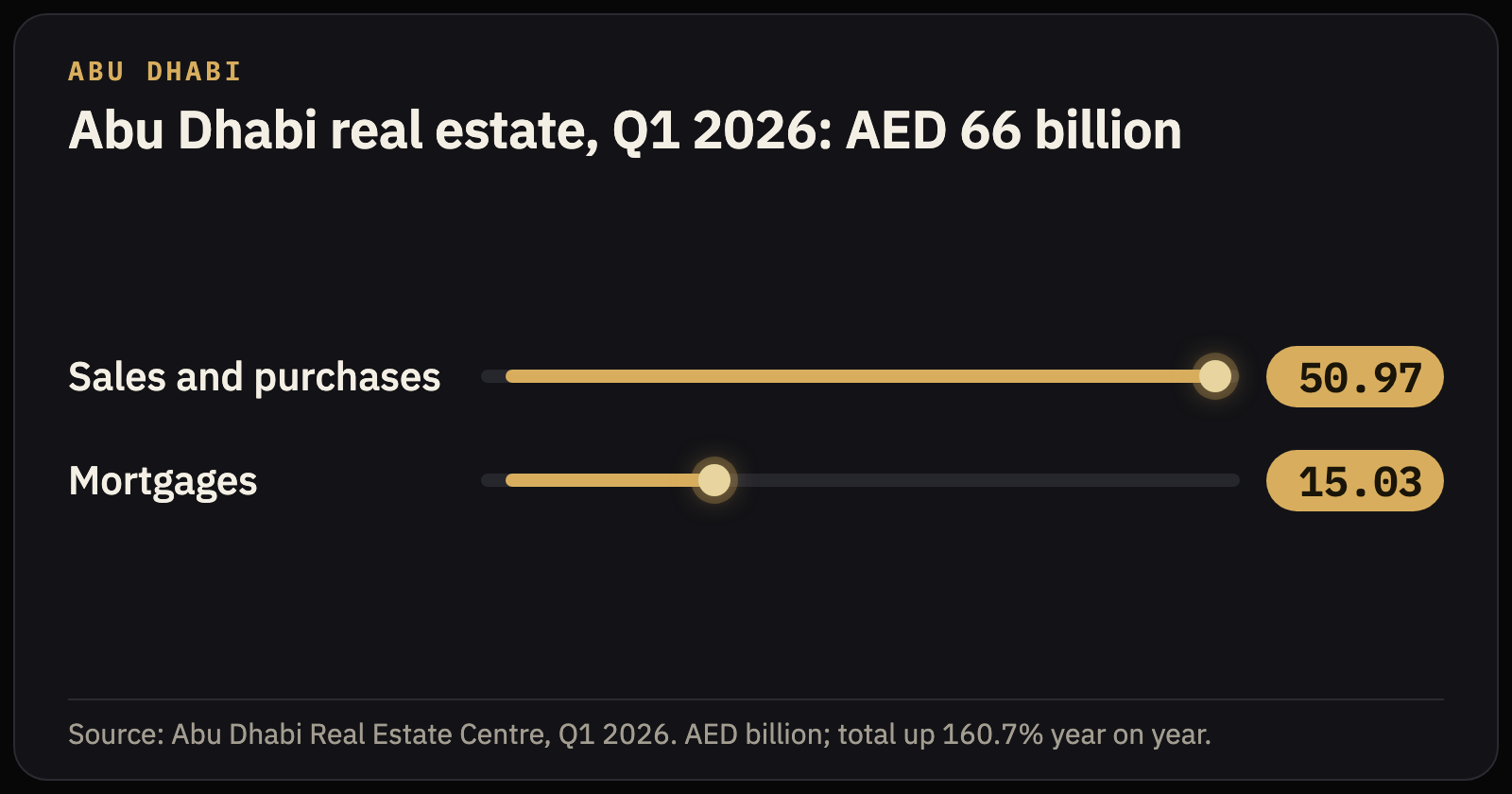
The first quarter of 2026 was the strongest quarter on record. Total transactions reached AED 66 billion across 13,518 deals. Sales made up AED 50.97 billion through 8,940 transactions. Mortgages added AED 15.03 billion through 4,578. Foreign direct investment by individuals hit AED 8.27 billion, which matched the whole of 2025 in a single quarter.
One note on that quarter. The 160.7% growth figure is measured against Q1 2025, when the market did AED 25.31 billion. That was a quiet quarter. A single strong quarter is not a run rate, and AED 66 billion should not be multiplied by four to guess at the year.
Hudayriyat Island led on value at AED 11.97 billion, then Reem Island at AED 9.45 billion and Saadiyat Island at AED 8.8 billion. Sixteen new projects were registered in the quarter, 60% more than a year earlier.
The Abu Dhabi real estate boom is, at bottom, a population story. The emirate's population reached 4,135,985 at the end of 2024, a rise of 7.5% in one year, according to the Statistics Centre – Abu Dhabi. Over the decade from 2014 it grew by 51%, from about 2.7 million.
That is the number worth holding on to. People arriving need somewhere to live, and they need offices, shops and warehouses around them. Transaction values can swing on a few large deals. Population growth of this size changes what a city needs for years afterwards.
It is worth being careful with it as well. 7.5% is one year's figure, not a settled rate, and projections that run it forward unchanged to 2030 are making an assumption rather than reporting a measurement.
Abu Dhabi's non-oil economy grew 7.6% year on year in the third quarter of 2025, and now accounts for 54% of total output. In that quarter it added AED 175.6 billion of value, and the economy as a whole reached AED 325.7 billion, its highest quarterly figure on record, growing 7.7%. The source is SCAD.
For property, the split matters more than the total. An economy that earns most of its money outside oil employs different people. It needs banks, logistics and factories, and the buildings all of those sit in. That demand is steadier than demand driven by the oil price. It is the part a commercial buyer should watch. Our longer piece on Abu Dhabi's economy and its property market covers how the two connect.
Abu Dhabi holds a large amount of investable money. Its three main sovereign funds, ADIA, Mubadala and ADQ, are together estimated at around USD 1.7 trillion. That is three funds added together, not one. The figures are estimates, not audited accounts, so read it as scale rather than an exact number.
The ratings tell a cleaner story. Fitch affirmed Abu Dhabi at AA with a stable outlook, putting sovereign net foreign assets at about 291% of GDP, far above the median for its rating peers. Moody's rates the emirate Aa2. Those are among the strongest sovereign ratings anywhere.
Abu Dhabi Global Market, the financial centre on Al Maryah Island, has grown alongside this. Assets under management rose 48% year on year in the third quarter of 2025, when the centre housed 161 asset and fund managers running 220 funds. By the end of 2025 that had reached 171 managers and 244 funds. Higher numbers get quoted, but they rarely carry a date. Check the quarter before you repeat one.
This is where you should be most careful, because it is the argument most often put to buyers, and the numbers behind it are frequently wrong.
Abu Dhabi had around 401,000 residential units in 2025, and roughly 409,000 by the middle of 2026. ADREC's market report for the first half of 2026 projects a further 71,000 units by 2030, which would take the total to about 480,000. Deliveries are expected to peak at around 21,800 units in 2028. Six districts account for 77% of that new supply: Saadiyat Island, Reem Island, Yas Island, Zayed City, Khalifa City and Hudayriyat Island.
Set that against demand and the position is tighter than the national average, without being a crisis. Some presentations in the market put the 2030 supply figure closer to 57,000 units. That is roughly 19% below the government's own published forecast, and it is always the supply side that gets shaded down, never the demand side. If you are shown a shortage calculation, ask which supply number it used and what date that number carries.
Check the demand half the same way. Turning population growth into a number of homes needed depends on how many people you assume live in each one. At four residents per unit you get a very large number. At eight you get less than half of it. The assumption does more work than the data, and it is rarely stated on the slide.
Still reading
Need expert help on this subject?
The same Fitch assessment that gave Abu Dhabi its AA rating also expects the economy to shrink by 1% in 2026. Both oil and non-oil sectors are affected. The government surplus is forecast to fall to 3.0% of GDP, down from 6.5% in 2025. Fitch attributes this to regional conflict and expects growth to resume afterwards.
That forecast belongs in any honest account of the market. A presentation that quotes Fitch approvingly for the credit rating, then leaves out the same agency's growth forecast, is selecting its evidence. The rating and the forecast come from the same report.
The drivers are real and they are documented by the government rather than by the people selling the buildings. Population growth, a diversifying economy and deep domestic capital are a sound base, and the transaction record of the last eighteen months is not in doubt.
What is doubtful is the urgency attached to it. Treat a shortage argument as a sales tool if it rests on three things. A low supply figure. A growth rate that does not compound. And a hidden guess about how many people share a home. The underlying market does not need them, which is the best reason to be suspicious when you see them.
For a buyer, the practical questions are narrower. Which district, against the 71,000 units arriving by 2030 and the delivery peak in 2028. What the asset yields today rather than what it might be worth later. And whether the ownership structure suits you, which differs from Dubai in ways worth understanding before you commit. Our guides on freehold and leasehold in Abu Dhabi, rental yields and buying off-plan deal with each of those.
Frequently asked questions
0501Is the Abu Dhabi real estate boom sustainable?
The demand drivers are durable, and population growth of 7.5% and non-oil GDP growth of 7.6% are not short-term effects. The next year is less certain. Fitch expects the emirate's economy to shrink by 1% in 2026, then grow again. Durable demand and a soft year are both true at once.
02How much property changed hands in Abu Dhabi?
AED 142 billion across 42,814 transactions in 2025, and AED 66 billion across 13,518 transactions in the first quarter of 2026. Both figures come from the Abu Dhabi Real Estate Centre.
03Is Abu Dhabi short of housing?
ADREC projects 71,000 new residential units by 2030, on top of roughly 409,000 at the middle of 2026, with deliveries peaking in 2028. Supply is tight in certain districts, not across the whole emirate. Lower figures than the ADREC forecast are being used in marketing material.
04How does Abu Dhabi compare with Dubai?
Abu Dhabi is smaller and slower moving, with a larger share of government and sovereign-linked activity. Transfer costs and ownership rules differ between the two emirates, so a Dubai calculation does not carry across.
05Who is buying in Abu Dhabi?
Foreign investment reached 72% of all real estate investment in 2025, worth AED 54.13 billion. Buyers came from more than 100 nationalities in 2025, and from 99 nationalities in the first quarter of 2026 against 68 in the same quarter a year earlier.
The figures in this article are published by the Abu Dhabi Real Estate Centre, the Statistics Centre – Abu Dhabi and Fitch Ratings, and are dated where they appear. We hold no Abu Dhabi register of our own, so nothing here is our own calculation.
If you are looking at an Abu Dhabi asset and want the supply position for a specific district checked before you commit, talk to us. More background sits in our Abu Dhabi section and our explainer on the 2030 masterplan.
This article reports figures published by the bodies named and is commentary rather than investment advice.
Next step
Talk to Mitchells
Tell us what you are weighing up — a building, a project, an area, or a rule you need to get right — and we will come back with the specifics that apply to it.
Published 8 October 2026 by Stephen James Mitchell MBA. Market figures quoted reflect the data available at that date.