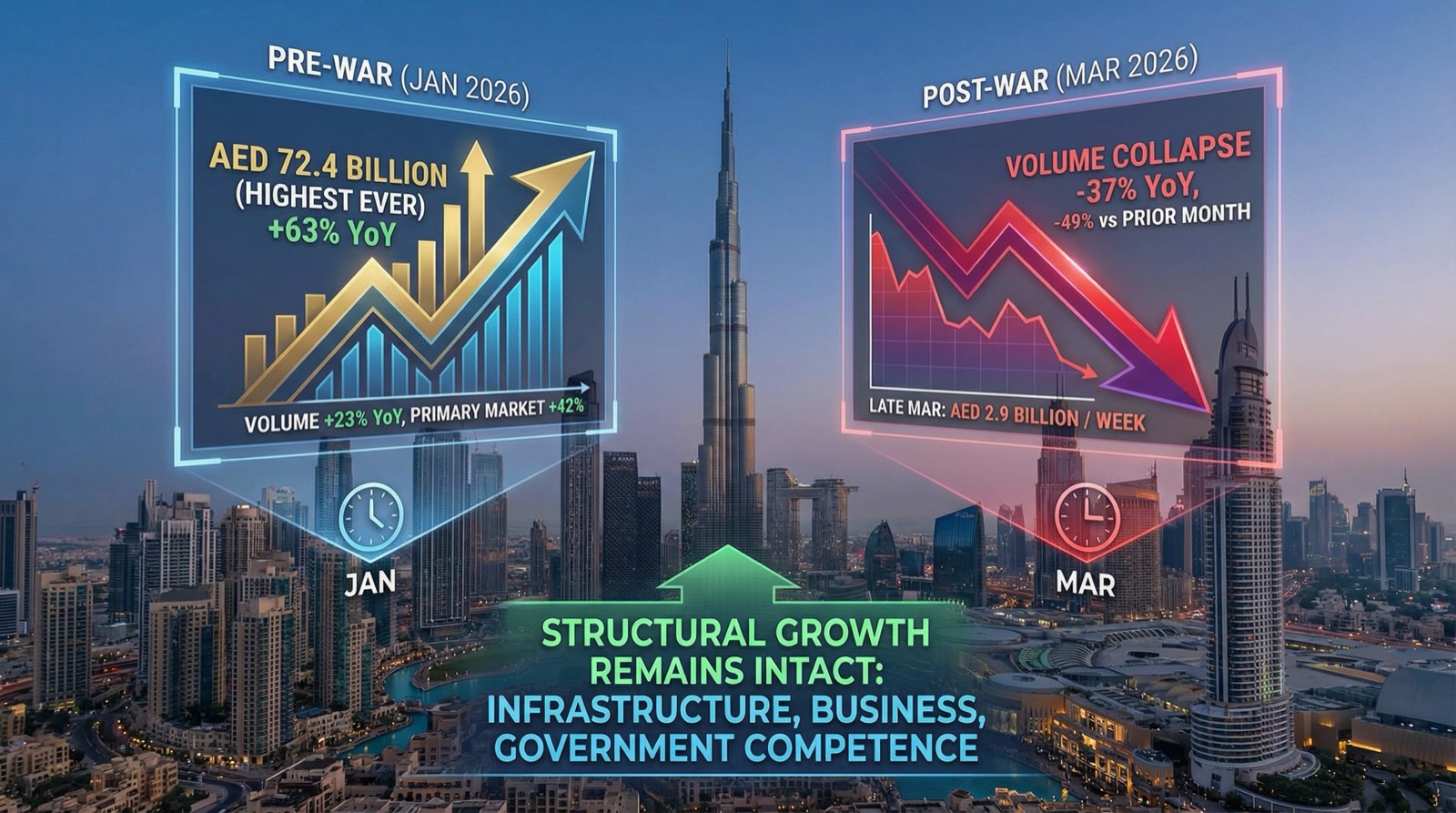
For over 19 years, I’ve worked in Dubai real estate as a broker, wealth manager, and investor, watching the market move through euphoric highs, painful corrections, and remarkable recoveries. Each cycle has reinforced the same lesson: price data often lags reality, and the earliest signals of change appear in volumes and sentiment long before they are reflected in average price-per-square-foot figures. That is exactly the moment we are in now in 2026.
Dubai entered 2026 from a position of extraordinary market strength. According to CBRE, Dubai recorded over 206,000 residential transactions in 2025, up 18% year-on-year, with sales prices increasing 13% annually as of Q4 2025. Off-plan sales dominated, accounting for nearly three-quarters of all activity. According to Reuters, off-plan transactions constituted 65% of Dubai's residential deals in 2025, representing AED 286 billion in sales value across 132,000 transactions. By any measure, the market was robust.
Then the Iran strikes changed everything — not necessarily the underlying fundamentals, but the trajectory of confidence that prices need to keep rising.
Understanding Dubai property price trends in 2026 now requires separating two distinct phases: the pre-war boom and the post-strike recalibration.
The headline price data for early 2026 has not yet shown sharp declines, and that is worth understanding carefully. Prices are ‘sticky’ in the short term because sellers do not immediately accept lower offers — they wait.
This is particularly true in Dubai’s cash-heavy market, where forced selling is less common than in heavily mortgaged markets. What changes first is not the asking price but the willingness to negotiate, the time a property sits on the market, and the incentives required to close a deal.
Post-war transaction volume data tells a starker story. In the first 12 days of March 2026, transaction volumes fell by 37% year-on-year and 49% compared to the prior month. This sounds drastic, but closer inspection reveals that government authorities, developer offices, and real estate brokerages were closed during the week following the conflict escalation. As a result, people were not physically present at work during that period to process property transactions.
That said, sales volume in Dubai dropped more than 30% year-on-year in the three weeks following the escalation. Price indices typically lag underlying transaction activity by 30–90 days, so the headline softening has not yet fully appeared in the data—but it is coming.
The most important insight for understanding 2026 Dubai property price trends is that the market is not moving uniformly. It never does — but the divergence is sharper now than at any point in the past five years.
Let me break down what I’m seeing by segment.
Villas and Low-Density Residential Villas
In this segment, values have risen over 200% since the pandemic trough in many established communities. Demand here is predominantly end-user driven — families who want to live in Dubai, not speculators looking to flip. That fundamentally changes the dynamic: end-users do not panic and sell because of international headlines.
I expect villas in established communities to see a mild softening of 3–7% at most before stabilising.
Mid-Market Apartments and Off-Plan
This is the most vulnerable segment in 2026. Over 200,000 new residential units are due for delivery across 2025–2026 — roughly double the prior three-year average, l — while foreign investor demand has weakened. The supply-demand balance has shifted sharply.
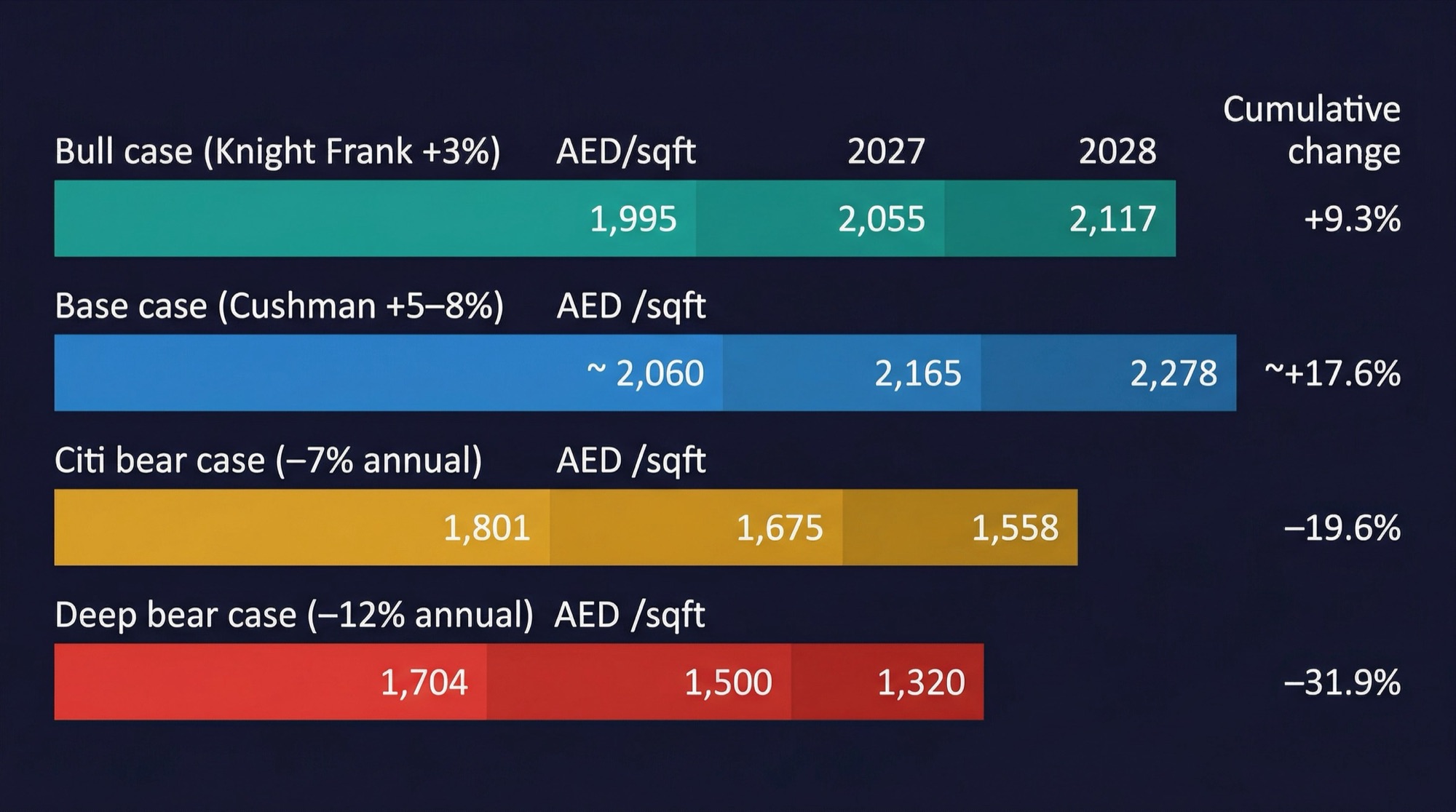
Fitch had already forecast 10–15% price declines across this segment before the war. Post-war, Citi’s bearish scenario of 7% annual declines through 2028 becomes plausible for this cohort.
Developers with weaker balance sheets or large outer-community pipelines face the greatest risk.
Prime and Luxury Residential
Before the war, analysts were forecasting 6–10% price growth in prime residential for 2026 — driven by limited supply, strong global HNWI demand, and Dubai’s tax-free yield advantage.
That outlook has been partially revised downward, but prime assets in genuinely scarce locations are likely to see far shallower corrections than the wider market.
Dubai’s prime residential yields of 6–9% annually remain among the highest of any major global city, and that continues to attract long-term wealth preservation capital.
Having watched multiple cycles here, what strikes me most about the current moment is the tension between two simultaneous forces that rarely operate at the same time. On one hand, the Iranian attacks are driving fear, reducing foreign enquiries, and pushing speculative capital to the sidelines.
On the other hand, regional instability is pushing capital away from higher-risk jurisdictions and into Dubai, which, despite recent geopolitical tensions, remains one of the most secure and functional cities in the region.
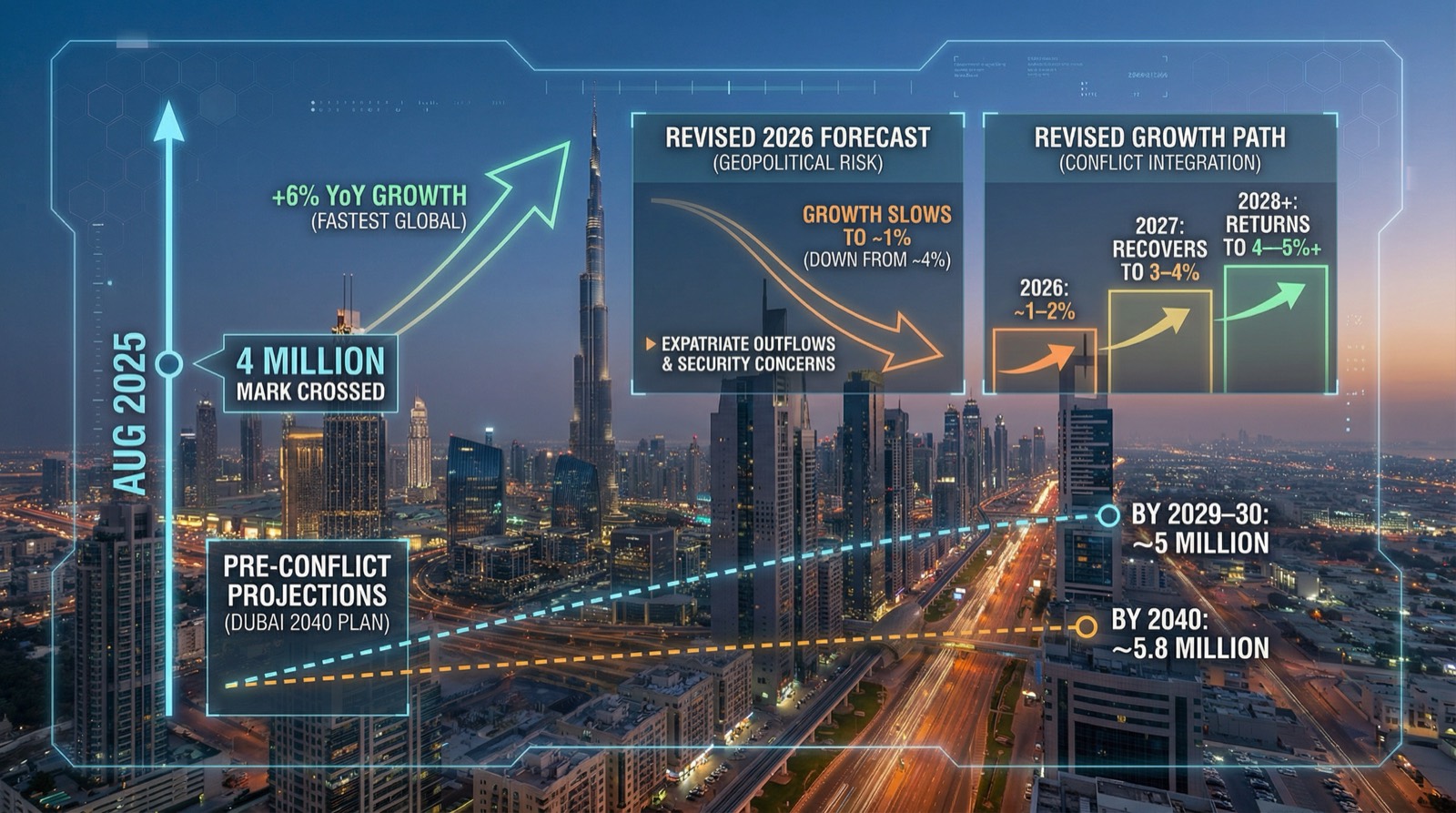
Dubai’s population is projected to exceed 5 million by 2030, with a mid-2026 estimate already reaching around 4.47 million. While a record 131,000+ new units are forecast for delivery in 2026, historical realisation rates of around 60% suggest actual handovers may be closer to 75,000–80,000 units.
This likely shortfall, combined with a supply pipeline heavily skewed toward apartments, means the long-term absorption base — particularly for villas and townhouses — remains structurally undersupplied.
The geopolitical shock disrupts the trajectory but does not eliminate the destination. That distinction matters enormously when assessing Dubai property price trends over a 3–5 year horizon rather than a short-term 3–5 month window.

Based on over 19 years of observing this market through multiple cycles, and with the best available data as of late March 2026, here is my honest assessment of where Dubai property price trends are heading over the next 12–18 months.
Established villa communities: Mild softening of 3–7%, driven by reduced foreign buyer pool and some investor profit-taking, but end-user demand provides a floor. Recovery is likely as soon as the geopolitical situation stabilises.
Prime and ultra-prime: 0–5% correction in most scenarios, with prices likely to remain stable or see modest gains in genuinely scarce Palm and waterfront assets. Long-term capital remains patient.
Mid-market off-plan: 10–18% price declines are probable over 12–18 months as the supply wave delivers into reduced demand. Incentive-laden launches will set a new price ceiling for the segment.
Retail and office spaces:*Relatively insulated. Strong tenant covenants and genuine occupier demand from D33-linked business relocations provide support.
My advice to clients right now is simple: do not make decisions based on international media headlines, and do not freeze into inaction.
The best outcomes across all the cycles I’ve worked through in Dubai have come to those who stayed analytical when others became emotional.
If you are a seller, price realistically. The era of buyers paying a premium purely on momentum is over for now. Correctly priced, quality stock is still moving. Overpriced stock is sitting.
If you are a buyer, your negotiating power has materially increased for the first time since 2022. Use it! Focus on developer strength, location fundamentals, and long-term supply constraints rather than short-term price momentum.
If you are already invested, stay calm, review your exit timeline assumptions, and consider whether the asset quality in your portfolio justifies holding through volatility. For quality assets in the right locations, it almost certainly does.
Dubai has absorbed every shock thrown at it in my more than 19 years here — the 2008 crash, the 2015–16 oil price correction, Covid-19, and now ongoing geopolitical tensions.
The property price trends in 2026 are being shaped by a period of heightened uncertainty, but this city’s structural growth story — population, infrastructure, business environment, and government competence — remains intact.
Personally, I am not moving, and neither is my investment thesis!
Next step
Discuss what this means for your position
Tell us what you are weighing up — a building, a project, an area, or a rule you need to get right — and we will come back with the specifics that apply to it.

Stephen James Mitchell is a licensed real estate broker with over 25 years of experience across finance, investment strategy, and real estate, including more than 19 years operating in Dubai. He specialises in advising investors on acquiring and optimising high-performing assets, with a focus on commercial and investment-grade real estate, combining strong financial expertise with deep, on-the-ground market knowledge of the UAE.
To connect directly with Stephen James Mitchell, please click here.
Published 6 April 2026 by Stephen James Mitchell MBA. Market figures quoted reflect the data available at that date.