I’ve lived and worked in Dubai’s property market since 2007. As a licensed commercial real estate broker, wealth manager, and business owner with operations across this city, I’ve navigated every cycle this market has thrown at us — the 2008 crash, the grinding recovery, and the post-pandemic explosion. Now, in 2026, we are facing something I didn’t fully anticipate: a regional conflict directly targeting the UAE. These recent events are beginning to test the safe-haven narrative that has underpinned Dubai’s extraordinary growth story.
When Iran launched its strikes across the Gulf, the immediate reaction in real estate wasn’t panic selling. It was something more subtle and potentially more consequential — a rapid erosion of confidence among international investors who had been pouring capital into this market for years.
As reported by Reuters, the UAE’s prolonged property surge is encountering its first significant challenge, as Iranian missile attacks disrupt the Gulf’s image as a safe haven and expose how heavily Dubai and Abu Dhabi rely on foreign capital to fuel their construction boom.
Before I go any further, let me say this clearly: I live in Dubai with my family of five. My children go to school here (albeit remotely at present). My businesses operate here every day. I feel completely safe, and I have complete faith in the UAE government’s handling of this situation.
Life here is normal. Restaurants are open, offices are open, meetings are happening, and the city is functioning as it always has, except on reduced volume as tourists and would-be residents postpone their trips. A lot of the panic you read in international media is simply disconnected from what those of us on the ground are actually experiencing. Much of the fear is being driven by headlines, not by reality in Dubai.
Section 01
The Impact of Iran’s Attacks on Dubai Real Estate: The Safe-Haven Narrative Under Pressure
For the better part of a decade, Dubai’s real estate pitch to international investors has rested on one central promise: political and economic stability in an otherwise volatile region. That narrative attracted Russian capital after the 2022 sanctions, European money during the sovereign debt crisis, and Asian wealth seeking diversification.
It is a story that has delivered extraordinary results. According to Fitch, Dubai property prices jumped 60% between 2022 and the first quarter of 2025, with growth continuing late last year and into early 2026.
The Iran attacks have directly challenged that promise. According to Bloomberg, real estate developers in the UAE are facing a drastically altered demand environment, with bond markets pricing in higher risk as Iran's attacks on Dubai dent the emirate's status as a regional safe haven. Strikes targeting airports, ports, and residential areas sent an unmistakable message to observers watching from overseas.
Yet here on the ground, the picture is very different. Having spoken to dozens of residents and investors in Dubai since the escalation began, I can tell you that the people actually living here — raising families, running businesses, building lives — are not panicking. They have confidence in the government, are committed to staying and expecting a quick return to normality once this crisis situation is over.
The UAE government has responded with measured competence and clear communication that inspires genuine confidence. What is being projected outward by international media often bears little resemblance to daily life here. This disconnect between perception and reality is itself the most important channel through which the Iran attacks are impacting Dubai real estate.
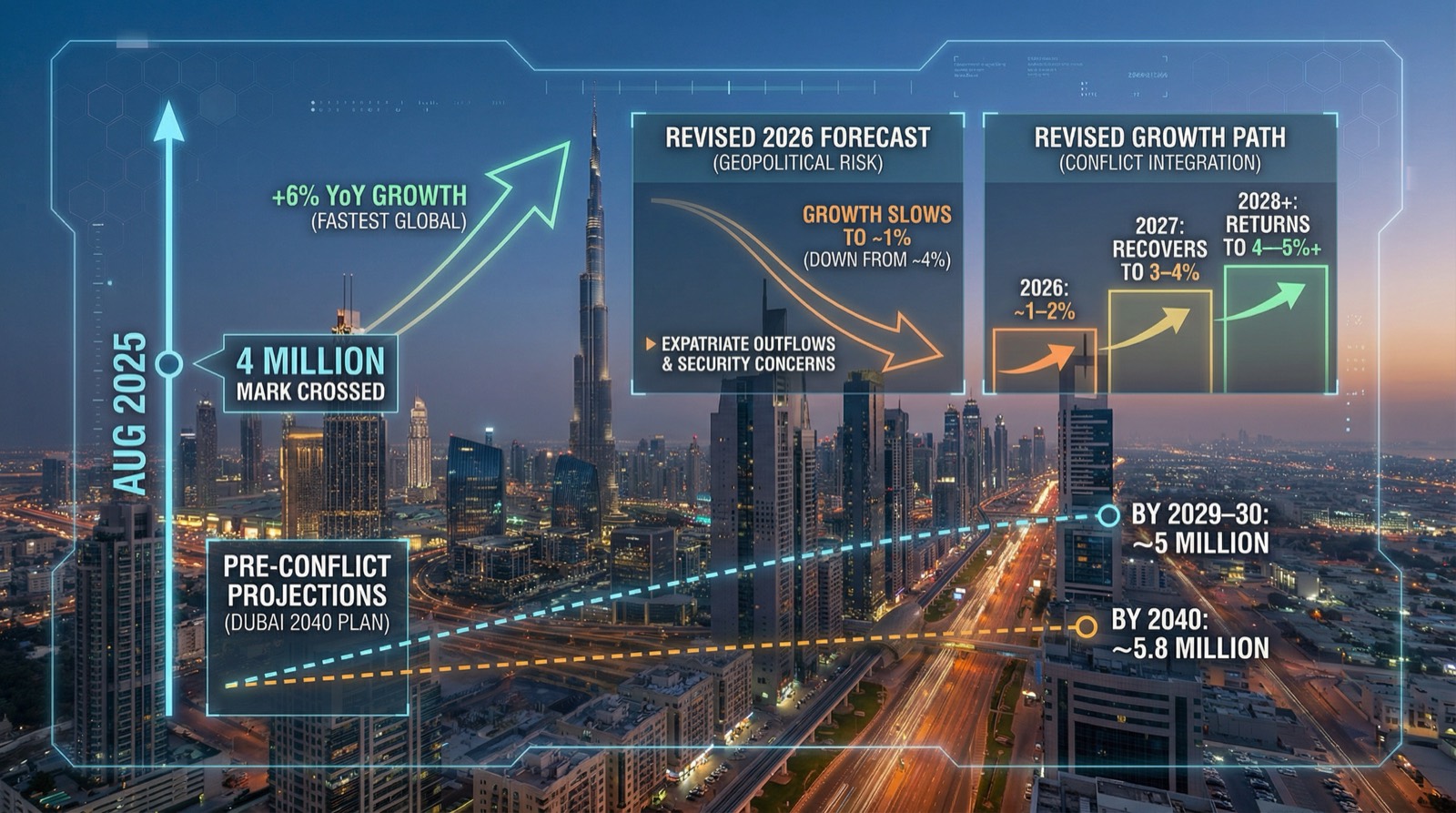
Offshore investors relying on vastly exaggerated international headlines for their risk assessment are recalibrating, even if those of us on the ground see a city continuing to function normally. In real estate, perception shapes pricing before fundamentals do.
While headline prices have remained relatively sticky, transaction volumes have shown signs of stress. According to Reuters, Dubai and Abu Dhabi's heavy reliance on foreign capital to fuel their construction boom has become a vulnerability as the Iran attacks disrupt the Gulf's safe-haven image.

The sharpest drop is in foreign investor enquiries — specifically from buyers who are not here and are forming their view of the market from international media coverage. Domestic and GCC-based buyers, who can see and feel the continued normality of daily life, remain active. But the European, South Asian, and East Asian capital that powered the 2022–2025 boom has noticeably slowed.
This matters because Dubai’s market has always been a leverage play on global capital flows. When those flows stall, absorption rates and pricing power deteriorate — even if the underlying city is functioning perfectly well.
Capital markets have repriced risk sharply. According to Bloomberg, UAE corporate bonds — particularly real estate developers — have been the worst performers in emerging markets, with developer bonds selling off as the Iran war threatens to end what had been a borrowing bonanza for property companies in Dubai and Abu Dhabi.
Major names like Emaar and Aldar saw their shares and bonds sell off sharply, reflecting investor concerns about weaker future sales, delayed project launches, and higher financing costs. Bond spreads widened — meaning developers now face higher borrowing costs for new projects, which puts pressure on launch economics and unit pricing.
For buyers who have already committed off-plan capital, the question of developer financial health and project delivery timelines has become significantly more pressing overnight.
One of the defining characteristics of Dubai’s current market cycle is the extraordinary dominance of off-plan sales.
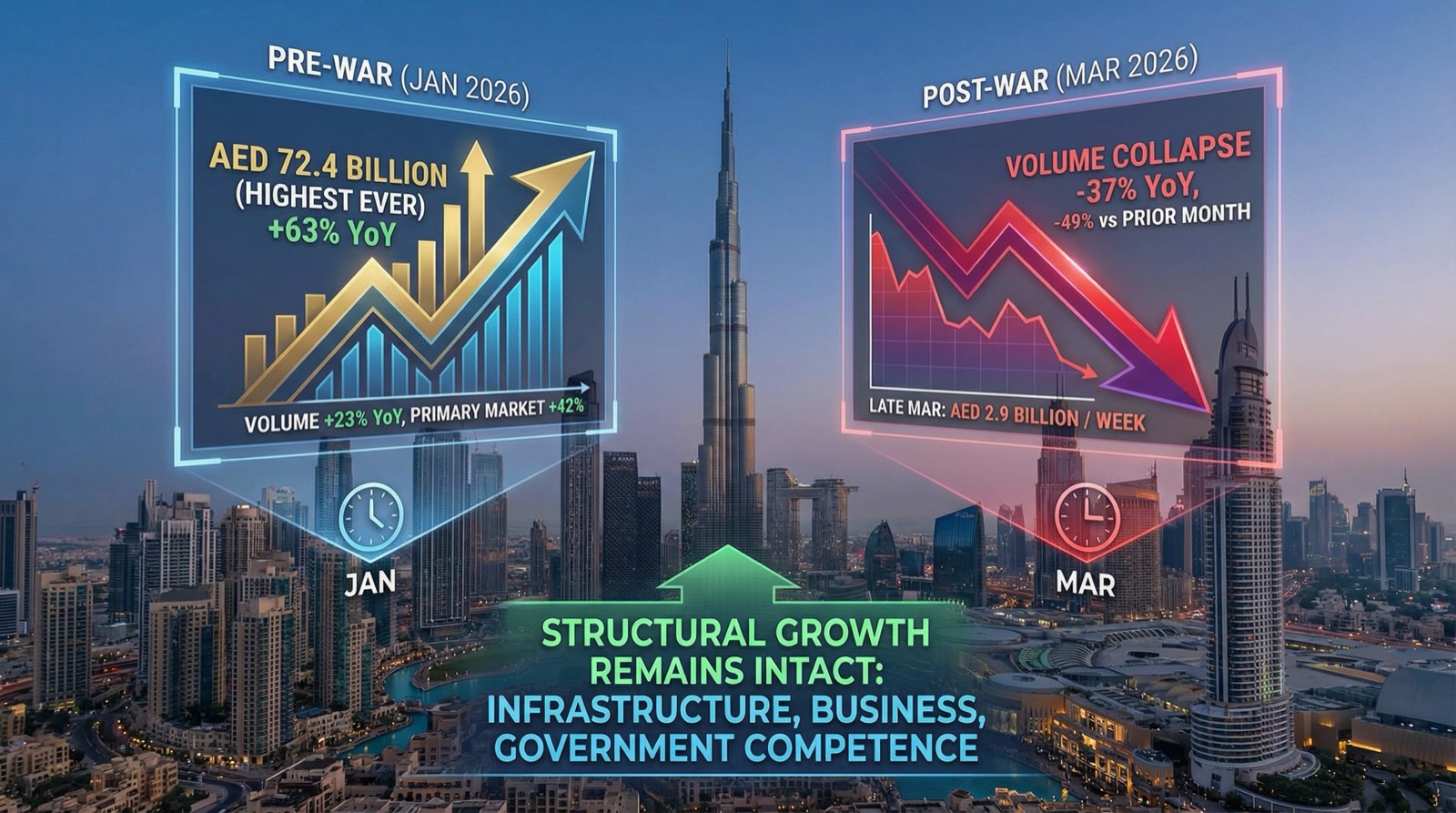
According to Betterhomes data cited by Reuters, off-plan transactions constituted 65% of Dubai’s deals in 2025 — and early 2026 data from Property Finder showed that figure climbing to over 71% of activity in January 2026 alone, when the market was still recording its highest-ever monthly transaction value of AED 72.4 billion.
This structural feature creates a specific vulnerability when sentiment deteriorates. Off-plan buyers are making multi-year commitments on future delivery and future market conditions. When geopolitical risk spikes and the future becomes harder to model confidently, rational investors defer commitments or demand higher returns to compensate for uncertainty.
I’m seeing this play out in real time: clients who were happy to lock in off-plan units at launch pricing six months ago are now asking for discounts of 5–10% or insisting on post-handover payment plans that shift risk back onto the developer. The Iran attacks haven’t triggered mass cancellations yet, but the mood has changed materially.
Not all segments are experiencing the Iran shock equally. Prime and ultra-prime assets — Palm Jumeirah villas, Emirates Hills, Downtown penthouses — are showing relatively modest impact so far. These markets attract end-users and ultra-high-net-worth buyers who are less sensitive to short-term headline risk and more focused on long-term scarcity value.
Engel & Völkers’ 2026 Dubai housing market analysis supports this view, noting that prime residential assets continue to attract committed long-term buyers despite the sentiment shift.
Mid-market and investor-driven off-plan projects are where the pressure is most acute. Projects in outer communities, high-density apartment towers, and anything relying heavily on speculative demand from overseas are experiencing sharp slowdowns in enquiries and longer sales cycles.
Commercial and logistics assets with strong institutional tenants are showing the most resilience of all, as cashflow-focused investors care less about geopolitical headlines and more about lease covenant quality.
Still reading
Need expert help on this subject?
If you are currently invested in Dubai real estate or considering entry, the Iran attacks demand a clear-eyed reassessment. For holders of off-plan at peak pricing, I would recommend modelling a resale downside of 10–20% and stress-testing cashflow and exit assumptions. Citi analysts are warning of a potential 7% annual price decline through 2028 in a bearish scenario — that is a real risk worth pricing in.
For opportunistic buyers, the market is shifting from seller to buyer power for the first time in three years. If you have liquidity and a medium-term horizon, the next 6–12 months could offer attractive entry points, particularly in quality ready assets where forced sellers begin to emerge. For end-users, the current environment offers negotiating leverage that simply did not exist during the euphoric phase of the cycle. Focus on established communities, proven developers, and assets with strong underlying fundamentals.
Having been on the ground through the 2008 crash, I understand why the comparison is being made. But the mechanics are fundamentally different. In 2008, the crisis was driven by a global credit freeze colliding with unregulated local speculation and massive oversupply.
The entire financial system was impaired. The structural conditions that led to the 2008 crash are simply not present in today’s market in the same form. Banks are well capitalised, regulation is more rigorous, and developers operate under escrow rules with progress-linked payment structures.
What we are experiencing now is a geopolitical sentiment shock layered onto a market that was already facing some cyclical headwinds from rising supply and emerging oversupply risks in certain segments. Fitch had already forecast price declines of up to 15% through 2026–2027 based purely on the pipeline of new units before a single missile was fired.
The Iran attacks have accelerated and amplified that correction, but they are not, in my assessment, a systemic collapse trigger — particularly given the UAE government’s demonstrated ability to manage this situation with competence and resolve.
I have no intention of leaving Dubai. My family is here, my businesses are here, and my capital is here. That is not bravado — it is a considered investment thesis built on over 19 years of watching this city navigate every challenge thrown at it and come out stronger.
The Iran attacks are a test. How the market navigates the next 12 months will separate the disciplined investors from the speculators — and create the kind of buying opportunities that define the next cycle.
Next step
Discuss what this means for your position
Tell us what you are weighing up — a building, a project, an area, or a rule you need to get right — and we will come back with the specifics that apply to it.

Stephen James Mitchell is a licensed real estate broker with over 25 years of experience across finance, investment strategy, and real estate, including more than 19 years operating in Dubai. He specialises in advising investors on acquiring and optimising high-performing assets, with a focus on commercial and investment-grade real estate, combining strong financial expertise with deep, on-the-ground market knowledge of the UAE.
To connect directly with Stephen James Mitchell, please click here.
Published 31 March 2026 by Stephen James Mitchell MBA. Market figures quoted reflect the data available at that date.