Any serious Dubai real estate crash 2009 comparison must begin with market structure, not sentiment. In 2008-2009, monthly UAE transaction values collapsed from $3 billion to $250 million — driven by a $26 billion sovereign debt standstill, zero escrow protection for off-plan buyers, and LTV ratios reaching 95%, as per IMF research.
Today, transaction volumes have declined 37% year-on-year per Goldman Sachs, while median prices are down only 3%. The regulatory architecture, population base, economic structure, and fiscal capacity of Dubai in 2026 represent a fundamentally different market. The risk is real but categorically different — investors who conflate the two episodes will misjudge both the downside and the opportunity.
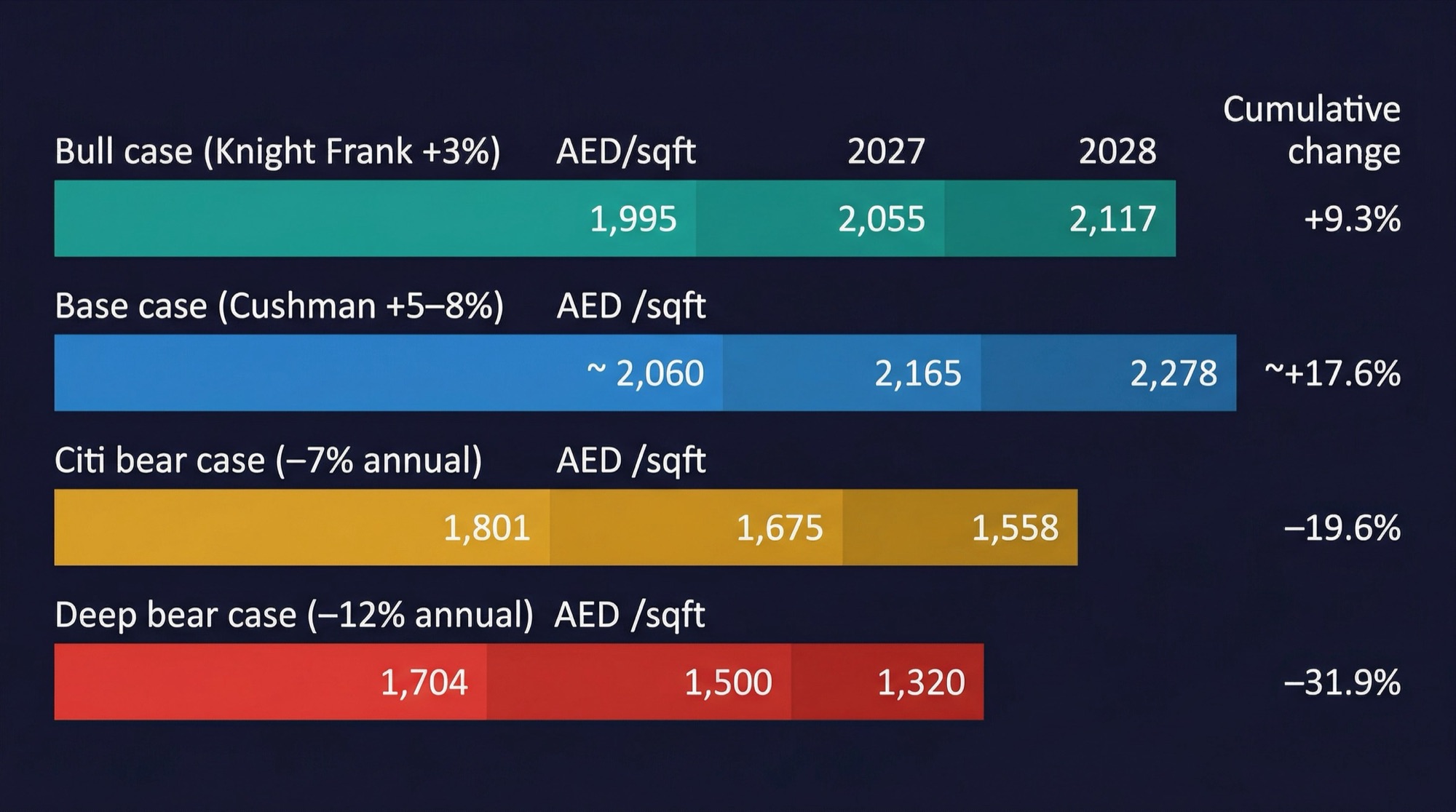
The 2009 parallel surfaced within days of Iran's retaliatory strikes on UAE targets in early March 2026. A widely-circulated post on X by PropertyDecoder stated that Dubai property "crashed 50-60% in 2008-09 within months." Citi research projected 7% annual price declines through 2028 and slashed its population growth forecast from 4% to 1%.
Reuters reported prime location discounts of 12-15%, while Emaar Properties shares shed 26%, and Goldman Sachs recorded a 49% month-on-month volume contraction. The fear is measurable and rational. By virtually every structural metric, however, the fundamentals of 2026 bear no resemblance to 2008.
The Dubai Real Estate Crash 2009 Comparison: Structural Differences
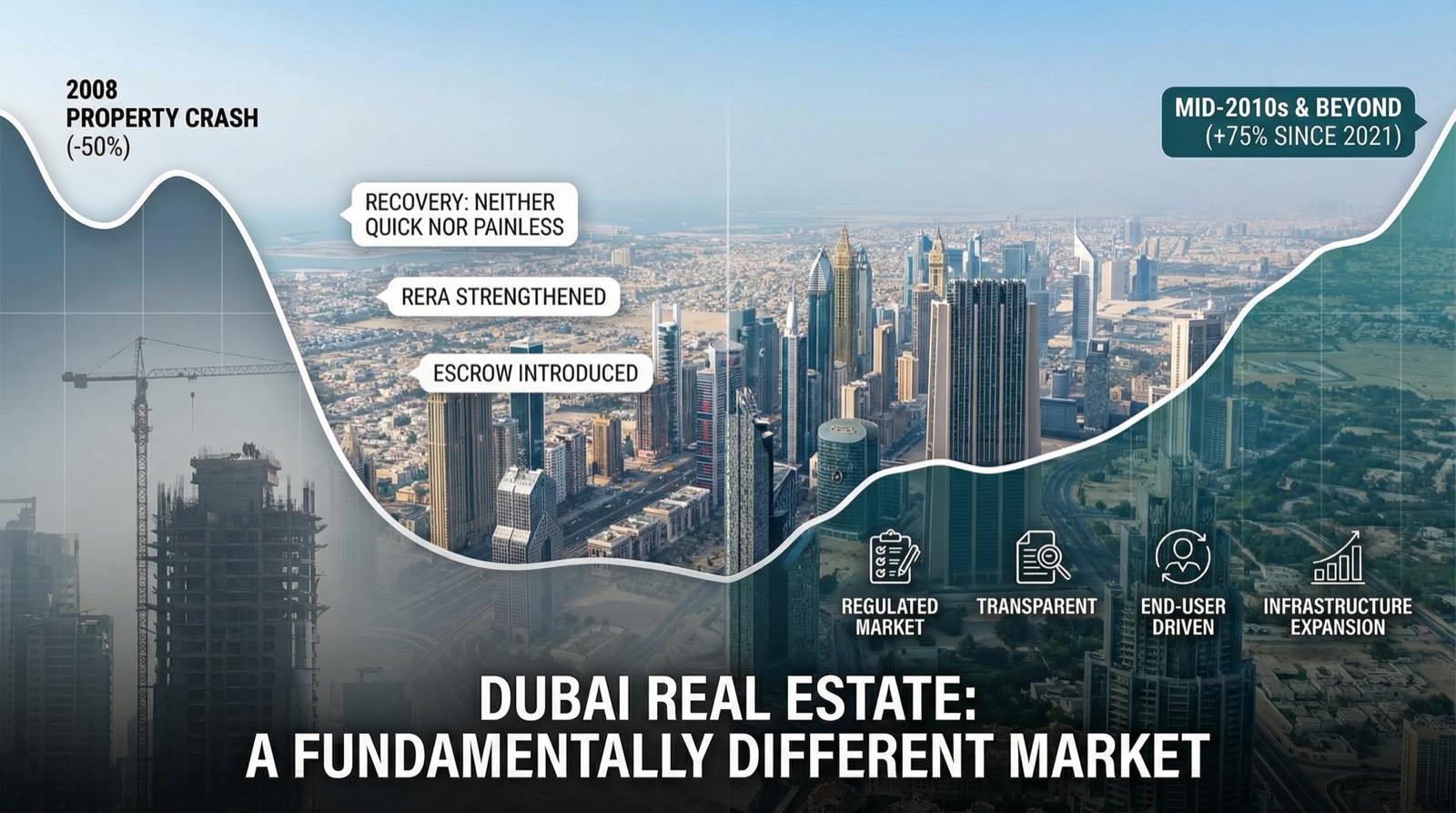
The defining characteristic of 2008-2009 was endogenous structural failure: UAE banks extended approximately $100 billion in credit above historical trend levels, LTV ratios approached 95%, and off-plan purchases carried zero buyer protection. Residential prices peaked at AED 2,700/sqft in Q3 2008, then fell to AED 1,180 by Q2 2009 — a 56% decline — with the city's population at just 1,645,973. I was here for all of it, watching half-built towers sit empty as developers vanished and buyers had no legal recourse.
Today, Dubai's population has reached approximately 4.0–4.1 million, non-oil GDP accounts for 77% of economic output, and bank real estate lending has declined from ~20% to 14% of gross loans following Central Bank mortgage caps. Our commercial property overview examines how these buffers affect current positioning.
The comparison table below covers the metrics that determine systemic risk:
| Metric | 2008–2009 | 2026 | Source |
|---|---|---|---|
| Peak-to-trough price decline | ~56% (AED 2,700 → AED 1,180/sqft) | ~3% median YoY to date | WSJ/Cluttons; Reuters |
| Population (emirate) | 1.65 million (end-2008) | 4.0–4.1 million (2026) | Dubai Statistics Center; The National |
| Non-oil GDP share | ~44% non-oil (2008) | ~77% non-oil (2026) | Emirates 24/7; Dubai Economy |
| Bank RE lending exposure | ~20% of gross loans | ~14% of gross loans | Fitch via The National |
| Maximum mortgage LTV | Up to 95% (unregulated) | 65–75% (Central Bank regulated) | IMF; Reuters |
| Off-plan buyer protection | None — deposits direct to developer | RERA escrow, milestone-release only | DLD |
| Credit growth preceding crisis | +51% YoY by September 2008 | No equivalent credit expansion | IMF |
| Government fiscal response | $20B reactive Abu Dhabi bailout | AED 302.7B pre-approved 2026–28 budget | CNN; Dubai DoF |
| Crisis trigger | Endogenous — domestic credit collapse | Exogenous — regional geopolitical event | HBS; Goldman Sachs via Reuters |

What Drove 2009 Versus What Is Driving 2026
The Dubai World debt standstill of November 2009 — a pause on at least $4 billion of its $26 billion in obligations — was the culmination of years of quasi-sovereign leverage. Abu Dhabi's $10 billion bailout followed a transaction value collapse from $3 billion to $250 million per month per IMF data.
The 2026 correction has a different profile: February alone produced AED 60.74 billion — an 18.14% year-on-year increase before the geopolitical shock arrived. Volume collapse with price resilience signals a sentiment-driven pause, not structural unwinding — the market intelligence dashboard tracks this in near real time.
Recovery Timelines and the Dubai Market Cycle Analysis
The 2009 crash took five years to recover: prices troughed in April 2009 and peaked again in September 2014 per Property Monitor. The COVID-19 dip recovered within 18 months and produced 60% appreciation through Q1 2025. Rental yields averaging 6.76% emirate-wide and reaching 8.51% in growth nodes provide income support absent in 2009.
One independent supply-side concern: 65% of 2025 Dubai transactions were off-plan, with 71,000 units scheduled for 2026 delivery — buyers at AED 2,600+/sqft face a distinct risk profile from completed income-producing assets, detailed in our investor guides.
The primary risk unique to 2026 is damage to Dubai's "safe haven" narrative. Citi cut its population growth forecast from 4% to 1%, and Fitch projected up to 15% correction before the conflict — overlaying geopolitical sentiment on pre-existing supply concerns creates compounding downside in weaker segments. Against this, mandatory RERA escrow limits developer collapse risk, bank lending at 14% of gross loans constrains contagion, and the pre-approved AED 302.7 billion government budget provides a demand floor. A 2009-scale correction of 50%+ is Low probability; a 10-20% correction in non-prime oversupplied segments is Medium. Our current deal pipeline covers distressed entry points.
- Distinguish between the DFMREI equity index (down 21% from peak) and physical property prices (down ~3% median) — these measure different instruments and should not be conflated
- Audit off-plan exposure at 2024-2025 peak pricing (AED 2,600+/sqft) and stress-test against a 10-15% decline at handover in 2027-2028
- Stress-test yield assumptions against Citi's revised 1% population growth scenario rather than the prior 4% baseline
- Verify escrow account status and developer financial health via the DLD/RERA portal before further capital deployment
- Prioritise completed, income-generating assets — rental yields of 6.76–8.51% provide downside protection absent in 2009
- Review prime location listings showing 12-15% discounts — historically the superior entry points in every prior Dubai correction
Still reading
Need expert help on this subject?
| Metric | Value | Source |
|---|---|---|
| 2009 peak-to-trough price decline | ~56% (AED 2,700 → AED 1,180/sqft) | WSJ / Cluttons |
| 2026 median price change (YoY to March) | -3% | Reuters / Goldman Sachs |
| Transaction volume decline (March 2026) | -37% YoY; -49% MoM | Goldman Sachs via Reuters |
| Population: 2008 vs 2026 | 1.65M vs 4.0–4.1M | Dubai Statistics Center; The National |
| Bank RE lending exposure (2026 vs 2008) | 14% vs ~20% of gross loans | Fitch via The National |
| Average rental yield (2026) | 6.76% overall; 8.51% in growth nodes | Engel & Völkers; GuestReady |
| Monthly RE transaction values: peak vs trough (2008-09) | $3B (May 2008) → $250M (Nov 2009) | IMF Finance & Development |
| Dubai government budget 2026–2028 | AED 302.7B (~48% infrastructure) | Dubai Department of Finance |
Is a 50-60% price collapse possible in 2026 as in 2009?
No — the structural conditions are absent. The 2009 crash required simultaneous failure across an unregulated off-plan market, $100 billion in excess bank credit, and a quasi-sovereign debt structure requiring external bailout. RERA escrow is now mandatory, Central Bank mortgage caps are enforced, and Dubai entered 2026 with a pre-approved AED 302.7 billion budget.
How long did the 2009 recovery take, and what does that imply for 2026?
Prices troughed in April 2009 and did not recover to peak until September 2014 — five years — because that was a credit-driven structural crash. The COVID-19 correction, a comparable exogenous shock, recovered within 18 months and produced 60% appreciation through Q1 2025 per Reuters; a conflict resolution within months makes a faster trajectory more historically consistent than the 2009 template.
What areas carry the most risk in the current correction?
Off-plan purchases at 2024-2025 peak pricing (AED 2,600+/sqft) in secondary locations face the greatest exposure, particularly where handover extends into 2027-2028. Prime, supply-constrained locations — Downtown Dubai, DIFC, Sheikh Zayed Road — have shown materially greater resilience in every prior correction cycle.
Do rental yields provide meaningful protection during this correction?
Yes. The emirate-wide average of 6.76% — up to 8.51% in growth nodes — provides income support structurally absent in 2009's speculative market. At 7% yield, an investor recovers the full purchase price in income within 14 years, materially changing the risk calculus versus a zero-income off-plan position.
What conditions would make 2026 resemble 2009?
Conflict lasting six or more months disrupting Strait of Hormuz flows, a structural population decline, and credit tightening impairing developer financing — all three simultaneously. Even then, scenario frameworks project 20-30% physical price declines, materially below 2009's 56% trough.
Next step
Talk to Mitchells
Tell us what you are weighing up — a building, a project, an area, or a rule you need to get right — and we will come back with the specifics that apply to it.
Published 30 March 2026 by Stephen James Mitchell MBA. Market figures quoted reflect the data available at that date.