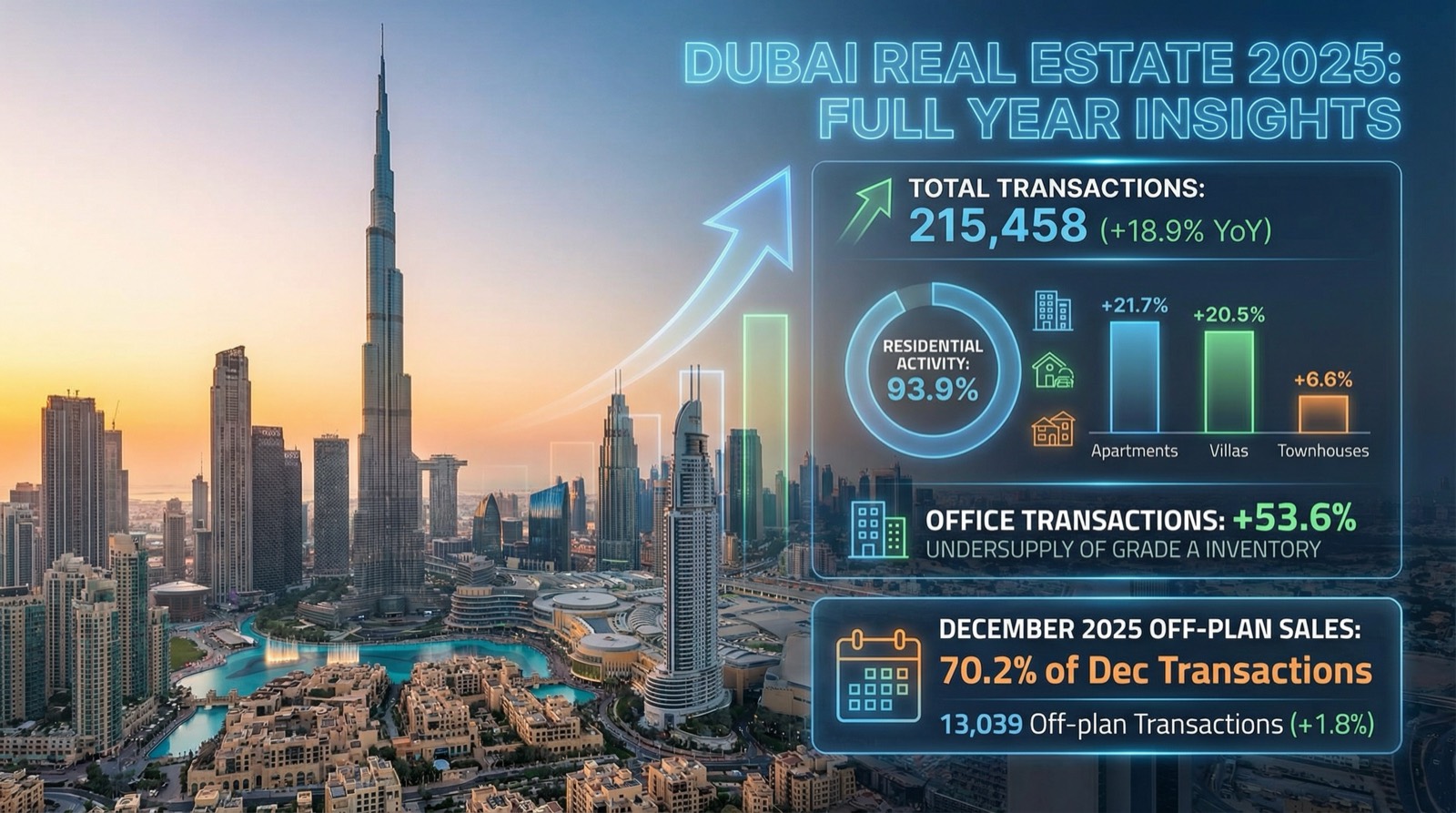
This week reset the macro picture for UAE real estate.
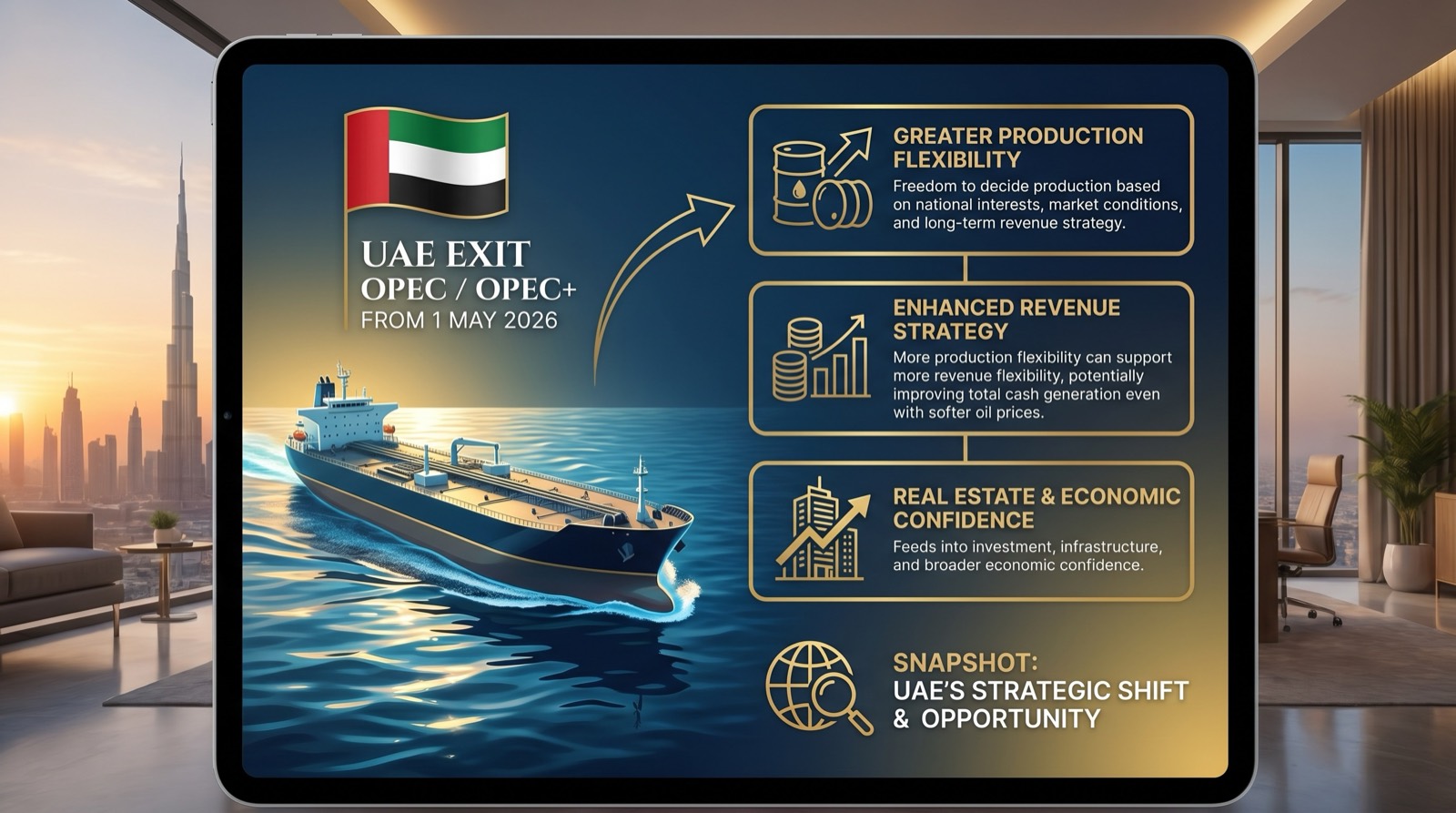
The UAE formally exited OPEC effective May 1, Dubai scrapped its AED 750,000 minimum for the two-year property investor visa, and April closed with record off-plan apartment sales.
All of this is unfolding against a more uncertain backdrop. The Iran conflict has now entered its third month, with the Strait of Hormuz still effectively constrained.
If you’re reassessing your positioning in this market, I can show you where risk-adjusted opportunities are emerging. Click here to speak with me directly.
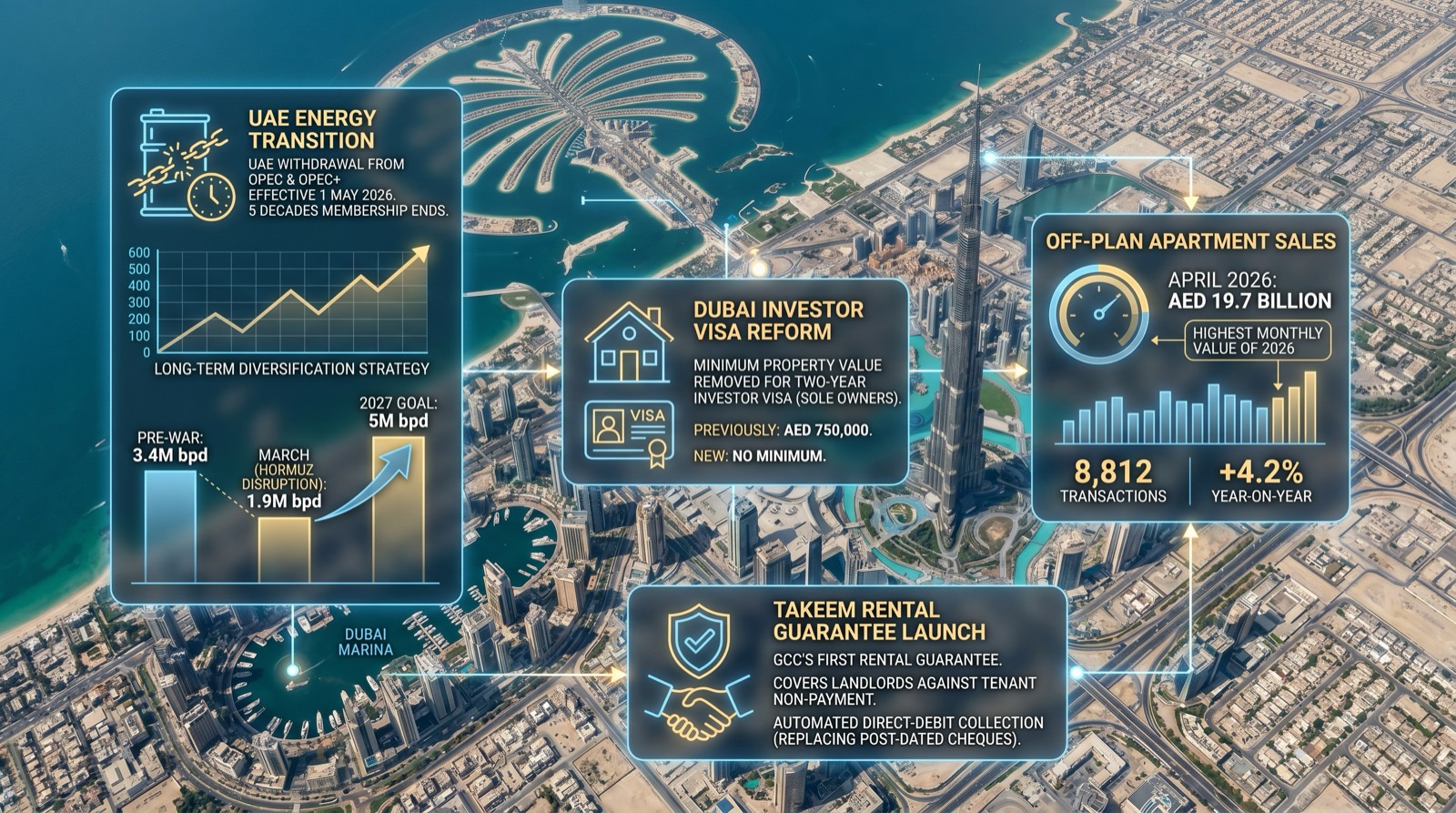
The UAE’s exit from OPEC and OPEC+ took effect on May 1, ending over 50 years of coordinated production policy. Energy Minister Suhail Al Mazrouei described the decision as “purely a policy move” rooted in a long-term diversification strategy.
This is reflected in the production data:
| Metric | Pre-War | March 2026 | 2027 Target |
|---|---|---|---|
| Oil Production (m bpd) | 3.4 | 1.9 | Up to 5.0 |
| Quota Constraints | Yes | Yes | Removed |
Production had fallen sharply due to Hormuz disruption, but quota removal now allows full capacity recovery as conditions stabilise.
For real estate, the implications are indirect but important:
- Hydrocarbon revenue remains the primary funding source for large-scale non-oil investment
- Capital is being directed into infrastructure, AI, logistics, manufacturing, and tourism
- These sectors directly support long-term residential and commercial demand
There is also a geopolitical angle. The move has been publicly supported by the US, reinforcing alignment rather than introducing instability, while the dirham peg remains unchanged.
This is a capacity expansion decision, not a risk event. It strengthens the UAE’s ability to fund growth, which ultimately supports property demand.
Dubai has removed the AED 750,000 minimum property value requirement for the two-year investor visa for sole owners. There is now no minimum threshold for individual buyers.
| Ownership Type | Requirement |
|---|---|
| Sole Owner | No minimum value |
| Joint Owners | AED 400,000 each |
The scale of this change becomes clear when compared to transaction data:
- 24% of ready home sales in 2026 were below AED 750,000
- 8.6% were below AED 500,000
- That entire segment is now visa-eligible overnight

This directly impacts demand in established affordable and mid-market locations:
- JVC
- Dubailand
- International City
- Dubai Silicon Oasis
- Arjan, Majan, and Production City
For investors, this widens the addressable buyer pool at the affordable end without disrupting mid-market or luxury pricing dynamics.
Explore curated office and retail opportunities at Mitchell’s Commercial Realty.
April recorded the strongest off-plan apartment sales month of 2026 so far:
| Indicator | April 2026 |
|---|---|
| Total Value | AED 19.7B |
| Transactions | 8,812 |
| YoY Growth | +4.2% |
| Leading Area | Dubai Islands (AED 2.6B / 691 deals) |
Dubai Islands has now led for four consecutive months, with AED 7.9B in sales year-to-date. Al Khairan First (AED 1.5B) and Madinat Al Mataar near Al Maktoum International (AED 1.4B) followed.
Two transactions broke AED 100 million: a 10,000 sq ft unit at Aman Residences Dubai at AED 171m (~AED 17,100 psf) and a 13,250 sq. ft. apartment at Baccarat Hotel & Residences at AED 121.8m.
The data confirms that demand has reaccelerated, specifically in master-planned, branded, and infrastructure-anchored locations — not broadly.
Three major construction awards were confirmed this week:
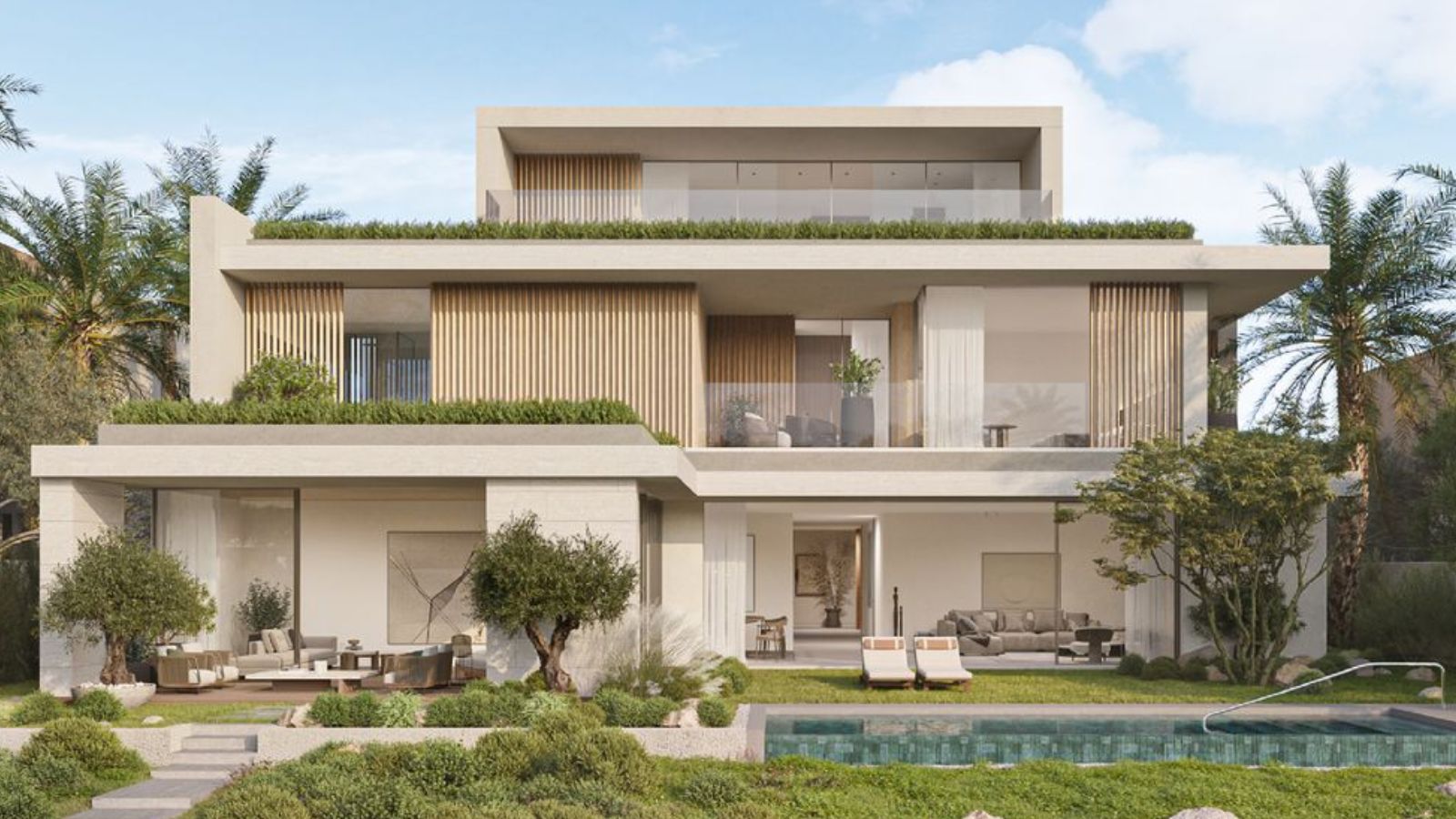
- Meraas: AED 2.4B for 557 villas (Dubailand)
- Nakheel: AED 3.5B for 544 villas (Palm Jebel Ali)
- Modon: Tara Park on Reem Island sold out (~AED 2B in sales)
These are long-cycle commitments, not short-term reactions.
- Capital is still being deployed aggressively into premium villa stock
- The development pipeline remains funded and progressing without delay
This also sets up a forward supply dynamic:
- Premium villa inventory will increase into 2027–2028
- Pricing in that segment will depend on absorption, not scarcity alone
Developers are not pausing. They are building through the cycle.
Still reading
Need expert help on this subject?
Recent transaction data covering 1 March – 15 April shows developer sales above AED 5 million reaching AED 25.04 billion across 1,813 deals, with value up 21.4% YoY and volume up 59.7%.
Breakdown by band:
| Price Band | Value | Change | Volume |
|---|---|---|---|
| AED 5–10M | AED 7.91B | +131% | 503 → 1,153 |
| AED 50–100M | AED 2.63B | +70% | — |
The standout is the AED 5–10 million band, where both value and volume have more than doubled. Higher tiers have also moved, but at a slower pace, indicating that activity is not limited to a small number of ultra-high-value transactions.
This points to a broader base of participation within the luxury segment, rather than concentration in a handful of trophy sales. Demand is expanding across price bands, which continues to support pricing in branded developments and prime locations.
PropTech platform Takeem has introduced the GCC’s first Rental Guarantee, designed to cover landlords against tenant non-payment while replacing post-dated cheques with automated direct-debit collection.
The platform now manages 95,000+ units representing over AED 9 billion in annual rental value.
As rental growth begins to stabilise in parts of the market, this type of structure becomes more relevant.
It provides:
- Income protection against default
- Improved cash flow predictability
- A shift away from cheque-based leasing toward automated collection systems
As headline rents soften in some areas, structured income protection becomes a more meaningful differentiator for landlord returns, particularly for investors focused on long-term yield rather than short-term pricing movement.
In closing
Final View for Dubai Property Investors
This week brings together three structural shifts:
- UAE exit from OPEC → increases long-term funding capacity
- Visa rule change → expands the entry-level buyer pool
- Developer commitments → confirms capital is still being deployed
At the same time, the Iran conflict has entered its third month, the Strait of Hormuz remains heavily disrupted, and the market is moving into the quieter summer period, where activity typically slows and pricing becomes more flexible.
The result is a narrower, more selective market. Buyers with capital and a clear brief are able to negotiate on quality stock, particularly where sellers need liquidity, while those waiting for full certainty will likely re-enter at higher prices.
Next step
Let’s Talk
If you’d like to unpack where the most resilient opportunities are emerging — in stabilised residential areas or income-generating commercial zones — I’d be happy to share a focused, data-driven shortlist based on your investment goals.
📞 No pressure, no sales pitch—just a focused, informed conversation about your investment goals.
Published 4 May 2026 by Stephen James Mitchell MBA. Market figures quoted reflect the data available at that date.