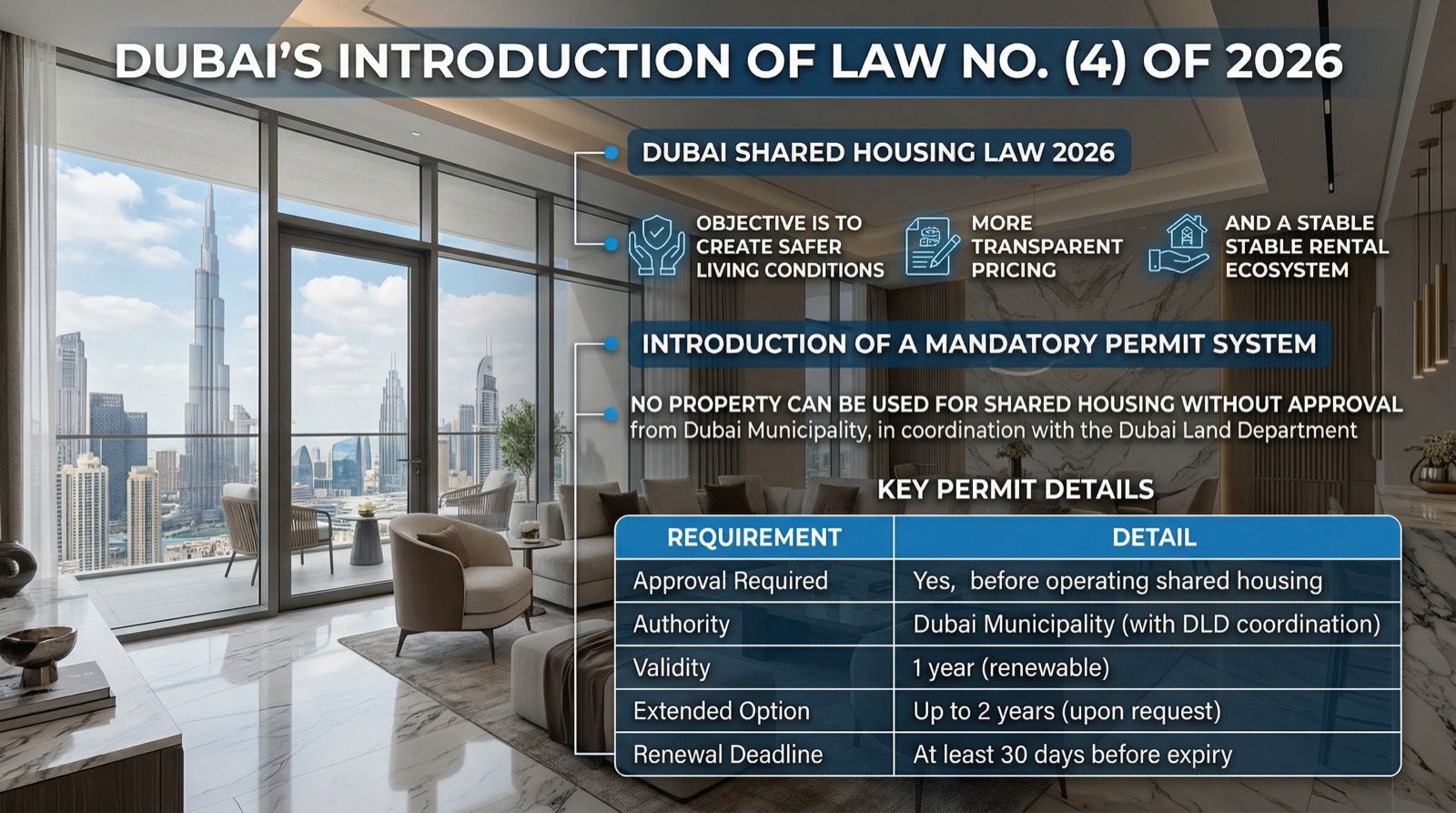
Dubai’s introduction of Law No. (4) of 2026 represents a meaningful shift in how shared accommodation is regulated across the emirate. While the headlines have focused on fines of up to AED 1 million, the more important takeaway for landlords is the structural change in how this segment of the market will operate going forward.
Shared housing has historically existed in a fragmented and loosely controlled space. It has often been used as a strategy to maximise rental yield through partitioning and higher occupancy density. At the same time, it has created inconsistencies around safety, tenant quality, and pricing transparency.
This new law formalises the segment. It introduces licensing, enforces standards, and brings shared accommodation into the broader regulatory framework that Dubai has been steadily building across its real estate market.
For landlords, this is less about restriction and more about transitioning into a more controlled, institutional-style operating environment.
The rationale behind the regulation is straightforward. Authorities are addressing a combination of safety concerns, market distortions, and tenant protection.
Several factors have contributed to this shift:
- The rise of overcrowded units in high-density areas
- The widespread use of unapproved internal partitions
- Fire safety risks linked to non-compliant modifications
- Inconsistent rental practices in the bed-space market
A high-profile residential fire incident in Dubai Marina brought many of these risks into focus, highlighting how quickly informal housing arrangements can create wider building-level hazards.
At a policy level, the objective is to create safer living conditions, more transparent pricing, and a stable rental ecosystem.
One of the most important changes is the introduction of a mandatory permit system.
No property can be used for shared housing without approval from Dubai Municipality, in coordination with the Dubai Land Department.
In addition, Dubai Municipality has the authority to designate specific zones where shared housing is permitted or prohibited, meaning compliance alone does not guarantee approval if the property is located in a restricted residential zone.
Key Permit Details
| Requirement | Detail |
|---|---|
| Approval Required | Yes, before operating shared housing |
| Authority | Dubai Municipality (with DLD coordination) |
| Validity | 1 year (renewable) |
| Extended Option | Up to 2 years (upon request) |
| Renewal Deadline | At least 30 days before expiry |
This introduces a clear entry threshold. Landlords can no longer implement shared housing arrangements informally or at short notice.
While this adds administrative steps, it also filters out non-compliant operators, which may ultimately support stronger and more stable rental conditions for those operating within the framework.

The law clearly defines who is allowed to lease shared housing units and how those arrangements can be structured.
Permitted Leasing Structures
- Direct leasing by the property owner
- Leasing through a licensed management company
- Leasing through an operator that subleases the unit (with proper authorisation)
These structures correspond to three recognised legal roles: Owner-Operator, Licensed Property Management Firm, and Licensed Subleasing Entity (the only permitted professional “middleman” model).
Tenants are not permitted to sublease any part of the unit.
This is a significant change. In many cases, tenants previously acted as informal operators — renting a unit and then monetising it through partitioning or bed-space arrangements.
That model is effectively removed.
For landlords, this creates:
- Greater control over how the property is used
- Clearer accountability for compliance
- Reduced risk of unauthorised modifications
At the same time, it places more responsibility on the landlord to ensure the unit is operated correctly.
To obtain and maintain a permit, units must meet a defined set of technical and operational standards.
Core Requirements
- Maximum occupancy limits must be observed
- Minimum space per resident must be provided
- Units must meet fire safety regulations
- Electrical systems must comply with safety standards
- Adequate sanitation and hygiene provisions must be in place
- Security measures must be maintained
- Shared facilities must meet defined requirements
The law specifies a minimum habitable space of 5 square metres per resident, calculated only on net internal living areas such as bedrooms and living rooms. Balconies, kitchens, corridors, and bathrooms are excluded from this calculation.
Occupancy Illustration
| Room Size (sqm) | Maximum Residents |
|---|---|
| 10 sqm | 2 residents |
| 15 sqm | 3 residents |
The law specifically targets unauthorised partitions, which are common in high-yield shared housing setups.
These typically involve:
- Dividing rooms using non-fire-rated materials
- Creating additional sleeping spaces in living areas or balconies
- Making structural changes without approval
These modifications are considered high-risk because they:
- Obstruct emergency exits
- Reduce ventilation
- Increase fire spread risk
- Potentially weaken structural integrity
Landlords with existing partitioned units will need to review and potentially reverse these modifications to achieve compliance.
The enforcement framework is deliberately strict, reflecting the importance placed on compliance.
Fine Structure
| Violation Type | Penalty |
|---|---|
| Initial Violation | AED 500 – AED 500,000 |
| Repeat Violation (within 1 year) | Up to AED 1,000,000 |
Additional Measures
Authorities may also:
- Suspend activity for up to six months
- Cancel permits
- Revoke commercial licences
- Disconnect utilities
- Evict occupants from non-compliant units
This goes beyond financial penalties. The real exposure lies in operational disruption and loss of income, particularly if a property is taken offline.
The law allows a transition period, but it is clearly defined.
Key Timeframes
- Law comes into force: 180 days after publication
- Compliance period: 1 year from implementation
- Possible extension: One-time, subject to approval
Importantly, the compliance timeline begins from the law’s effective date (post-publication), not from the initial announcement in March 2026.
This provides a window for landlords to assess their portfolios and make necessary adjustments.
However, given the scale of enforcement expected, delaying action is unlikely to be a viable strategy.
Still reading
Need expert help on this subject?
The effect of the law will vary depending on how properties are currently being operated.
The law applies across Dubai, including private and freehold zones, but explicitly excludes collective labour accommodation, which remains governed by separate labour housing regulations.
Professional and Institutional Landlords
- Already aligned with compliance standards
- Likely to benefit from reduced informal competition
- Better positioned to scale within the new framework
Individual Investors Using Shared Housing for Yield
- May face increased costs to meet compliance
- Need to reassess occupancy and layout strategies
- Must shift from informal to regulated operations
Partition-Based Operators
- High-risk model under the new law
- Significant restructuring required
- In many cases, the model may no longer be viable
For landlords currently operating or considering shared housing, a structured approach is essential.
Recommended Steps
1. Conduct a Unit Audit
- Identify partitions and structural modifications
- Review current occupancy levels
2. Assess Compliance Gaps
- Fire safety systems
- Electrical infrastructure
- Space allocation per tenant
3. Review Leasing Arrangements
- Eliminate any tenant-led subleasing
- Ensure contracts align with new rules
4. Prepare for Permit Application
- Gather required documentation
- Engage with relevant authorities if needed
5. Upgrade Where Necessary
- Remove non-compliant partitions
- Improve safety and facility standards
6. Reposition Rental Strategy
- Align with future rental index expectations
- Focus on quality and sustainability of income
Taking early action may not only reduce risk but also position landlords ahead of slower-moving competitors.

Beyond individual properties, the law is likely to reshape the shared housing segment at a broader level.
Expected Market Effects
- Reduction in informal and non-compliant supply
- Increased demand for regulated shared accommodation
- Potential upward pressure on compliant rents
- Improved tenant conditions and retention
- Stronger regulatory credibility for Dubai internationally
This aligns with the emirate’s continued focus on attracting long-term capital and institutional investment into real estate.
It is easy to focus on the restrictions introduced by the Dubai shared housing law 2026 — permits, compliance requirements, and penalties. However, the more relevant perspective for landlords is how this positions the market going forward.
Dubai is steadily moving toward a more structured and transparent real estate environment. Shared housing was one of the remaining segments operating outside that framework. This new law closes that gap.
For landlords who adapt early, there is a clear opportunity to operate within a more stable, predictable, and professionally managed segment of the market.
For those who do not, the combination of enforcement risk and operational constraints will make the model increasingly difficult to sustain.
In closing
Conclusion
Dubai’s shared housing law introduces a clear shift in priorities: safety, transparency, and control.
For landlords, the key takeaway is not simply compliance — it is positioning.
Those who align with the new framework are likely to benefit from:
- Reduced competition from informal operators
- Greater pricing stability
- Improved tenant quality
- Lower long-term regulatory risk
In a market that is becoming increasingly institutional, compliance is no longer a cost — it is a competitive advantage.
Next step
Ask us about this


Stephen James Mitchell is a licensed real estate broker with over 25 years of experience across finance, investment strategy, and real estate, including more than 19 years operating in Dubai. He specialises in advising investors on acquiring and optimising high-performing assets, with a focus on commercial and investment-grade real estate, combining strong financial expertise with deep, on-the-ground market knowledge of the UAE.
To connect directly with Stephen James Mitchell, please click here.
Published 13 March 2026 by Stephen James Mitchell MBA. Market figures quoted reflect the data available at that date.