The Dubai property price forecast for 2026, 2027, and 2028 fractured in March when Citi analysts published a bearish scenario projecting 7% average annual price declines — a cumulative drawdown of roughly 20% from peak.
Reuters reported the projection stemmed from Citi slashing its Dubai population growth forecast from 4% to 1% for 2026, citing geopolitical risk.
The base case among most consultancies remains positive or flat. I have mapped the Citi scenario against real AED/sqft data and supply fundamentals to identify where the numbers land and which segments carry the most structural exposure.
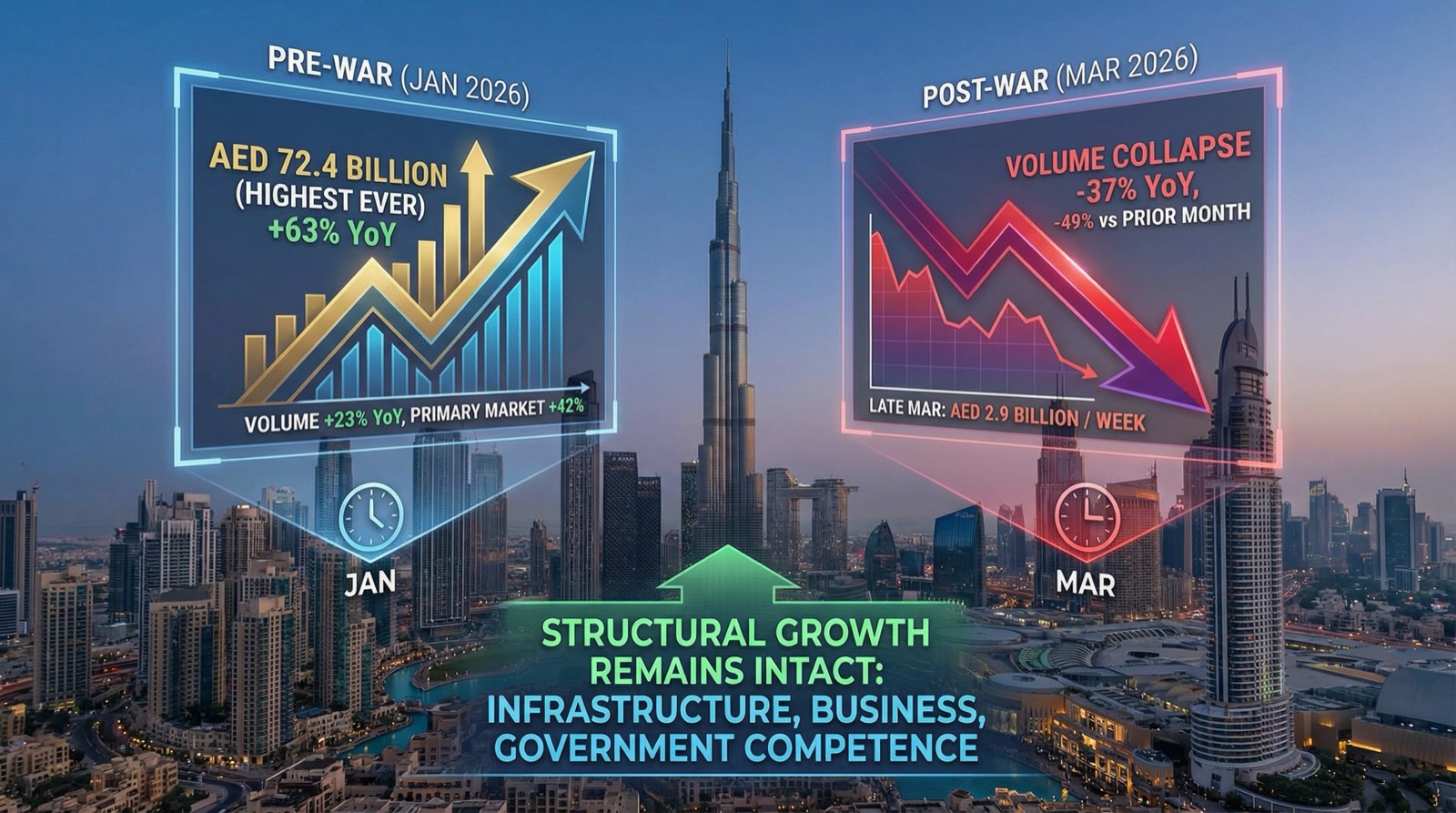
The Citi forecast emerged in the third week of March 2026. According to Reuters, transaction volumes fell 37% year-on-year and 49% month-on-month in the first 12 days of March per Goldman Sachs data, with transaction values collapsing 51% month-on-month.
The DFM Real Estate Index shed approximately 20% in five trading sessions from its February 27 peak of 16,910, per Business Standard. Median apartment prices showed only a 3% year-on-year decline through mid-March — a divergence reflecting a liquidity freeze rather than a valuation collapse.
Citi's population growth revision from 4% to 1% for 2026, and 2–2.5% annually from 2027 to 2031, was the demand mechanism driving the bearish price model.
Section 02
Running the Dubai Property Price Forecast 2026, 2027, & 2028 Against Historical AED/sqft Data
The citywide median stood at approximately AED 1,937/sqft in early 2026 — up from AED 916/sqft at the 2020 COVID trough, a 111% nominal increase in six years.
Engel & Völkers February 2026 data places the citywide average at AED 1,667/sqft, with Downtown Dubai at AED 2,980/sqft, Business Bay at AED 2,673/sqft, Dubai Marina at AED 2,061/sqft, and JVC at AED 1,448/sqft.
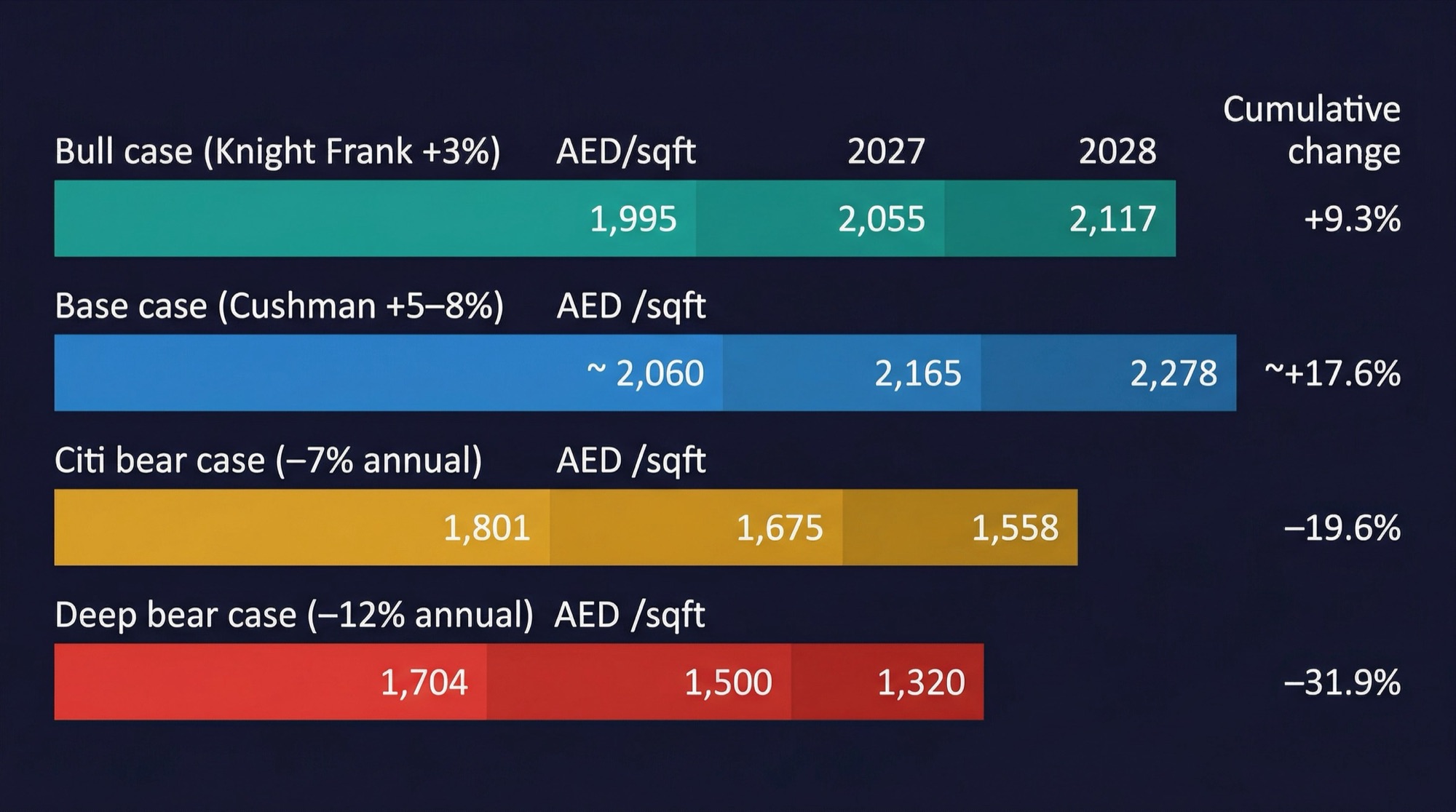
Applying –7% annually produces a 2028 citywide endpoint of approximately AED 1,558/sqft — last seen around mid-2022 — and prime Downtown at roughly AED 2,384/sqft. Investors who purchased before 2022 still hold nominal gains under the full bear scenario.
For investors modeling how these trajectories interact with specific acquisition costs, the market intelligence dashboard tracks live AED/sqft and yield data across product categories and districts.
Scenario Comparison Table
| Scenario | 2026 AED/sqft | 2027 AED/sqft | 2028 AED/sqft | Cumulative Change |
|---|---|---|---|---|
| Bull case (Knight Frank +3%) | 1,995 | 2,055 | 2,117 | +9.3% |
| Base case (Cushman +5–8%) | ~2,060 | ~2,165 | ~2,278 | ~+17.6% |
| Citi bear case (–7% annual) | 1,801 | 1,675 | 1,558 | –19.6% |
| Deep bear case (–12% annual) | 1,704 | 1,500 | 1,320 | –31.9% |
Sources: Knight Frank Q4 2025; Reuters/Citi, March 2026.
The Citi bear case endpoint of AED 1,558/sqft still represents a 70% premium over the 2020 trough, quantifying the distance between a cyclical correction and structural market failure.
Which Segments Are Most and Least Vulnerable
Structural risk concentrates along two dimensions: product type and pipeline location. On product type, 66% of the upcoming supply pipeline consists of studios and one-bedroom units — the same category that showed the weakest price performance in March 2026.
Goldman Sachs data recorded median apartment prices down 3% year-on-year and 8% month-on-month, while villa prices held up 16% year-on-year despite a 2% monthly dip. Villas benefit from genuine scarcity: limited land release, owner-occupier demand, and a price point less saturated by speculative off-plan supply.
On location, pipeline data indicates JVC at 31,578 units, Dubai South at 30,608, and Business Bay at 23,752, reflecting concentrated supply in high investor-to-owner-occupier districts. Palm Jumeirah, Downtown core, and established Dubai Hills face materially less pressure.
Where Entry Points Emerge Under a Correction Cycle

The historical 48% completion rate is the key moderating variable. Of approximately 71,613 units planned for 2026, roughly 34,000 will realistically hand over — above the long-run absorption of 27,000–30,000 but not the catastrophic oversupply implied by headline numbers.
Moody's projects 60,000 average annual deliveries from 2026 to 2028, roughly double the historical norm.
Under the Citi bear case, entry points emerge as completed tenanted assets in JVC, Dubai South, MBR City, and Business Bay begin trading at 10–15% discounts — tracked in our distressed property pipeline.
Current gross apartment yield is 7.07% per Engel & Völkers. A 20% price decline with flat rents expands yield on cost to approximately 8.8%; with 10% rent softening, yield still reaches 7.9%.
| Segment | Risk Level |
|---|---|
| Speculative off-plan studios and one-bedrooms in outer-ring, supply-heavy districts | High |
| Completed mid-market apartments in established corridors | Medium |
| Villas in land-constrained areas and prime waterfront residential | Low |
The Citi scenario depends on population growth remaining suppressed at 1%. If geopolitical conditions normalize by Q2–Q3 2026, that assumption reverts, and the bear case loses its central pillar.
The non-obvious risk: 65% of 2025 transactions were off-plan, meaning a large cohort holds deferred settlement positions that could generate supply beyond what completion-rate adjustments capture. The structural buffer: 87% of 2025 purchases were cash, reducing forced-liquidation cascades.
- Segment your exposure: Identify whether target holdings fall in the high-supply studio/1BR corridor or in villa and prime categories. The bear case applies unevenly across product types.
- Model three entry prices: Calculate yield at current asking price, at –10%, and at –15%. Establish the minimum acceptable yield before entering negotiations.
- Prioritize completed and tenanted over off-plan: Off-plan in outer-ring areas compounds delivery risk on top of price risk in a supply-heavy environment.
- Track completion rate data quarterly: The ~48% historical completion rate is the single most important variable separating the bear case from the deep bear case. Monitor DLD handover registrations against announced schedules.
- Prioritise a 15–20% discount for off-plan in top supply zones: JVC, Dubai South, Business Bay, MBR City, and Dubailand carry concentrated pipeline risk.
- Stress-test yields at 10% rent decline: Ensure acquisition price sustains acceptable returns under simultaneous price and rental softness.
- Size for a 12–18 month holding window: Capital deployed in Q2–Q3 2026 should remain liquid-neutral through at least Q4 2027.
| Metric | Value |
|---|---|
| Citi bear case annual price decline | –7% per year, 2026–2028 |
| Citi revised population growth forecast | 1% for 2026 (down from 4%) |
| Citywide average AED/sqft (Feb 2026) | AED 1,667; DXBInteract median AED 1,937 (+14% YoY) |
| COVID trough to 2026 price appreciation | AED 916/sqft → AED 1,937/sqft (+111%) |
| Current gross apartment yield | 7.07% |
| Transaction value decline (first half March 2026, MoM) | –51% |
| Studio/1BR share of supply pipeline | 66% of upcoming units |
| Historical handover completion rate | ~48% of announced units |
| Cash purchase share of 2025 transactions | 87% |
Frequently asked questions
0501Is the Citi bear case a consensus forecast?
No. Citi's –7% annual projection is explicitly a bearish scenario, not their central case.
Knight Frank projects roughly 3% growth in prime and 1% in mainstream for 2026, while Cushman & Wakefield forecasts 5–8% growth. The Citi scenario requires population growth to remain suppressed and supply to deliver above historical completion rates simultaneously.
02Why is the villa market behaving differently from apartments?
Villas are a land-constrained product with strong owner-occupier demand and lower speculative inventory exposure.
Goldman Sachs data from March 2026 showed villas up 16% year-on-year while apartments declined 3%. New villa supply is a fraction of apartment pipeline volume, insulating the segment from the primary supply pressure driver.
03At what price level does Dubai become a compelling entry under the bear case?
Under –7% annual declines, the citywide average reaches approximately AED 1,558/sqft by end-2028, where gross yields on entry expand to approximately 8.5–9% — historically the threshold that has attracted sustained institutional buying in Dubai.
04How does the 87% cash purchase rate affect correction depth?
It materially reduces forced liquidation cascades. With 87% of 2025 buyers holding unencumbered positions, correction depth is driven by sentiment and supply absorption rather than lending defaults, making declines more gradual compared to the 2009 cycle.
05What was the scale of Dubai's last major correction?
Dubai prices fell approximately 30–35% peak-to-trough between 2014 and 2020, averaging roughly 5–6% annually. The Citi bear case at –7% per year is within that historical range, though the current market's cash buyer dominance and stronger RERA oversight provide structural differences.
If you are structuring a position across different market scenarios, execution matters as much as the outlook. Get in touch to stress-test your entry assumptions against the supply and yield data we track across segments.
Next step
Ask us about this


Stephen James Mitchell is a licensed real estate broker with over 25 years of experience across finance, investment strategy, and real estate, including more than 19 years operating in Dubai. He specialises in advising investors on acquiring and optimising high-performing assets, with a focus on commercial and investment-grade real estate, combining strong financial expertise with deep, on-the-ground market knowledge of the UAE.
To connect directly with Stephen James Mitchell, please click here.
Published 10 April 2026 by Stephen James Mitchell MBA. Market figures quoted reflect the data available at that date.