Population growth is the foundation of any sound property investment thesis. Not transaction volumes, not price momentum, not off-plan pipelines — population. The number of people who choose to live and work in Dubai is the most fundamental driver of long-term real estate demand. It is the metric I have consistently focused on for over 19 years in this market, across every cycle, and it remains the most reliable lens through which to assess the current geopolitical shock.
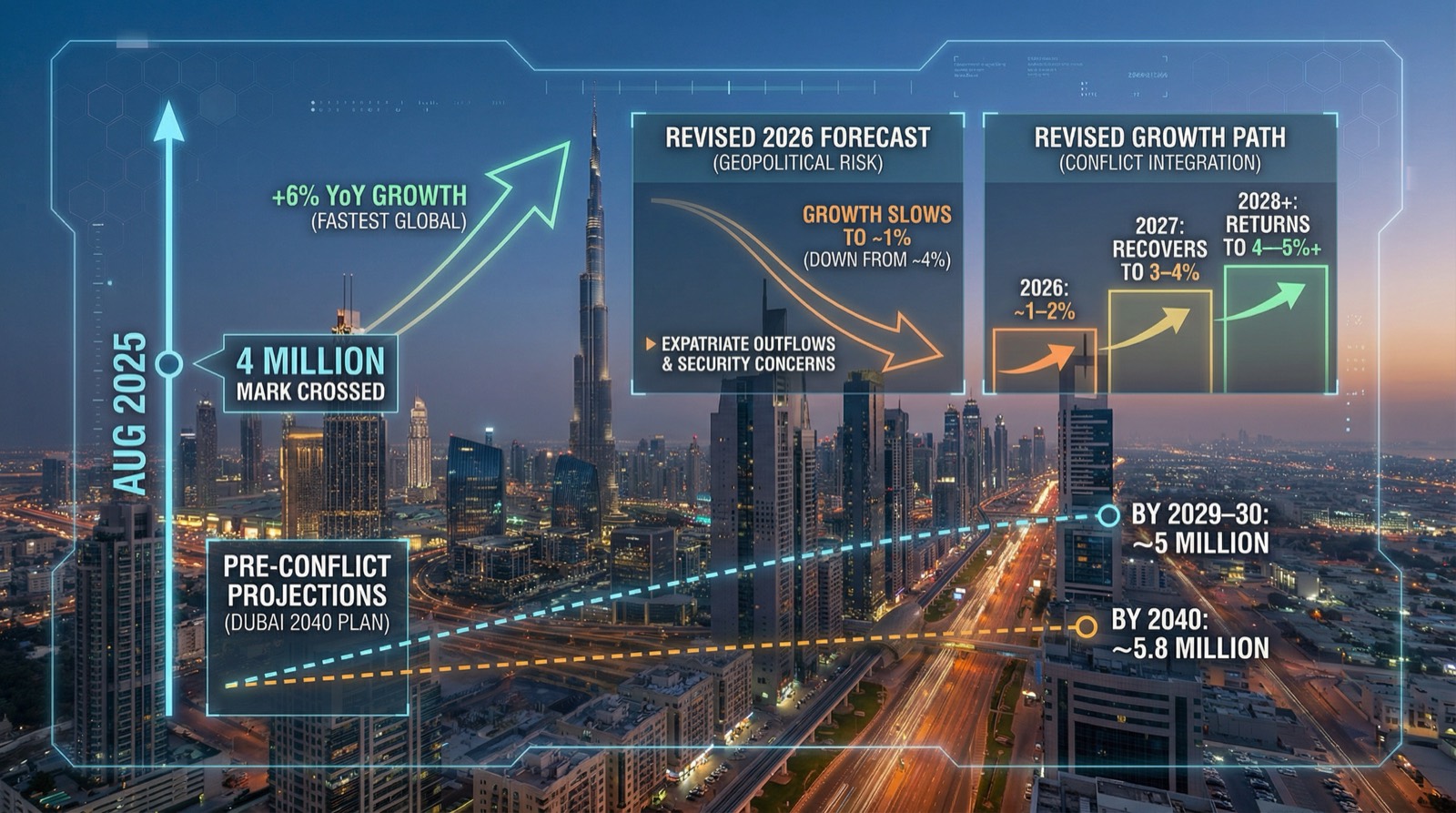
Dubai crossed the four million population mark in August 2025, according to official emirate records published by The National. In the years leading up to that milestone, the city was expanding at approximately 6% year-on-year — one of the fastest growth rates of any major global city.
Prior to the escalation of the Iran conflict, consensus projections pointed to a population of around five million by 2029–2030, and approximately 5.8 million by 2040, broadly aligned with the planning assumptions underpinning the Dubai 2040 Urban Master Plan.
The Iranian strikes have introduced a degree of uncertainty into those projections. Analysts at Citi have revised Dubai’s population growth forecast for 2026 down from approximately 4% to closer to 1%, reflecting concerns around expatriate outflows and a potential slowdown in inbound migration driven by shifting security perceptions.
This represents a meaningful adjustment to the forecasts and warrants careful, objective analysis rather than dismissal.

To understand where we might be heading, it helps to be precise about where we were. Dubai’s population trajectory coming into 2026 was exceptional by any global benchmark. The National’s August 2025 report confirmed the four million milestone, with the emirate having added hundreds of thousands of residents in the preceding three years through a combination of natural growth, skilled worker migration, and high-net-worth inflows attracted by the Golden Visa programme and broader residency reforms.
Demographic modelling projected Dubai’s population at approximately 4.22 million in 2026, rising to 4.46 million in 2027, 4.72 million in 2028, 4.95 million in 2029, and 5.15 million by 2030 — implying annual growth rates of roughly 4–6% throughout the second half of the decade. These projections were based on assumptions of sustained employment growth, business expansion under D33, and continued inbound migration from South Asia, Europe, the Middle East, and East Asia.
The Dubai 2040 Urban Master Plan’s longer-range targets of 5.8 million residents by 2040 have been consistently referenced in municipal planning documents and were supported by substantial infrastructure investment commitments. These are not aspirational targets, but working assumptions around which schools, hospitals, transport networks, and housing supply are being planned.
The revision from 4% to 1% growth in 2026 — Citi’s bearish-scenario forecast — reflects two potential channels of population impact. First, expatriate outflows: residents who feel uncertain or whose employers relocate operations may leave. Second, a slowdown in inbound migration, as those planning to move to Dubai defer decisions until the security outlook becomes clearer.
It is worth being honest about what I am seeing on the ground. Some residents in my network have had conversations about contingency plans. A small number of families have decided to relocate temporarily. But the overwhelming majority of the people I know here — residents of many nationalities, across different income levels, with families and businesses — are staying. I am among them. I live here with my family of five, my children are in school (albeit remotely), and my businesses are running. We feel safe, have total belief in the government, and no intention of leaving.
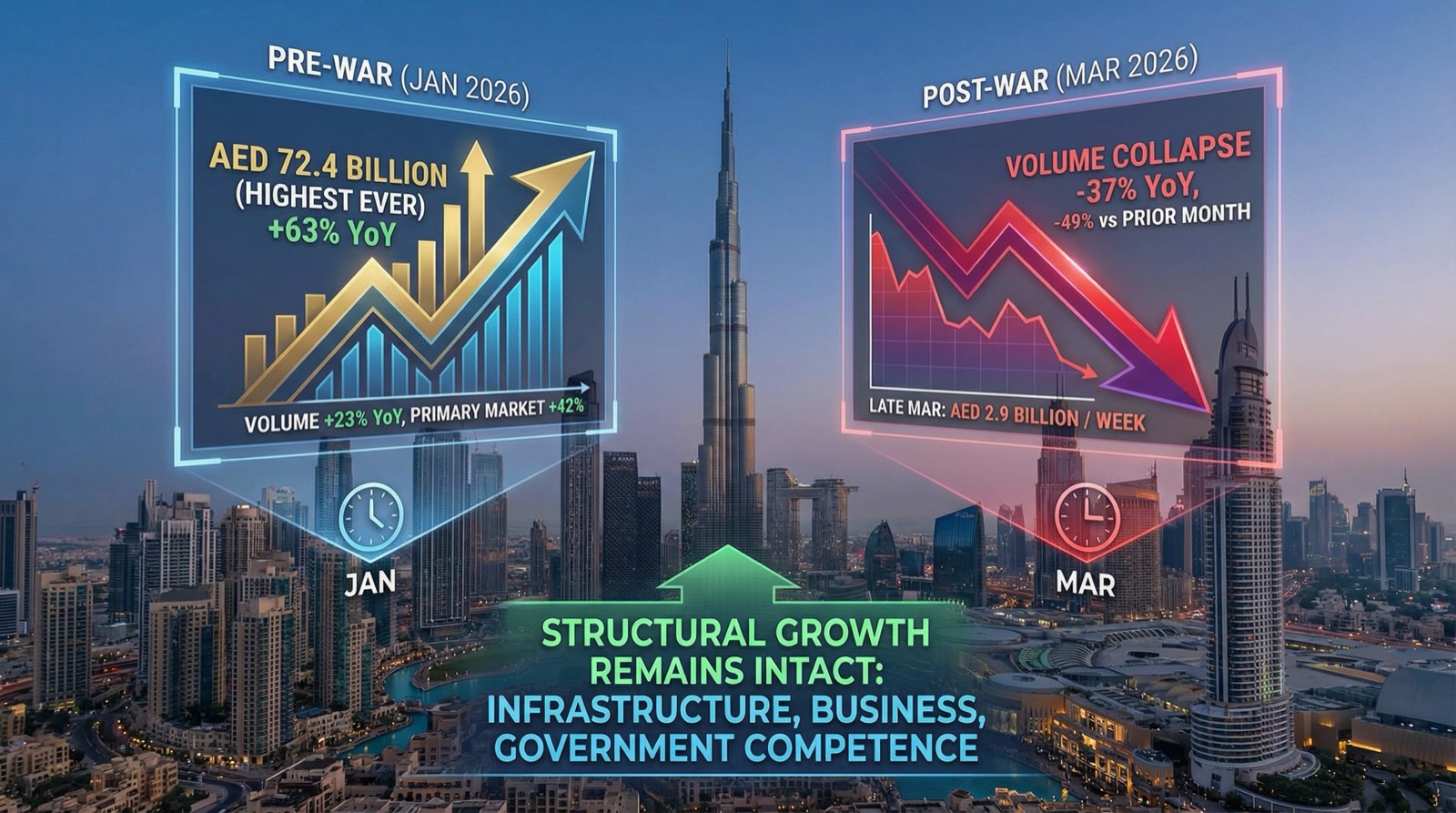
The UAE government has handled the geopolitical situation with the level of competence and measured response that inspires confidence among long-term residents.
The assessment that expatriates may flee Dubai assumes a level of panic that I simply do not observe in daily life here. International media coverage has, in my view, significantly overstated the fear on the ground. What I do observe is a short-term pause in new arrivals and some increased enquiries about contingency destinations, which is rational and proportionate given the uncertainty. That is not a population exodus; it is a temporary slowdown in inbound momentum.

The key question for long-term population forecasts is not whether the 2026 growth rate temporarily slows — it almost certainly will. The key question is whether the fundamental reasons people choose to move to Dubai have changed. I do not believe they have.
The reasons Dubai attracts migrants are structural and enduring: zero personal income tax; one of the world’s most connected airports; high-quality infrastructure and healthcare; access to a dynamic, internationally connected business ecosystem; political stability relative to most alternatives in the broader region; a legal framework that respects private property rights and business contracts; and a forward-thinking government that has consistently delivered on its promises and demonstrated capacity to manage crises. None of those fundamentals has changed because of the Iran strikes.
The Golden Visa programme — which expanded business ownership rights for foreign nationals — along with initiatives such as the digital nomad and retirement visas, all remain firmly in place and continue to attract high-quality, high-income migrants who drive demand at the upper end of the property market.
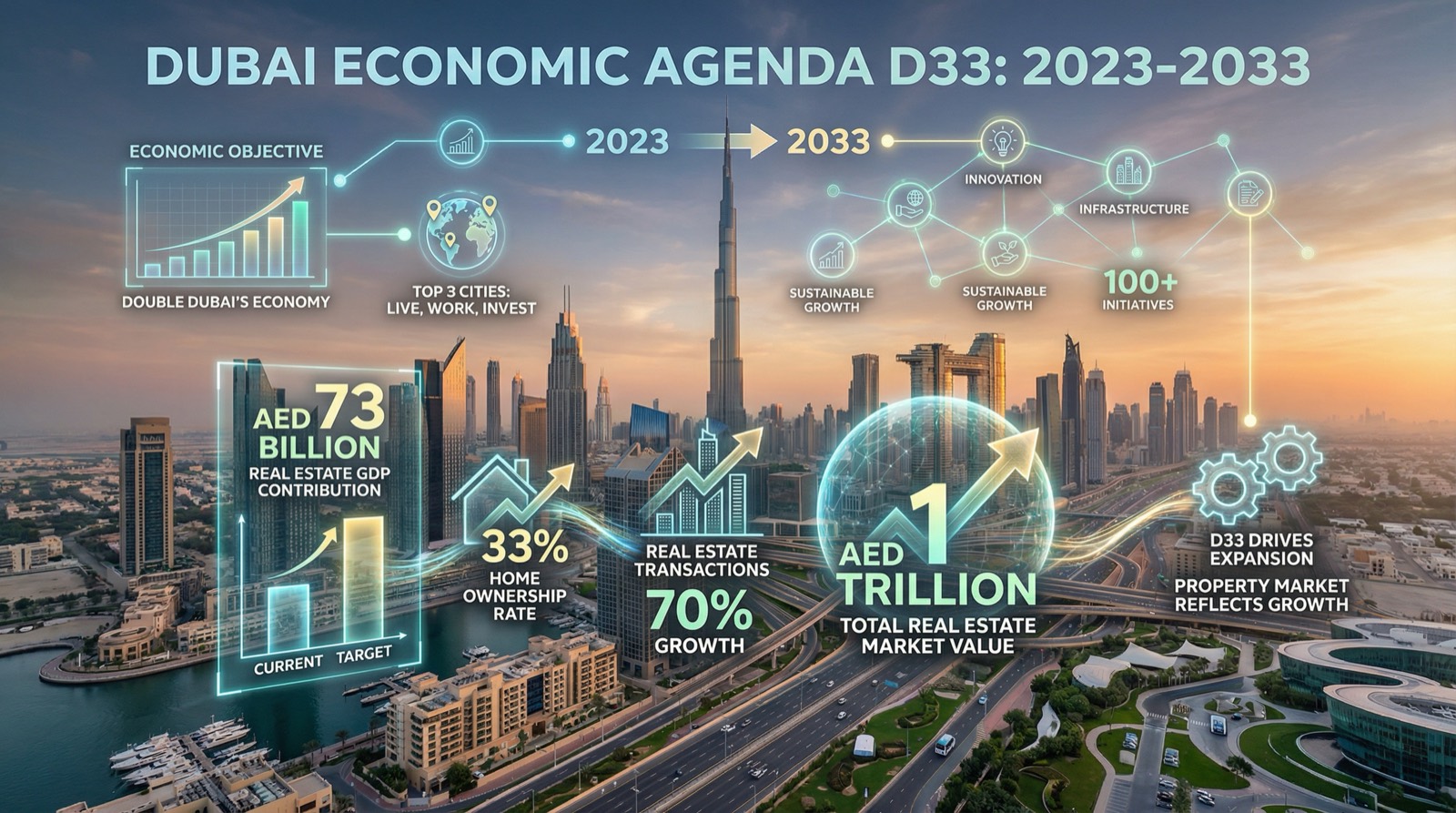
D33’s job creation targets, if delivered, will continue to attract skilled workers from across the globe. These pipelines do not switch off overnight because of geopolitical headlines.
Even under a moderately bearish population scenario — say 1–2% growth in 2026, recovering to 3–4% from 2027 onwards — the long-term absorption capacity of Dubai’s property market remains substantial. With approximately 131,000 new units forecast for delivery in 2026, the combination of population growth, replacement demand, investor activity, and second-home ownership suggests the market remains broadly capable of absorbing this supply over a 2–3 year period.
The implication for property investors is nuanced. A 2026 population growth slowdown — from 6% to 1% — applied to a base of four million people still adds approximately 40,000 new residents.
Those residents need housing. They also need offices, schools, healthcare, and retail — all of which generate demand across the commercial and mixed-use property spectrum. A slowdown is not a reversal. And if the conflict de-escalates, as I believe it ultimately will, the returning momentum could be sharp.
I have watched Dubai’s population grow from under one million when I first arrived to over four million today. I have seen it absorb the 2008 crash, the 2015–16 oil price shock, and Covid-19 — each of which triggered predictions of mass emigration that ultimately did not materialise at the scale feared. Each time, the city’s underlying attractiveness as a place to live, work, and do business reasserted itself more strongly than the shock itself.
The Iran war presents a more direct challenge than previous cycles because it tests the safe-haven perception itself. But I am not relocating my family, and I am not moving my capital. That is not bravado — it is informed conviction built over 19 years of living and operating in this market. The government remains capable, the city continues to function, and the long-term drivers remain intact.
My revised Dubai population growth forecast 2026, integrating the current geopolitical risk, is as follows: 2026 growth slows to approximately 1–2%, recovering to 3–4% in 2027 and returning to 4–5%+ from 2028 onwards as the conflict either resolves or the market adapts.
Under this trajectory, Dubai still reaches five million residents by 2030–2031 — perhaps one to two years later than the pre-war baseline, but not fundamentally derailed. The 5.8 million by 2040 target remains achievable.
For property investors with a time horizon beyond 18 months, the Dubai population growth dynamic — and the demand it underpins — remains one of the most compelling among major global markets. The disruption in 2026 is real, but it represents a phase within a longer trajectory, not a reversal of it.
Next step
Talk to Mitchells
Tell us what you are weighing up — a building, a project, an area, or a rule you need to get right — and we will come back with the specifics that apply to it.

Stephen James Mitchell is a licensed real estate broker with over 25 years of experience across finance, investment strategy, and real estate, including more than 19 years operating in Dubai. He specialises in advising investors on acquiring and optimising high-performing assets, with a focus on commercial and investment-grade real estate, combining strong financial expertise with deep, on-the-ground market knowledge of the UAE.
To connect directly with Stephen James Mitchell, please click here.
Published 1 April 2026 by Stephen James Mitchell MBA. Market figures quoted reflect the data available at that date.