If you’re looking at how to buy property in Dubai as a foreign investor, the process itself is relatively straightforward. Where I see things go wrong—and where I spend most of my time advising clients—is in how that process is executed.
Over the past 19+ years operating in Dubai, I’ve seen investors generate strong returns here. I’ve also seen others underperform, not because the market didn’t move, but because they entered deals without a clear structure, misunderstood pricing dynamics, or underestimated how important liquidity is when it comes to exiting.
In this guide, I’ll walk you through exactly how I approach this with clients. Not just the steps, but how to execute each one properly and where the real risks sit.
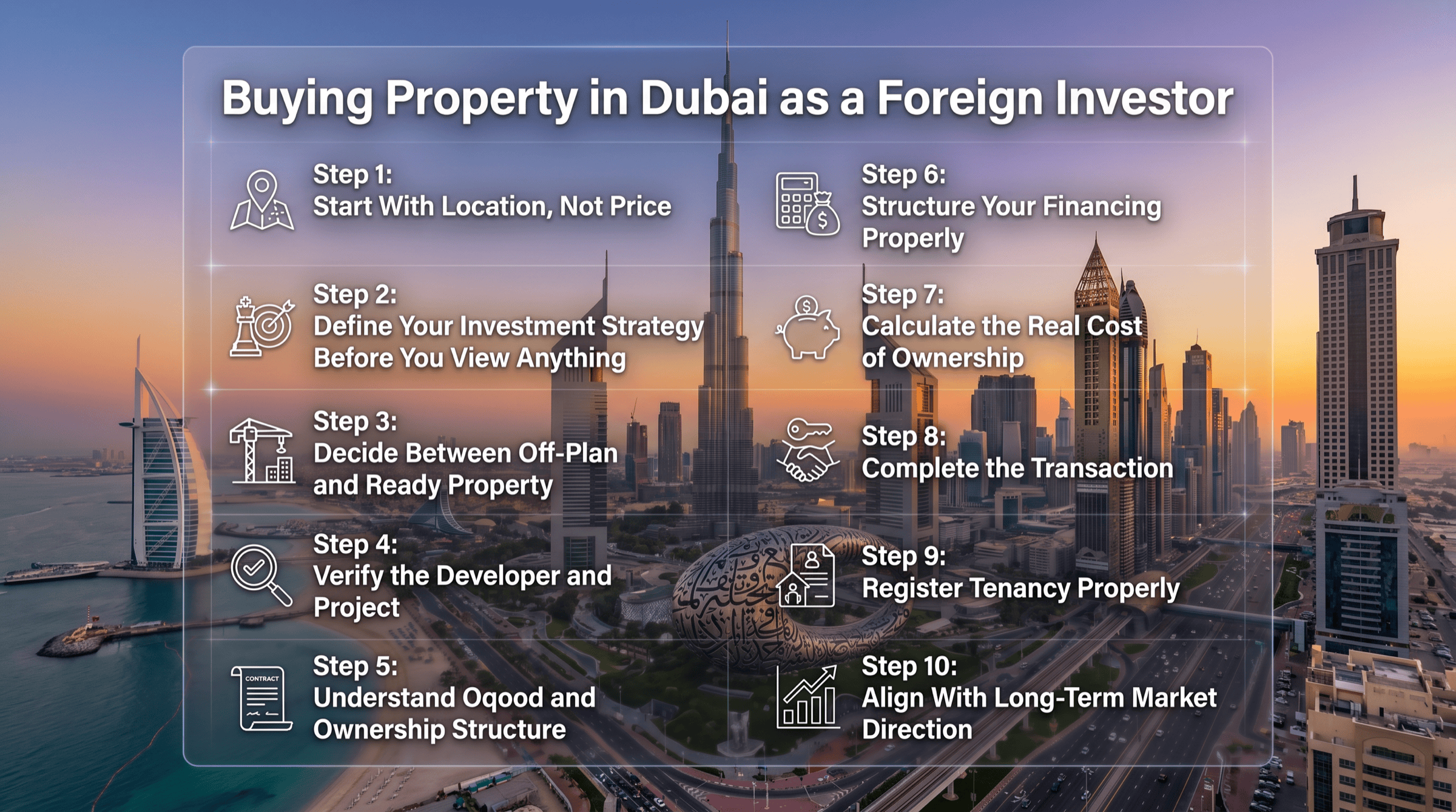
The first thing I always advise is to start with the location, not the property itself.
As a foreign investor, you can only purchase property in designated freehold areas. That’s the legal framework. From an investment perspective, however, what matters is where demand actually exists.
Areas such as Dubai Marina, Downtown Dubai, Dubai Hills Estate, and Palm Jumeirah consistently perform because they have depth—both in rental demand and resale liquidity. That depth is what protects your downside and gives you flexibility on exit.
A common mistake I see is investors focusing on price per square foot. On paper, a cheaper unit in a weaker or oversupplied area can look attractive. In practice, it often leads to lower rental demand and slower resale.
To verify ownership zones and project registration, you can check directly through the Dubai Land Department.
Before I look at a single property, I want clarity on what we’re trying to achieve.
Broadly, I break this into three approaches.
If the focus is income, we prioritise rental yield and tenant demand. If the focus is capital appreciation, we look at supply pipelines and future demand drivers. A balanced approach sits somewhere in between.
The mistake I see repeatedly is investors trying to achieve all three without defining priorities. That usually leads to compromise—buying something that doesn’t maximise yield and doesn’t have a strong upside either.
When I work with clients, we define the objective first, then filter every opportunity through that lens. This also determines whether we should be looking at off-plan opportunities or completed assets.
This is one of the most important structural decisions.
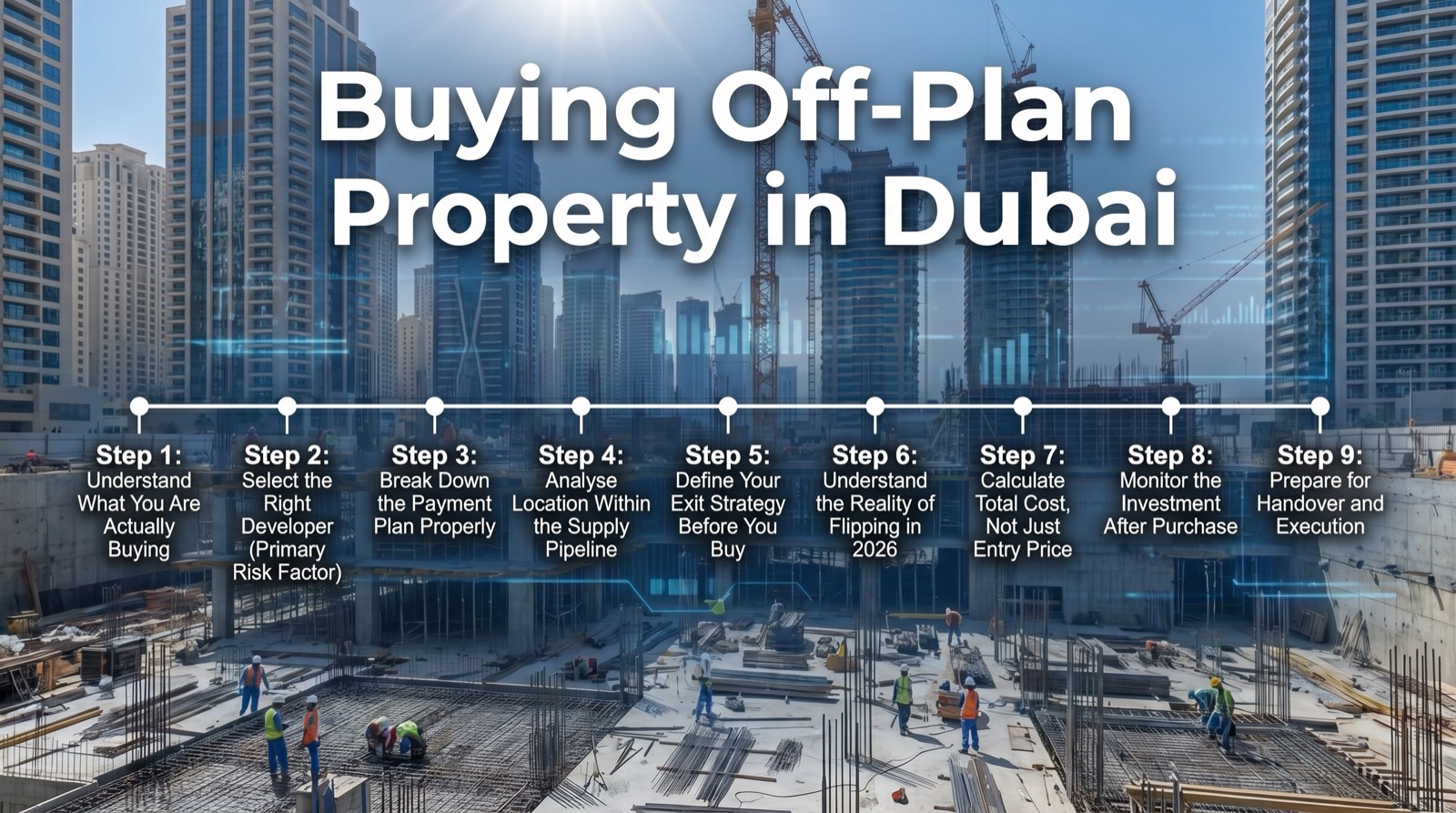
Off-plan property allows you to buy before completion, typically with staged payment plans. This can be an effective way to deploy capital over time and potentially benefit from price appreciation before handover.
However, in my experience, off-plan only works well if you have a clearly defined exit strategy before committing.
You need to decide whether you plan to sell before completion, hold and rent after handover, or refinance and hold long term. Without that clarity, you are relying on market timing.
With ready property, the dynamics are different. You are buying into a functioning market with real rental data and comparable sales. You can generate income immediately, and pricing is more transparent.
There is no universally better option. The key is alignment with your strategy.
If you are buying off-plan, this is where I slow the process down.
The first step is to confirm that the project is registered with the Dubai Land Department.
The second is to ensure that all payments are made into a regulated escrow account. This means your funds are released in stages as construction progresses.
The third is to assess the developer’s track record. Delivery history, build quality, and market reputation all matter.
You can cross-check project data using the Dubai REST platform.
I have seen investors skip this step because they assume regulation removes all risk. It does not. It reduces risk, but execution still matters.
If you are buying off-plan, your ownership is recorded through the Oqood system.
Oqood is your interim ownership record. The title deed is issued once the property is completed.
This distinction is important. I have seen investors assume they hold full ownership immediately after signing, which is not the case.
Ensuring Oqood registration is completed gives you formal recognition of your ownership within the system.
If you are considering financing, the key question is not just whether you can obtain a mortgage—it is whether it improves your position.
Non-resident investors can access mortgages in Dubai, typically with stricter criteria and lower loan-to-value ratios.
In some cases, leverage enhances returns. In others, the cost of borrowing reduces net performance.
This should be aligned with your broader capital strategy. If you are building a portfolio, how you allocate financing across assets matters.
Interest rates are influenced by the Central Bank of the UAE.

One of the most common issues I see is investors focusing purely on purchase price.
In Dubai, you need to account for:
- A 4% transfer fee payable to the Dubai Land Department
- Registration and administrative costs
- Ongoing service charges
Service charges cover maintenance, security, and shared facilities. These directly affect your net rental yield.
Two properties with similar prices can produce very different returns once these costs are factored in.
Still reading
Need expert help on this subject?
For ready property, ownership is transferred through the Dubai Land Department.
This involves signing the sale agreement, completing payment, and registering the transfer through an authorised trustee office. Once completed, a title deed is issued.
For off-plan property, you sign directly with the developer, and ownership is recorded through Oqood until completion.
The regulatory framework is overseen by RERA.
If you plan to rent the property, tenancy must be registered through Ejari.
Ejari formalises the lease and ensures it is legally enforceable.
Without it, tenants cannot activate utilities, disputes become harder to resolve, and your position as a landlord is weakened.
Dubai’s long-term development strategy is outlined in the Dubai 2040 Urban Master Plan.
This provides visibility on infrastructure expansion, population growth, and future demand corridors.
In my experience, the strongest investment outcomes come from positioning ahead of demand, not reacting to it.
The patterns are consistent.
Buying based on price instead of demand is one of the biggest mistakes. It often leads to weaker rental performance and slower resale.
Another is entering off-plan deals without a defined exit strategy.
Finally, underestimating costs—particularly service charges—can erode returns over time.
These are execution issues, not market issues.
In closing
Final Thoughts
Buying property in Dubai as a foreign investor is not complicated, but it does require structure.
If you approach this with a clear framework, you improve your ability to make consistent decisions and manage risk effectively.
If you do not, you are relying on the market to compensate for poor planning.
That is not a strategy I would recommend.
Frequently asked questions
0601Can foreigners fully own property in Dubai?
Yes, within designated freehold areas.
02Do I need to be in Dubai to buy?
No, transactions can be completed remotely.
03Is off-plan property safe?
Generally, yes, but developer selection remains critical.
04What are the main costs?
DLD fees, registration costs, and service charges.
05Can non-residents get mortgages?
Yes, but with stricter criteria.
06How long does the process take?
2–6 weeks for ready property, longer for off-plan.
Next step
Talk to Mitchells
Tell us what you are weighing up — a building, a project, an area, or a rule you need to get right — and we will come back with the specifics that apply to it.

Stephen James Mitchell is a licensed real estate broker with over 25 years of experience across finance, investment strategy, and real estate, including more than 19 years operating in Dubai. He specialises in advising investors on acquiring and optimising high-performing assets, with a focus on commercial and investment-grade real estate, combining strong financial expertise with deep, on-the-ground market knowledge of the UAE.
To connect directly with Stephen James Mitchell, please click here.
Published 25 January 2026 by Stephen James Mitchell MBA. Market figures quoted reflect the data available at that date.