Dubai real estate is showing early signs of recovery, although the rebound remains highly selective. Rental enquiries climbed 40% month-on-month, transaction activity surpassed AED 6 billion in a single day, and Dubai Holding completed a major ownership consolidation involving Emaar.
The price index continues to decline, but at a much slower pace than in March. Capital is flowing back into specific communities and product types rather than the broader market.
If you’re reassessing your positioning in this market, I can show you where risk-adjusted opportunities are emerging. Click here to speak with me directly.
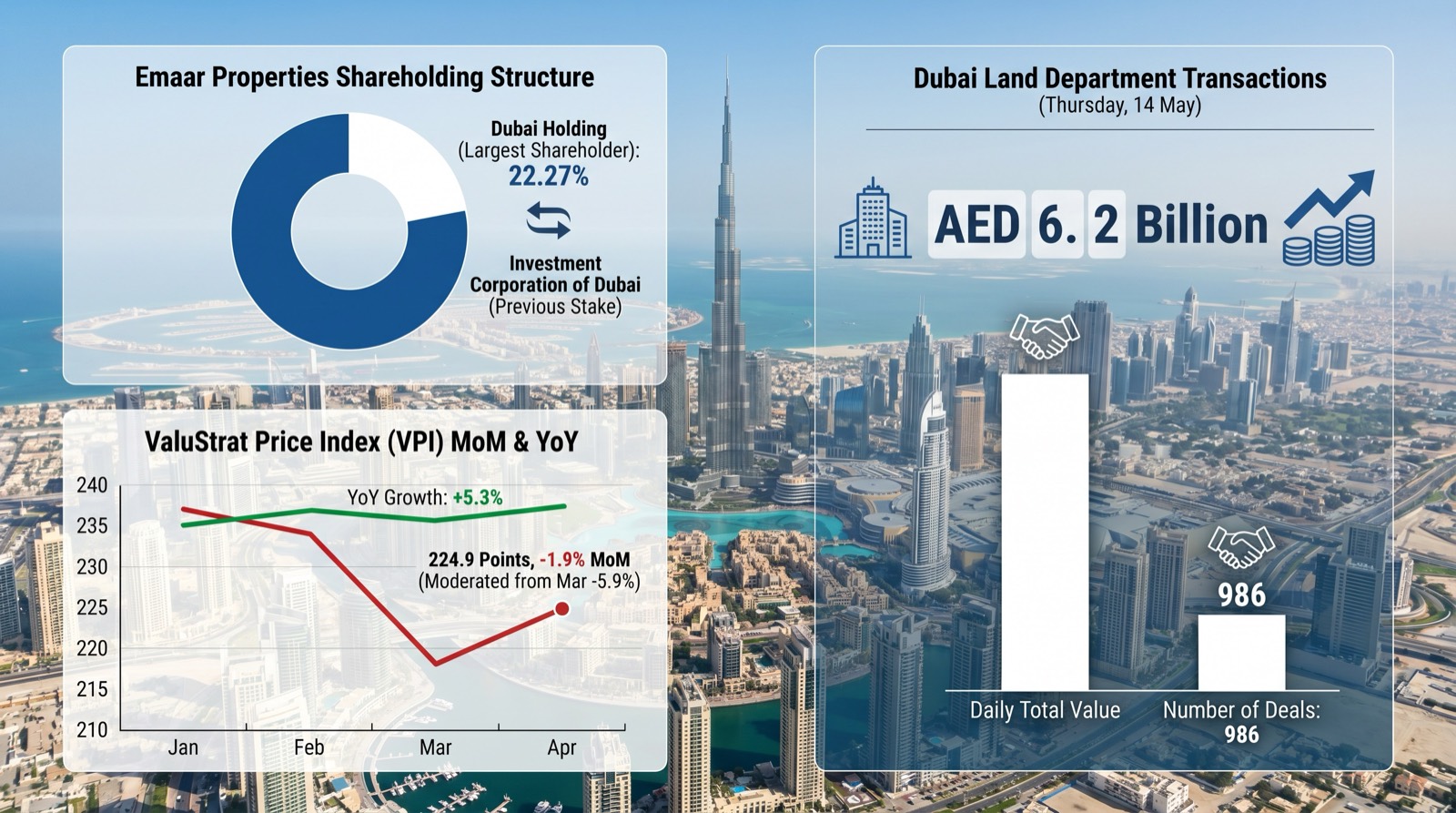
The ValuStrat Price Index fell 1.9% MoM to 224.9 points in April — the second consecutive monthly decline, but a sharp moderation from March's 5.9% drop.
YoY growth remains positive at 5.3%. Villas held up better: villa values are still up 8.3% YoY, apartments only 0.5% ahead.
| Segment | Leaders (YoY) | Laggards (YoY) |
|---|---|---|
| Villas | Jumeirah Islands +24.5%, The Meadows +14.9%, Emirates Hills +14.6%, Palm Jumeirah +12.3% | International City -1.6%, Arabian Ranches 2 -1.1%, Victory Heights -1.0% |
| Apartments | Dubai Silicon Oasis & Remraam +12.4%, DIFC +10.0%, JVT +7.8%, Dubai Sports City +7.6% | Burj Khalifa -10.4%, JBR -5.9%, Town Square -4.3% |
Community-level dispersion is what matters now. Jumeirah Islands (+24.5% YoY), The Meadows (+14.9%), Emirates Hills (+14.6%), and Palm Jumeirah (+12.3%) lead the villa segment.
Dubai Silicon Oasis and Remraam (both +12.4%) and DIFC (+10%) are still expanding on the apartment side, while Burj Khalifa (-10.4%), JBR (-5.9%), and Town Square (-4.3%) are correcting.
Off-plan registrations rose 4% MoM, but ready home transactions fell 43.8% YoY. The market is splitting by community, product type, and developer.

Dubai Land Department recorded AED 6.2 billion of transactions on Thursday, 14 May alone, across 986 deals, including:
- 805 sales worth AED 2 billion
- 145 mortgage transactions
- 27 gift transactions worth AED 440 million
Notable individual transactions included:
- An AED 56 million off-plan apartment in Palm Jumeirah
- An AED 48 million apartment at Jumeirah Asora Bay
A single-day transaction volume at this scale — with mortgage and gift activity running alongside outright sales — confirms financing pipelines, family-office transfers, and institutional acquisitions are all still functioning.
Aldar acquired an AED 1.1 billion (USD 272 million) Dubai Studio City development from SRG, comprising 312 homes across six mid-rise buildings scheduled for completion in 2028.
The project is being developed as a build-to-rent asset rather than a build-to-sell scheme. It adds to Aldar’s managed rental portfolio alongside its DIFC office tower, Sheikh Zayed Road Grade A asset, and Dubai South logistics holdings.
Aldar also launched Al Ghadeer Gardens, a 437-unit villa and townhouse community located on the Abu Dhabi–Dubai border near Expo City Dubai, Palm Jebel Ali, and Al Maktoum International Airport, with sales beginning on May 18.
Abu Dhabi-based developers and investment groups are continuing to increase their exposure to income-generating assets in and around Dubai, a pattern that other major regional players are likely to follow.
Betterhomes data showed that tenant enquiries rose 40% between March and April, marking the sharpest monthly recovery since the conflict began.
Available rental inventory increased from just over 1,000 units at the start of March to nearly 2,200 by the end of April, while around 70% of listings recorded price adjustments averaging just under 10%.
The enquiry-to-listing ratio sits at 6.6, down from 10 pre-conflict but still indicating a demand surplus.
Sales enquiries are around 30% below year-ago levels but stabilising, and mortgage brokers report a buildup of buyers waiting on agreements in principle — a latent-demand indicator that typically precedes a sales recovery by 8–12 weeks.

The UAE wellness real estate sector reached USD 14.6 billion in 2025, up from USD 3.3 billion in 2017, per the Global Wellness Institute.
The segment now represents more than 12% of all UAE construction, with over 555,000 wellness-focused units in the pipeline across the UAE and Saudi Arabia.
GWI’s review of more than 300 studies found that wellness-positioned properties command price premiums of 10–25%, reflecting measurable resale value and sustained international demand rather than simple marketing positioning.
Still reading
Need expert help on this subject?
Data from Luxury Price Drops, which tracks around 27,000 live listings, shows that roughly one in ten Dubai sellers has reduced asking prices since the conflict began.
The cuts now total AED 1.7 billion (USD 463 million) across more than 2,800 properties, including more than 500 price reductions recorded within a single week.
The largest price reductions are concentrated in off-plan properties held by leveraged investors facing upcoming payment-plan obligations. Secondary villas in communities such as Arabian Ranches and La Mer have recorded multiple consecutive price cuts, including one La Mer property that was reduced from AED 110 million to AED 85 million.
Emaar founder Mohamed Alabbar told Bloomberg TV that customer requests for payment-plan extensions increased from around 825 in December to approximately 1,050 during the conflict period, before easing to around 735 by early May.
Smaller developers have generally been less flexible on payment restructuring, contributing to the resale pressure now emerging across the off-plan market.
Click here to explore current distress opportunities and discounted market entries.
Two transactions highlighted where buyer depth remains strongest. Boli, the UAE’s first fully digital property auction platform, sold a 1,753 sq. ft. apartment in City Walk within seven days after launching with a no-reserve opening bid of AED 500,000 and live international bidding through to close.
The transaction marked the UAE’s first regulated end-to-end digital property auction, bringing Dubai’s auction infrastructure closer to more mature UK and Australian market models.
In JVC, IMAN Developers sold out Oxford Cove, a 247-apartment project valued at AED 300 million, within two hours of launch.
The rapid sell-out demonstrates that well-located, mid-market projects with accessible pricing and flexible payment structures continue to see exceptionally strong demand, even as luxury off-plan resale stock faces increasing pressure.
In closing
Final View for Dubai Property Investors
Liquidity is returning selectively rather than evenly across the market. Prime villa communities, end-user mid-market projects, and institutional rental assets continue to attract capital, while leveraged off-plan resales and secondary apartment stock in weaker locations remain under pricing pressure.
The 40% rebound in rental enquiries and the AED 6.2 billion in transactions recorded by the DLD in a single day point to functioning demand and financing activity.
At the same time, AED 1.7 billion of active asking-price reductions confirms that pricing pressure remains elevated across stressed inventory.
Selectivity by community, developer, and product type is now the decisive variable — not market timing.
Next step
Let’s Talk
If you’d like to unpack where the most resilient opportunities are emerging — in stabilised residential areas or income-generating commercial zones — I’d be happy to share a focused, data-driven shortlist based on your investment goals.
📞 No pressure, no sales pitch—just a focused, informed conversation about your investment goals.
Published 18 May 2026 by Stephen James Mitchell MBA. Market figures quoted reflect the data available at that date.