April transaction volumes recovered after March's geopolitical disruption, but the underlying signals are mixed. ValuStrat recorded Dubai's first quarterly decline in residential capital values since 2020, and CBRE Q1 data confirms pricing momentum has moderated.
At the same time, institutional capital continues to commit to commercial real estate — particularly offices, where supply remains structurally constrained. The gap between a repricing residential market and a supply-tight commercial sector is widening, and the data now rewards selectivity over speed.
If you’re reassessing your positioning in this market, I can show you where risk-adjusted opportunities are emerging. Click here to speak with me directly.
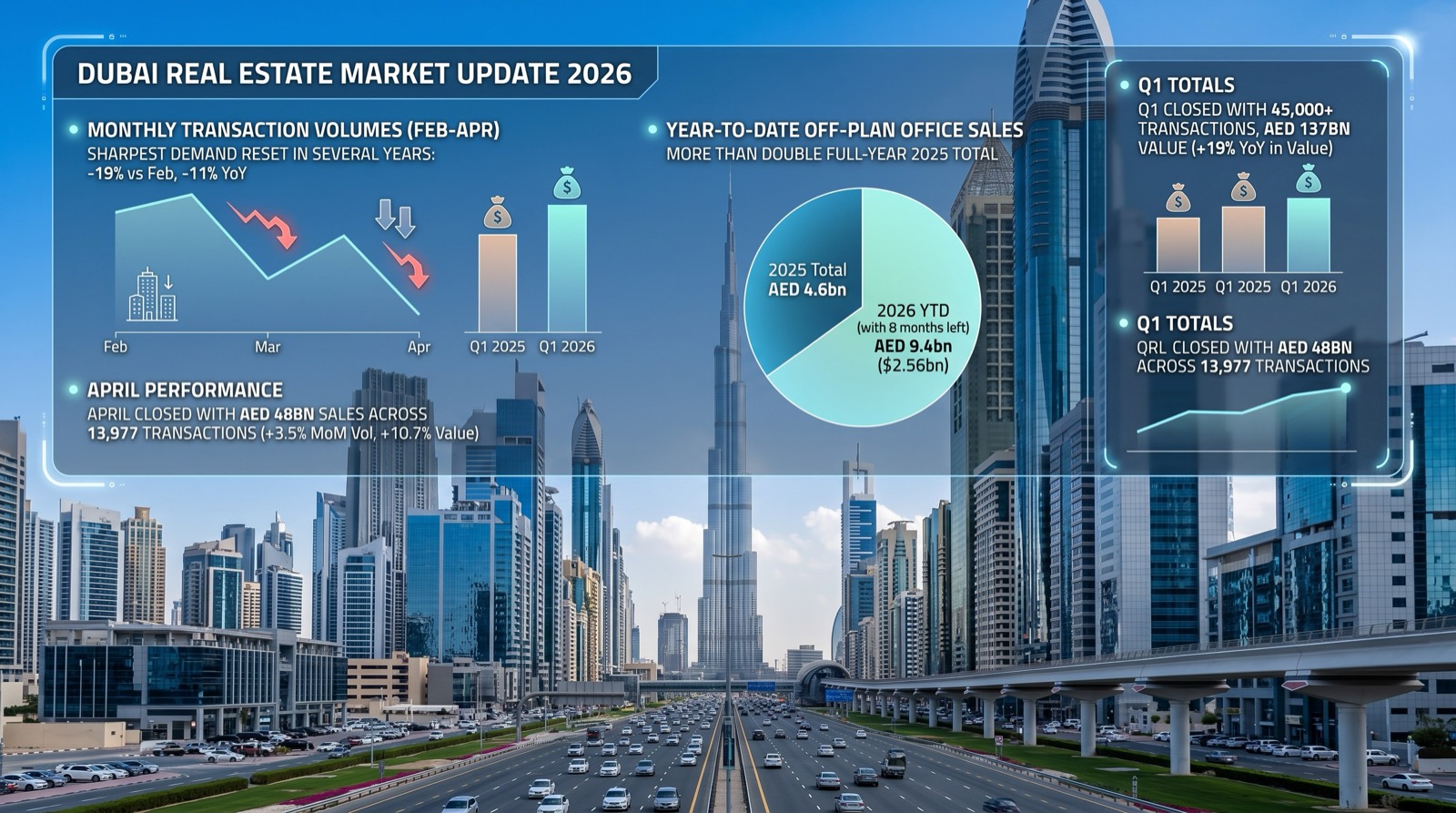
The Iran conflict, which began on 28 February, had a clear impact on Dubai's March property market after a strong start to the quarter. According to CBRE's Q1 2026 report, transaction volumes fell 19% against February and 11% year-on-year in March, while off-plan secondary sales dropped more than 40% in a single month as investors paused during the escalation.
Developers also sharply reduced launches, with new supply falling from a January-February run rate of 25,600 units to just 6,300 in March. Residential price growth moderated to 9.1% year-on-year from 12.9% previously, while rental growth slowed to 4.1%. Despite the March slowdown, Q1 still closed with more than 45,000 transactions worth AED 137bn, up 19% year-on-year in value.
Read the full report: CBRE Q1 2026 Report
The broader economic backdrop reflected the same pressure. The IMF revised UAE 2026 GDP growth projection down to 3.1% from 5.0%, citing the impact of Strait of Hormuz disruption and a 1.9 percentage point downward adjustment relative to October 2025 projections, with a recovery to 5.3% projected for 2027.
Even so, S&P reaffirmed the UAE's AA/A-1+ sovereign rating in March, supported by strong fiscal buffers and the Central Bank's AED 1 trillion asset base. The ultra-luxury segment also remained active throughout Q1, recording more than 800 transactions above US$5m worth AED 26bn.
Overall, the data points to a market that slowed materially during the regional disruption, while liquidity and transaction activity remained more concentrated in core and ultra-prime segments.
ValuStrat's Price Index for residential capital values fell 3.8% in Q1 2026 to 229.2 points— the first quarterly contraction since 2020 — while remaining up 8.9% year-on-year. Average villa values are at AED 13.6m (+12.1% YoY), apartments at AED 1.85m (+3.9% YoY).
Ready home transactions fell 8.1% YoY and 16.4% quarter-on-quarter. Off-plan registrations rose 12% annually but fell 17.9% versus Q4 2025. Rental growth has flattened: +4.2% YoY, but essentially flat quarter-on-quarter, suggesting affordability is now binding for tenants.
With ~130,000 units projected for delivery in 2026 (only 7,400 were completed in Q1), supply will be the dominant variable for the rest of the year.
April closed with AED 48bn in sales across 13,977 transactions(fäm Properties data). Volumes rose 3.5% month-on-month, value up 10.7%. The primary market drove the activity: 10,563 deals worth AED 35.8bn, versus 3,414 resale deals at AED 12.2bn. Apartments led at AED 24.1bn (11,377 deals), plot sales jumped 34.7% to AED 6.6bn, and commercial transactions reached AED 4bn across 561 deals.
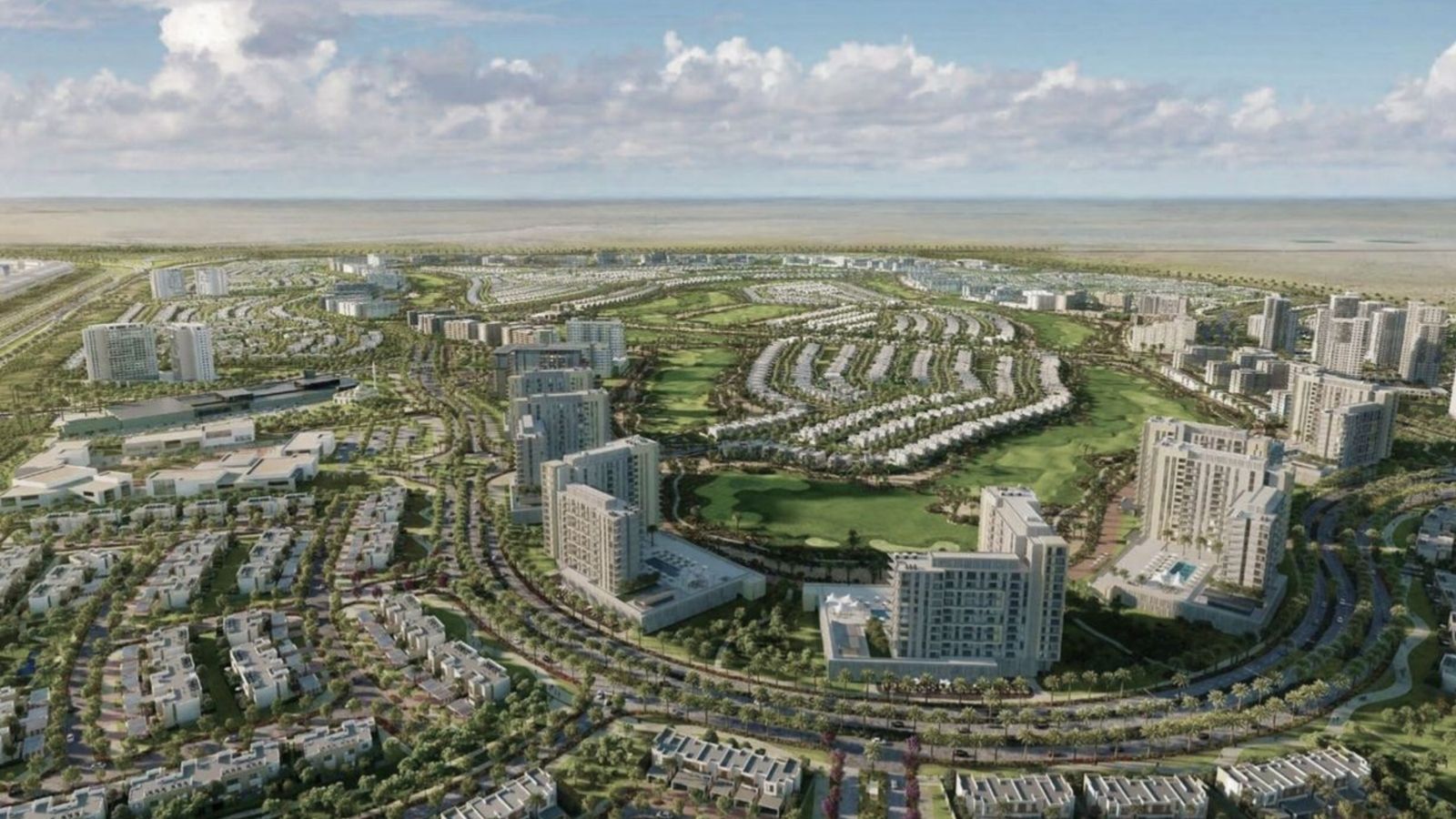
Top-performing areas included:
- Dubai South (1,171 transactions worth AED 2.7bn, marking the second consecutive month as the market’s most active area)
- Jebel Ali First
- Al Barsha South Fourth
- Dubai Islands (AED 2.8bn in total transactions)
The AED 1m–2m segment accounted for 34.7% of all transactions, while properties below AED 1m represented 23.3% of activity. Transactions above AED 5 million made up around 12% of the market. Average pricing reached AED 1,840 per sq. ft., up 16.1% year-on-year, although the pace of price growth continues to moderate.
| Period | Value | Transactions |
|---|---|---|
| January 2026 | AED 2.4bn ($653m) | 414 |
| February 2026 | AED 2.7bn ($735m) | 355 |
| March 2026 | AED 1.3bn ($354m) | 182 |
| April 2026 | AED 3.0bn ($817m) | 318 |
| YTD Jan-Apr 2026 | AED 9.4bn ($2.56bn) | 1,269 |
| Full-Year 2025 (comparison) | AED 4.6bn ($1.25bn) | 1,412 |
The clearest sign of where institutional and corporate confidence sits is in the office market. Off-plan office sales hit AED 3bn ($817m) in April across 318 deals — a record monthly high. Year-to-date off-plan office sales of AED 9.4bn ($2.56bn) are already more than double the full-year 2025 total of AED 4.6bn, with eight months still to run.
Business Bay led with AED 2.8bn across 158 deals. This is structural, not cyclical: Grade A office availability remains tight, occupier demand is strong, and corporates are pre-committing to space well ahead of delivery. For investors who do not yet hold commercial exposure, the supply-demand imbalance is now too clear to ignore.
Explore curated office and retail opportunities at Mitchell’s Commercial Realty.
Canada's Brookfield and Kuwait's Alshaya Group recently announced a real estate joint venture to develop a 480,000 sq. ft. mixed-use commercial asset in Dubai Hills, comprising offices, residential units, and retail. Alshaya — which operates 70 brands across 4,000 stores — will establish its new UAE office there. Brookfield Properties will be development and asset manager.
Brookfield manages $16bn in regional assets and has steadily increased UAE exposure (the 2025 $1bn Lunate JV; the prior ICD Brookfield Place stake sale).
Importantly, this commitment was announced amid the Iran conflict, not before it — a credible institutional vote on Dubai's medium-term fundamentals.
A new analysis of 1.1 million DLD transactions by fäm Properties found that 42% of buyers from 2014 still hold their property 11 years later, 53% from 2017 still hold after eight years, and 61% of 2022 buyers still hold after three years. Of all post-2012 primary market purchases, 69.9% have never been resold.
That puts Dubai broadly in line with US homeowner tenure (11–12 years) and UK turnover (~4% per year). The structural shift is real — Golden Visa, off-plan buyer protections, and infrastructure expansion across districts like Dubai South, Creek Harbour, and Dubai Islands have changed the mix from speculative flippers to long-term holders.
For yield-focused investors, a longer-tenured owner base also means a more stable transaction pipeline and less forced supply during downturns.
Still reading
Need expert help on this subject?
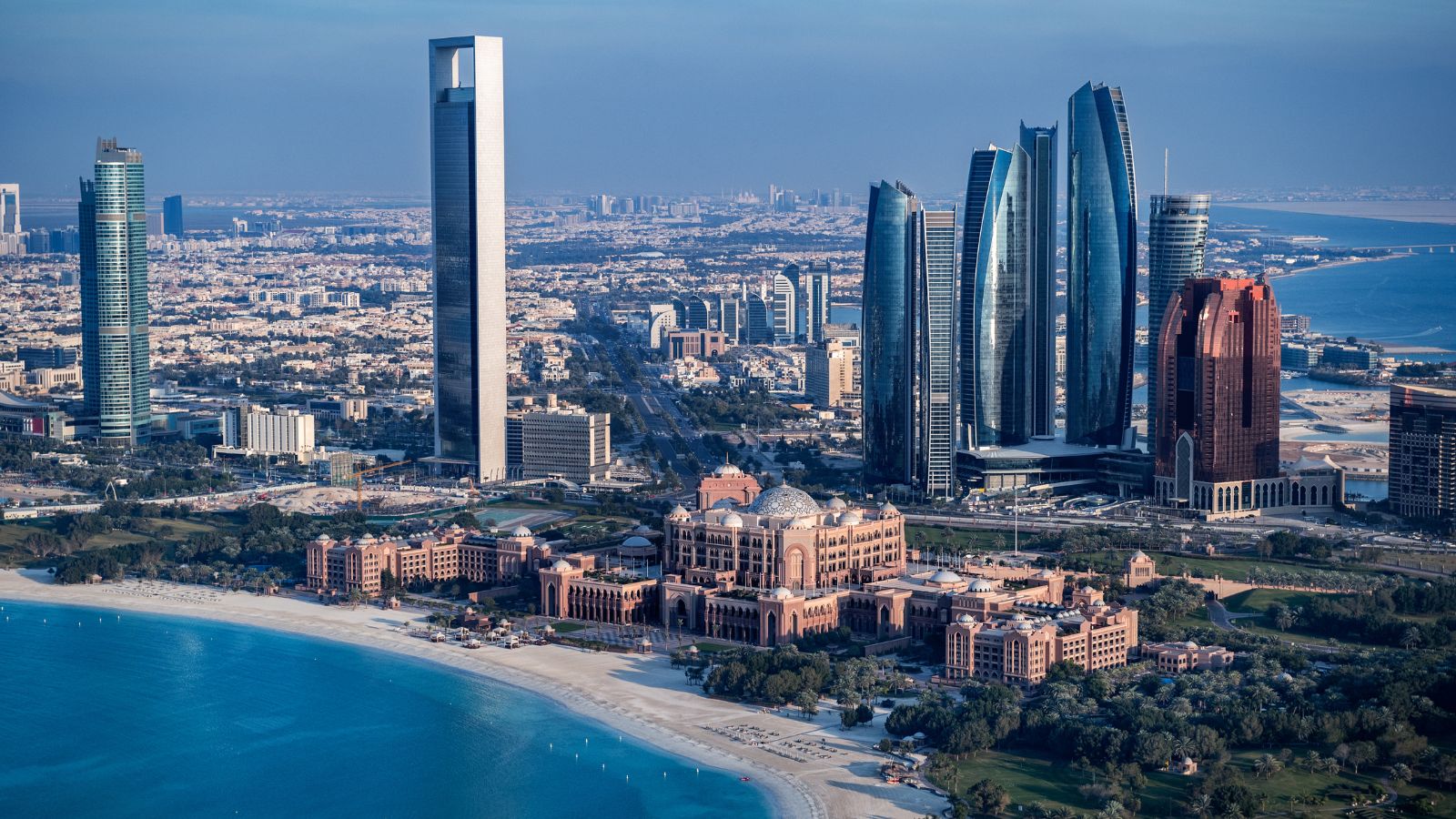
Abu Dhabi's Q1 VPI reached 148 points, up 17.8% year-on-year, though most of that gain was registered before 28 February. The cleaner read on current conditions comes from April, with Adrec recording 3,200+ transactions worth AED 13bn+. Roughly 90% of listings showed no price change or increases, and where reductions occurred, 85–90% were under 10%.
New April launches included Aldar's Yas Park Place, Sobha City Abu Dhabi, and Ohana's Manchester City Yas Residences. With Abu Dhabi's prime PSF still well below Dubai's, the capital remains a different entry point for long-cycle capital.
The Make it in the Emirates summit closed with AED 171bn ($46.56bn) in announced deals, including AED 48.5bn in new investment commitments and a forward procurement pipeline expanded to AED 180bn over the next decade. Industrial GDP contribution has now reached AED 200bn, while industrial exports total AED 262bn, including AED 92bn in advanced exports.
For real estate, thiscontinues to support long-term demand for staff housing, logistics assets, warehousing, and supporting commercial infrastructure across the UAE.
In banking, the CBUAE has now extended AED 6.2bn ($1.69bn) in loan deferrals, interest relief, and fee waivers to 65,000+ customers under the wartime resilience package. Between 1 March and 1 May, banking sector assets increased 2.1%, loans rose 3.2%, deposits grew 1.9%, and FX reserves remained above AED 1 trillion.
Despite the regional disruption, liquidity conditions and refinancing capacity across the banking system have remained stable.
Fitch warned that smaller UAE developers could face liquidity pressure if the Iran conflict continues. Hormuz disruption is raising pre-development costs, GCC debt costs are at five-year highs, and bank appetite for smaller projects has tightened.
Fitch has placed Binghatti and Omniyat on sector ratings watch — both maintain strong escrow positions, but their sukuk slipped into distress in late March before recovering.
Separately, Wynn Resorts confirmed a "modest delay" to the opening of the $5.1bn Wynn Al Marjan Island project, which had originally been scheduled for March 2027. Wynn has now invested approximately $1bn into the development.
The revised timeline appears linked to scheduling and construction sequencing rather than any reduction in commitment to the project itself. For Ras Al Khaimah real estate, the delay slightly pushes back the expected tourism and pricing catalyst tied to the resort’s opening.
In closing
Final View for Dubai Property Investors
The market is recalibrating, not contracting. Residential pricing has softened off pre-war highs, but Q1 transaction values still closed up 19% year-on-year, and April volumes rebounded.
Institutional capital — Brookfield, Aldar, Modon — continues to commit through the cycle, holding periods are lengthening, and the office market remains in genuine excess demand.
Risk is concentrated in over-leveraged smaller developers and fringe-location off-plan stock rather than in the core.
For investors with cash and a five-year-plus horizon, entry terms are more negotiable than they have been at any point in the past three years.
Next step
Let’s Talk
If you’d like to unpack where the most resilient opportunities are emerging — in stabilised residential areas or income-generating commercial zones — I’d be happy to share a focused, data-driven shortlist based on your investment goals.
📞 No pressure, no sales pitch—just a focused, informed conversation about your investment goals.
Published 11 May 2026 by Stephen James Mitchell MBA. Market figures quoted reflect the data available at that date.