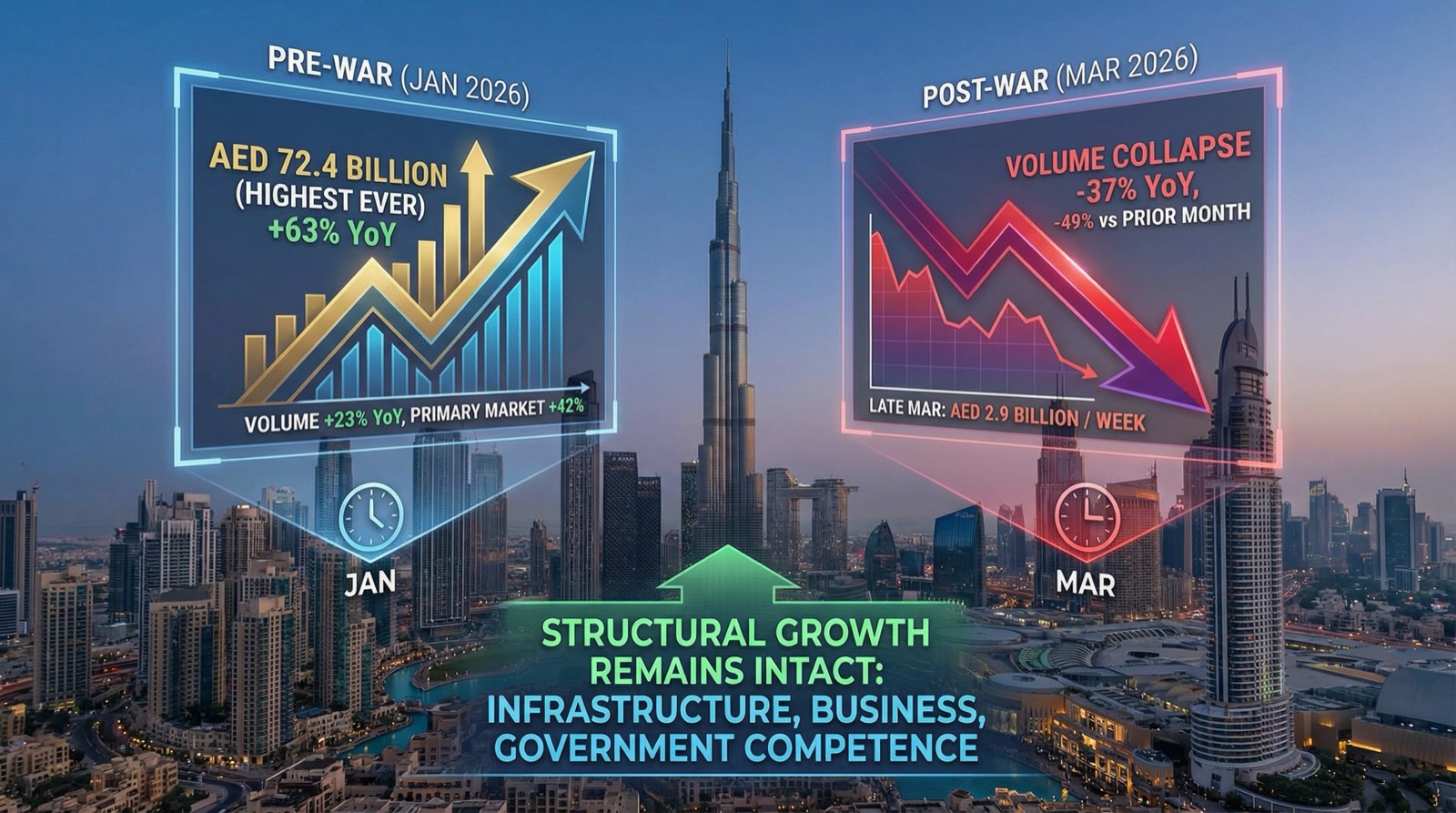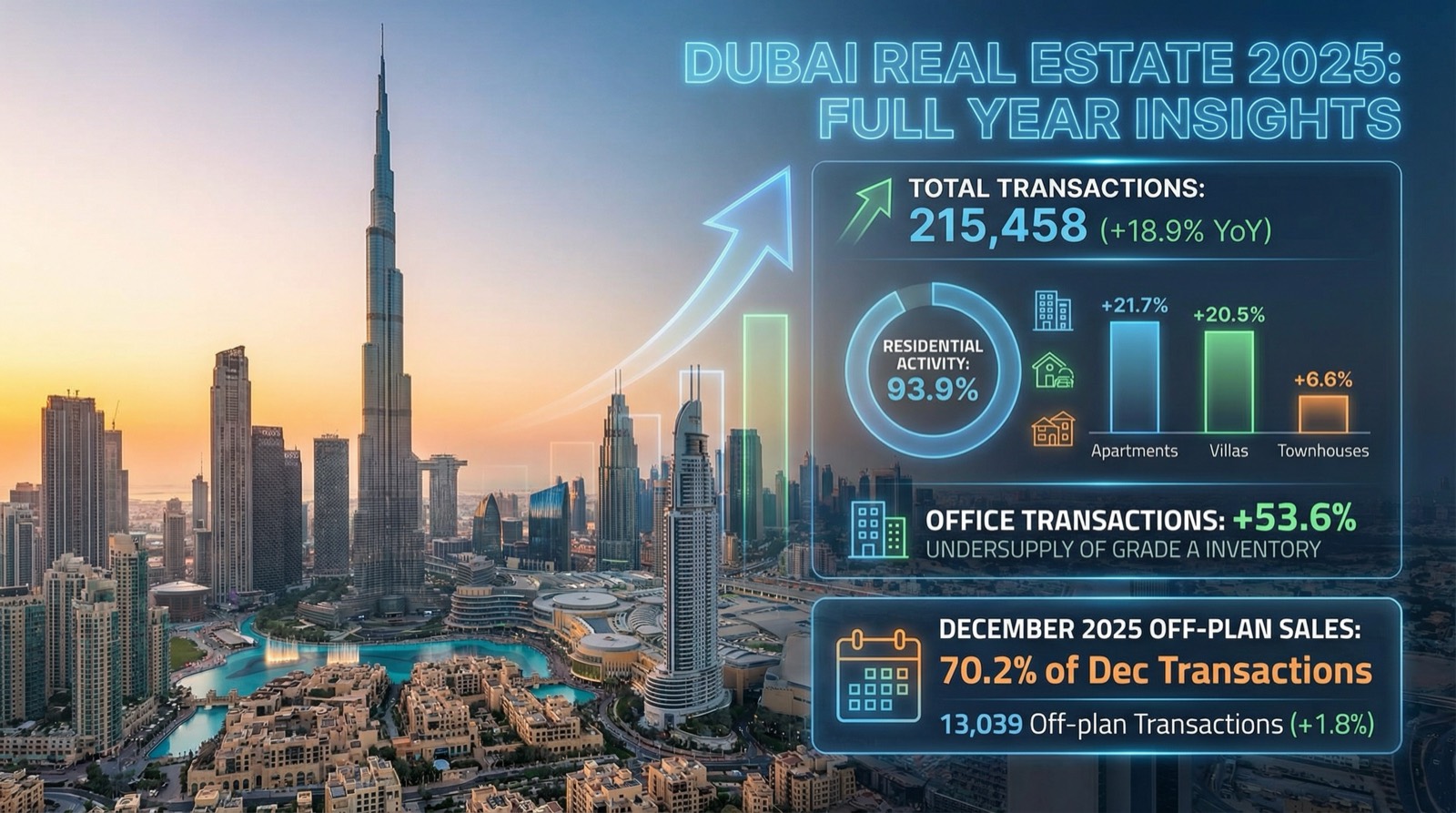
Dubai’s real estate market is expected to remain in an expansionary phase in 2026, but with more moderate, selective growth than in the 2020–2025 surge, and with clear outperformance in offices and certain commercial segments over mainstream residential. Investors should also pay close attention to Abu Dhabi, where a strong 2025 and a large off‑plan pipeline point to a meaningful upswing in 2026.
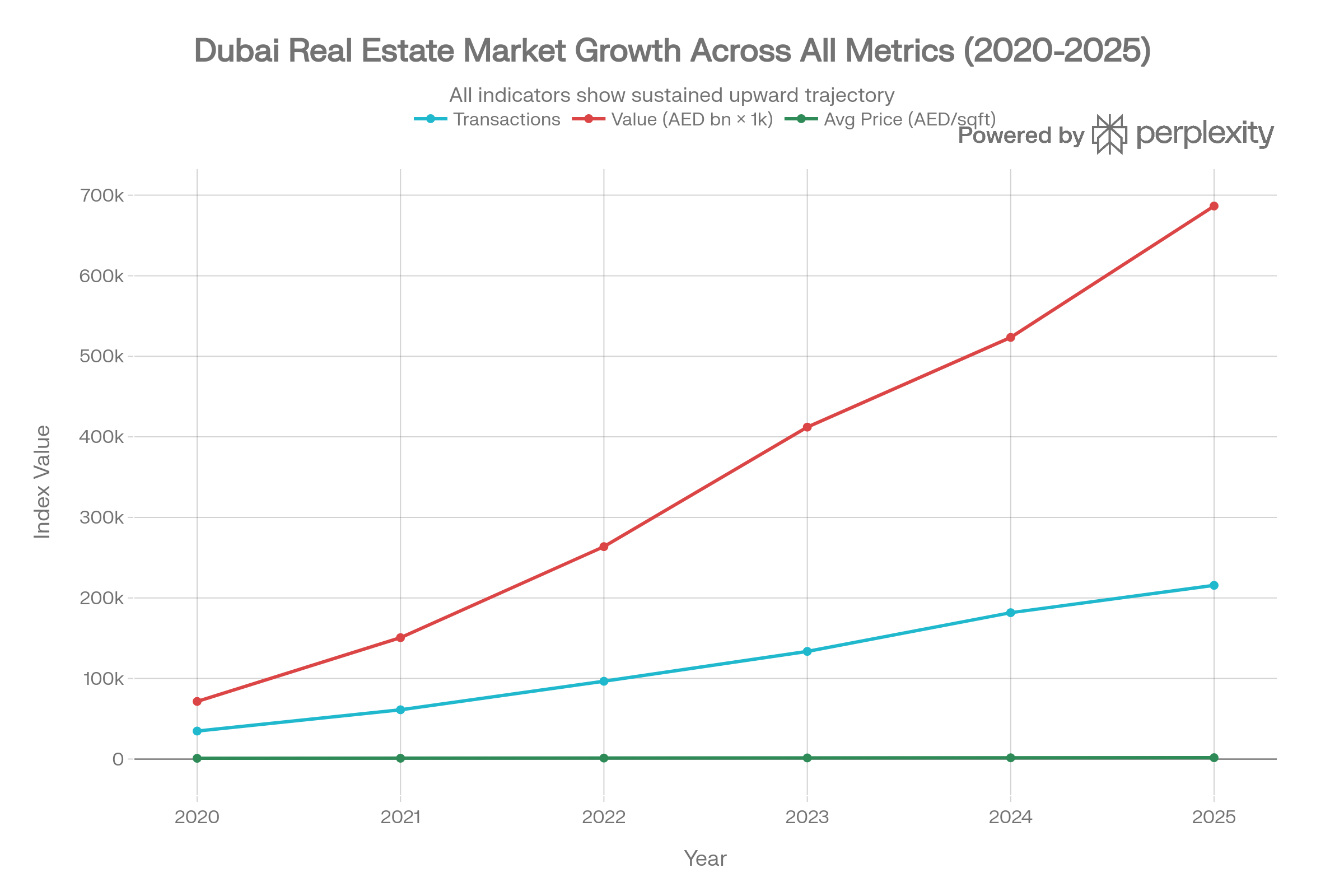
Dubai’s 2020–2025 cycle was characterized by a powerful, broad‑based expansion in transaction volumes, total values, and achieved prices per square foot. The data below provides the starting point for thinking about how 2026 is likely to evolve.
Market metrics by year
| Year | Transactions (number) | Transaction value (AED billion) | Avg price (AED/sq ft) |
| 2020 | 34,737 | 71.5 | 917.7 |
| 2021 | 61,124 | 150.7 | 992.4 |
| 2022 | 96,534 | 263.7 | 1,201.2 |
| 2023 | 133,643 | 412.1 | 1,370.6 |
| 2024 | 181,689 | 523.5 | 1,529.1 |
| 2025 | 215,671 | 686.6 | 1,656.5 |
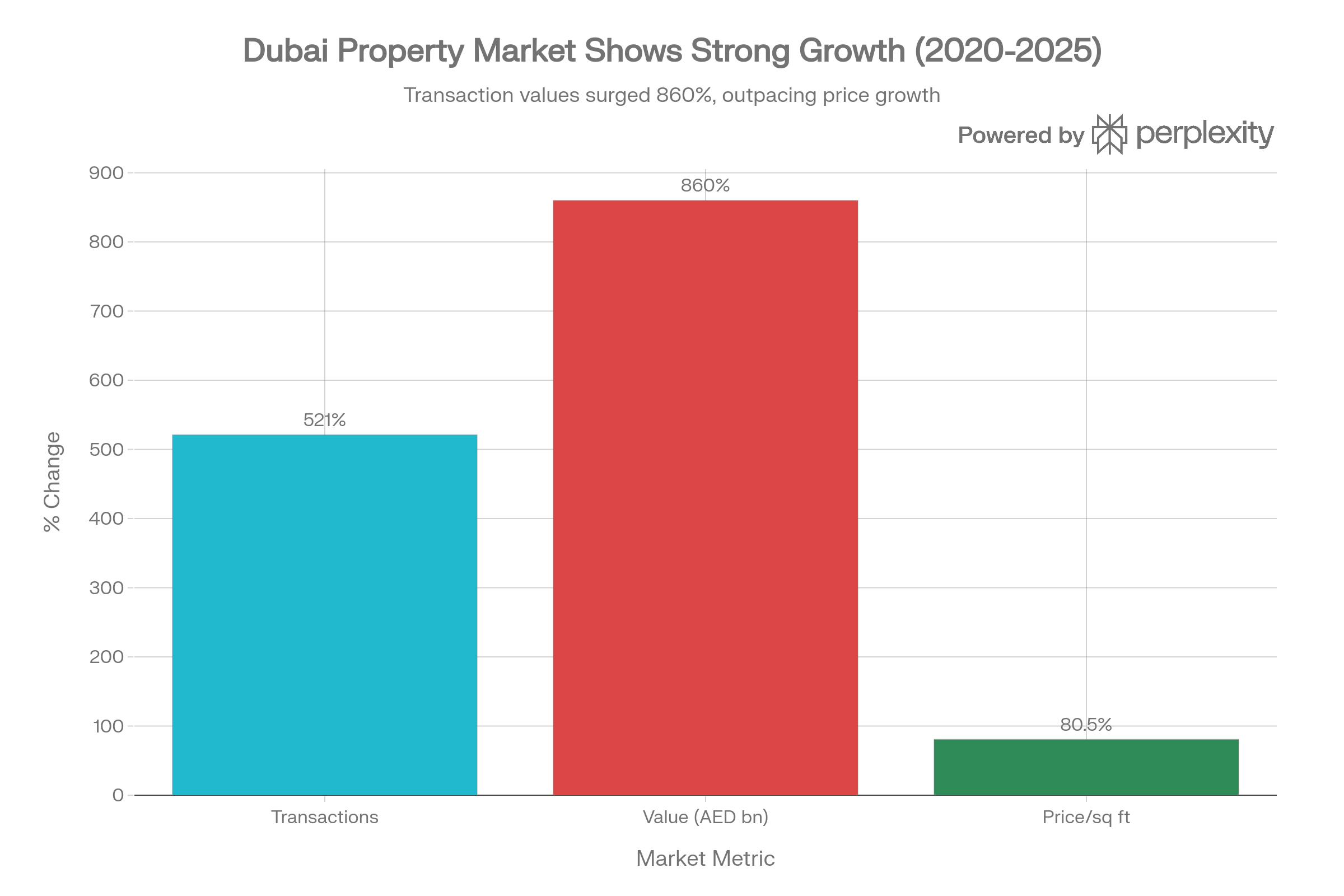
Summary: Between 2020 and 2025, transactions rose 521%, total value 860%, and average price per square foot 80.5%, signalling a sustained multi‑year upcycle rather than a short‑lived rebound.
In 2025, the UAE market entered 2026 with momentum still intact, underpinned by population growth, inflows of global talent, and regulatory stability that helped the market absorb new supply while maintaining pricing strength. Market behaviour also became more discriminating, with buyers placing more emphasis on quality, delivery certainty, and developer credibility, a pattern consistent with a maturing, not overheating, cycle. Against that backdrop, 2026 forecasts for Dubai point to continued growth, but at lower, more sustainable rates, and with bigger gaps between asset classes.
External forecasts indicate that overall Dubai property prices are expected to rise in 2026, but more slowly than in the recent peak years. Residential prices are forecast to grow around 10% in 2026, roughly half the pace of 2025, indicating a transition from surge to stability rather than a downturn. Within residential, villas and townhouses are projected to rise by about 17.7%, while apartments are expected to grow by around 7.4%, reflecting stronger demand for larger, higher‑quality stock.
On the commercial side, office capital values and rents are forecast to increase by roughly 15% in 2026, outpacing both villas and apartments and reinforcing offices as the top‑performing segment. This is driven by sustained corporate expansion in sectors such as finance, technology and professional services, combined with a shortage of new Grade A space in established business districts. Overall, the outlook suggests a more selective market where not all segments rise equally, and where location, quality and asset type will matter more to returns than in the initial post‑Covid rebound.
The 2020–2025 figures can be used to frame realistic expectations for 2026 performance and risk.
Aggregate growth over the period
| Metric | 2020 value | 2025 value | Change 2020–2025 |
| Transactions | 34,737 | 215,671 | +521% |
| Transaction value (AED billion) | 71.5 | 686.6 | +860% |
| Avg price per sq ft (AED) | 917.7 | 1,656.5 | +80.5% |
Summary: The steepest gains came in aggregate value, reflecting both higher volumes and higher prices; this underscores a demand‑driven upcycle and explains why forecasters now anticipate more moderate, differentiated growth rather than a new acceleration.
From an investment standpoint, three points follow for 2026:
- The “easy” phase of the cycle is behind us. After an 860% increase in transaction value over five years, double‑digit gains in 2026 should not be extrapolated as a repeat of the prior period.
- Value will be created more through asset selection than broad beta. Forecasts already show diverging growth paths between offices, villas, and apartments, and this dispersion is likely to widen.
- Liquidity depth is supportive but may normalise. The surge in transaction numbers implies a much deeper market than in 2020, but as the cycle matures, time‑to‑sell and negotiation dynamics may shift in favour of more price‑sensitive buyers.
Oil, macro shocks, and why correlation can mislead
The 2014–2024 data window suggests that simple correlations between Brent crude and Dubai property prices can be distorted by global shock periods. Post‑Covid liquidity and reopening, as well as the Russia‑Ukraine war, moved multiple asset classes together, but often for different underlying reasons. In the post‑Covid phase, for example, ultra‑loose global liquidity and reopening effects supported risk assets broadly, including real estate. In the Russia‑Ukraine period, oil rose on supply disruptions and sanctions, while Dubai property was propelled more by capital inflows, relocations, and safe‑haven positioning than by oil revenue itself.
Qualitative indicators around oil and macro shocks
| Aspect | Description in article |
| Data window | DXBInteract compared average Brent prices and Dubai price/sq ft from 2014–2024. |
| Overall correlation | Relationship appears modest and is influenced by global shock periods rather than direct causation. |
| Distortionary periods | Post‑Covid recovery; Russia‑Ukraine war period. |
| Post‑Covid dynamics | Liquidity, reopening and mobility lifted multiple asset classes at once. |
| Russia‑Ukraine dynamics | Oil moved on supply disruption and sanctions, while Dubai property rose on capital inflows and relocations. |
| Main point | Synchronized moves reflect shared macro regimes, not oil directly setting property prices. |
Summary: For 2026, oil remains a background factor in the macro mix, but the evidence suggests it is not a reliable, linear driver of Dubai housing valuations; investor focus is better placed on demand, capital flows and policy.

Supply, construction costs, and how prices actually clear
Narratives that link cheaper oil to cheaper construction, and therefore lower Dubai home prices, rest on a cost‑plus view of pricing that does not match how the market typically operates. In practice, the market clears at the intersection of demand and available stock, with developers adjusting margins, incentives and launch timing far more readily than base list prices in response to input cost changes. Lower costs can make certain projects viable, shape future supply or widen developer margins, but they do not automatically reset the prices at which current inventory sells.
Market structure and pricing drivers
| Topic | Article’s characterization |
| Oversupply + cheaper energy view | Claims cheaper construction should lower home prices. |
| Market pricing mechanism | Described as primarily demand‑led, not cost‑plus. |
| Impact of lower input costs | Benefits flow mainly to developer margins, incentives, or launch timing, not automatic price cuts. |
| Effect on future supply | Lower costs can shape future projects but do not reset current clearing prices. |
Summary: For 2026, investors should be cautious about simple “oil down = prices down” logic; capacity for developers to absorb cost shifts and vary product, payment plans and phasing makes demand the dominant price determinant.
Structural demand drivers: why momentum can persist
Forward‑looking drivers now outweigh oil in explaining Dubai’s pricing and volume dynamics:
Core demand‑side factors
| Factor | Role in the cycle |
| Population inflows and wealth migration | Support sustained end‑user and investor demand. |
| Residency‑linked demand and policy clarity | Encourage long‑term commitments from buyers and investors. |
| Global liquidity and interest‑rate conditions | Shape the availability and cost of capital for buyers and developers. |
| Market segmentation (location, quality) | Concentrates demand in specific areas and asset types. |
| Safe‑haven positioning amid geopolitics | Channels regional and global capital into Dubai. |
Summary: For 2026, these structural demand pillars align with what UAE‑wide market commentators describe as “resilience anchored in fundamentals” and a more mature, quality‑conscious buyer base.
5.1 Residential (apartments, villas, townhouses)
- Apartments: Forecast price growth of about 7.4% in 2026, slower than in recent years, suggests an environment where investors must focus on micro‑location, building quality, service levels, and service‑charge efficiency rather than expecting uniform uplift.
- Villas and townhouses: Expected to grow around 17.7% in 2026, supported by continued demand for space, lifestyle‑oriented communities, and limited prime supply in established areas.
- Off‑plan vs ready: Sector commentary indicates off‑plan will continue to dominate transactions in 2026, but with buyers more attentive to developer track record and handover timelines, which can create relative value in high‑quality ready stock in certain sub‑markets.
From a risk perspective, leverage into mid‑tier, highly commoditised apartment stock looks more vulnerable if global conditions tighten or buyer preferences shift further toward quality and community amenities.
5.2 Offices (prime and Grade A)
- Capital values and rents: Offices are forecast to see around 15% growth in both rents and capital values in 2026, making them the strongest major sector.
- Drivers: The key supports are sustained corporate demand across finance, technology and professional services, and an ongoing shortage of Grade A space in prime business districts.
- Risk/return profile: The imbalance between prime demand and limited new supply is a clear positive, but it also elevates entry costs and concentrates risk in a narrower set of locations and asset specifications (true Grade A versus simply well‑located).
For a platform like mitchellscommercialrealty.com, this points to a 2026 strategy oriented toward careful selection of established or genuinely emerging office nodes with credible infrastructure, rather than speculative fringe office plays.
5.3 Other commercial assets
- Warehouses / logistics: Demand is supported by e‑commerce, regional trade, and supply‑chain diversification, with industrial and logistics assets appearing on 2026 “wish lists” alongside offices and local retail.
- Local/community retail: Neighbourhood‑level retail linked to growing residential communities and daily‑needs spending continues to attract interest, but investors should differentiate between well‑anchored community centres and discretionary, high‑rent retail that remains sensitive to consumer confidence.
Overall, 2026 commercial performance is likely to be led by offices, followed by well‑specified industrial/logistics and needs‑based retail, with more mixed outcomes in discretionary retail and secondary offices.
Still reading
Need expert help on this subject?
Abu Dhabi’s real estate market delivered a record 2025, with total sales reaching about AED 142 billion (USD 38.7 billion), representing a 47% rise in value and a 38% increase in transaction volumes compared with 2024. Off‑plan transactions dominated, accounting for over 66% of total deals, indicating strong forward demand and developers’ willingness to commit to future supply. Residential assets formed the bulk of activity, while commercial and agricultural segments contributed smaller, but still meaningful, slices of the market.
Looking ahead, off‑plan sales in Abu Dhabi are expected to exceed USD 32.7 billion in 2026, signalling a looming boom underpinned by population growth, controlled supply, and renewed investor focus on the capital. For investors largely concentrated on Dubai, this raises two practical considerations: first, Abu Dhabi can function as a portfolio diversifier within the UAE, with different policy priorities and supply profiles; second, early positioning in credible off‑plan schemes may offer upside, but requires disciplined scrutiny of developers, product positioning and exit liquidity.

For a professional, consultative platform like mitchellscommercialrealty.com, the 2026 outlook suggests a shift from broad market exposure to more curated, thesis‑driven allocation:
- Emphasise offices and high‑quality commercial. Forecast outperformance in offices, supported by structural demand and constrained Grade A supply, makes this a logical core focus, particularly where leases can be structured with inflation‑sensitive escalations and strong covenants.
- Be selective in residential. With overall residential growth expected around 10% and clear outperformance of villas over apartments, the opportunity lies in specific communities and projects rather than generic exposure; attention to build quality, service levels, and long‑term liveability will be critical.
- Watch liquidity and buyer behaviour. The UAE‑wide trend toward more discerning, quality‑focused buyers means that marketing narratives alone are less effective; assets with credible fundamentals are more likely to maintain pricing power if sentiment softens.
- Incorporate Abu Dhabi into strategy. A record 2025 and a projected off‑plan boom in 2026 position Abu Dhabi as a complementary market for capital that might otherwise be concentrated entirely in Dubai, especially for medium‑term investors willing to underwrite development risk in exchange for potential upside.
Under realistic assumptions, 2026 appears more likely to deliver measured, segment‑specific growth than either a sharp correction or a repeat of the 2020–2025 surge. For investors and occupiers, the key is to align exposure with the structural demand drivers—population inflows, capital migration, and credible urban planning—rather than short‑term moves in oil or construction costs, and to treat Dubai and Abu Dhabi as complementary parts of a broader UAE real estate strategy.
In closing
Conclusion
The Dubai real estate outlook 2026 points to a market in transition—moving from the rapid growth phase of 2020–2025 to a more selective, quality-driven environment where returns will be determined by careful asset selection and understanding of underlying demand fundamentals.
With offices forecast to outperform residential, villas outpacing apartments, and Abu Dhabi emerging as a credible diversification play, the opportunity set remains robust for investors who approach 2026 with discipline and clarity. The key drivers are no longer tied to oil price movements but to migration patterns, capital flows, policy stability, and the quality of urban planning and execution.
For those positioning capital in UAE real estate in 2026, success will come from recognizing that this is a demand-led cycle anchored in structural fundamentals, not a speculative run. Focus on prime office exposure where supply constraints support pricing, selective residential plays in proven communities with strong developer track records, and measured Abu Dhabi exposure for medium-term growth potential.
The Dubai real estate outlook 2026 is one of continued expansion, but with clearer differentiation between winners and laggards than at any point in the past five years.---
About Mitchell's Commercial Real Estate
Mitchell's Commercial Real Estate is a Dubai-based advisory firm specializing in data-driven real estate intelligence and strategic market analysis across the UAE. Led by Stephen James Mitchell MBA, the firm provides institutional-grade research, investment positioning, and market insights for investors, developers, and occupiers navigating Dubai and Abu Dhabi's evolving property markets.
With a focus on commercial office, residential, and mixed-use assets, Mitchell's Commercial Real Estate combines rigorous data analysis with on-the-ground market knowledge to help clients make informed decisions in one of the world's most dynamic real estate environments. For more insights and analysis on the Dubai real estate outlook 2026 and beyond, visit mitchellscommercialrealty.com.
Next step
Talk to Mitchells
Tell us what you are weighing up — a building, a project, an area, or a rule you need to get right — and we will come back with the specifics that apply to it.
Published 27 January 2026 by Stephen James Mitchell MBA. Market figures quoted reflect the data available at that date.