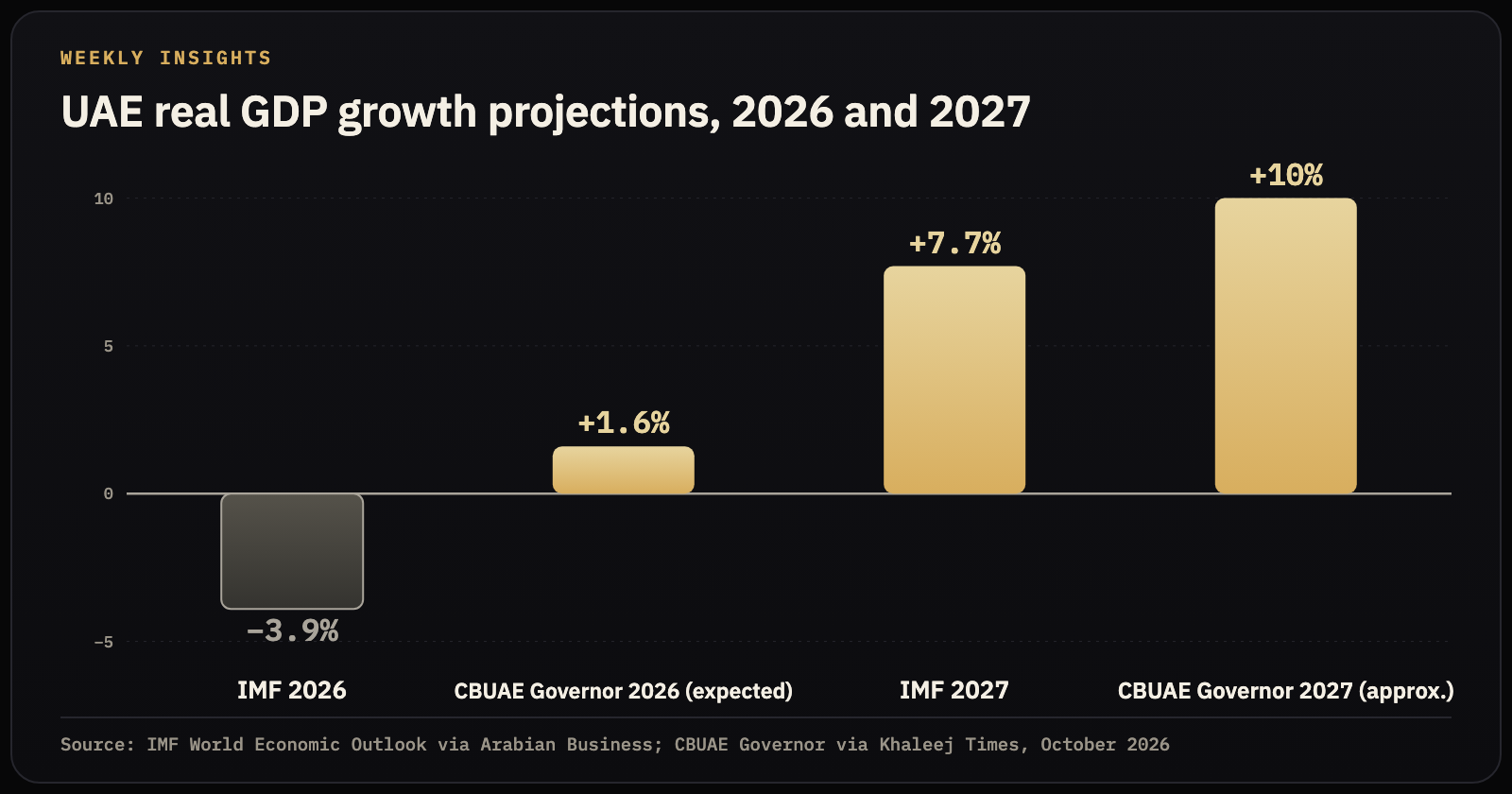
Two official projections for the UAE economy came out within days of each other this week, and they do not agree. The IMF's latest World Economic Outlook projects the UAE economy will contract 3.9% in 2026 and then grow 7.7% in 2027. Speaking in Bangkok during the IMF–World Bank Annual Meetings, the Governor of the Central Bank of the UAE projected growth of approximately 10% in 2027, up from an expected 1.6% in 2026. On my arithmetic, the two views are 5.5 percentage points apart for this year alone.
Dubai's transaction register held up regardless. Land Department data reported by Arabian Business shows AED13.47 billion of transactions between 12 and 16 October, including AED8.59 billion of sales across 2,676 deals. Savills' third-quarter report gives the quarterly view. Ready-home sales value rose about 18% on the quarter, while the total number of residential transactions fell 38% year-on-year.
That is this week's tension. Activity is holding up. But the official assumptions behind any 2027 recovery now run from a contraction this year to near double-digit growth next year, and money is getting more expensive, not less: the Federal Reserve raised rates in September and Brent touched $110 on Friday. My approach this week is to plan around the more cautious of the two official views and treat the faster one as upside.
If you're weighing entry points while this market reprices, I can show you where the risk-adjusted opportunities are emerging. Click here to speak with me directly.
Section 01
The IMF Sees a 3.9% UAE Contraction in 2026, While the Central Bank Governor Expects 1.6% Growth
UAE and regional growth projections (IMF World Economic Outlook; CBUAE Governor, October 2026)
| Measure | Figure |
|---|---|
| UAE 2026, IMF | −3.9% (7 points lower than April) |
| UAE 2027, IMF | +7.7% (2.4 points higher than April) |
| UAE 2026, CBUAE Governor | +1.6% (expected) |
| UAE 2027, CBUAE Governor | Approximately +10% |
| MENA 2026 / 2027, IMF | −2% / +7% |
| Saudi Arabia 2026 / 2027, IMF | −3.3% / +7.9% |
| IMF oil price assumption, 2026 / 2027 | $96 / $87 a barrel |
| IMF Hormuz assumption | Reopening resumes March 2027; pre-war conditions broadly by October 2027 |
The IMF's revision is large. Its UAE figure for 2026 is 7 percentage points lower than in April, and its 2027 figure is 2.4 points higher. The Fund sets out its basis: "The reopening of the Strait of Hormuz is assumed to resume in March 2027, with a return to pre-war conditions broadly by October 2027." That is an assumption built into the model, not a forecast of when the Strait will reopen. Within the Gulf, the UAE sits in the middle of the IMF's range. The Fund projects 2026 contractions of 15.6% for Qatar and 16.7% for Kuwait and growth of 4.1% for Oman.
The Governor gave three drivers for his projection: economic diversification, infrastructure investment, and increased oil production capacity following the UAE's withdrawal from OPEC. I am reporting both rather than choosing between them.
Also in Bangkok, the CBUAE held bilateral meetings with the Bank of Korea and the Monetary Authority of Singapore. International officials praised the UAE's financial system as a model of stability and resilience, in statements given to WAM, the state news agency.
If a purchase only makes sense under roughly 10% growth in 2027, it depends on the more optimistic of two official views. I would test every hold on the IMF's −3.9% for 2026 and its Hormuz timetable first.
Section 02
Dubai Recorded AED13.47 Billion of Transactions in Five Days, Including AED8.59 Billion of Sales
Dubai weekly transactions, 12–16 October (DLD data, via Arabian Business)
| Measure | Figure |
|---|---|
| Total transactions | AED13.47bn ($3.67bn) |
| Sales | AED8.59bn ($2.3bn), 2,676 transactions |
| Mortgages | AED3.72bn ($1bn) |
| Gifts | $316m |
| Notable sale: W Residences, Palm Jumeirah (apartment) | AED53.7m ($14.6m) |
| Sensoria at Five Luxe, Dubai Marina (apartment) | AED21.8m ($5.9m) |
The headline AED13.47 billion is total registered activity: sales, mortgages and gifts combined. Sales alone were AED8.59 billion, and gifts were $316 million.
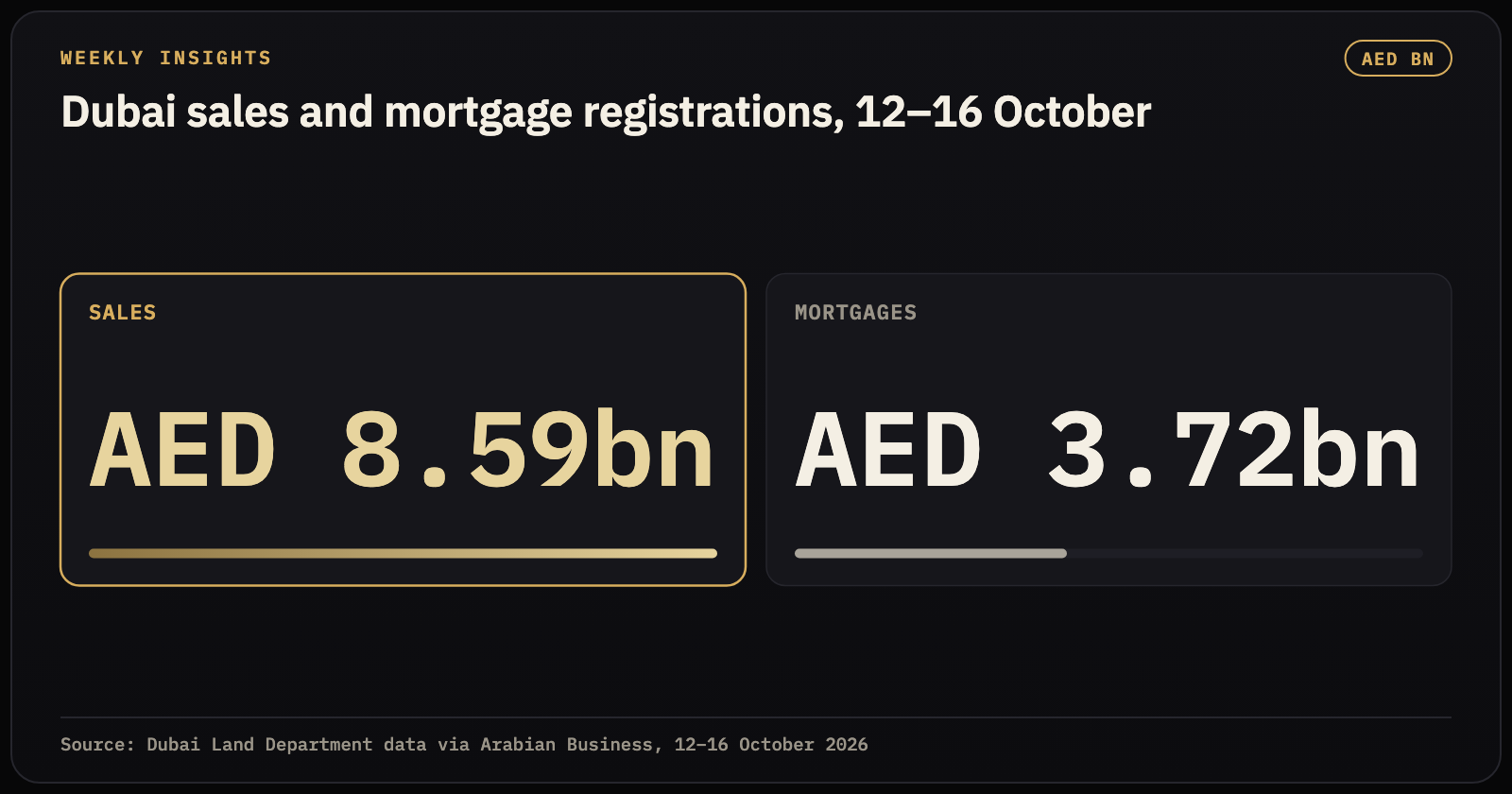
On my arithmetic, mortgages were about 27.6% of the week's total value, and the average sale was roughly AED3.21 million. The weekly data does not separate new purchase loans from refinancing, so the mortgage share does not cleanly measure leveraged buying.
At roughly 27.6% of value, secured debt is still a large part of Dubai's weekly activity. That is the part of the market exposed to the Fed's direction, covered below.
Section 03
Savills Finds Ready-Home Sales Up About 18% in Q3, but Residential Transactions Down 38% Year-on-Year
Dubai residential market, Q3 2026 (Savills, Dubai Residential Market in Minutes)
| Measure | Figure |
|---|---|
| Ready-property transaction value | AED25.1bn (Q2: AED21.3bn), ~+18% |
| Residential transactions | ~34,500 (−4% QoQ, −38% YoY) |
| Total residential transaction value | AED70.8bn (−14% QoQ) |
| Average apartment price | AED1,817/sq ft (−4.8% QoQ; like-for-like −1.7%) |
| Average villa/townhouse price | AED1,523/sq ft (−3.3% QoQ; like-for-like unchanged) |
| Transactions above AED10m | 669 (Q2: 871) |
| Prime apartments / prime villas and townhouses | AED5,237 (+4% YoY) / AED2,791 (+3.6% YoY) per sq ft |
| Units launched | ~5,000 in Q3 (Q2: ~36,400); ~50,000 in nine months, ~64% below 2025 |
| Rental transactions | ~181,900 (+16% QoQ); new leases 44% of activity (Q2: 36%) |
| Units scheduled for delivery, 2027–2030 | 525,000+ |
Reading only the ready-sales rise would give a one-sided picture. Ready-property value rose from AED21.3 billion to AED25.1 billion. On my arithmetic, that is 17.8%, and ready homes made up about 35% of the quarter's AED70.8 billion residential value. But total value fell 14% on the quarter, and transaction numbers were 38% lower than a year earlier.
Average prices fell 4.8% for apartments and 3.3% for villas and townhouses. On a like-for-like basis, apartments were down only 1.7% and villas were unchanged. That like-for-like comparison is the evidence behind the "signs of stabilisation" Savills describes. Savills says headline falls are partly driven by changes in the type and value of homes sold. At the top end the picture is mixed. On my arithmetic, deals above AED10 million fell about 23% on the quarter, yet prime prices per square foot were still up year-on-year.
Supply is shrinking at the front end. Launches fell to about 5,000 units, from around 36,400 in Q2. That does not change the more than 525,000 units already scheduled for 2027–2030. As I noted in the September 26 edition, a brokerage analysis of DLD data showed new leases outnumbering renewals in July and August for the first time. Savills now puts new leases at 44% of Q3 rental activity, up from 36%. The two measures differ, so I would not join them into one series. They do point the same way: more tenants are moving, and new-lease pricing matters more than sitting rents.
Buyers are moving toward completed stock they can inspect and let. If you are valuing a unit, use the like-for-like figure (−1.7% for apartments), not the headline average, and price rent at new-lease levels.
Explore curated office and retail opportunities at Mitchell's Commercial Real Estate.
Section 04
The Fed Raised Rates in September, and Its Chairman Is Now Weighing Financial-Stability Risks
Speaking at the Bangkok meetings, Fed chairman Kevin Warsh said the Fed needed to consider financial-stability risks as it assesses the US outlook. He declined to signal the next decision and said he does not "prejudge" the meeting on 27–28 October, when markets expect rates to stay unchanged. The same report confirms that the Fed raised rates in September, intending to deliver price stability and withdraw some monetary accommodation. The Federal Reserve's 16 September statement raised the target range by a quarter point, to 3.75–4%. Warsh also said he had been surprised by global resilience, noting that most central banks have tightened policy to deal with inflation.
Markets are not ruling out further moves. The National reports that gold fell on the week as investors looked for Fed clues on more interest-rate increases. The IMF projects global headline inflation of 4.7% in 2026, easing to 4.1% in 2027, so there is little room for an early easing cycle.
The dirham is pegged to the US dollar, so US policy feeds into dirham borrowing costs. Market expectations for 27–28 October are for no change, not a cut. I would not model any reduction in mortgage costs into a purchase decided this quarter.
Section 05
Brent Touched $110 for the First Time Since May, Against an IMF Assumption of $96 for 2026
Energy and markets, Friday 16 October (The National)
| Measure | Figure |
|---|---|
| Brent settle | $109.86, +3.72% (highest close since mid-May) |
| WTI settle | $101.41, +3.55% (first time above $100 in nearly a month) |
| Weekly change | Brent nearly +5%; WTI more than +10% |
| IEA emergency release agreed | More than 20 million barrels |
| G7 pledge | 100 million barrels of diesel and other reserves |
| Wholesale diesel (IEA) | Above $200 in Singapore; roughly $220 in Europe and the US |
Brent touched $110 on Friday for the first time since May and settled at $109.86, with the war in Iran now in its eighth month. The IEA's view is more mixed than the price suggests: it said exports out of the Middle East have recovered to pre-crisis levels and global oil storage is not tight. That sits awkwardly beside the IMF's assumption that Hormuz reopening only resumes in March 2027. The two describe different things, export volumes and normal transit, and I note the tension without resolving it.
A higher benchmark price does not translate directly into Gulf revenue. The same report says Gulf producers are cutting prices and relying on makeshift export routes under congestion. The IMF's $96 a barrel is a full-year average assumption, so Friday's settle is not directly comparable with it.
With diesel above $200 in Singapore, fuel and freight costs are the more immediate channel. That pressure feeds into fit-out, construction and operating costs before it shows up in any fiscal surplus.
The Cabinet, chaired by Sheikh Mohammed bin Rashid Al Maktoum, approved a federal budget of AED292.5 billion ($80 billion) for 2027–2029, 28.3% higher than the previous three-year period. Estimated federal spending for 2027 is AED90.1 billion. Social development and pensions take the largest share at AED34.6 billion (38.4%). Government affairs follow at AED29.1 billion (32.3%), then federal expenses at AED17.8 billion (19.7%) and financial assets and investments at AED5.6 billion (6.2%). Infrastructure and economic resources receive AED3 billion (3.4%).
On my arithmetic, the three-year envelope averages AED97.5 billion a year. Because 2027 is below that average, the later years carry more of the spending. The federal infrastructure allocation is small, so I would not read this budget as a direct construction stimulus. Its relevance to property is indirect: social spending supports the residents who make up housing demand.
A 28.3% larger envelope, approved while the IMF projects a contraction, is a statement of fiscal capacity. I treat it as support for demand, not as a catalyst for prices.
Section 07
Dubai Law Caps Developer Deductions on Defaulted Off-Plan Units at 25%, 30% or 40%, Depending on Progress
With Savills describing buyers as more selective, it is worth knowing exactly what happens if an off-plan instalment is missed. This Khaleej Times explainer is dated 10 October, so I treat it as reference rather than news. It sets out the process under Article 11 of Law No. 13 of 2008, as amended by Law No. 19 of 2017. The developer must first notify the DLD. The DLD then issues a formal notice giving the buyer 30 days to pay. If the default is not settled, the DLD certifies the unit's completion percentage, and that percentage determines what the developer may do:
- Above 80% complete: pursue the balance, request a public auction, or terminate and deduct no more than 40% of the unit's value. The remainder is returned within one year of termination or 60 days of resale, whichever comes first.
- 60–80% complete: terminate and deduct up to 40%.
- Construction begun, below 60%: a maximum deduction of 25%.
- Work not started for reasons beyond the developer's control: terminate and deduct up to 30% of amounts paid, with the rest returned within 60 days.
- Project cancelled by RERA: full refund under Law No. 8 of 2007 on escrow accounts.
These bands match the text of Law No. 19 of 2017 as published by the Dubai Land Department. One detail deserves attention: the higher bands are expressed as a share of the unit's value, while the not-started band is a share of amounts paid.
Before signing a back-loaded payment plan, check whether a deduction of up to 40% of unit value could exceed what you would have paid by the time the late stages fall due.
Still reading
Need expert help on this subject?
Section 09
Abu Dhabi's Circular No. 9 of 2026 Makes Contractors and Consultants Jointly Liable for Defects
Abu Dhabi's Urban Planning and Permits Centre, part of the Department of Municipalities and Transport, issued Circular No. 9 of 2026. It applies to all new and ongoing building projects. For designated categories, certified technical reports are now accepted in place of traditional phase-closure permits and are submitted through the Unified Permitting System. Contractors and supervision consultants share joint liability for defects and non-compliant work, within defined legal responsibilities. Mandatory field inspections still apply where physical checks are needed, as do approvals from bodies such as Abu Dhabi Civil Defence Authority. Unannounced site inspections will continue, and violations can lead to fines and legal penalties.
The stated aim is to speed up construction and streamline approvals. For off-plan buyers in Abu Dhabi, joint liability gives a clearer route to recourse for defects. It is worth confirming that your developer's contractor and consultant are named in the documentation.
Section 10
Etihad Rail Opened a 375-Metre Link Between Al Yalayis Station and the Dubai Metro Red Line
Etihad Rail opened a 375-metre pedestrian bridge linking its Dubai Al Yalayis Station with Jumeirah Golf Estates Metro Station. The crossing takes about five minutes, and a combined Etihad Rail and Dubai Metro ticket is available through Nol via a QR code. The bridge follows the official launch of the national passenger network.
The link to neighbourhood appeal is my own inference. Even so, a five-minute connection between intercity rail and the Metro is a concrete example of the network integration behind Dubai's infrastructure case. Communities near that interchange are the ones to watch as the network matures.
In closing
Final View for Dubai Property Investors
This week gave investors two official forecasts for the same economy, and they are far apart. The IMF projects a 3.9% contraction in 2026, built on a Hormuz reopening assumed for March 2027. The Central Bank Governor expects 1.6% growth this year and about 10% next. I would base every hold, exit and refinancing on the IMF case and treat the Governor's figure as upside, not as the base case.
Dubai's market itself is not breaking. A week of AED13.47 billion in registered activity and like-for-like apartment prices only 1.7% lower in Q3 describe a market that has slowed and become selective, not one that is falling apart. The selectivity points toward ready stock. Savills' ~18% rise in ready-home value tells me where buyers are finding confidence: in units they can inspect, let and price against new-lease rents.
What I would do differently this week comes down to four things. First, assume no relief on borrowing costs before at least the Fed's 27–28 October meeting, and stress-test any leveraged position at current rates. Second, if you hold or are buying off-plan, read your payment plan against the DLD default bands, especially the up-to-40% deduction on advanced projects. Third, treat yields offered at forums and in developer marketing, including Sharjah's 8–12%, as claims to verify. Fourth, keep an eye on oil-driven cost pressure, not just the oil price. Patience, completed assets and conservative leverage remain the right posture until the gap between the two official forecasts narrows.
Next step
Let’s Talk
If you’d like to unpack where the most resilient opportunities are emerging — in stabilised residential areas or income-generating commercial zones — I’d be happy to share a focused, data-driven shortlist based on your investment goals.
📞 No pressure, no sales pitch—just a focused, informed conversation about your investment goals.
Published 17 October 2026 by Stephen James Mitchell MBA. Market figures quoted reflect the data available at that date.