The UAE economy grew through the first half of 2026 despite the Iran war, but only just. According to the Federal Competitiveness and Statistics Centre, reported by The National on Friday, real GDP rose 0.4% year on year to AED 961.9 billion in the six months to June. The second quarter alone contracted 2.1%, and non-oil activity in that quarter shrank 1.1%. That compares with growth of 6.2% for 2025 as a whole.
Forecasters expect the full year to be weaker than the first half. The World Bank now projects the UAE economy to contract 1.6% in 2026 and rebound 9.5% in 2027, and says the rebound largely reflects the restoration of oil production and exports. Brent was still at $103.30 a barrel on Friday morning, and Gulf stock markets had just had one of their worst days since March.
That is this week's tension. Dubai property kept trading through the third quarter, with a press release putting Q3 activity at AED 90.62 billion. But the economy underneath it slowed in the second quarter, the recovery case rests on oil flows, and at least one Abu Dhabi investment firm expects US rates, and therefore dirham borrowing costs, to stay high into late 2027. At the same time, regulators set out rules that limit some of the ways landlords push up yields.
If you're weighing entry points while this market reprices, I can show you where the risk-adjusted opportunities are emerging. Click here to speak with me directly.
UAE real GDP, H1 2026 (FCSC, via The National, 9 October 2026)
| Figure | |
|---|---|
| Real GDP, H1 2026 | AED 961.9bn ($262bn), +0.4% |
| Real GDP, Q2 2026 | AED 476.9bn, −2.1% |
| Non-oil activity, Q2 2026 | −1.1% |
| Non-oil share of GDP | 79.2% (up 1.8%) |
| Real estate growth, H1 | +2.3% |
| Construction growth, H1 | +5.1% |
| Real GDP, 2025 | AED 1.9tn, +6.2% |
| S&P Global UAE PMI, September | 55.3 (August: 55.3) |
One figure is easy to misread. The 1.8% rise is the increase in the non-oil sector's share of GDP, which reached 79.2%. It is not the non-oil growth rate. A larger non-oil share partly reflects weaker oil output, not only stronger non-oil activity.
Subtracting the second quarter from the half-year total, first-quarter real GDP was about AED 485.0 billion on my arithmetic. The first half grew because the first quarter was stronger. The second quarter, the first full quarter of the conflict, went backwards.
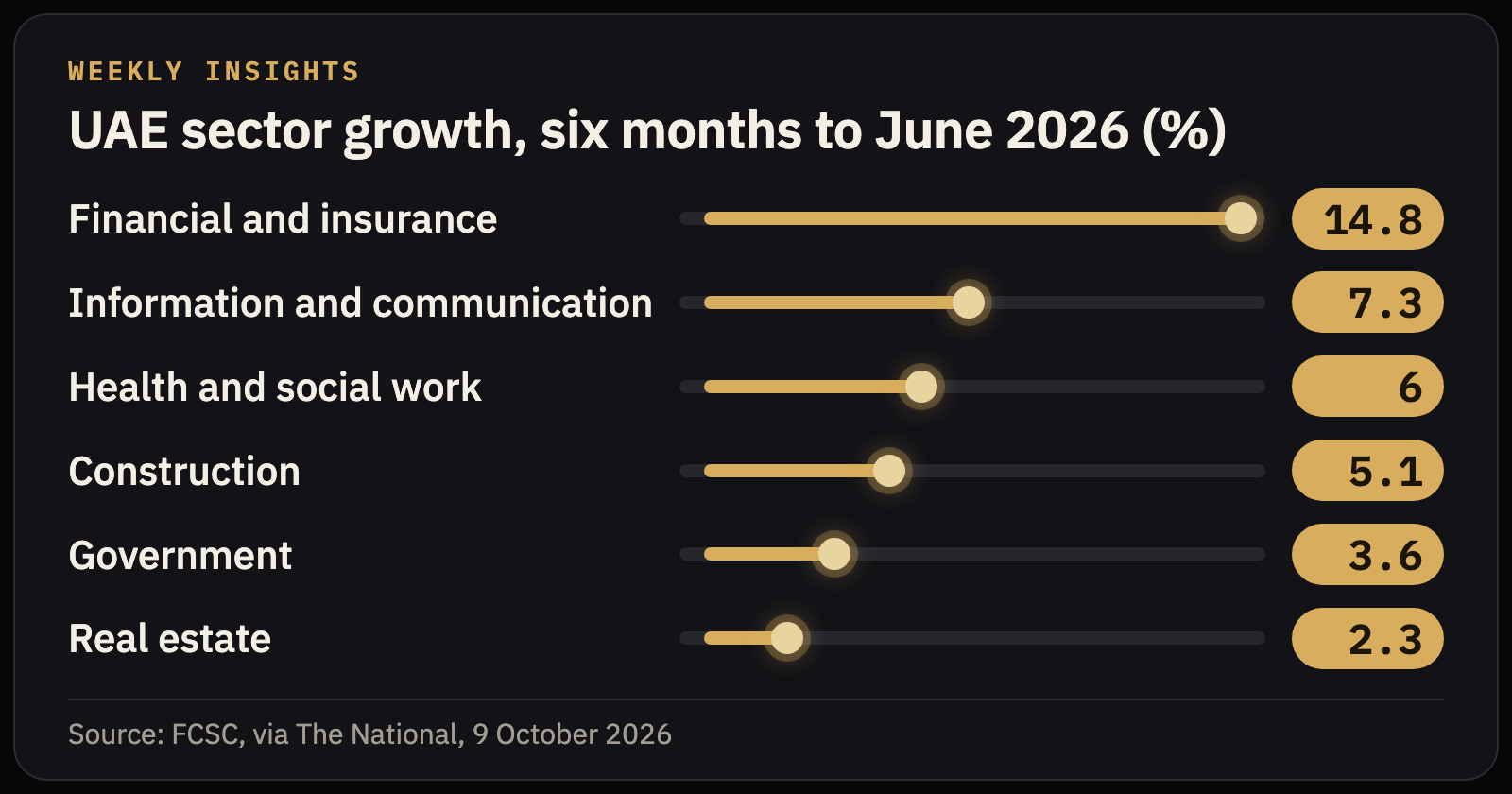
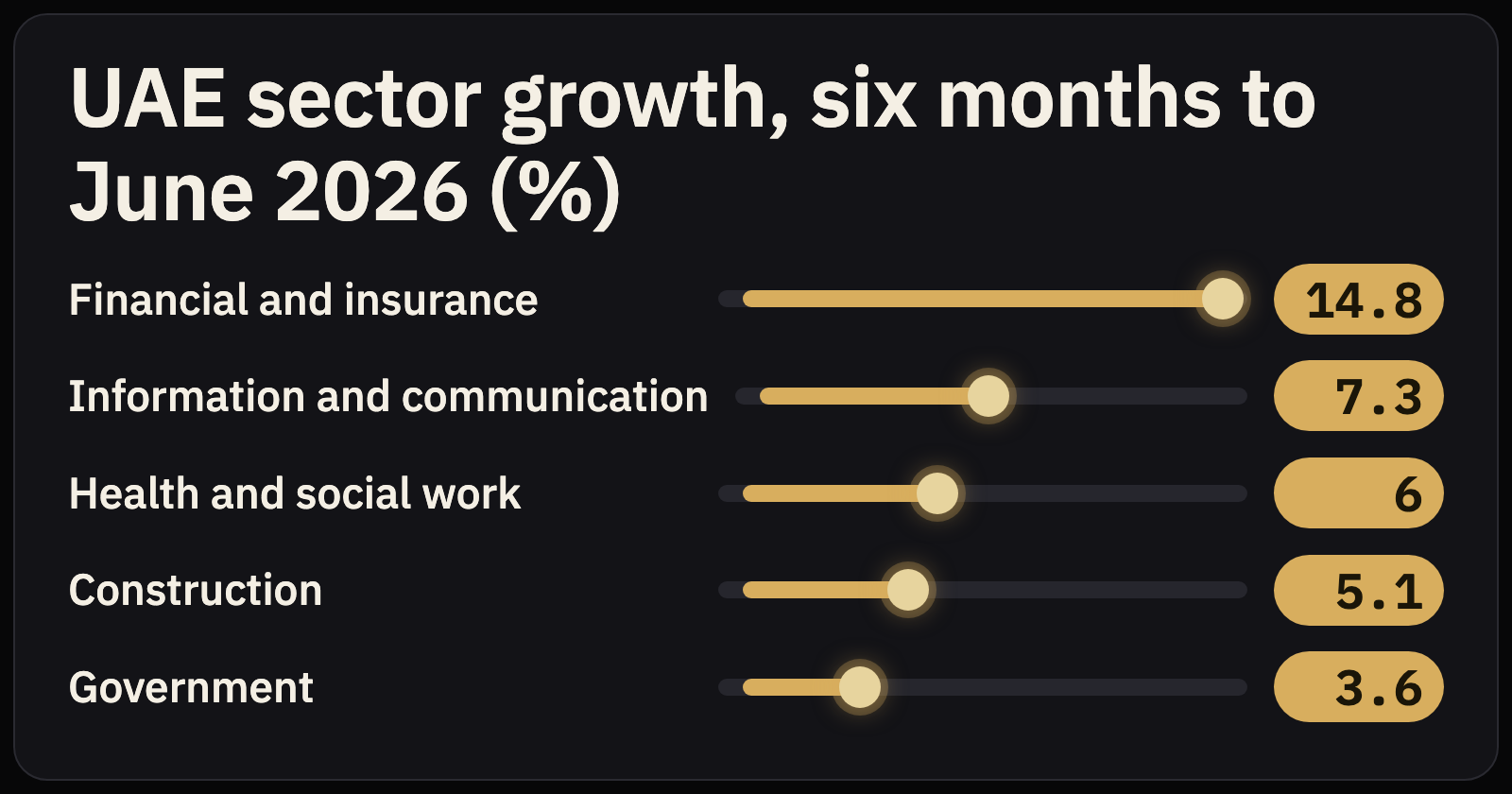
By sector, financial and insurance services grew 14.8%, information and communication 7.3%, health 6%, construction 5.1% and government 3.6%. Real estate grew 2.3% and accounts for 7.9% of non-oil GDP. More recent data points the other way: S&P Global's UAE PMI held at 55.3 in September, above the 50 line that separates expansion from contraction, and S&P Global says the non-oil economy has moved past the midyear slowdown linked to the conflict. The finance sector's growth supports office demand, which matters for commercial investors. But real estate's own output grew only 2.3%, so I would not underwrite residential rent growth at 2025's pace.
Growth forecasts published this week (sources as listed, October 2026)
| Figure | |
|---|---|
| UAE 2026 / 2027 (World Bank) | −1.6% / +9.5% |
| UAE 2026 (ICAEW and Oxford Economics) | −1.5% |
| GCC 2026 / 2027 (World Bank) | −4.3% / +10.3% |
| GCC 2026 / 2027 (ICAEW and Oxford Economics) | −6.4% / +5.8% |
| Global 2026 (UNCTAD) | 2.6% (2025: 2.9%) |
| Global 2026 (SAMA governor) | ~3%; global inflation ~4.7% |
The World Bank report, published on 6 October, assumes disruptions ease from early next year. It also puts the UAE's fiscal surplus at 4.2% of GDP this year and the current-account surplus at 8.2%. The sharpest swings are elsewhere in the Gulf: Qatar −20.9% then +26.7%, Kuwait −14.6% then +22%.
The forecasts agree on the UAE but not on the region. ICAEW and Oxford Economics put the UAE at −1.5%, close to the World Bank. For the GCC they expect a deeper fall of 6.4% and a much smaller 2027 rebound of 5.8%. Global forecasts also differ: UNCTAD expects 2.6%, while Saudi Central Bank Governor Ayman Al-Sayari cited approximately 3% with global inflation around 4.7%. He warned that a prolonged conflict could push inflation higher and weaken growth.
A full-year forecast and a half-year outcome are not like-for-like. Still, for a −1.6% year to follow a +0.4% first half, the second half would have to be weaker than the first. A 2027 rebound of 9.5% is a forecast that depends on oil exports recovering. It should not be the basis of a valuation.
Dubai real estate transactions, Q3 2026 (press release on Zawya, October 2026; data source not stated)
| Figure | |
|---|---|
| Total | AED 90.62bn, 36,738 transactions |
| Residential | AED 72.58bn, 33,949 transactions |
| Off-plan | AED 41.58bn, 23,457 transactions |
| Secondary | AED 30.83bn, 10,442 transactions (value +24.22% on Q2) |
| Commercial | AED 18.04bn, 2,789 transactions |
| Deals below AED 3m | 84.28% of transactions (Q2: 82.45%) |
As I noted in the October 3 edition, a separate release of DLD data put Q3 sales at roughly AED 92.3 billion across 37,124 transactions. This week's release gives AED 90.62 billion across 36,738. The two sources disagree by about AED 1.7 billion and 386 deals. The earlier data ran to 29 September, and this release does not state its source or method, so I am not choosing between them. Both show the same thing: a quarter far below Q3 2025.
This release does not add up internally either. Off-plan plus secondary comes to AED 72.41 billion and 33,899 deals on my arithmetic, against the AED 72.58 billion and 33,949 stated for residential. The gaps are small, but they suggest a category that has not been separately reported.
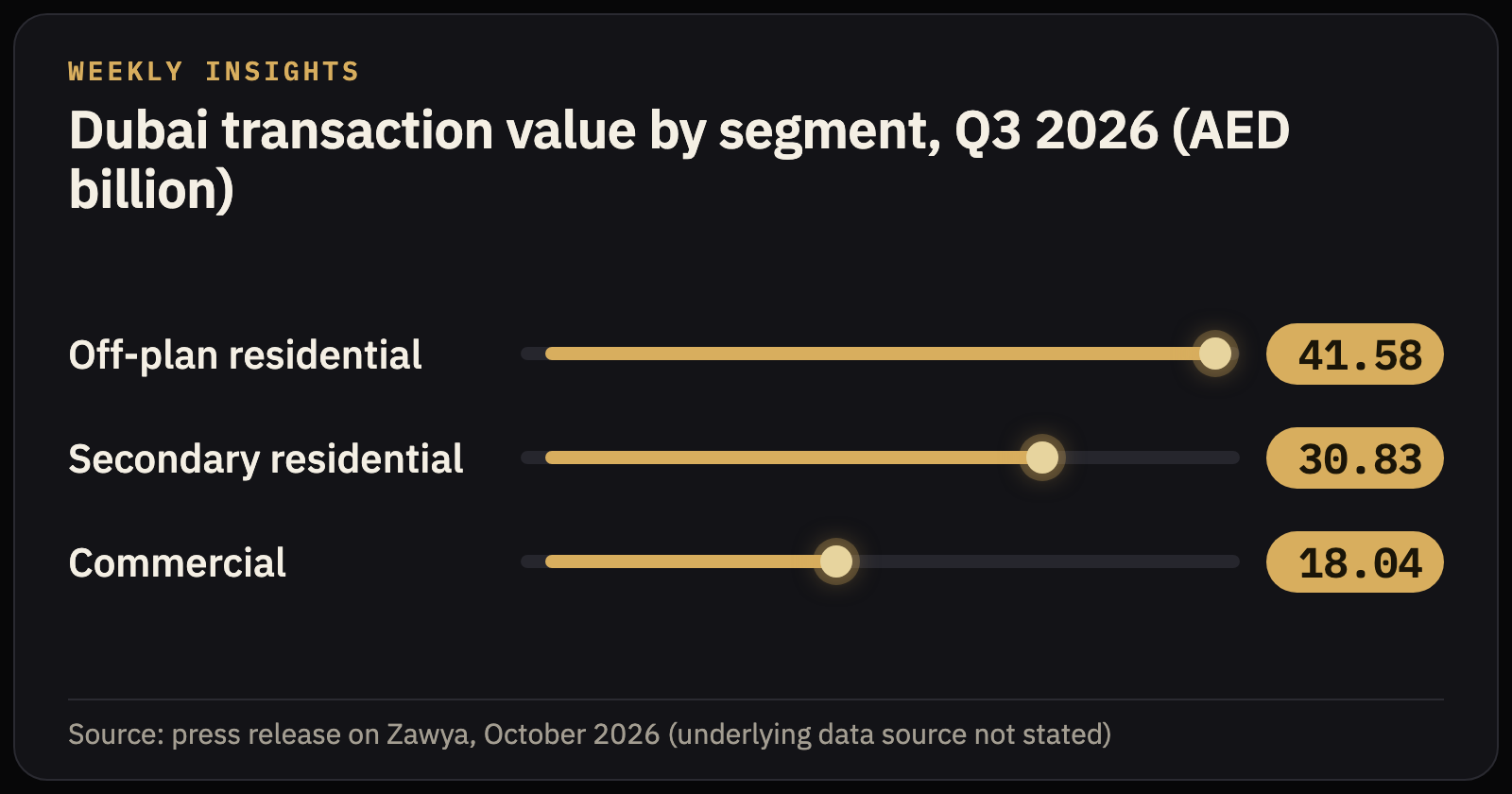
The split is the useful part. Off-plan took about 57% of residential value and about 69% of deals. The average off-plan deal was roughly AED 1.77 million, against roughly AED 2.95 million for secondary. The secondary market strengthened, with value up 24.22% and volumes up 22.52% on Q2. Activity stayed concentrated in lower-priced, outlying areas. Dubai South led with 5,165 deals at an average AED 1,690 per sq ft, followed by JVC on 2,312 (up from 1,992) and Downtown Jebel Ali on 1,890. With 84.28% of deals below AED 3 million, the market is moving mainly at the affordable end. That is also where the most new handovers will compete for tenants.
According to the same release, commercial sales came to AED 18.04 billion across 2,789 transactions. Land made up AED 6.91 billion, or 38.30%. There were 1,123 office transactions worth AED 4.35 billion, up from 1,005 in Q2. That is about 11.7% more deals on my arithmetic, at an average of roughly AED 3.87 million each.
Whole buildings were the notable shift. There were 87 deals worth AED 3.64 billion, and the segment's share of commercial value rose from 13.40% to 20.18%. On my arithmetic, the average whole-building deal was about AED 41.8 million. Capital buying entire assets during a quarter of regional disruption is a sign of longer-term confidence. It also means fewer, larger buyers are setting prices in that part of the market.
The release does not separate ready and off-plan offices, so I cannot tell how much of the 1,123 is income-producing stock. Ask for that split before using these numbers to justify a price. An office with a tenant already in place, which you can check, carries less risk than one sold on a handover date.
Explore curated office and retail opportunities at Mitchell's Commercial Real Estate.
Emirates 24/7 reported data prepared by a property portal showing about 40,963 resale transactions worth AED 153.4 billion between January and August. The average transaction value rose from AED 3.61 million to AED 3.75 million, and the number of deals fell compared with the same period of 2025. The report gives no percentage for that fall. The market started strongly in January, slowed from March and stabilised through August.
The location mix moved. Business Bay, Downtown Dubai, Dubai Marina and Palm Jumeirah slowed compared with 2025, while Mohammed Bin Rashid City, Dubai South and Jebel Ali grew strongly. The data comes from a platform that earns from listings, so I weight it below DLD figures. Its averages also do not fit neatly with the Q3 release above, which puts the secondary average closer to AED 2.95 million. The two cover different periods and probably different definitions.
A rising average alongside falling volume usually reflects which properties are selling, not higher prices for the same property. If you are selling in one of the slower prime districts, expect a smaller pool of buyers than in 2025 and allow more time to sell.
Section 07
A Missed Off-Plan Payment Can Cost Up to 40% of a Unit's Value, and Courts Are Enforcing Refunds
With off-plan the largest residential segment, Khaleej Times set out what a developer can do when a buyer defaults. Under Article 11 of Law No. 13 of 2008, as amended by Law No. 19 of 2017, the developer must first notify the DLD. The DLD then gives the buyer 30 days to pay. Above 80% completion, the developer can keep the contract and pursue the balance, request a public auction, or terminate and deduct no more than 40% of the unit's value. Between 60% and 80%, the cap is also 40%. Below 60%, once construction has begun, it is 25%. If work has not started for reasons outside the developer's control, the developer can deduct up to 30% of amounts paid. If RERA cancels a project, the buyer gets a full refund.
To put that in money terms, 40% of the Q3 average off-plan deal of about AED 1.77 million is roughly AED 708,000 on my arithmetic.
The courts also applied contract terms in the other direction. The Dubai Real Estate Court cancelled an AED 80 million sale of a Dubai Silicon Oasis plot after the seller failed to attend the title transfer. It ordered the seller to refund the AED 30 million already paid, plus 5% annual interest and AED 1.5 million in compensation. If you are on a payment plan, check your cash reserves against the instalments due after the conflict-related slowdown. Being forced to sell near handover can cost up to 40% of the unit's value.
Still reading
Need expert help on this subject?
OPEC+'s seven core members kept November production targets unchanged. Gulf OPEC+ exports have been running at 60% to 80% of normal levels, and in August the group pumped 25 million barrels per day, still about 5 million below pre-war levels. Output changes are considered unlikely before 2027.
On Friday, Brent fell nearly 1% to $103.30 after President Trump said the US would not attack Iran before the 3 November midterm elections, a day after it closed 4% higher. Shipping figures cited by AGBI, from Reuters and Kpler, show up to 10 vessels crossing Hormuz on Wednesday, against more than 20 on Sunday and Monday. Dubai's stock index fell 1.7% on Thursday and Abu Dhabi's 1.6%. A Houthi claim of a missile attack on Riyadh's airport had not been confirmed by the Saudi government.
The sources give different pre-war baselines for Brent: about $73 according to Arabian Business, and about $70 according to UNCTAD, which also says the price went above $110 in the weeks after the outbreak. High prices support Gulf budgets, but only on the barrels that actually get exported. Until Hormuz traffic settles, the swings in Gulf equities are a better guide to risk pricing for listed property developers than the $103 oil price.
Lunate's outlook, titled "Even Higher for Even Longer" and reported by Khaleej Times, expects one further 25 basis-point Fed hike in December, to 4.25%. It treats that as the peak and expects cuts no earlier than late 2027. It also expects US 10-year Treasury yields to stay above 4.5%. Khaleej Times notes that the dirham is pegged to the US dollar and that the UAE Central Bank follows Fed decisions.
This is one asset manager's forecast, not a consensus, and I treat it as opinion. It matters because it fits the rest of this week's data. UNCTAD finds that capital-flow volatility has doubled since the conflict began, and Lunate reports Brent up more than 44% this year. Both point to inflation and funding costs staying high. If you are buying with debt, test your figures at a policy rate of 4.25% held until late 2027. Do not assume a refinancing window opens in 2026.
According to Kamco Invest, GCC contract awards fell 37.2% year on year to $47.4 billion in the third quarter and 19.2% on the previous quarter. The UAE awarded $15.6 billion, and every GCC country recorded a double-digit decline. Construction awards fell 44.7% to $14.8 billion. Across nine months, however, awards were still up 2.5% at $204.1 billion. MEED Projects puts the regional pipeline at $2.05 trillion, with the UAE holding 26.4%.
The report does not say whether projects are being delayed or cancelled, and I would not assume either. A drop in construction awards now could mean fewer completions later. That would ease the supply pressure on rents, but only if it continues. One quarter of 44.7% lower construction awards is something to track, not a reason to change your supply assumptions yet.
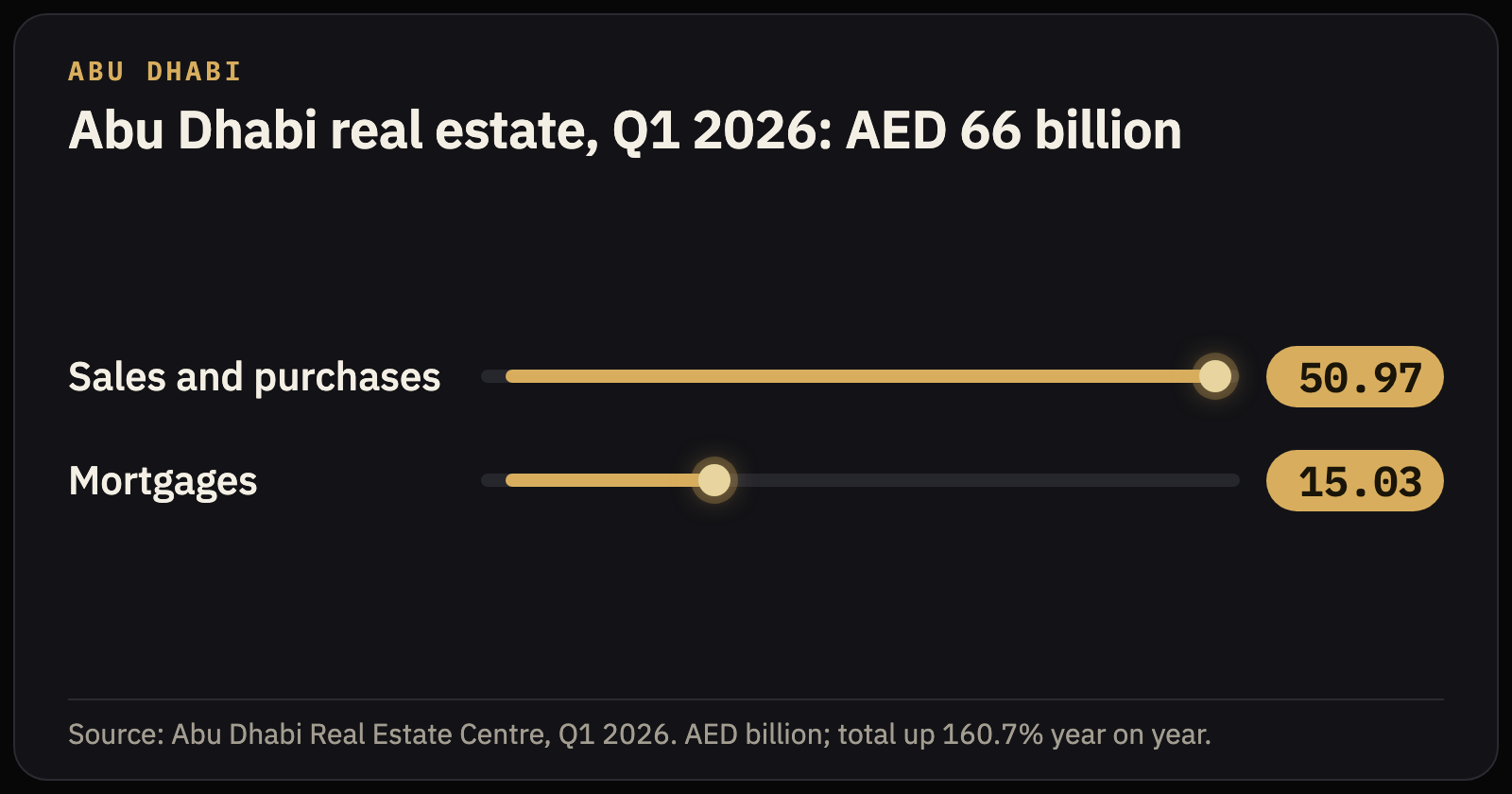
ADREC has replaced its previous broker course with a mandatory Broker Transformation Course. Brokers who pass receive an ADREC Certified Broker credential, renewed annually. ADREC's own H1 report puts Abu Dhabi transactions at AED 117 billion ($31.9 billion), up 112% year on year, with 2,040 professional licences issued, up 34%, and 3,302 licensed brokers. The page's subheading gives $32 million, which looks like an error, so I have used the figure from the body of the article.
Abu Dhabi doubling its transactions while the economy slowed is a notable contrast with Dubai's weaker Q3. Higher licensing standards give buyers more protection. If you are buying in Abu Dhabi, confirm the intermediary holds the current annual ADREC credential before you sign anything.
In closing
Final View for Dubai Property Investors
This week's official data makes the position clearer. The UAE grew 0.4% in the first half, but the second quarter contracted, and forecasters expect a full-year contraction of around 1.5% to 1.6% before a rebound that depends on oil. Dubai property is still trading in volume, but most deals are off-plan, priced under AED 3 million, and in outlying areas. Rates may stay high into late 2027.
Here is what I would do differently. First, base any 2027 recovery case on oil-export data, not the 9.5% headline. Second, if you are on an off-plan payment plan, hold cash for the remaining instalments, since a default can cost up to 40% of the unit's value. Third, if your yield relies on shared or subdivided letting, value the asset without that income from September 2027. Fourth, in commercial property, prefer let, ready offices whose rent and tenant you can check over off-plan floor space. Finally, wherever two datasets disagree, as the Q3 totals did this week, rely on DLD's own figures and allow for the difference.
Next step
Let’s Talk
If you’d like to unpack where the most resilient opportunities are emerging — in stabilised residential areas or income-generating commercial zones — I’d be happy to share a focused, data-driven shortlist based on your investment goals.
📞 No pressure, no sales pitch—just a focused, informed conversation about your investment goals.
Published 10 October 2026 by Stephen James Mitchell MBA. Market figures quoted reflect the data available at that date.