This week, positive geopolitical developments outpaced the underlying economic numbers. Following the US-Iran agreement and the reopening of the Strait of Hormuz, UAE equities climbed to a three-month high, oil prices eased, and institutional desks began referring to a “new cycle.”
The hard data has yet to reflect this shift. Dubai home sales dropped by around 19% in May, with the monthly transaction value roughly halving compared to the pre-conflict run rate. The largest foreign buyer group continues to transact in smaller ticket sizes.
By contrast, Abu Dhabi recorded its strongest quarter on record, while Dubai’s prime rental market continued to reach new highs. The property market is clearly operating at two different speeds.
For investors, the divergence between improving market sentiment and still-soft transaction volumes is the central theme this week. It defines both the risks and the opportunities.
The analysis below examines what is genuinely improving, what remains under pressure, and the key macro factor—a hawkish US Federal Reserve—that is narrowing the window for cheap financing that many are now trying to secure.
If you’re reassessing your positioning as this cycle turns, I can show you where the risk-adjusted opportunities are emerging. Click here to speak with me directly.
The Sentiment Turn: Markets Move First
The clearest signal of the shift came from the markets that reprice fastest.
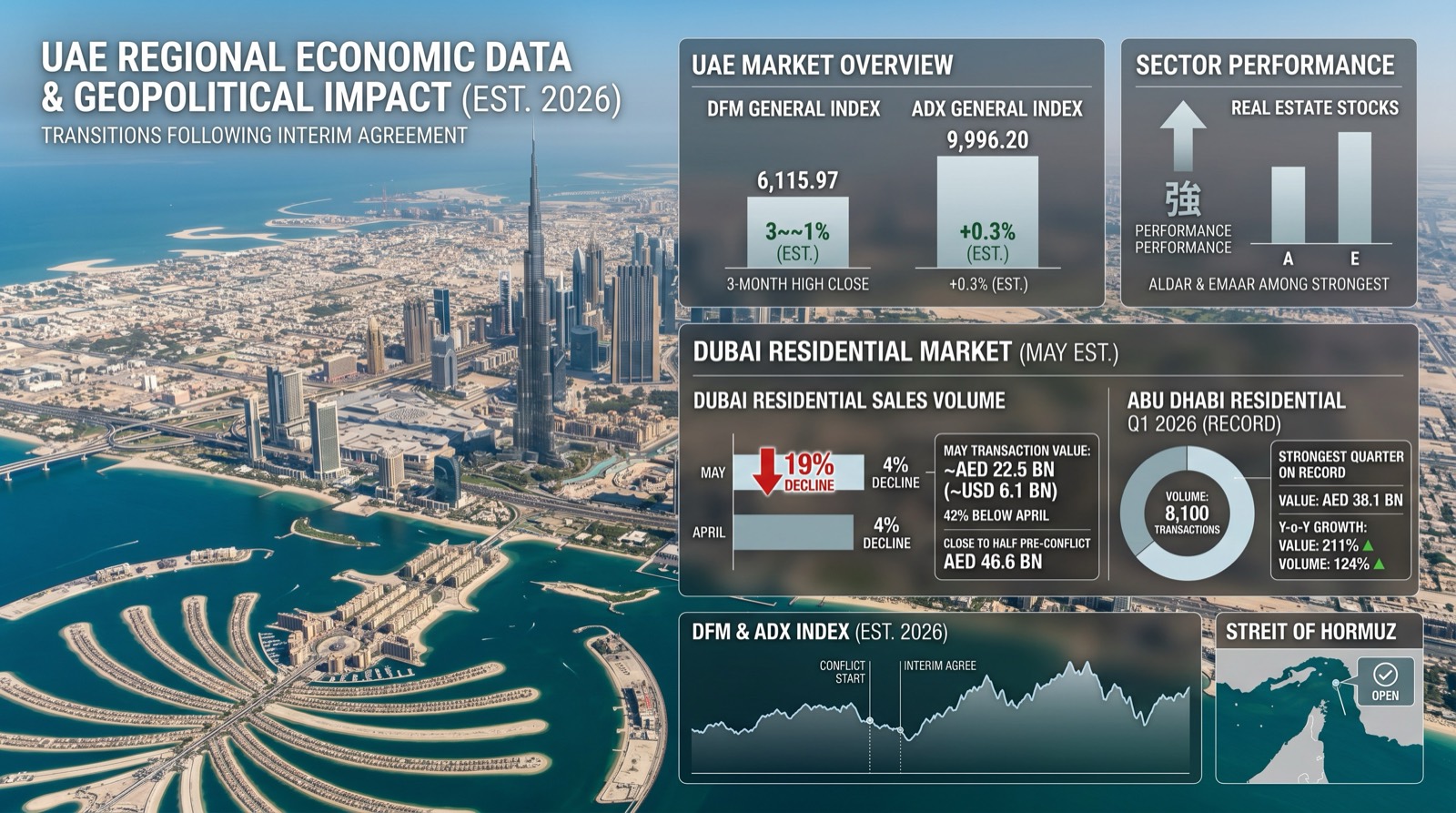
Following the interim US-Iran agreement, UAE bourses closed at their highest levels in three months, with the Dubai Financial Market up around 1% to 6,115.97 and Abu Dhabi’s index at 9,996.20. Real estate stocks led the way, with Aldar and Emaar among the strongest performers. Equity investors were clearly taking the conflict premium out of property prices.
Institutional research moved in the same direction. A widely circulated Jefferies note argued UAE real estate is entering a new cycle following the de-escalation, with the broader market having reached roughly USD 290 billion in 2025 after a 30% compound annual growth rate since 2021. Notably, the bank judged Abu Dhabi to be positioned more favourably than Dubai for the next leg — a view this week’s data supports.
This feels more like a shift in sentiment than a confirmed bottom. Markets and analysts tend to move first, while actual transaction data follows weeks later. The practical takeaway right now is that downside risk has narrowed, but the cooling in parts of the market is not over yet.
The Cooling Is Still in the Numbers: Dubai Sales Down ~19%
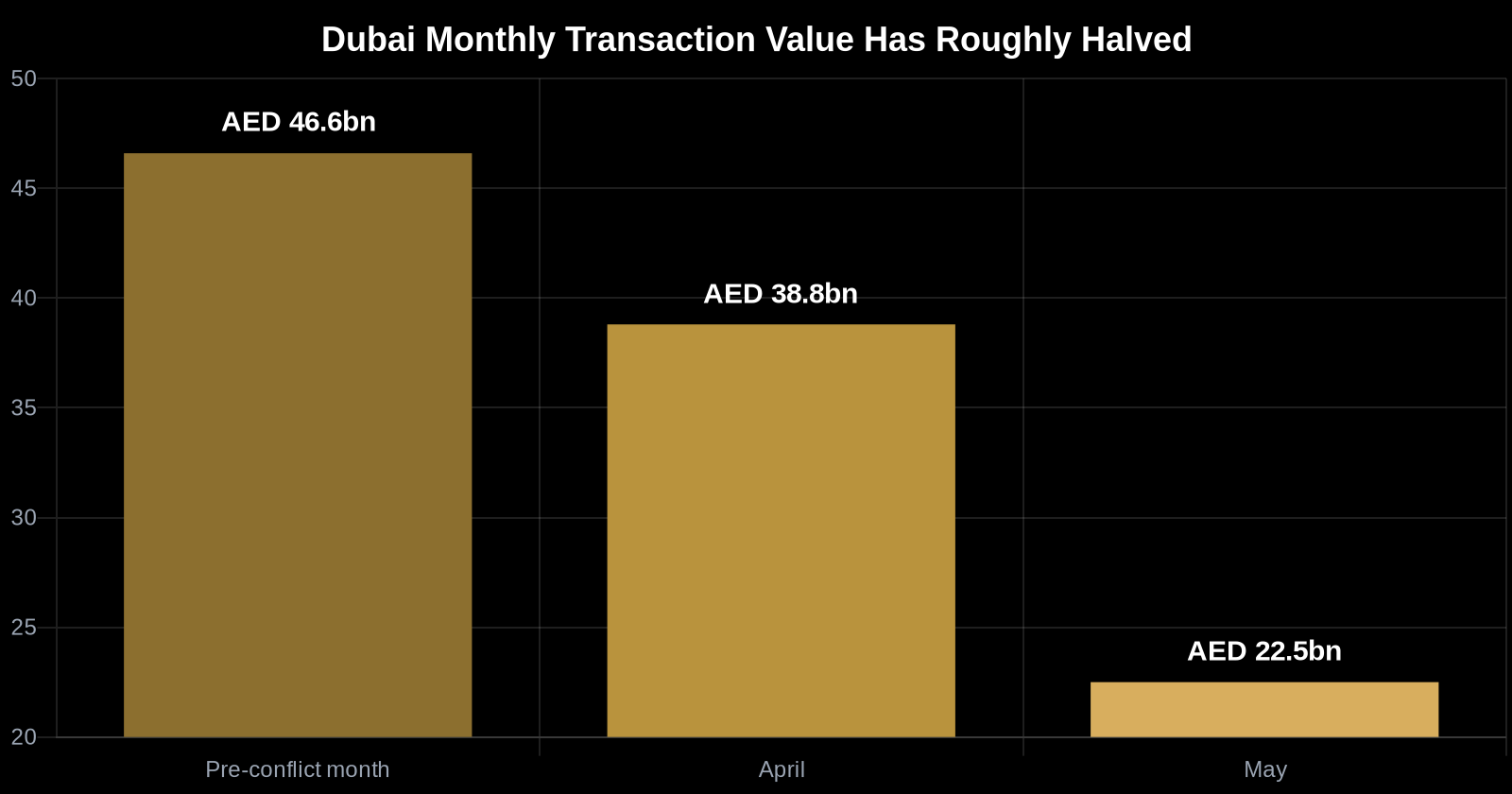
Behind the improving market sentiment, the transaction record still reflects the shock. According to ValuStrat, Dubai residential sales fell roughly 19% in May versus April — an acceleration from the 4% decline the month before. The total May transaction value came in around AED 22.5 billion (USD 6.1 billion), about 42% below April and close to half the AED 46.6 billion recorded in the last full month before the conflict.
That is a meaningful contraction, and it is concentrated where you would expect. The pullback is sharpest among completed-home and discretionary buyers, while the very top of the market has seen some ultra-prime (USD 10 million-plus) deals reportedly closing at 20–25% discounts as a small number of motivated sellers meet a thinner pool of buyers.
This lines up with what I’ve been pointing out for the past few weeks. What we’re seeing is a demand-side, sentiment-driven repricing — not a wave of forced selling. Liquidity remains in the market. Dubai recorded AED 9.63 billion across 4,283 transactions in the latest week, with off-plan sales (AED 3.83 billion) once again outweighing ready-property deals (AED 2.89 billion). Buyers haven’t disappeared; they’re just negotiating harder.
Abu Dhabi’s Record Quarter Sharpens the Divergence
If Dubai represents the cooling side of the market, Abu Dhabi is the clear counterpoint. Data from advisory firm Cavendish Maxwell shows the capital recorded AED 38.1 billion in residential sales in Q1 2026 across roughly 8,100 transactions — its strongest quarter on record. Transaction value jumped 211% year-on-year, and volumes rose 124%, with off-plan accounting for around 90% of value. Apartment prices rose about 17% and villa prices about 11%, with Yas Island leading demand.
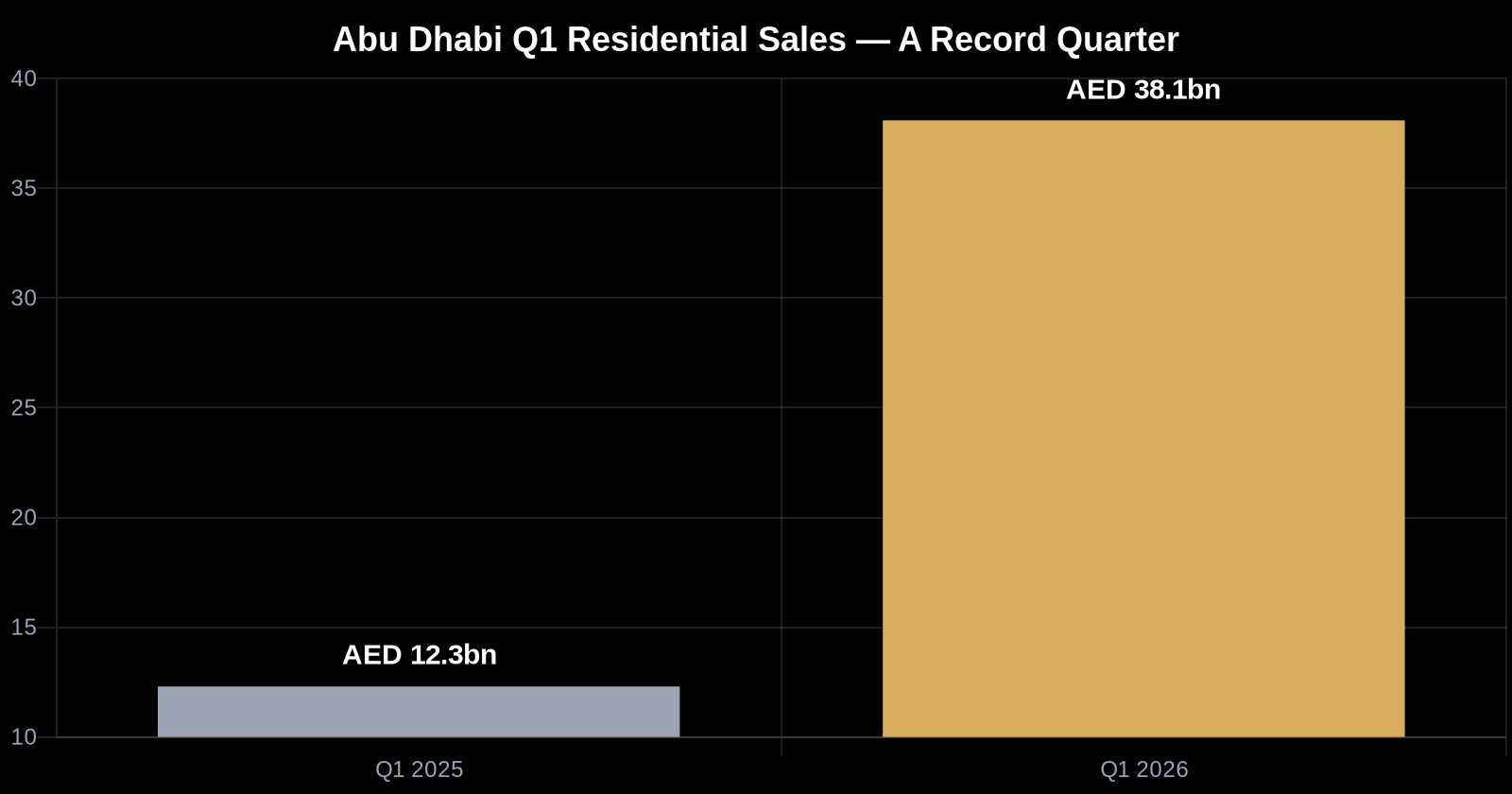
This is the divergence investors should be watching most closely. Abu Dhabi is operating on a different cycle to Dubai right now — earlier in its supply build-out, anchored by sovereign-linked demand and an institutional developer base, and less exposed to the speculative froth that ran through Dubai in 2024–25.
New supply continues to come, with Aldar this week launching a 217-home community at Yas Acres. For portfolios concentrated in Dubai, the case for cross-emirate diversification has rarely been clearer in the data.
Explore curated office and retail opportunities at Mitchell’s Commercial Realty.
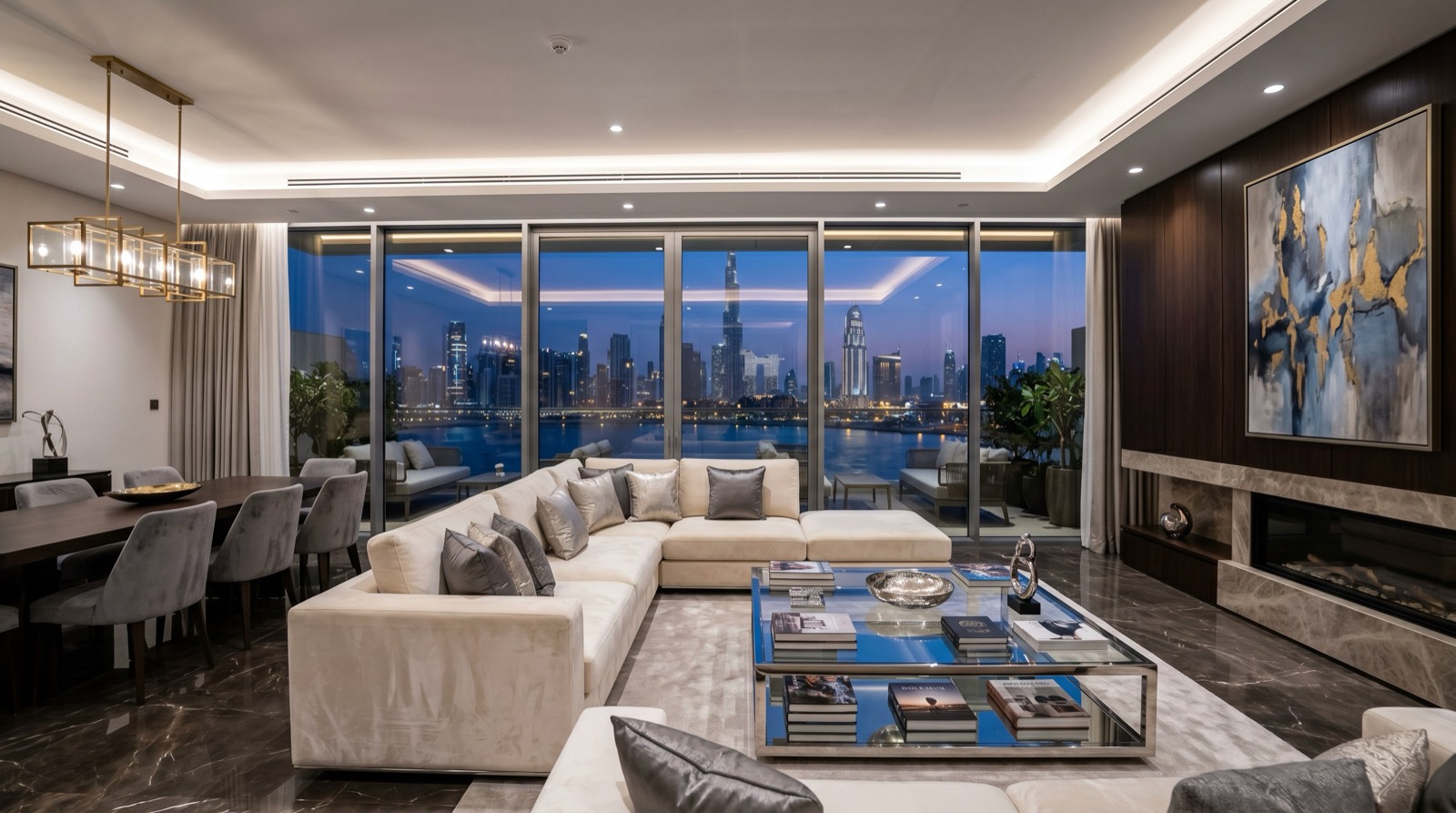
The resilience at the top end is clearest in the rental market. Analysis of new leasing contracts shows the annualised value of new Dubai villa rental contracts above AED 1 million rose 27% year-on-year to AED 509 million in the first five months of 2026, with renewals above AED 1 million up 28% to AED 114 million. Seven of those new contracts exceeded AED 10 million a year, with Palm Jumeirah and Dubai Hills Estate leading the segment.
The picture is clear. With buyers in the sales market turning more cautious, wealthy occupiers are opting to rent prime properties at record levels rather than commit capital to purchases in this uncertain environment. There simply isn’t enough top-tier trophy stock to satisfy the demand. For owners of genuinely scarce villa and waterfront assets, rental income is strengthening even as headline capital values soften. This is why I continue to direct investors toward properties with real scarcity value instead of more commodity-style stocks.
The Buyer Base Recalibrates: Smaller Deals and Better Financing
The demand picture is not collapsing; it is recalibrating. Among Indian buyers — historically the largest foreign cohort in Dubai — inquiries remain below pre-conflict levels. The preferred ticket size has fallen to roughly AED 1.2–1.5 million, down from AED 2 million and above, with a clear shift toward smaller, rental-yielding units over trophy purchases. Part of that is risk appetite; part is competition from higher-yielding alternatives back home.
Financing, meanwhile, has turned more attractive. Dubai buyers are moving to lock in fixed-rate mortgages starting from 3.75%, with first-time buyers of ready property able to borrow up to 80% loan-to-value. For yield-focused investors, the combination of lower borrowing costs and softer entry prices improves the math — as long as rates stay supportive. Which brings us to the week’s most important caveat.
The Fed Twist: The Rate Window May Be Closing, Not Opening
Here is the week’s biggest caveat. At its June 17 meeting — the first chaired by Kevin Warsh — the US Federal Reserve held rates at 3.5–3.75% by a unanimous 12–0 vote but turned distinctly hawkish. The median projection now points to a higher rate path, with the 2026 forecast rising to 3.8% from 3.4% in March. Nine of eighteen policymakers now expect at least one rate hike this year.
Since the dirham is pegged to the US dollar, UAE monetary policy effectively imports the Fed’s stance. The takeaway for property investors is counterintuitive against the local “mortgage rates are falling” headlines: the global rate cycle has just tilted away from cuts and toward a possible hike.
If you have been waiting for materially cheaper money before financing a purchase, this week argues the better-priced window may be the one in front of you now, not a lower one later. I don’t try to time rates to the last basis point, but it makes sense to underwrite with a flat-to-higher rate path in mind instead of counting on further relief.
| Financing & the rate backdrop | Reading |
|---|---|
| Dubai 1-year fixed mortgage | From 3.75% |
| First-time buyer LTV (ready property) | Up to 80% |
| US Fed funds target (held, June 17) | 3.5%–3.75% |
| Fed median 2026 projection | 3.8% (up from 3.4% in March) |
| Officials seeing a 2026 hike | 9 of 18 |
One regulatory change this week deserves more attention than it received. The new UAE Civil Code (Federal Decree-Law No. 25 of 2025) took effect on 1 June 2026, replacing the 1985 version that had governed property and contract law for four decades. Key changes relevant to real estate include a formal good-faith obligation at the pre-contract stage (covering reservation agreements, MoUs and heads of terms), greater scrutiny of standard-form contracts, and a set of lease-law updates covering holding-over, landlord security over tenant property, and tenant-improvement compensation.
This is not a headline-grabbing item, but it rewires the legal framework for every deal and lease in the country. Investors signing reservation agreements or putting together leases should check their documents against the new rules. In a softer market, the small print is exactly where value gets protected — or slips away.
Infrastructure Repricing: the Gold Line Puts the Map in Play
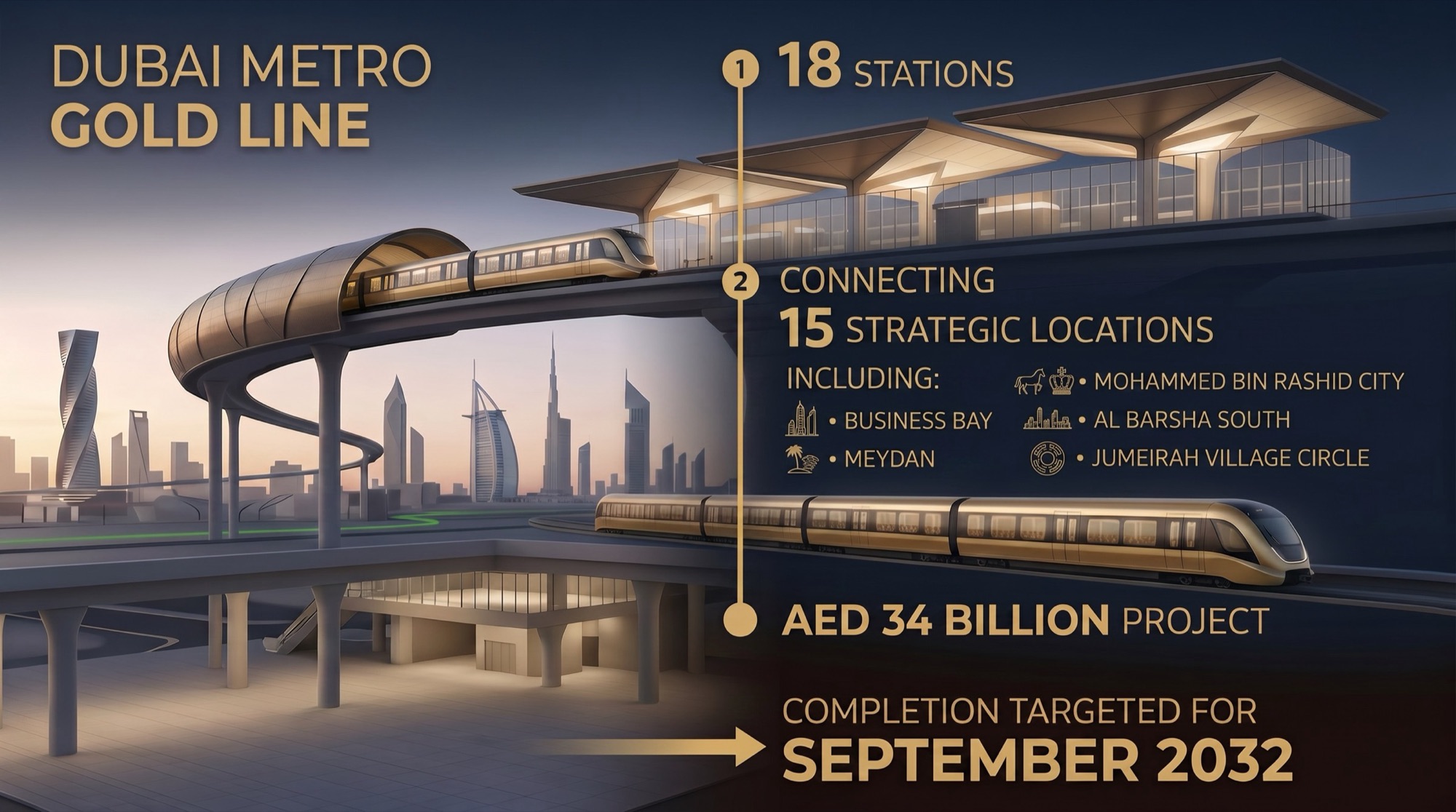
Longer term, capital continues to follow infrastructure. Attention this week turned to Dubai’s planned AED 34 billion Gold Line metro, a fully underground line of 18 stations connecting 15 strategic locations, with completion targeted for September 2032. Communities along the route, including Jumeirah Village Circle, Mohammed Bin Rashid City, Meydan, Al Barsha South, and Business Bay, are already being repriced by investors getting ahead of the future connectivity.
The mechanism is well established: transport infrastructure pulls forward land and rental values across a multi-year horizon. The key is not to overpay today for a benefit that is still six years away. Double-digit uplifts near stations are plausible in direction, but they are forecasts, not certainties, and they depend on the line being delivered on time. Patient capital can do well here; the risk is paying 2032 prices in 2026.
The Macro Frame: A Trough Year Before the Rebound
The week reinforced the broader shape that is now familiar: a challenging 2026 followed by a strong recovery. ICAEW and Oxford Economics forecast the GCC economy contracting 2.4% in 2026 before expanding 8.1% in 2027 as oil output normalises. Against that short-term pressure, the structural strengths remain: the UAE ranked first globally for economic performance (and fifth overall) in the IMD World Competitiveness Yearbook 2026, leading the region for the tenth year running.
Finally, the backdrop against which all of this sits. The week reinforced a now-familiar shape: a difficult 2026 followed by a sharp recovery. ICAEW and Oxford Economics projected the GCC economy will contract 2.4% in 2026 before rebounding 8.1% in 2027 as oil output normalises.
Against that near-term weakness, the structural strengths remain: the UAE ranked first globally for economic performance (and fifth overall) in the IMD World Competitiveness Yearbook 2026, leading the region for the tenth year running.
The government also moved to address the conflict’s central vulnerability directly, announcing a plan to reduce reliance on the Strait of Hormuz toward “zero” through expanded Gulf-of-Oman port capacity at Fujairah, Khor Fakkan, and Dibba, plus new pipelines and rail links. It is a multi-year strategic hedge against precisely the risk that has weighed on the market — and a clear indication of how seriously the leadership treats long-term investor confidence.
Final View for Dubai Property Investors
This week confirmed a market in transition. Sentiment has turned positive faster than the hard data, creating a classic gap where risks and opportunities both sit. The actionable takeaway is clear: focus on the stronger half of the market. Prioritise Abu Dhabi exposure, prime scarce assets with rental income, and underwrite conservatively with a flat-to-higher rate outlook in mind. Let motivated sellers set your price rather than chasing improving headlines. The cycle is likely bottoming, but patience on entry will matter more than timing the exact turn.
Next step
Let’s Talk
If you’d like to unpack where the most resilient opportunities are emerging — in stabilised residential areas or income-generating commercial zones — I’d be happy to share a focused, data-driven shortlist based on your investment goals.
📞 No pressure, no sales pitch—just a focused, informed conversation about your investment goals.
Published 22 June 2026 by Stephen James Mitchell MBA. Market figures quoted reflect the data available at that date.