The central divide in Dubai’s property market stood out clearly this week. Developers launched a record AED 275 billion (USD 74.9 billion) of new projects in the first half of 2026 — the largest half-year pipeline the emirate has ever seen. Meanwhile, the resale and rental markets continued to cool, with villa and townhouse rents falling 2.1% between March and May and capital values declining for a third consecutive month.
Record supply is landing in a market that is still finding its level. This tension defines the current phase of the cycle and will likely determine where investors make or lose money over the next two years.
The week also brought a notable policy development. Dubai Land Department launched a new "Flexi Rent" scheme allowing tenants to pay rent in monthly instalments — a direct response to affordability pressures in the rental market.
On the macro front, S&P quantified the economic impact of the recent conflict, while fresh foreign investment data showed the underlying demand base continuing to broaden.
Below, I examine how these developments fit together, what the supply surge means for pricing through the rest of 2026, and where the more resilient pockets of the market sit.
If you’re weighing entry points while this market reprices, I can show you where the risk-adjusted opportunities are emerging. Click here to speak with me directly.
The Supply Surge: A Record AED 275 Billion in Launches
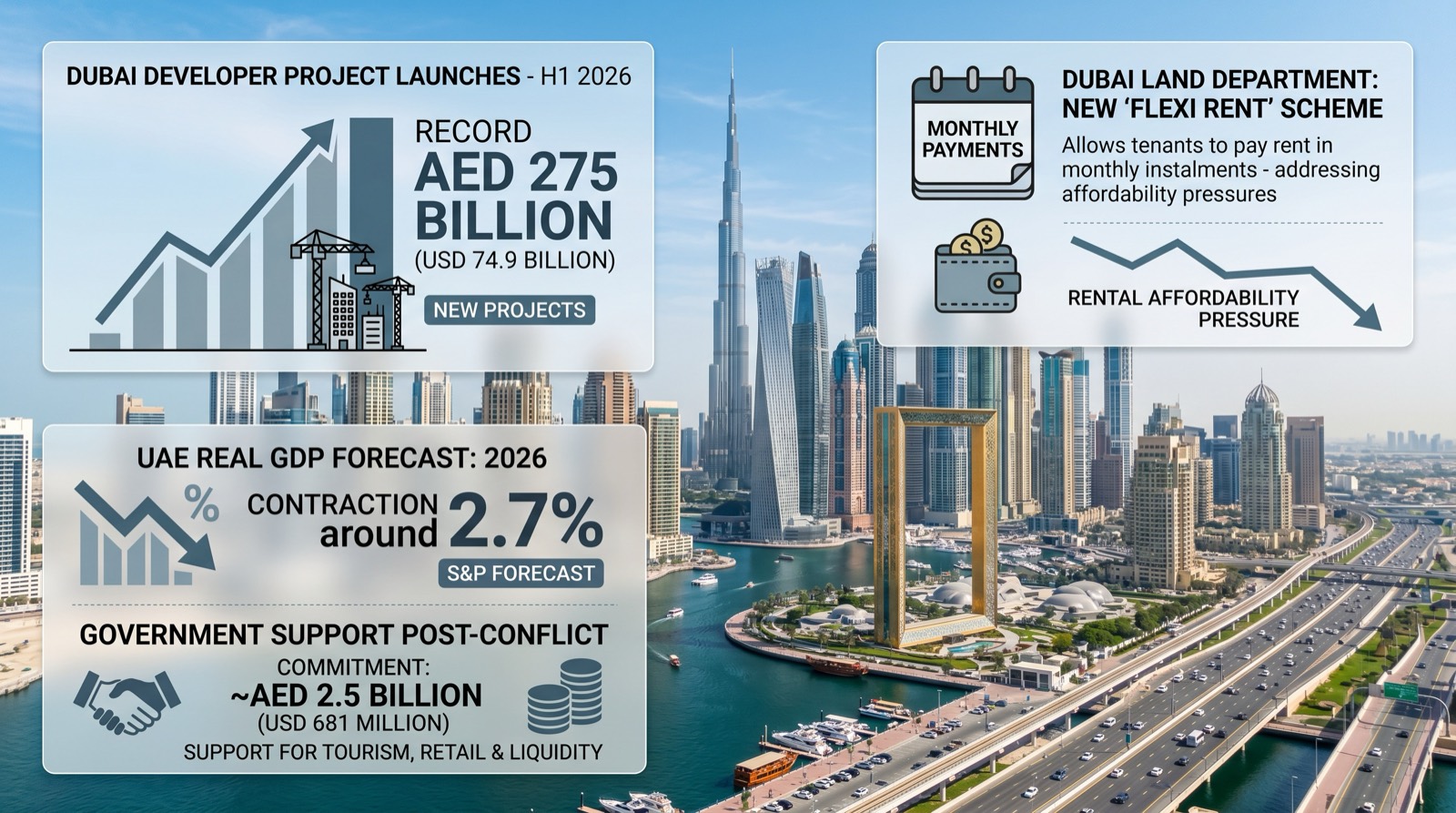
The standout figure this week was the launch pipeline. Dubai recorded more than AED 275 billion (USD 74.9 billion) in new and announced real-estate projects in the first half of 2026 — the largest half-year total on record. Around 250 new projects were registered with the Land Department through the end of May, with Emaar's recently unveiled mega-district accounting for a large portion of the value.
A pipeline of this size, coming in the middle of a regional conflict, shows that developers remain confident in Dubai’s long-term prospects. For investors, however, it cuts both ways. It reinforces long-term belief in land and community values along key growth corridors, but it also adds significantly to future supply.
The additional supply, more than anything else, is likely to be what limits rental growth and secondary-market pricing as these projects deliver into 2028 and beyond.
The practical implication is clear. In a market adding inventory at this pace, the risk is not missing the cycle — it is overpaying for a product that will face direct competition from a wave of similar launches. Entry price and developer track record matter more at this point in the cycle than they have at any stage since 2021.
According to Cavendish Maxwell, Dubai residential rents rose just 0.4% month-on-month from April to May and fell 1.1% over the three months to May. Apartment rents dropped 0.9% while villa and townhouse rents declined 2.1% over the same period. Around 18,200 units have been delivered so far this year, 13.1% more than the same period in 2025. This added supply is real and is giving tenants negotiating leverage they haven’t had in years.
Context matters. Rents are still around 9% higher than a year ago and roughly 44% above 2020 levels. What we’re seeing is a flattening after an exceptional run, not a reversal.
On the capital values side, the ValuStrat Price Index eased 1.2% in May — a third consecutive monthly decline, but a far gentler one than the 5.9% drop recorded in the war-shock month of March. Annual growth remains positive at 2.5%.
Three straight monthly declines confirm the market has passed its 2024–25 peak. But the slowing pace of the fall — from nearly 6% to just over 1% — suggests an orderly adjustment rather than a sharp correction. For buyers, this is the most constructive entry environment in two years: more choice, greater negotiating room, and sellers who are starting to accept where the market stands.
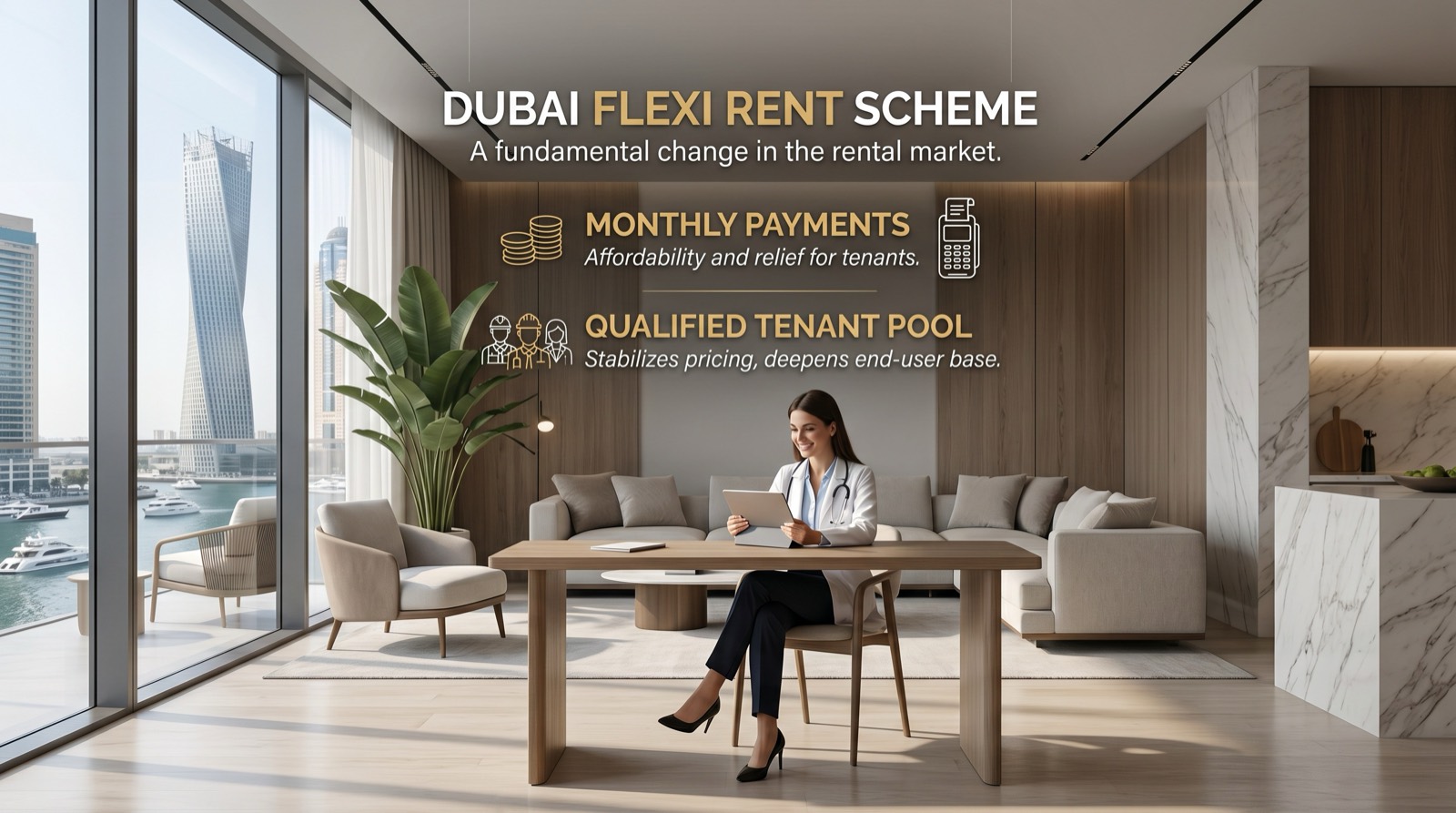
The Dubai Land Department launched "Flexi Rent," a new scheme that allows tenants to pay rent in monthly instalments instead of the traditional one-to-four cheques upfront. The scheme launched in partnership with twelve real estate firms, including Wasl, Deyaar and Driven Properties. The total rent owed remains the same regardless of payment frequency, bounced-cheque penalties are waived, and card payments are accepted.
Flexi Rent marks a fundamental change in how Dubai's rental market operates. For landlords, monthly payments add some administrative work and default risk, but they also open the door to a broader pool of qualified tenants — especially salaried professionals who form the backbone of mid-market demand and have long struggled with the traditional upfront payment system.
For the market overall, introducing affordability relief at a time when supply is sound counter-cyclical policy. It deepens the end-user base at a point in the cycle when that base is exactly what stabilises pricing.
Abu Dhabi’s Quieter Recovery Continues
While Dubai captures attention with record launches and cooling prices, Abu Dhabi continues its steadier path. Portal data from Bayut and dubizzle showed search and engagement activity in the capital recovering to around 95% of its 2026 baseline by mid-quarter, with buyers and tenants returning to both ready and off-plan properties. Off-plan demand has been particularly resilient — Abu Dhabi accounted for around 70% of off-plan activity tracked this year, a telling indication of where committed capital is flowing.
The completed sales data makes the picture more concrete. Aldar sold out The Orchids at Yas Acres, generating more than AED 680 million (USD 185 million) in townhouse sales, with UAE nationals making up 54% of buyers and 73% purchasing from Aldar for the first time. A buyer base that is predominantly domestic, first-time and owner-occupier is structurally more durable than one driven by speculative or discretionary foreign demand.
New business licences in Abu Dhabi also rose 21% year-on-year in Q1, confirming that the population growth and business formation underpinning housing demand remain intact despite the conflict.
For investors with a Dubai-heavy portfolio, the case for diversifying into Abu Dhabi has rarely been stronger. The capital is earlier in its supply cycle, better anchored by domestic and institutional demand, and less exposed to the speculative correction now working through parts of Dubai.
AED 124 Million Business Bay Office Sale Confirms Prime Commercial Demand Remains Intact
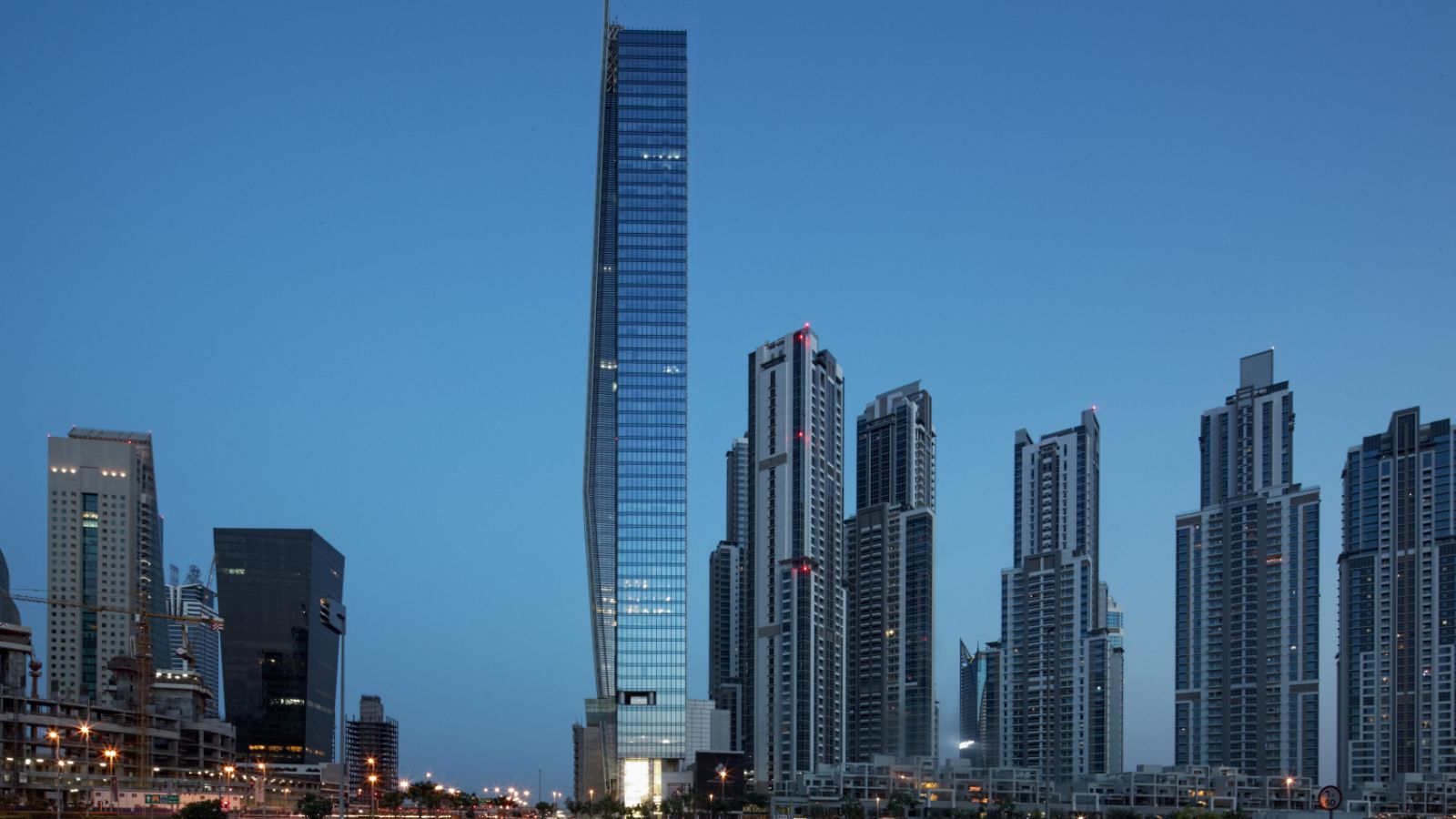
The week's standout commercial deal confirmed that prime commercial assets are still attracting serious capital. Around 40,000 square feet of Grade-A office space at Vision Tower in Business Bay sold for AED 124 million (USD 33.8 million) — one of the largest deals of its kind in Dubai. A UAE-based company acquired the space as a contiguous multi-floor block.
Owner-occupiers and investors acquiring whole floors of prime, centrally located office stock while the residential resale market cools points to capital still committing decisively to scarce, income-grade commercial assets. Dubai's Grade A office market remains structurally undersupplied, and transactions at this scale confirm the office market is running on a tighter, different cycle to mid-market residential.
Explore curated office and retail opportunities at Mitchell’s Commercial Realty.
The War's Economic Cost in Numbers: S&P Projects 2.7% Contraction and Recovery by 2027
| S&P Macroeconomic Outlook | Data |
|---|---|
| UAE real GDP, 2025 | +6.2% |
| UAE real GDP, 2026 (f) | -2.7% |
| Abu Dhabi GDP, 2026 (f) | ~ -9% |
| Dubai GDP, 2026 (f) | ~ -2.5% |
| Oil output | 2.5–2.6m bpd (2026) → ~4m (2027) → 5m (2029) |
The week’s most important macro update came from S&P Global Ratings, which published detailed numbers on the conflict’s economic impact. S&P forecasts UAE real GDP contracting around 2.7% in 2026, following 6.2% growth in 2025. Abu Dhabi’s oil-heavy economy is expected to shrink roughly 9%, while Dubai’s more diversified economy contracts around 2.5%. The main driver is the sharp reduction in oil output — down to 2.5–2.6 million barrels per day in 2026 from 3.14 million in 2025 — as a result of the disruption.
The recovery is already built into the outlook. S&P expects output to rebound toward 4 million barrels per day by 2027 and 5 million by 2029, supported by ADNOC’s roughly USD 150 billion capital programme. Strong fiscal buffers and ongoing economic diversification should help cushion the near-term hit.
For property investors, the takeaway remains consistent: this is a deep but temporary downturn set against a very strong balance sheet. The 2026 figures look tough on their own, but the trajectory from 2027 onward is what supports the medium-term outlook.
A Record 2025 Gives Dubai a Cushion Against the 2026 War Shock
The structural strength Dubai built before the conflict is now serving as its buffer. The emirate attracted a record 1,253 new foreign direct investment projects in 2025, drawing AED 32.4 billion and creating nearly 39,000 jobs — an 18.8% increase in employment year-on-year. This kept Dubai as the world's top destination for greenfield FDI for the fifth consecutive year through 2025.
These figures predate the conflict, so they reflect the starting position rather than today’s conditions. But the distinction is important: the job base built through 2025 continues to support housing demand through this softer period, even as fresh investment decisions pause while the conflict lingers.
Behind the scenes, Dubai has also moved quickly to protect its position as a global hub. Reuters reported the government convened business leaders after the conflict and committed around AED 2.5 billion (USD 681 million) in support, largely aimed at tourism and retail, alongside a central bank liquidity package.
Against a 2024 real GDP of roughly USD 121 billion, the package is modest in scale — but it shows an administration actively defending Dubai's hub status rather than waiting out the shock, which is what matters most to long-term investor confidence right now.
Final View for Dubai Property Investors
One conclusion runs through everything this week: supply, not demand, is now the dominant variable that will shape returns. For much of the cycle the key question was whether you were in the market. That question has now shifted to what you own and at what price.
A record pipeline means almost everything purchased today will soon face newer, competing inventory.
This completely reframes the cooling. Softer prices and greater negotiating room are not reasons to stay on the sidelines — they are the conditions that allow disciplined buyers to enter well. The real risk lies in paying a premium for assets that the pipeline can replicate at scale. Scarcity is the only reliable protection against the supply still to come.
The right stance now is clear: focus on assets that cannot be easily duplicated, underwrite income conservatively as if rents stay flat, and view this repricing as an opportunity rather than a threat.
Next step
Let’s Talk
If you’d like to unpack where the most resilient opportunities are emerging — in stabilised residential areas or income-generating commercial zones — I’d be happy to share a focused, data-driven shortlist based on your investment goals.
📞 No pressure, no sales pitch—just a focused, informed conversation about your investment goals.
Published 29 June 2026 by Stephen James Mitchell MBA. Market figures quoted reflect the data available at that date.