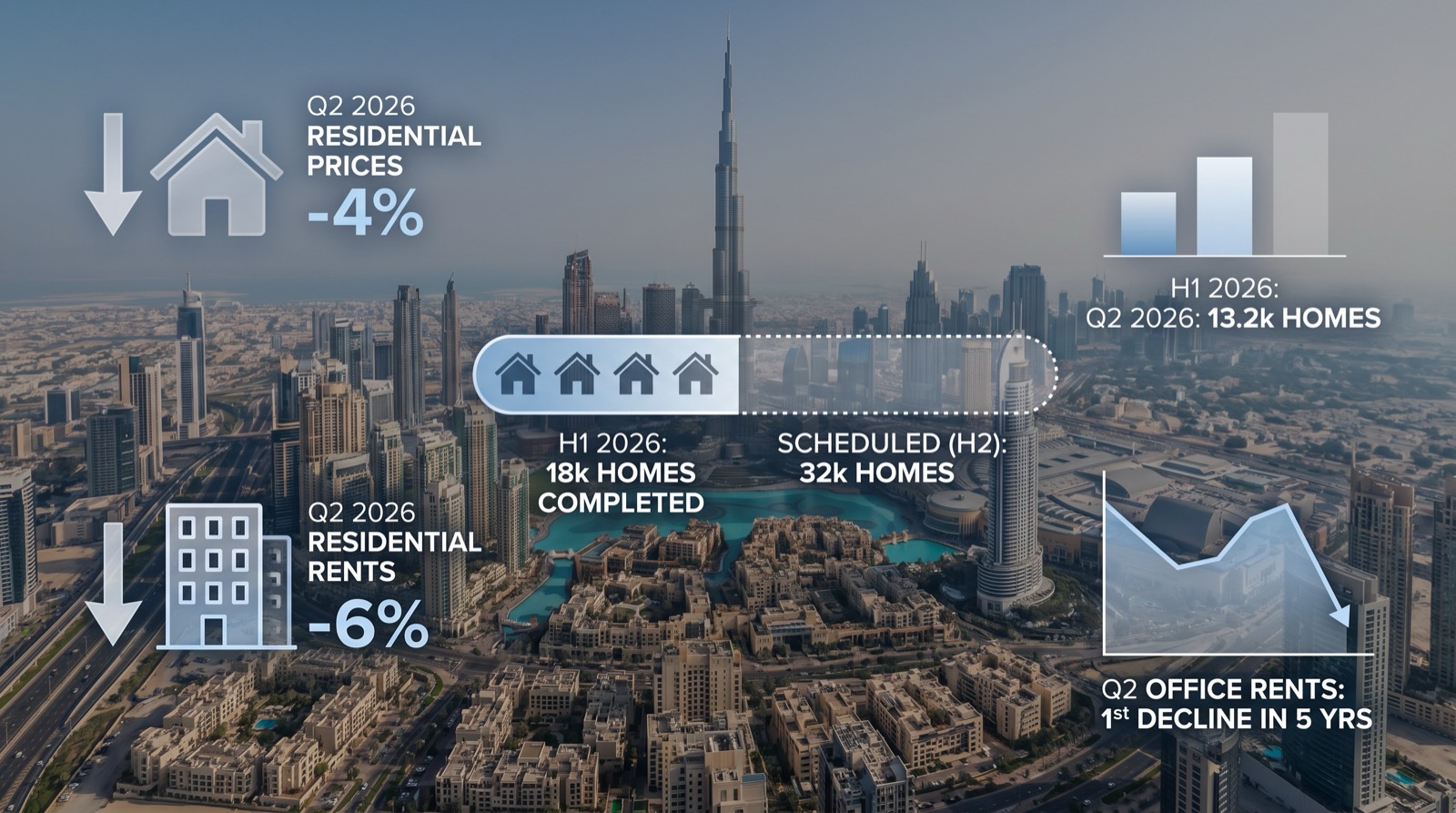
Dubai residential prices fell 4% in Q2 2026, and rents fell 6%, according to Cushman & Wakefield Core data released this week. Both are quarterly figures, and both mark a clear break from the past five years.
Volume did not follow prices down. Ready-home sales reached a six-month high in July 2026, and the Land Department registered AED 9.58 billion in the week to 14 August. Buyers are transacting at the new level rather than waiting for a lower one. That is what an absorption cycle looks like when demand holds and supply runs temporarily ahead of it.
Supply is the reason. Dubai completed about 18,000 homes in H1 2026, with a further 32,000 scheduled before year-end.
Abu Dhabi completed roughly 3,450 homes over the same period. For the first time, Abu Dhabi now trades higher per square foot than Dubai, at AED 2,005 against AED 1,937 in July, according to Bayut data.
The gap between falling prices and holding volumes is the week's central finding, and it governs how the rest of this data should be read.
If you're weighing entry points while this market reprices, I can show you where the risk-adjusted opportunities are emerging. Click here to speak with me directly.
| UAE residential, 2026 year-to-date (ADREC and DLD, via AGBI) | Data |
| Abu Dhabi sales including mortgaged deals | AED 111bn YTD vs AED 118bn full-year 2025 |
| Abu Dhabi transactions | ~31,000 YTD vs ~41,000 full-year 2025 |
| Abu Dhabi deal growth, year-on-year | +86% in Q1, +50% in Q2 |
| Dubai residential transactions, Q2 | ~−33% year-on-year |
| Dubai residential sales value, Q2 | ~−40% year-on-year |
| Price per sq. ft., July (Bayut) | Abu Dhabi AED 2,005 / Dubai AED 1,937 |
Dubai residential transactions fell roughly a third year-on-year in the second quarter, with sales values down close to 40%.
Abu Dhabi went the other way. AGBI's assessment of Abu Dhabi Real Estate Centre data puts capital sales at AED 111 billion by mid-August. That is within 6% of the AED 118 billion the emirate recorded across all of 2025.
Abu Dhabi is reaching that total on fewer deals. Roughly 31,000 transactions have produced AED 111 billion this year, an average of about AED 3.6 million each.
Last year took around 41,000 transactions to produce AED 118 billion, averaging roughly AED 2.9 million. The average deal has grown 24% while the number of deals has shrunk — buyers are spending more per purchase, not buying more often. Growth in deal count ran 86% ahead of last year in the first quarter, then halved to 50% in the second.
What separates the two emirates is how much stock each is releasing. Abu Dhabi completed 1,834 apartments and 1,620 villas in the first half, just under a fifth of what it expects to deliver across the full year. Dubai handed over more than 13,200 units in the second quarter alone.
Aldar has applied the same restraint at company level, and its results show what that costs and what it protects. First-half net profit rose 18% year-on-year while new launch sales fell 43%, after the developer pulled back on releases when the conflict began. Selling less and earning more is the trade a developer makes when deciding not to chase volume into a falling market.
| Dubai residential, Q2 2026 quarter-on-quarter (Cushman & Wakefield Core) | |
| City-wide sale prices | −4% |
| City-wide rents | −6% |
| Units completed in Q2 | 13,200+ |
| Further units due in H2 2026 | ~32,000 |
According to Cushman & Wakefield Core, Dubai sale prices fell 4% quarter-on-quarter in Q2 and rents fell 6%. The firm found corrections spreading across most apartment and villa submarkets after five years of exceptional growth. It expects the softening to continue while volumes stay subdued and buyers and sellers disagree on price.
More than 13,200 homes were completed in Q2. Sobha Hartland, DAMAC Lagoons and Jebel Ali Village were among the sites handing over. Another 32,000 units are scheduled before year-end, though the firm expects contractor capacity and supply chain constraints to affect handovers in coming months. Dubai has consistently delivered below its announced pipeline, so treat 32,000 as a ceiling rather than a forecast.
For a landlord, the rental figure is the one that bites first. A 6% rent reset takes an asset bought at a 6% gross yield down to roughly 5.6% on original cost, before any change in service charges or vacancy.
Community-level declines run well beyond the city-wide average. Owners in heavily supplied submarkets are therefore facing considerably more than a 6% reduction.
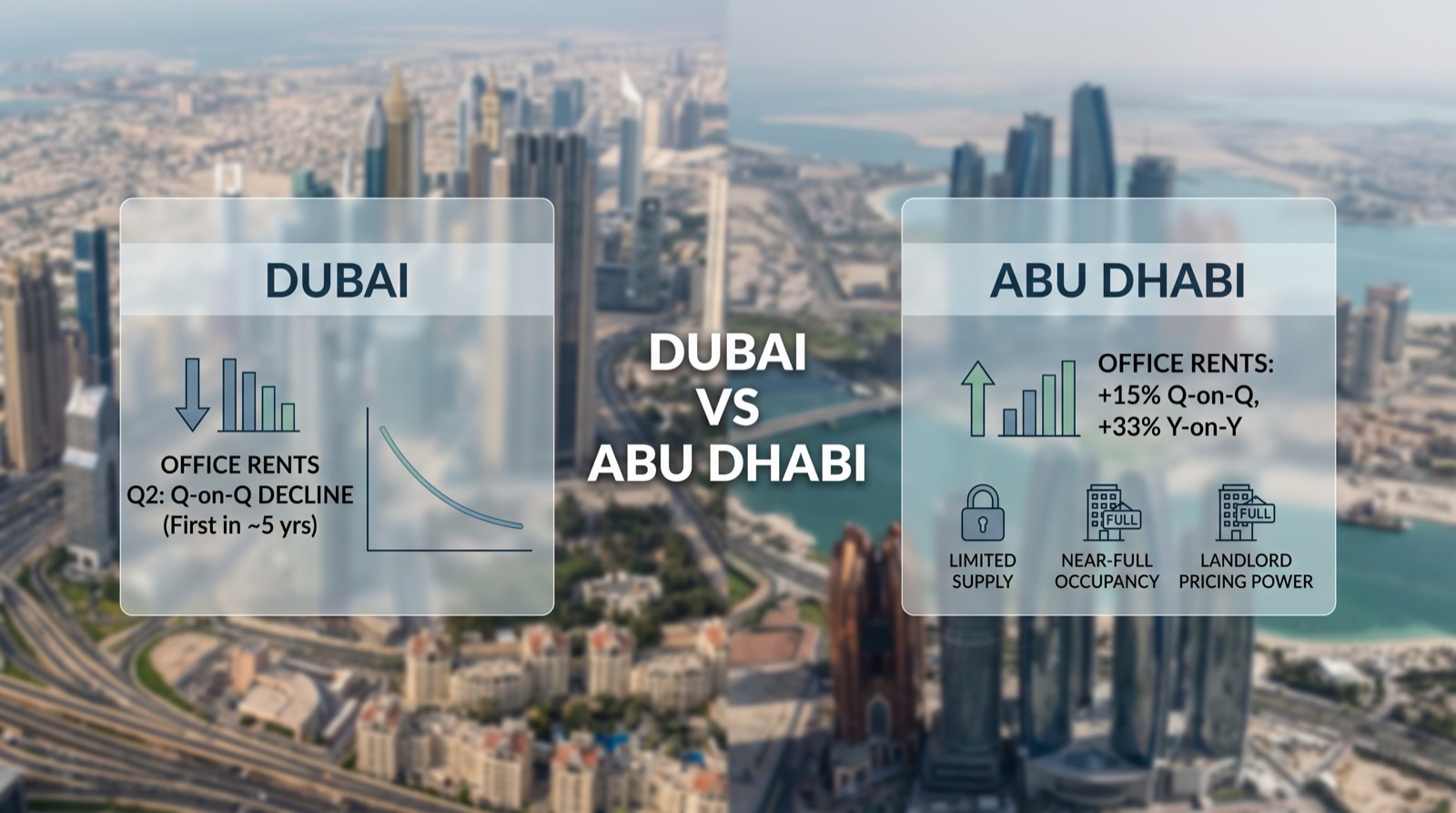
Dubai office rents fell quarter-on-quarter in Q2 2026, the first such decline in nearly five years according to Cushman & Wakefield Core. Leasing activity softened, and secondary stock began returning to the market, easing conditions in a segment that has been tight since 2021.
That sits awkwardly against the office data covered in the 1 August and 8 August weekly reports. JLL recorded Dubai Grade B rents up 31.5% year-on-year; CBRE put average office rent growth at 13%. Both numbers are still correct. They cover a twelve-month period, eleven months of which preceded the recent turn of events.
Abu Dhabi has not softened at all. Office rents there rose 15% quarter-on-quarter and 33% year-on-year. Limited new supply and near-full occupancy continue to leave pricing power with landlords.
One quarter does not establish a trend, and Dubai office fundamentals remain tighter than residential. But an investor underwriting Dubai commercial on the strength of the past two years is now working from figures that describe a period the market has left.
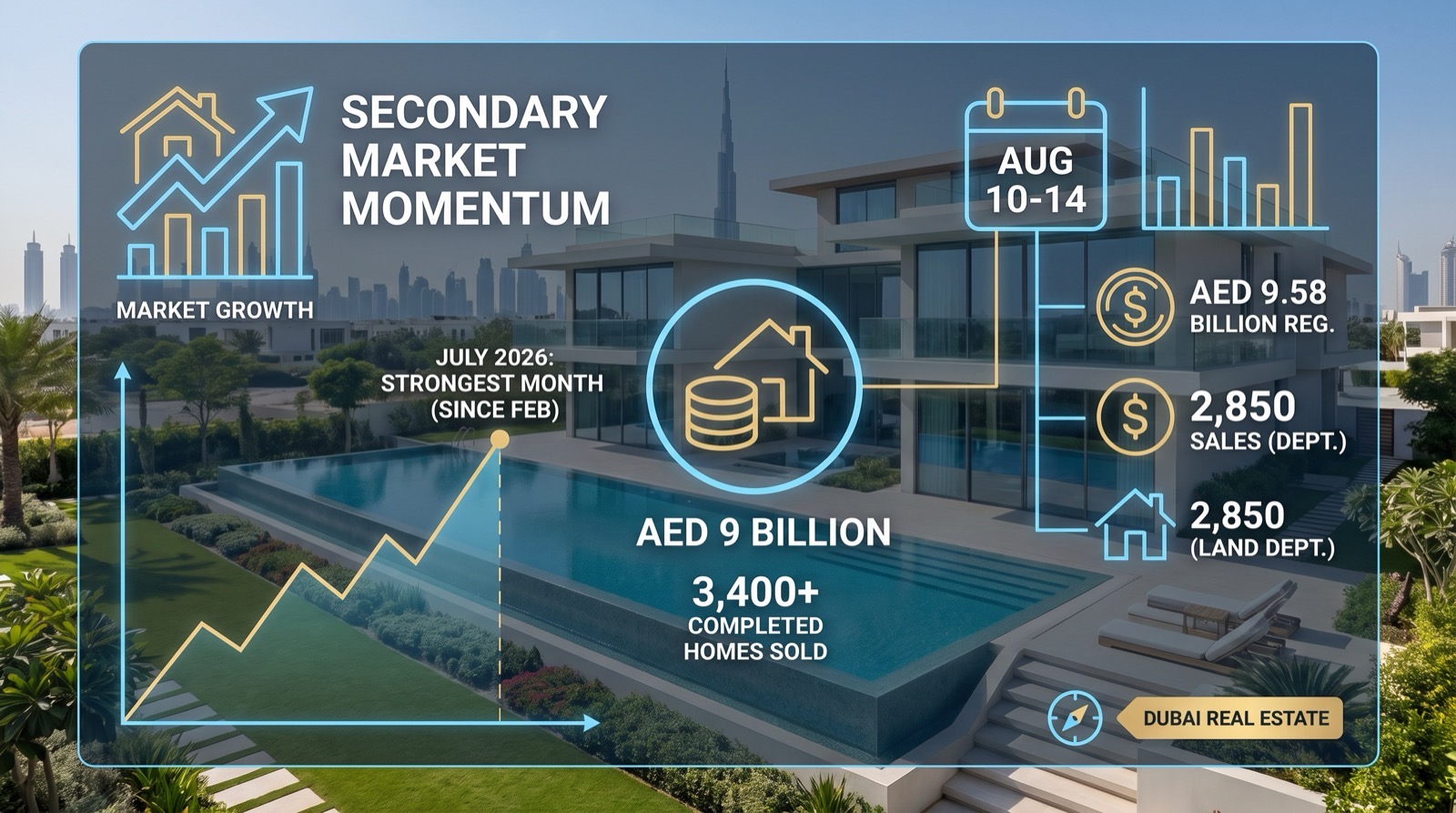
Dubai's secondary market had its strongest month since February 2026. More than 3,400 completed homes sold for AED 9 billion in July. In the week from 10 to 14 August, the Land Department registered AED 9.58 billion across 2,850 sales.
The largest single deal was an apartment at Orla Infinity on Palm Jumeirah at AED 79 million.
A six-month high does not equal a recovery, and the year-to-date picture remains considerably weaker. Combined ready and off-plan sales from January through July totalled AED 247.2 billion across 92,130 transactions. Cumulative value is down 21% year-on-year and transaction numbers are down 17%. July was a strong month inside a materially softer year.
The divergence between the two segments is the more useful signal. Off-plan still accounts for the majority of volume — 9,475 Oqood registrations in July, or roughly 73% of all residential sales. Yet that figure stood 45.3% below its July 2025 level even as completed-home sales reached a six-month peak.
Buyers who want a Dubai property are increasingly choosing one they can see, price and rent out today rather than one scheduled for completion in 2029.
According to Dubai Land Department data reported by Gulf News, 186 new real estate development companies entered the market between January and mid-August 2026 — an average of roughly 25 a month. The Department of Economy and Tourism issued 180 of those licences. Trakhees issued three, the Mohammed bin Rashid Establishment for SME Development two, and Expo City Dubai one.
New developers forming in a falling market is a supply signal worth monitoring. It is first and foremost a counterparty question. New entrants typically operate with thinner balance sheets than established names. Off-plan sales are the funding source they rely on most, and that segment has already contracted 45% in a year.
What has changed this summer is the consequence of failure. The UAE Cabinet activated the emergency financial-crisis provisions of the bankruptcy law under Cabinet Decision No. 94 of 2026, issued on 1 June. These cover businesses whose distress is directly linked to the conflict and that seek court protection after 28 February 2026.
The provisions have been in force since June; what emerged this week was the legal profession’s practical reading of how they operate.
While the provisions remain active, creditors cannot initiate bankruptcy proceedings against a defaulting debtor. A restructuring approved by two-thirds of creditors binds all of them. As Katharina Schaub of Dentons observed, the government “doesn’t create a new law. It simply switches on the temporary rules that already exist.” No end date has been fixed; a future Cabinet decision will set one.
For a buyer holding off-plan paper from a smaller developer, this alters the recovery position. A minority creditor who votes against a restructuring can still be bound by it. Escrow protection under Law No. 8 of 2007 remains intact, so deposits stay ring-fenced. The real exposure lies in the delivery timeline rather than the deposit itself — which makes the identity of the counterparty more material than it was in July.
Still reading
Need expert help on this subject?
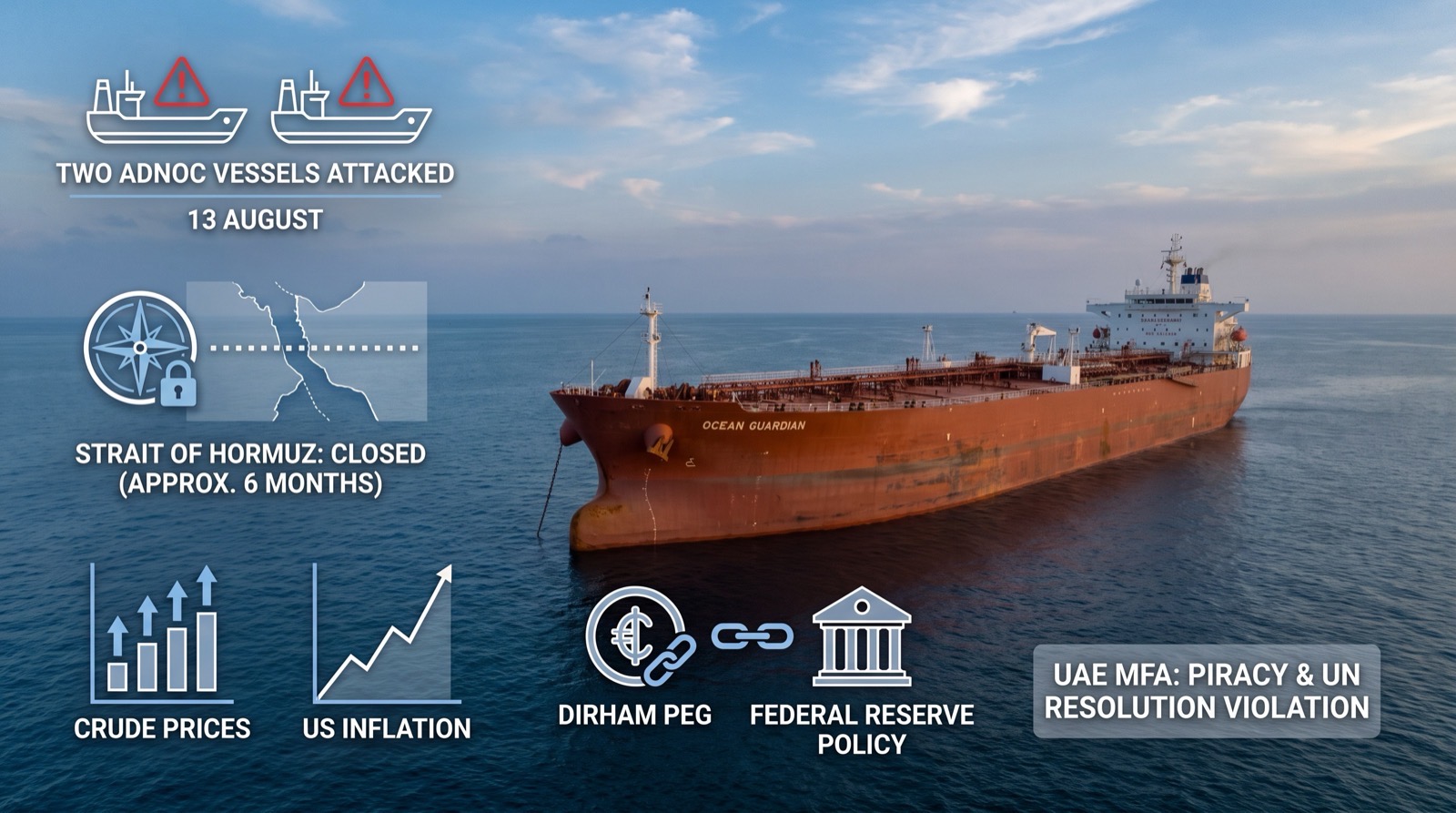
Two ADNOC vessels were attacked overnight on 13 August. The UAE Ministry of Foreign Affairs condemned the strikes as piracy and a violation of the UN resolution affirming freedom of navigation. The Strait of Hormuz has now been effectively closed for nearly six months.
The human and operational costs exceed the shipping statistics. ADNOC has had 15 vessels attacked since the conflict began, three of them in the week of 10–14 August. One crew member was killed and 20 injured.
The company stated that it has been significantly affected while continuing to meet customer requirements in what it described as an exceptionally challenging environment.
Rather than wait for the strait to reopen, ADNOC has built an alternative system. The state energy company runs shuttle tankers past the Musandam Peninsula, transfers crude to chartered vessels at anchorage off Fujairah, and now moves Iraqi crude through the same network. That is exactly why its ships have become the primary target: they remain the vessels still moving oil through the strait.
The path from a tanker strike to a Dubai mortgage is short. Prolonged conflict keeps crude prices elevated. Higher crude keeps US inflation above target. And the dirham peg imports whatever policy response the Federal Reserve adopts.
Section 07
US Inflation Eased in July but the September Rate Decision Is Still Open — and UAE Borrowers Are on the Hook Either Way
US headline CPI rose 0.1% in July and 3.4% year-on-year, down from 3.5% in June, with core at 2.5%. Both figures matched forecasts. For a Dubai borrower this is not remote information: the UAE Central Bank follows Federal Reserve policy with no independent rate tool, and EIBOR sets the local mortgage rate.
Cooler inflation did not settle the September question. Futures had priced a hike at roughly even odds before the release. Immediately afterwards, CME FedWatch showed a 61.9% probability of a hold at 3.50–3.75%, with hike odds at 38.1%. By 13 August, CME hike pricing had moved back to around 44% while prediction markets held at 32–33%.
Two markets interpreting the same data five weeks before the 16 September decision, and still twelve points apart. That is genuine uncertainty, not consensus. Energy keeps the question open. Gasoline fell 1.5% month-on-month in July after a 5.7% drop in June, yet the energy component remains up 14.7% year-on-year.
The market is not pricing rate relief this year. The live question for September is whether costs rise. Futures show no EIBOR relief before 2027. Underwriting a Dubai acquisition on the assumption of lower financing costs means working against what the curve is currently pricing. The 1 August and 8 August weekly reports took the same position, and the data continues to support it.
In closing
Final View for Dubai Property Investors
A price correction can be a demand problem or a supply problem, and the distinction determines how long it lasts. This week's data points clearly to the second.
Demand problems need sentiment to recover, and sentiment cannot be scheduled. Supply problems clear on a timetable that is already published. Dubai's July ready-home sales hit a six-month high while prices fell — buyers are present and transacting, just not at last year's asking price. That is absorption, not a buyers' strike.
It follows that the completion schedule is a more reliable forecasting tool right now than any price index. Dubai has a pipeline equal to 36% of its existing housing stock, against 12% in Abu Dhabi, and roughly 29,300 units are due before year-end. Even at Dubai's habitual under-delivery rate, their locations are published well in advance. Which submarkets carry another year of rent pressure and which have already taken the hit is knowable today.
That points to a specific kind of seller. The one worth buying from holds an asset completed in the past eighteen months, in a community where the delivery wave has already passed. That seller has absorbed the repricing and settled into a stable rent roll. The one to avoid holds a unit in a district with 2027 completions still ahead of it, at a price anchored to a market that has not finished adjusting.
The interest-rate backdrop reinforces the same caution from the other direction. Futures still price a September hike near 44%, and the dirham peg leaves no local buffer. Being wrong on timing now carries a higher cost than it did previously. Buy where the remaining supply pressure sits behind the asset rather than in front of it.
Next step
Let’s Talk
If you’d like to unpack where the most resilient opportunities are emerging — in stabilised residential areas or income-generating commercial zones — I’d be happy to share a focused, data-driven shortlist based on your investment goals.
📞 No pressure, no sales pitch—just a focused, informed conversation about your investment goals.
Published 16 August 2026 by Stephen James Mitchell MBA. Market figures quoted reflect the data available at that date.