The UAE Ministry of Foreign Affairs announced late on August 18 that all trade, commercial exchanges and financial transactions with Iran have been halted until further notice. The statement was issued by Afra Al Hameli, Director of the Strategic Communications Department, after the Ministry of Defence reported two ballistic missiles launched from Iran that day, one of which fell inside UAE territorial waters.
There is no stated end date and no review mechanism.
In the same week, three official datasets landed that describe a property market still functioning. The Dubai Land Department reported 104 projects completed in the first half of 2026, worth AED 111 billion. The Abu Dhabi Real Estate Centre put H1 residential sales at AED 70.4 billion against AED 25.3 billion a year earlier. The Central Bank published its Financial Stability Report, showing mortgage lending grew 24% in 2025.
Also in the same week, thirty-year US Treasury yields reached their highest level since 2007, US federal debt passed $40 trillion, and minutes of the July 29 FOMC meeting revealed three voting members who wanted rates higher, not lower.
The property data describes the first half of the year. The financing and geopolitical data describes the last five days.
That gap is the whole of this week's analysis.
If you're weighing entry points while this market reprices, I can show you where the risk-adjusted opportunities are emerging. Click here to speak with me directly.
Section 01
The UAE Halted All Trade and Financial Transactions With Iran on August 18, With No End Date Stated
The Ministry of Foreign Affairs statement is short and unambiguous: all trade, commercial exchanges and financial transactions with Iran are halted until further notice, "in light of regional escalations that undermine regional and international peace and security." The statement adds that the UAE "remains firmly committed to safeguarding the integrity of the international financial system."
The scale of what has been switched off is harder to fix than the headlines suggest. Iranian customs data puts merchandise trade with the UAE at $21.3 billion across the first ten months of the last Iranian fiscal year — a ten-month figure, not an annual one. Official goods-trade series record far less. Neither captures Dubai's re-export, logistics and trade-finance role, which is the part that matters and the part nobody measures.
Iran called the missile accusations "baseless." Separately, Dr Anwar Gargash, diplomatic adviser to the UAE President, said on August 19 that reports of the UAE cancelling labour residencies or providing financial facilities to Iran were "untrue and part of desperate media campaigns."
For Dubai property, the transmission channel is not sanctions compliance — it is the trading, logistics and warehousing tenant base in Deira, Al Quoz and Jebel Ali that has serviced Iranian commerce for four decades. That exposure sits in the commercial rent roll, not the residential one, and it will show up in renewals over the next two quarters rather than in this week's numbers.
Section 02
Dubai Completed 104 Projects Worth AED 111 Billion in the First Half and Delivered 24,537 Homes, Up 36%
The Dubai Land Department released its H1 completions data on August 20. 104 projects were completed against 75 in the first half of 2025, a rise of 38.7%, with combined value up 52% from AED 73 billion to AED 111 billion. Units delivered climbed 36% to 24,537 from 18,043. The land value of completed projects rose 135% to AED 19.46 billion from AED 8.27 billion.
One clarification matters before the number travels further. The AED 111 billion is the investment and construction value of projects that reached completion — not sales, not transaction value, not developer revenue. It should never be set against the emirate's H1 sales figures.
The composition is the useful read. Value rose 52% while units rose 36%, putting the average completed unit at roughly AED 4.5 million of project value against AED 4.0 million a year earlier. Dubai is completing more expensive product, not simply more of it.
Delivery accelerating by more than a third into a half-year in which prices were falling is the supply-side confirmation of what the price series has signalled since Q2.
Section 03
Fitch Puts UAE Residential Transactions Down 19% in the Second Quarter as Developers Retreat to Funded Projects
Fitch Ratings published a note on August 18 on UAE homebuilders. The single hard figure in it is the important one: residential transactions across the UAE fell 19% quarter-on-quarter in Q2 2026, with new launches also materially lower, according to Diego Della Maggiore of Fitch's EMEA Real Estate team, as reported by Khaleej Times on August 19. That is a UAE-wide, quarter-on-quarter measure, and it should not be conflated with the year-on-year Dubai declines quoted elsewhere.
Fitch's behavioural finding is more useful than the number. Developers "have adapted to the current market environment by prioritising projects that have achieved certain thresholds in funding, capex and pre-sale rates." Larger developers can stage unit releases against execution capacity; smaller ones "may find this more difficult, especially if land, construction and financing costs stay high." Fitch's existing oversupply view stands, and is now "exacerbated by weaker demand," arriving "in phases, rather than through a steady fall in total supply."
This is the counterparty question in its clearest institutional form. Off-plan buyers are creditors of a construction programme. When a rating agency says small developers will struggle to phase releases, it is describing exactly where completion risk concentrates.
Section 04
Dubai Recorded 9,217 Sales in July, With Secondary Volumes Up 18% and Four in Five Apartments Bought Without a Mortgage
Property Finder's July analysis, published August 17, puts Dubai transaction volumes at 9,217 in July against 8,877 in June, up 3.8%, with value rising 5.2% from AED 33.2 billion to AED 34.9 billion. Secondary-market volumes grew roughly 18%, from about 4,100 to 4,800. Commercial volumes rose 24.8% to 397 deals worth AED 5.8 billion.
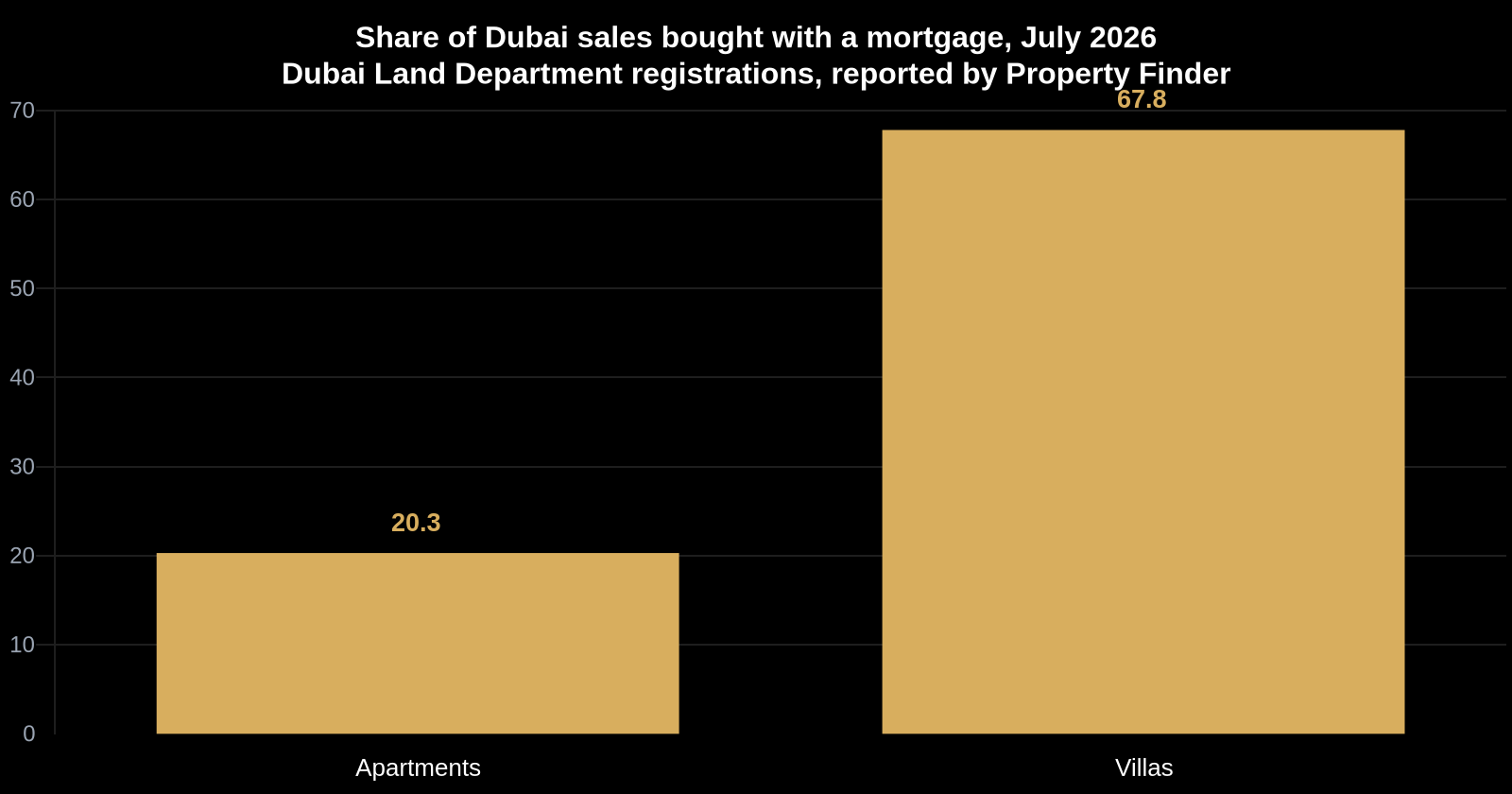
The mortgage detail comes from Dubai Land Department registrations and is the most revealing part. Of 2,887 mortgages registered in July, worth AED 4.93 billion, only 20.3% of apartment sales involved a mortgage against 67.8% of villa sales. The investor share of mortgage transactions rose from 9% in June to 12.8% in July.
Four in five Dubai apartment purchases in July completed without bank finance. That is a segment largely insulated from the rate path, sitting alongside a villa segment that is not. The two respond to entirely different variables, which is why they keep printing divergent numbers.
Property Finder's listing index sat 2.5% below the pre-conflict baseline for a second consecutive month, and the gap between asking and transacted prices narrowed from 6–12% in May to 5.5–11% in July. These are portal metrics rather than registry data. The narrowing spread is the more reliable signal: sellers are meeting the market rather than holding out.
Section 05
Abu Dhabi Residential Sales Nearly Tripled to AED 70.4 Billion in the First Half, With Off-Plan at 89% of Value
| Abu Dhabi residential, H1 2026 (ADREC, August 18) | Data |
|---|---|
| Residential unit sales | AED 70.4bn (H1 2025: AED 25.3bn) |
| Off-plan share | 89% of value, 82% of transactions |
| Repeat-sales price growth, year-on-year | Apartments +20%, villas +12% |
| Top 10 developers, primary off-plan sales | AED 51bn, 90% of the segment |
| Top 10 projects | AED 30bn, 43% of residential sales |
| Emirati buyers | AED 21.0bn (H1 2025: AED 8.9bn) |
| Ready-market purchases in cash | 61% |
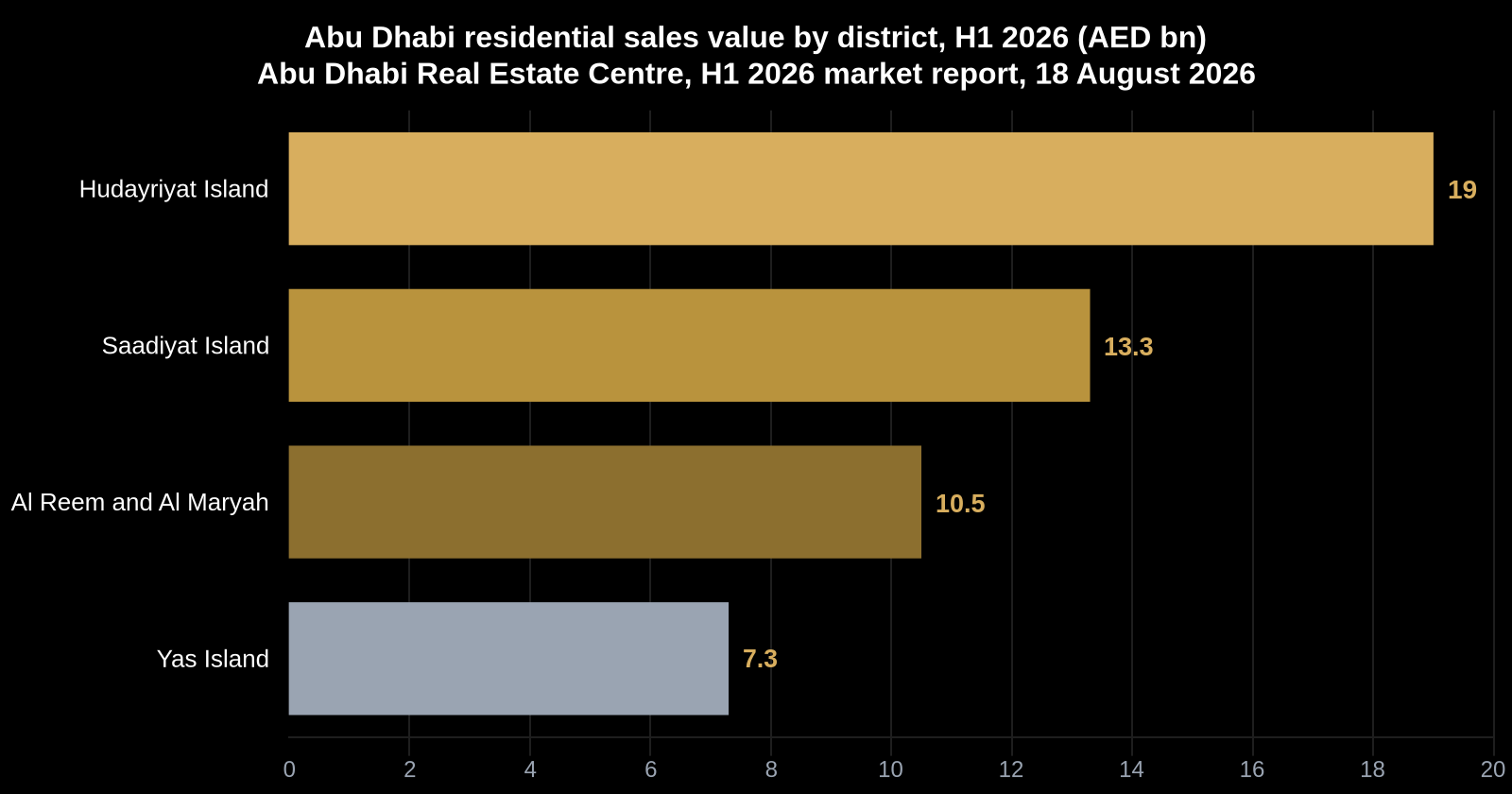
The Abu Dhabi Real Estate Centre published its H1 2026 market report on August 18, built on registered sales, lease and mortgage transactions. Hudayriyat Island led at AED 19 billion, 27% of all residential sales value, followed by Saadiyat at AED 13.3 billion, Al Reem and Al Maryah combined at AED 10.5 billion, and Yas at AED 7.3 billion. Those four groupings account for 71% of the emirate's residential sales value.
Concentration is the risk running through every line of this report. Ten developers control 90% of primary off-plan sales. Ten projects account for 43% of all residential value. One island produced more than a quarter of the market. A market where off-plan is 89% of sales value and ten counterparties hold 90% of that segment is not diversified, however strong the growth rate looks.
A scope note, because three Abu Dhabi figures are now in circulation and they are not interchangeable. The AED 70.4 billion is registered residential unit sales for January to June. The AED 86.3 billion covered in last week's edition excludes mortgaged deals and runs to mid-August. The AED 111 billion in that edition adds mortgaged transactions back — and is entirely unrelated to the Dubai AED 111 billion completions figure above.
Section 06
Abu Dhabi's Pipeline Runs to 71,000 Homes by 2030 While New-Lease Apartment Prices Rose 17% and Offices Sit at 95% Occupancy
The same ADREC report puts Abu Dhabi's existing residential stock at approximately 409,000 units, growing at an average 2.9% a year since 2022, with 71,000 further units projected by 2030 and delivery peaking at around 21,800 in 2028. Six districts — Saadiyat, Al Reem, Yas, Zayed City, Khalifa City and Hudayriyat — account for 77% of projected incremental supply, and nine developers for 76% of the pipeline.
That pipeline equals roughly 17% of existing stock, against the equivalent Dubai ratio of about 36% on ValuStrat's figures. Abu Dhabi is absorbing roughly half Dubai's relative supply load, which is the mechanical explanation for the two emirates' divergent rent data rather than any difference in demand quality.
On the leasing side, new-lease prices rose 17% year-on-year for apartments and 9% for villas, and 21% and 16% respectively inside the investment zones. There were 233,000 active residential lease contracts worth AED 9.3 billion, up 8% year-on-year on 2% volume growth. Office supply reached 3.4 million square metres, up just 0.3% on end-2025, with occupancy at 95% and new-lease prices up 13%. Retail gross leasable area reached 3.85 million square metres, up 5%, with new-lease prices up 9%.
Two qualifications belong with those rent figures. They are new leases, not renewals — ADREC froze renewal increases at 0% from June 2026 until further notice, excluding the ADGM-managed Al Maryah and Al Reem. And a 0.3% increase in office supply against 95% occupancy is the entire explanation for the 13% office rent growth. There is no new stock.
Explore curated office and retail opportunities at Mitchell's Commercial Real Estate.
Still reading
Need expert help on this subject?
Section 07
The Central Bank Grew Mortgage Lending 24% in 2025 and Is Now Stress-Testing for a 31.3% Fall in Dubai Prices
| UAE banking and property credit (CBUAE Financial Stability Report, August 17) | Data |
|---|---|
| Banking system assets, end-2025 | AED 5.3tn, +17.1% |
| Sector net profit, 2025 | AED 90.8bn, +11.7% |
| Mortgage lending growth, 2025 | +24% year-on-year |
| Average loan-to-value, new mortgage commitments | ~60% (caps: 85% nationals, 80% non-nationals) |
| Real-estate non-performing loan ratio | 5.0% (2024: 6.3%) |
| Adverse-scenario house price assumption | Dubai -31.3%, Abu Dhabi -27.6% start-to-trough |
| Countercyclical capital buffer | 50bp, effective January 2026 |
The Central Bank published its Financial Stability Report on August 17. The banking data is end-2025 vintage and therefore dated, but the supervisory posture and the forecasts inside it are current, and they are why this report matters more than its headline profit figure.
The regulator is explicit about where it sees risk. It maintained "a conservative stance on borrower-based measures" specifically to mitigate "potential systemic risks stemming from strong mortgage growth and elevated real estate valuations," describes the financial cycle as "in an expansionary phase" carrying "a gradual build-up of cyclical systemic risks," and calls for "heightened macroprudential vigilance."
The adverse scenario is the number to write down: the Central Bank tested UAE banks against Dubai residential prices falling 31.3% and Abu Dhabi prices falling 27.6% from peak to trough, with oil at $42 and non-hydrocarbon GDP contracting 5.9%. Aggregate CET1 fell from 14.1% to a trough of 11.1% and stayed above minimum requirements. This is a resilience test, not a forecast — but it is the official view of what a severe UAE property downturn looks like, and an average origination loan-to-value of 60% is why the banking system passes it.
The report also carries the freshest official UAE growth forecast available: 2026 GDP revised to 1.7% from a pre-crisis estimate of 5.6%, with non-hydrocarbon growth of 1.9%, followed by 9.8% in 2027 as OPEC-exit production capacity comes online.
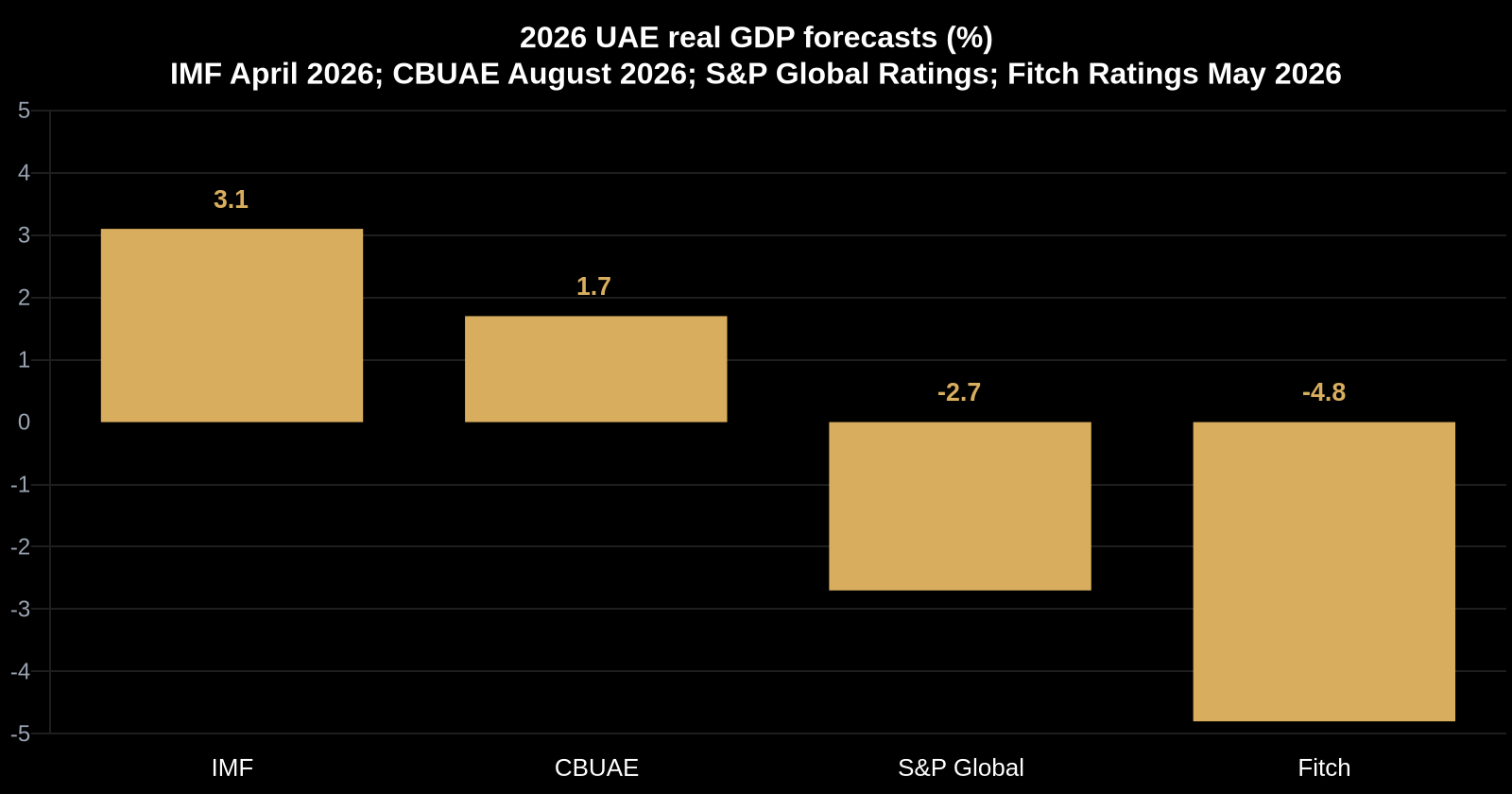
That +1.7% sits inside a remarkably wide institutional range — the IMF at +3.1% in April, S&P at -2.7%, and Fitch at -4.8% in May with Dubai down close to 7%. When the spread between credible 2026 forecasts for a single economy is roughly eight percentage points, the responsible position is to underwrite an asset's own cash flow rather than a macro view.
Section 08
Thirty-Year Treasury Yields Hit a 19-Year High and Three FOMC Members Voted for a Rate Rise
The long end of the global bond market repriced this week. The thirty-year US Treasury yield peaked at approximately 5.33% on August 18, its highest level since 2007. Japan's ten-year reached 2.945%, a three-decade high; the German Bund hit its highest since May 2011 and the thirty-year gilt its highest since 1998.
US federal debt passed $40 trillion for the first time, confirmed by Treasury figures published August 19. Hours earlier, the Treasury announced it would at least double the maximum size of each long-end liquidity buyback operation, from $2 billion to $4 billion, effective September 9. Yields fell on the news — the thirty-year down 9 basis points to 5.196% — and then gave it back. By August 21 the relief rally had been erased and the Treasury Secretary was signalling further increases. The S&P 500 finished the week down 1.43%.
Minutes of the July 29 FOMC meeting, released August 19, remove any ambiguity about direction. The target range was held at 3.50–3.75% on a 9–3 vote, with Hammack, Kashkari and Logan all dissenting in favour of a 25 basis point increase — the most same-direction dissents since 2016. The minutes state that "inflation risks were skewed to the upside" and that "many participants assessed that policy tightening would likely be necessary if inflation did not decline." There is no discussion of a cut anywhere in the document. Participants noted that the Middle East escalation "significantly clouded the inflation outlook."
CME FedWatch put the probability of a September hold at 69.4% on August 17, with the balance priced for a hike rather than a cut. The next meeting is September 15–16.
The dirham peg transmits this directly to EIBOR. Any Dubai underwriting model that assumes cheaper debt in 2027 is now arguing against the curve, the minutes and three sitting voters.
Brent settled at $94.39 on Friday August 21, a sixth consecutive daily gain and up 6.39% on the week, after the United States said it would announce new Iran sanctions the following Monday.
The physical picture behind that price is tighter than the headline. The US Strategic Petroleum Reserve fell 5.3 million barrels in the week to August 14, to 293.4 million barrels — the lowest level since the week ending December 31, 1982, down roughly 122 million barrels or 29% from about 415.4 million in mid-March, and equal to just 41% of its 714 million barrel capacity. Refined products are tighter still: the US diesel crack spread hit a record $102.20 a barrel on August 17, and the IEA estimates more than 20% of the Middle East's 9.6 million barrels per day of refining capacity has been knocked out during the conflict. Seven ships transited the Strait of Hormuz on August 20, none carrying crude or LNG.
The domestic pass-through is already visible: the UAE Fuel Price Committee added AED 0.20 per litre to diesel in August, taking it to AED 3.80.
One forecast caveat. The EIA's Short-Term Energy Outlook of August 11 projects Brent averaging $85 in the third quarter and $87 across 2026. That outlook closed its data when Brent was in the low $80s. With the benchmark at $94 entering the final weeks of the quarter, the official forecast has already been overtaken by roughly $9 — it has not been revised down, it has simply been left behind.
Higher diesel prices raise service charges, construction costs and fit-out budgets. That is the channel through which an oil price reaches a net operating income, and it currently points the wrong way for landlords.
In closing
Final View for Dubai Property Investors
The property data published this week describes January to June. The rate, energy and geopolitical data describes the last five days. Anyone reading the first as a guide to the second will misprice the risk.
Three clear implications follow:
Underwrite the counterparty before the community. Fitch has put UAE residential transactions down 19% quarter-on-quarter and stated that smaller developers will struggle to phase releases if land, construction and financing costs stay high. In Abu Dhabi, ten developers hold 90% of primary off-plan sales and off-plan is 89% of all residential value. Off-plan is a credit exposure to a construction programme — establish who is building, what stage the escrow is at, and whether the project cleared the funding and pre-sale thresholds Fitch says now govern which schemes proceed.
Stop modelling rate relief and start modelling rate risk. Three FOMC voters wanted a hike in July, the minutes contain no discussion of a cut, thirty-year Treasury yields are at a nineteen-year high, and the Treasury's own buyback intervention lasted two days. The peg passes all of this through to EIBOR. A Dubai villa acquisition financed today — where 67.8% of buyers use a mortgage — should be stress-tested upward from current rates, not downward.
Treat the Central Bank's adverse scenario as a planning input. The regulator modelled Dubai prices down 31.3% and Abu Dhabi down 27.6%, and the banking system held because average origination loan-to-value is around 60%. That figure is instructive for private buyers too. Leverage above 60% in a market the Central Bank itself describes as carrying "elevated real estate valuations" removes the buffer currently protecting the lenders.
The two emirates are not converging. Dubai delivered 24,537 homes in six months into a market absorbing a pipeline worth roughly 36% of existing stock. Abu Dhabi's pipeline is around 17% of its stock, its office market runs at 95% occupancy on 0.3% new supply, and new-lease apartment prices rose 17%. Those are different problems requiring different holding periods.
The question is therefore not which emirate is stronger. It is whether the asset under consideration generates enough income, at today's cost of debt and at 60% leverage, to survive a scenario the Central Bank has already put on paper. If it does not, what exactly is the thesis?
Next step
Let’s Talk
If you’d like to unpack where the most resilient opportunities are emerging — in stabilised residential areas or income-generating commercial zones — I’d be happy to share a focused, data-driven shortlist based on your investment goals.
📞 No pressure, no sales pitch—just a focused, informed conversation about your investment goals.
Published 22 August 2026 by Stephen James Mitchell MBA. Market figures quoted reflect the data available at that date.