Federal Reserve Chairman Kevin Warsh used his Jackson Hole keynote on August 28 to say something the market had not priced. Describing the current stance of policy, he told the symposium: "on balance, I would be hard pressed to describe broad financial conditions as restrictive."
That is a central banker telling the market its own conditions are too loose.
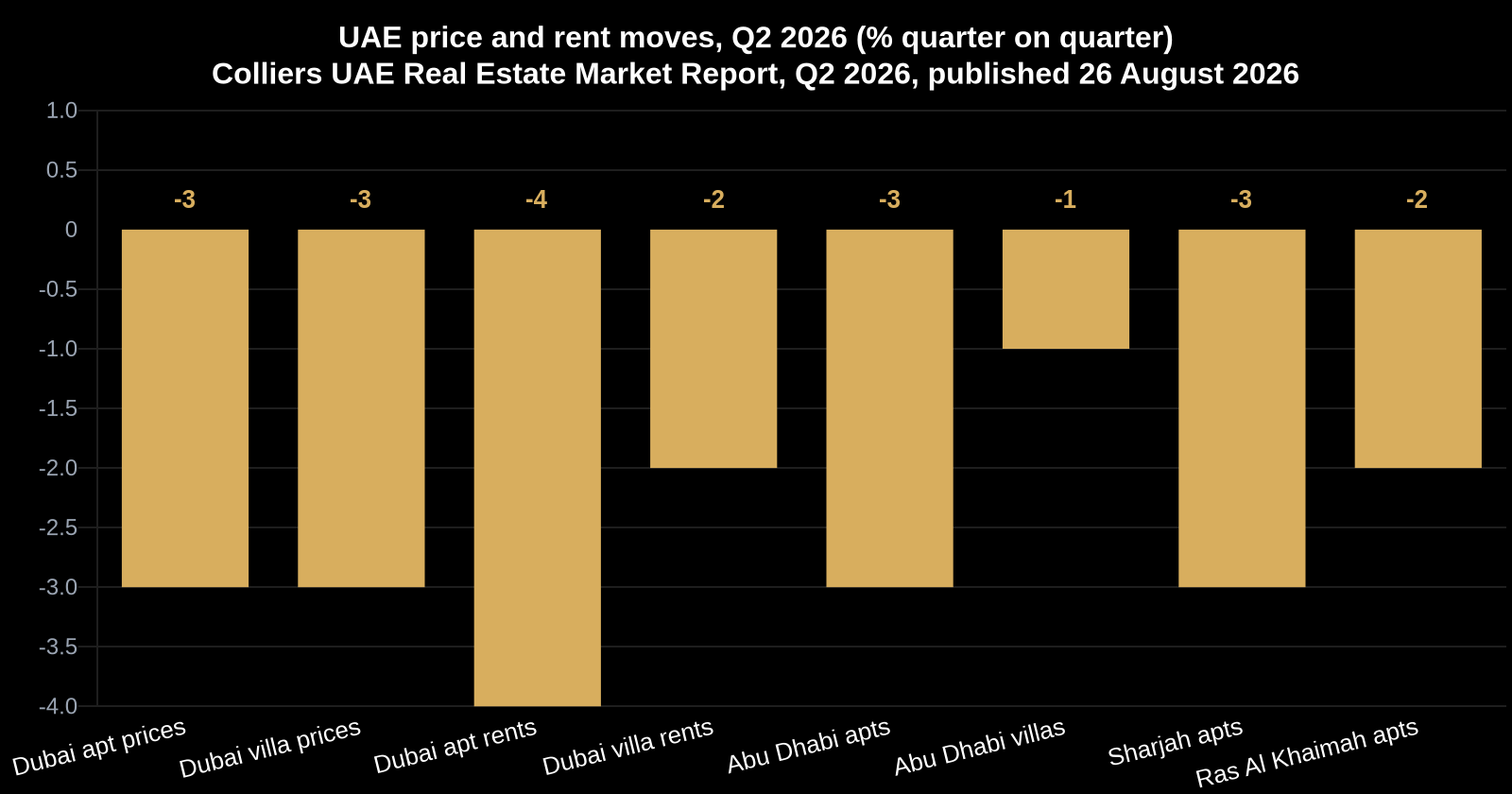
Within hours, futures pricing for the September 15–16 meeting flipped from a comfortable hold to something close to a coin toss on a rate rise. Gold gave up $70 an ounce in ten minutes. Brent closed the week at $89.31, down 5.4%, as US Central Command declared the Strait of Hormuz shipping lanes clear of mines. And Colliers' Q2 2026 UAE report, published on August 26, confirmed what the transaction data had been implying for two quarters: Dubai apartment and villa prices fell 3% in the quarter, and apartment rents fell 4%.
The property data in this edition describes April to June. The rates data describes last Friday afternoon.
Almost everything that matters to a leveraged Dubai buyer sits in that gap.
If you're weighing entry points while this market reprices, I can show you where the risk-adjusted opportunities are emerging. Click here to speak with me directly.
Chairman Warsh's keynote, titled "In Our Time," was delivered on August 28 at the Kansas City Fed's Jackson Hole symposium, on what he called his hundredth day in the chair. He never used the word "hike." He did not need to.
The speech set out a test rather than a decision: "We must be confident that underlying inflation is moving to our objective, clearly and at sufficient speed. Otherwise, we have work to do." He noted that credit spreads on corporate bonds and leveraged loans sit "near the low ends of their historical ranges," and that "credit and loan markets are showing few signs of policy restraint."
The inflation arithmetic he cited is the part investors here should sit with. The PCE price index rose 3.7% over twelve months — but 4.1% on a six-month annualised basis. Inflation is running faster over the recent window than over the full year. On the Fed's own preferred gauge, the disinflation trend has stopped and partially reversed.
The hawkish shift did not begin last Friday. At the July 29 meeting the Committee held the target range at 3.50%–3.75% on a 9–3 vote, with Beth Hammack, Neel Kashkari and Lorie Logan all voting to raise by a quarter point. Three same-direction dissents is unusual. Warsh's speech gave that minority a chair sympathetic to their reading.
The repricing was fast. CME FedWatch put a September hike at 39.9% on August 21; CNBC reported it at 57% on August 28, with prediction markets Polymarket and Kalshi still leaning the other way at roughly 52% for a hold. In the August 22 edition the equivalent reading was a 69.4% probability of a hold. The distribution has moved a long way in seven days.
For Dubai, the transmission is mechanical. The dirham is pegged to the dollar, so the UAE Central Bank follows the Fed. A quarter-point rise takes the range to 3.75%–4.00% and lifts EIBOR-linked mortgage costs with it. The financing assumption underneath most 2026 Dubai underwriting — that debt gets cheaper from here — is now the less likely outcome.
| Dubai residential, Q2 2026 (Colliers, August 26) | Data |
|---|---|
| Apartment sale prices | −3% quarter on quarter |
| Villa sale prices | −3% quarter on quarter |
| Apartment rents | −4% quarter on quarter |
| Villa rents | −2% quarter on quarter |
| Units delivered in Q2 | ~11,650 (9,200 apartments, 2,450 villas) |
| Scheduled to complete by year-end | ~56,600 |
| Leasing transactions | Down approximately a quarter |
Colliers' UAE Real Estate Market Report for Q2 2026 describes the market as entering a "more balanced phase." The language is measured. The numbers are not ambiguous.
This is the second major international advisory house to put Dubai's Q2 residential move in negative territory. Cushman & Wakefield Core's Q2 read, covered in the August 15 edition, put city-wide prices down 4% and rents down 6% over the same quarter. Two independent houses, different methodologies, same direction and broadly the same magnitude. When the advisory firms converge, the debate about whether Dubai has turned is over; the debate is now about depth and duration.
One number in the Colliers release deserves scepticism rather than repetition. The report puts roughly 56,600 units as scheduled for completion by the end of 2026. ValuStrat's pipeline work, cited in the August 15 edition, put the remaining 2026 delivery at closer to 29,300. That is a near two-fold divergence between credible sources on the single most important variable for 2027 pricing. Scheduled completion dates in Dubai routinely slip, and the gap most likely reflects how aggressively each house discounts announced dates. Treat the higher figure as the pessimistic bound, not the base case.
Note what Colliers does not provide: any year-on-year figure for Dubai. Every Dubai number in the report is quarter on quarter. Anyone quoting a Colliers Dubai annual change is quoting something that is not in the document.
Colliers' observation that Dubai leasing transactions fell about a quarter in Q2 is corroborated by contract-level data reported by Khaleej Times on August 24: 115,992 rental transactions worth AED 10.18 billion in the second quarter, with volume down 19% and value down 18% on Q1.
The composition matters more than the total. New contracts fell 15% to 42,100. Renewals fell 20% to 73,892, and renewals accounted for 63.7% of all rental activity. Median rental pricing fell 7% to AED 93 per square foot.
A market where two-thirds of activity is renewal, and where new lettings are shrinking faster in value than in volume, is a market where tenants have stopped moving. That is usually a sign of tenants holding cheaper legacy contracts rather than a sign of scarcity.
For landlords, the practical consequence is that the renewal negotiation, not the new letting, is now where the year's income is decided. It is also the context for FlexiRent, the Dubai Land Department initiative launched in June that lets participating property management companies offer monthly, quarterly or semi-annual rent instalments on leases of twelve months or more. Participation is voluntary and sits with the management company, not the individual landlord, and DLD has published no fee or profit rate — terms are set company by company. It is a tenant-retention tool arriving precisely when retention has become the binding problem.
| Dubai Land Department, week to August 27 (published August 28) | Data |
|---|---|
| Total activity | AED 12.0 billion, 3,657 transactions |
| Sales | AED 7.2 billion, 2,564 transactions |
| Off-plan sales | AED 4.6 billion, 985 transactions |
| Ready sales | AED 2.6 billion, 1,579 transactions |
| Mortgages | AED 4.0 billion, 939 transactions |
| Gifts | AED 736 million, 154 transactions |
| Prior week (August 17–21) | ~AED 10.7 billion, 4,092 transactions |
The headline from the Dubai Land Department register published August 28 reads as strength: AED 12 billion is up around 12% on the prior week's AED 10.7 billion.
Transaction count went the other way, falling from 4,092 to 3,657 — 435 fewer deals, down 10.6%. Average value per registered transaction therefore rose from roughly AED 2.61 million to AED 3.28 million, an increase of about 26% in a single week.
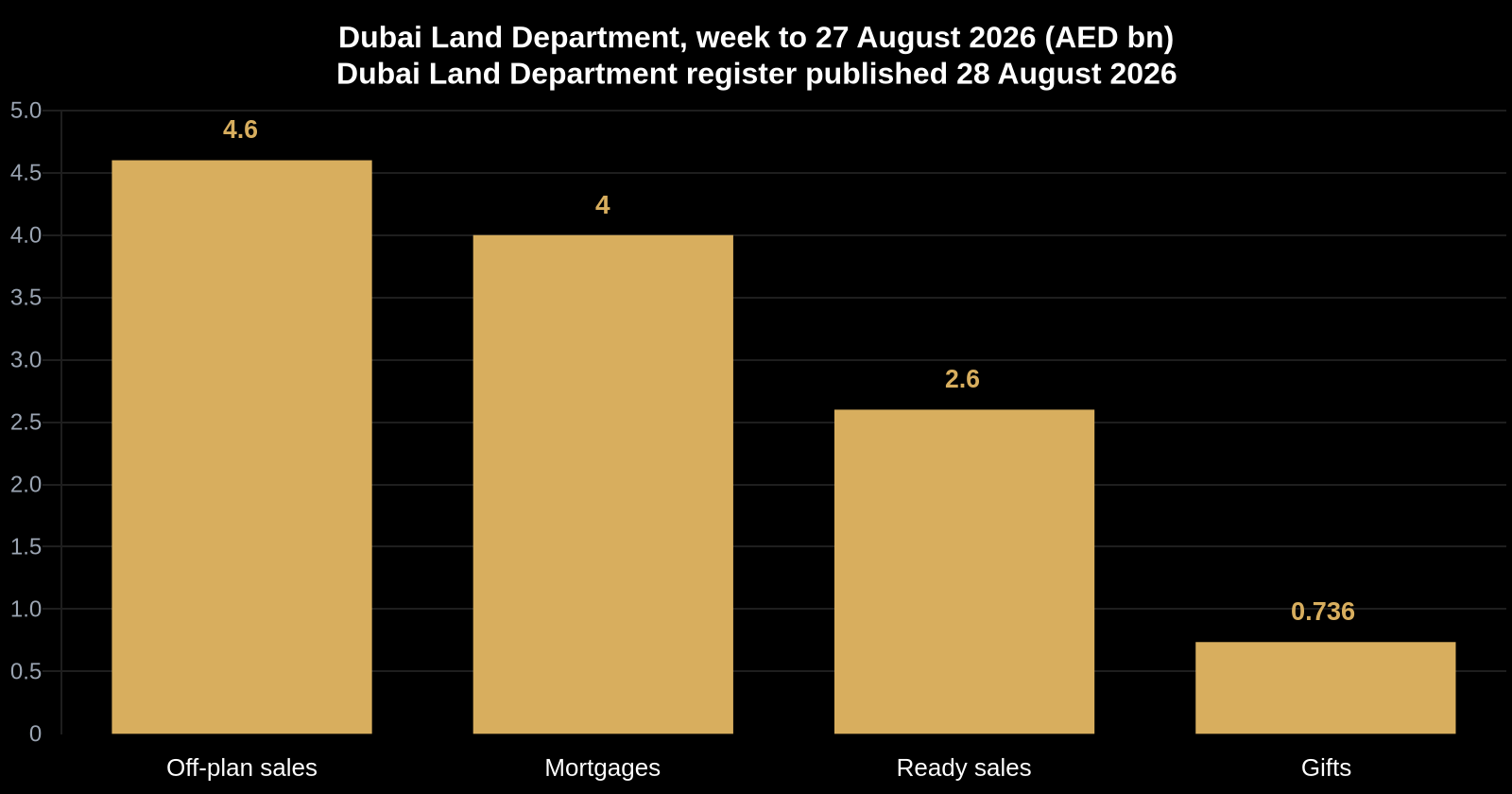
The off-plan split is the more instructive number. Off-plan accounted for 64% of sales value but only 38% of sales count. The average off-plan ticket was approximately AED 4.67 million against roughly AED 1.65 million for ready stock — off-plan units are transacting at about 2.8 times the average ready-market price. Concentration is high too: Burj Khalifa (AED 845 million), Airport City (AED 491 million), Al Yafra 1 (AED 489 million), Dubailand Residential Complex (AED 286 million) and Me'aisem First (AED 259 million) together took roughly a third of the week's sales value.
A week of higher value on lower volume is not broad-based demand. It is a small number of large tickets doing the work. One week is noise; the pattern is worth watching for confirmation.
Khaleej Times reported on August 26 that UAE lenders have widened access to off-plan home finance. Dubai Islamic Bank's product, announced August 20, offers up to 50% finance-to-value to UAE nationals, residents and non-residents, releasing tranches against construction milestones. Buyers pay only the profit component during construction, with the full instalment beginning at handover or within 24 months, whichever comes first. ADCB, in a tie-up with Ellington Properties, offers pre-approval up to 50%, valid twelve months and renewable to handover, with rates from 3.49% fixed for three years and processing and valuation fees waived.
Coverage of this has described banks "loosening" off-plan lending. That is not what has happened. The UAE Central Bank's mortgage regulation caps off-plan loan-to-value at 50% for every category of buyer — national, resident expatriate and non-resident alike. These banks are lending at the regulatory ceiling, not above it. The innovation is structural: milestone-linked disbursement and a profit-only construction period.
That structure is the point to examine. A profit-only period lowers the monthly outgoing during construction and defers the full instalment by up to two years. On a variable-rate facility, it also defers the buyer's first encounter with the true cost of the debt to a date the buyer cannot forecast. If a September hike is followed by others, a purchaser signing today at a construction-phase profit rate meets the amortising instalment in a materially different rate environment. Credit is being extended into the most speculative segment of the market at the exact point in the cycle where the rate path has turned.
| Abu Dhabi residential, Q2 2026 (Colliers, August 26) | Data |
|---|---|
| Apartment sale prices | −3% QoQ / +19% YoY |
| Villa sale prices | −1% QoQ / +10% YoY |
| Apartment rents | −2% QoQ / +7% YoY |
| Villa rents | −3% QoQ / +5% YoY |
| Transactions | ~7,200, −8% QoQ, +83% YoY |
| Off-plan share of transactions | ~84% |
| Units delivered in Q2 / due in remainder of 2026 | ~2,200 / ~3,200 |
Abu Dhabi is the one market in the Colliers report where the annual and quarterly readings point in opposite directions. Apartment prices are 3% lower on the quarter but 19% higher on the year. Transaction volumes fell 8% quarter on quarter while remaining 83% above the same quarter of 2025.
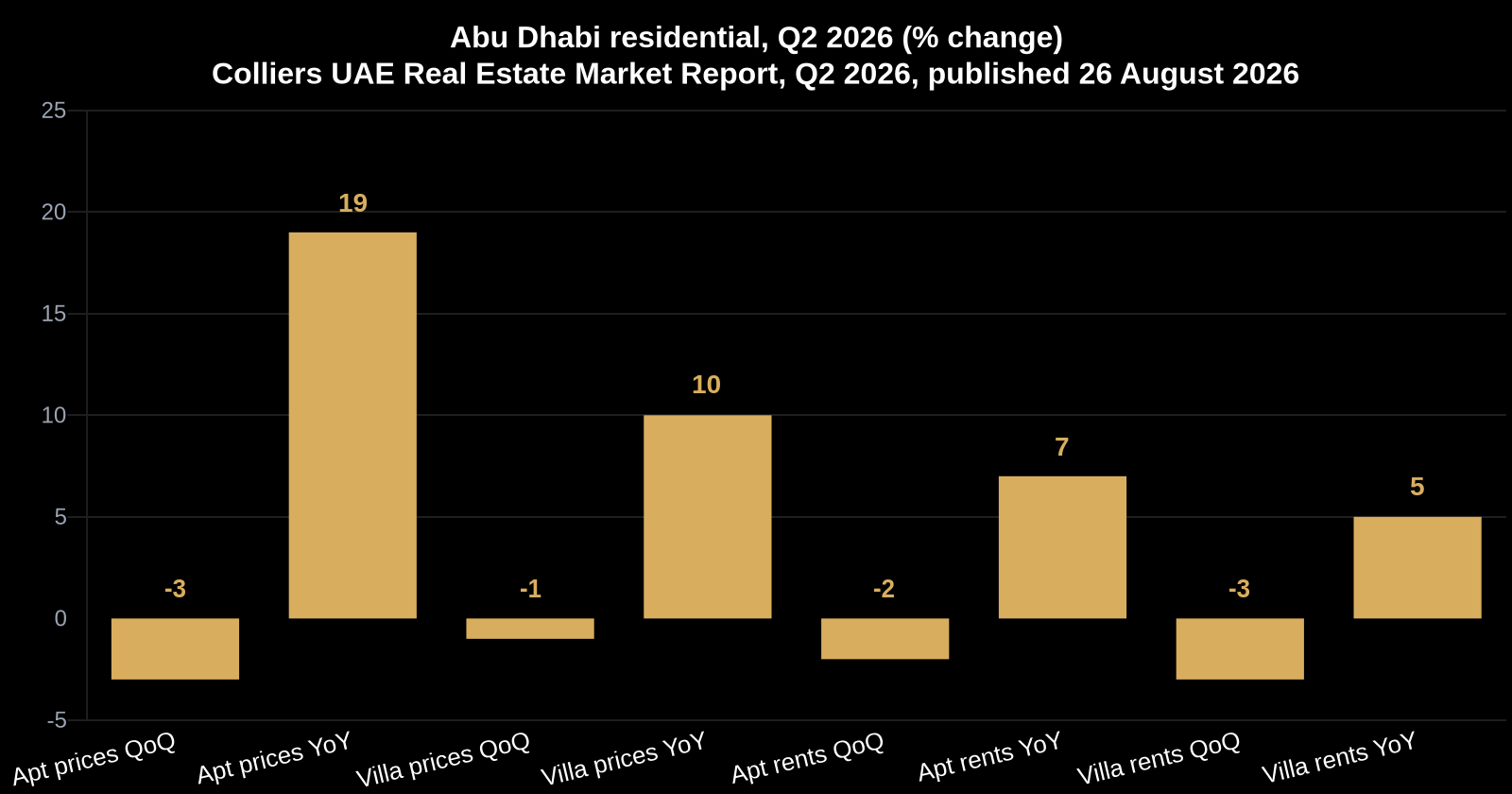
This is what a market looks like when it pauses after a fast run rather than when it turns. The distinction matters for allocation: Dubai's quarterly softening sits on top of a flat-to-negative annual base, while Abu Dhabi's sits on top of a strong one. Colliers also notes that the rental freeze introduced by the Abu Dhabi Real Estate Centre on renewals and new contracts left renewals accounting for most Q2 leasing activity — a policy-suppressed rent line, not a demand-suppressed one.
The Northern Emirates moved with everyone else. Sharjah apartment sale prices fell 3% in the quarter and Ras Al Khaimah apartments 2%, with Northern Emirates apartment rents down around 2% on average and Sharjah the largest adjustment at roughly 4%. Around 4,600 residential units were launched in Sharjah during the quarter, against a 2026 Northern Emirates completion pipeline of about 7,450 units — Sharjah 5,450, Ras Al Khaimah 1,400 and Ajman 600.
Explore curated office and retail opportunities at Mitchell's Commercial Real Estate.
Still reading
Need expert help on this subject?
Section 07
The US Treasury Moves on Banque Misr's UAE Branches and the Central Bank Orders a Lookback
On August 28 the US Treasury announced that FinCEN had found Banque Misr UAE to be "a financial institution operating outside the United States of primary money laundering concern," and issued a notice of proposed rulemaking under section 311 of the USA PATRIOT Act. The proposed special measure would prohibit US financial institutions from opening or maintaining correspondent accounts for the bank's UAE branches. Treasury estimates that between January 2024 and June 2026 those branches processed approximately $1.8 billion for 103 companies potentially connected to Iranian shadow-banking networks.
Precision matters here, because the coverage has not been precise. This is a proposal, not a rule in force. The comment period runs for 30 days from publication in the Federal Register, and it applies only to Banque Misr's UAE operations, not to the bank in Egypt or elsewhere. What did take immediate effect the same day were two OFAC designations: Reza Mohammad Taeedi, general manager of Bank Melli's Dubai branch, and Kameng Trading Limited of Hong Kong.
The UAE response came the following day. On August 29 the Central Bank of the UAE issued a five-point statement confirming it would conduct "a special and urgent examination that includes a forensic/in-depth lookback covering the period referred to in the statement issued by the U.S. authorities," and that it is "currently studying the available options regarding the status of the bank in the event it is decided to impose the special measure."
For property investors the exposure is not headline risk, it is operational. Dubai's inbound purchase flow depends on dollar correspondent banking working smoothly. Enhanced scrutiny across the UAE banking system raises documentation requirements and lengthens settlement timelines for cross-border buyers, particularly those routing funds through the wider region. The realistic effect is friction and delay in completions rather than a reduction in underlying demand — but friction shows up in transaction volumes before it shows up in prices.
Brent settled Friday August 28 at $89.31 a barrel, down 43 cents on the day and $5.08, or 5.4%, on the week from the prior Friday's $94.39. WTI settled at $83.40, down 4.2% on the week. The two-week winning streak ended. Note that the October Brent contract expired on August 28, so this is the clean Friday-to-Friday comparison.
The driver was Hormuz. Axios reported on August 28 that CENTCOM commander Admiral Brad Cooper had declared internationally recognised sea routes in the strait "free of Iranian sea mines," with more than 200 mine-like objects swept of which only 11 were actual mines, and that 2% of vessels transiting in the past month were struck. US officials put current traffic at 20 to 30 tankers a night carrying 9 to 10 million barrels — roughly half the pre-war volume — with a stated goal of 50 ships a night by mid-September.
Read those numbers carefully before treating the strait as reopened. Every favourable statistic in that account originates with US officials. Tanker trackers and Iran's navy dispute the picture, and week-end shipping data showed just seven commodity vessels crossing on Thursday against 17 on Wednesday and a ten-day average of 15. Goldman Sachs estimates Gulf exports have recovered to roughly 15–16 million barrels per day, up 5–6 million from the March low but still 7–8 million below pre-war levels.
The institutional read arrived on August 25, when IMF Managing Director Kristalina Georgieva told reporters at the Fund's headquarters that the global economy "has weathered the energy shock caused by the closure of the Strait of Hormuz better than we feared," describing "a tug of war between the negative supply shock from the Middle East and the positive demand shock from AI." The Fund now projects global growth of 3.0% for 2026, marginally below its April 3.1%. Middle East growth for 2026 was cut by 1.2 percentage points to 0.7%.
That combination is the honest frame: the world absorbed the shock; the region wearing it did not.
Gold traded at $4,626 an ounce immediately before Warsh's remarks were published, then fell as low as $4,554 and fixed at the London 3pm auction around $4,560 — a $70 move inside ten minutes. That flipped the week from a 1.0% gain to a 0.4% loss, and cut August's monthly advance from 15.8% to 13.3%. Silver hit a ten-week high above $71 before dropping as much as $2.
In Dubai, 24-carat retail gold stood at about AED 536.75 per gram on August 29, with 22-carat at AED 497.00, 21-carat at AED 476.75 and 18-carat at AED 408.50.
A 13.3% monthly gain in a non-yielding asset is a market pricing persistent inflation and a compromised path back to target. That one speech removed a sixth of it in an afternoon shows how tightly hard assets are now tethered to the rate path. Dubai property is a hard asset with a rent line attached. The rent line is what separates it from bullion, and this quarter the rent line is falling.
In closing
Final View for Dubai Property Investors
The week produced two datasets moving in opposite directions, and the temptation is to average them. Dubai's residential prices and rents fell in the second quarter on the reading of two independent international advisory houses. Meanwhile lenders extended milestone-linked credit into off-plan, and the Fed's chairman said financial conditions are not restrictive. The misreading to avoid is treating easier access to finance as market support. It is not support. It is leverage arriving in the most speculative segment at the point in the cycle when the cost of that leverage has stopped falling.
Three clear implications follow:
Stop underwriting off-plan on the assumption that leverage is a tailwind. The 50% off-plan cap is a regulatory ceiling, not a bank concession. A profit-only construction period defers the buyer's first full instalment by up to 24 months into a rate environment nobody can forecast, and the September meeting is a live hike risk at close to even odds. Off-plan took 64% of last week's DLD sales value on 38% of the count, at an average ticket 2.8 times the ready market. If the purchase only works at a construction-phase rate, it does not work.
Price the rent line, not the capital value line. Dubai apartment rents fell 4% in Q2, villa rents 2%, and median rental pricing dropped 7% to AED 93 per square foot. New lettings fell 15% while renewals took 63.7% of activity. A capital value can hold on thin volume and a handful of large tickets. Income cannot. Model the renewal, at a lower rent, against a debt cost that may be higher in September than it is today.
Treat Abu Dhabi and Dubai as different points on the same cycle, not as substitutes. Abu Dhabi apartments are 3% lower on the quarter but 19% higher on the year, on volumes still 83% above Q2 2025, with 84% of transactions off-plan and a policy-imposed rent freeze on renewals. Dubai's quarterly softening sits on a flat annual base; Abu Dhabi's sits on a strong one. The freeze also means the Abu Dhabi rent line is being held by regulation rather than by demand — a distinction that will matter when it is lifted.
The Q2 data tells you where the market has been. The Warsh speech and the September meeting tell you what the debt will cost. For any asset under consideration this week, the question is whether it generates enough income, at today's rents rather than last year's, to service its debt if the Fed raises rather than cuts. And if the answer depends on a construction-phase profit rate that expires, what happens on the day it does?
Next step
Let’s Talk
If you’d like to unpack where the most resilient opportunities are emerging — in stabilised residential areas or income-generating commercial zones — I’d be happy to share a focused, data-driven shortlist based on your investment goals.
📞 No pressure, no sales pitch—just a focused, informed conversation about your investment goals.
Published 29 August 2026 by Stephen James Mitchell MBA. Market figures quoted reflect the data available at that date.