I was in Dubai when the 2008 property crash happened. I remember the atmosphere changing almost overnight — the frantic energy of a booming market turning first to quiet, then to something closer to dread. Projects were frozen. Expatriates were packing up and leaving in the middle of the night, handing their car keys to the bank as they went.
Properties that had been sold and re-sold three times before completion suddenly had no buyers at any price. It was, without question, the most dramatic market collapse I have witnessed in over 19 years of working here as a real estate broker and wealth manager.
The 2008 Dubai property crash is now being studied again in the context of today’s market disruption, and rightly so. Understanding what actually caused it — not just the headline narrative but the granular mechanics — is essential for anyone investing in Dubai real estate today. So let me tell you what I saw, what the data confirms, and what the combination of eyewitness experience and analytical rigour tells us about how it unfolded.
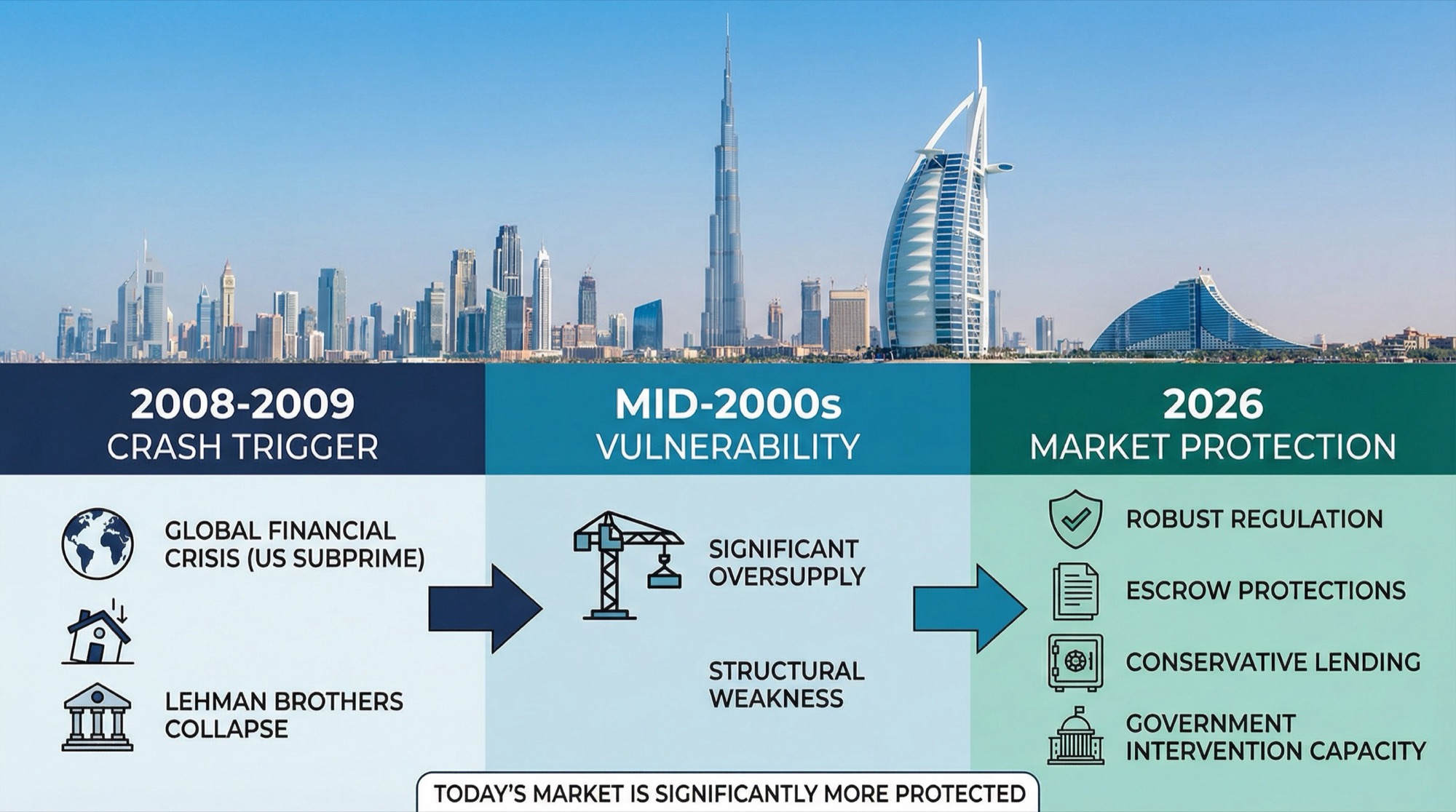
The proximate cause of the 2008 Dubai property crash was the global financial crisis, triggered by the collapse of the US subprime mortgage market and crystallised by the failure of Lehman Brothers in September 2008.
As widely documented, the 2009 Dubai housing crash was triggered by the 2008 global financial crisis, which severely impacted the emirate’s economy, particularly its real estate sector. When global credit markets froze, the liquidity that had been flowing into Dubai from international investors and banks evaporated with startling speed.
Dubai’s growth model at the time was heavily dependent on continuous inflows of foreign capital. International investors had been aggressively buying property as a diversification play, often using leverage. When the crisis hit, many faced margin calls at home and losses across their broader portfolios. Risk appetite reversed quickly, and capital flows dried up.
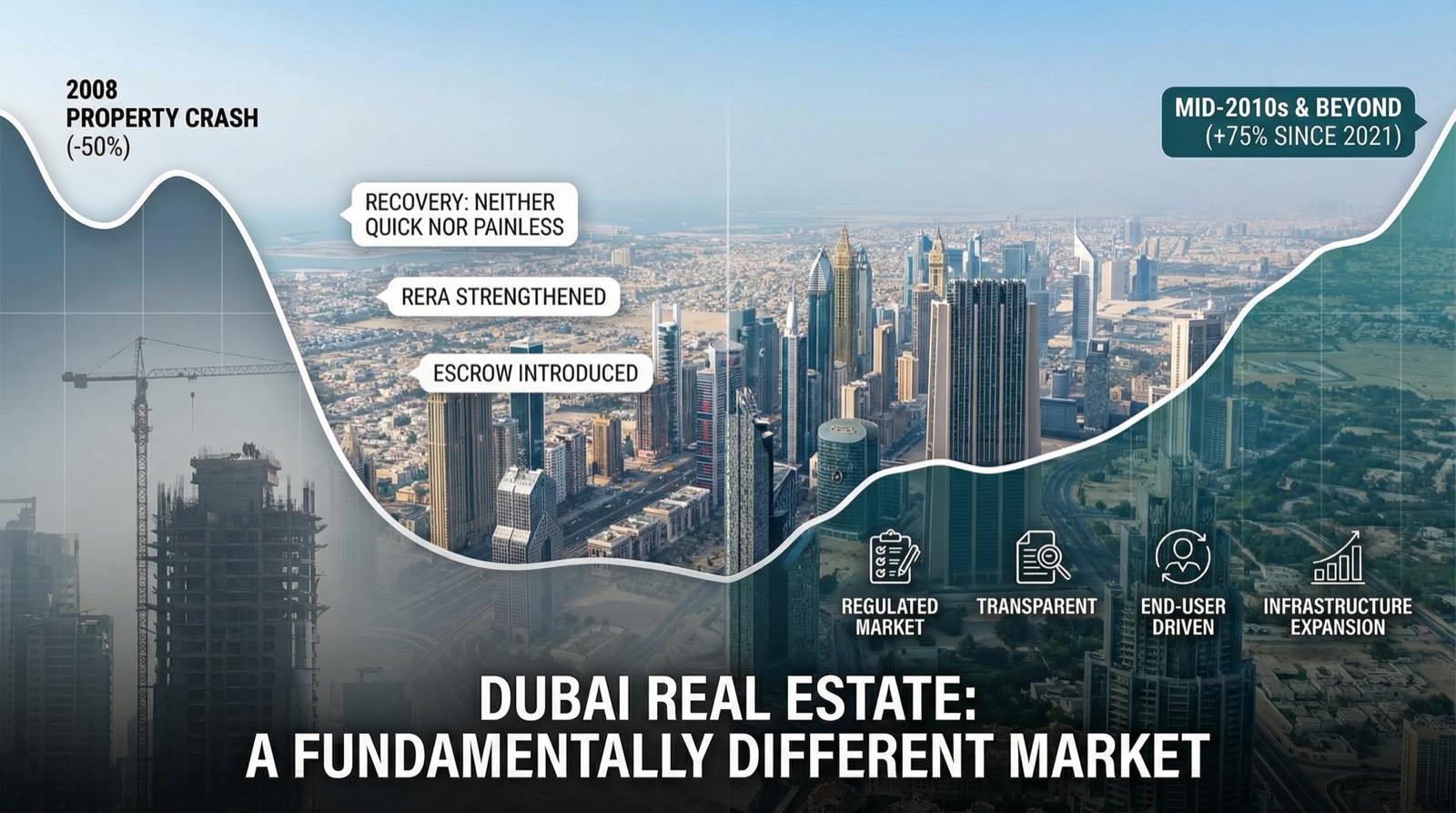
As the NUS Middle East Institute’s analysis documented, when the global financial crisis occurred, the flight of capital and the departure of expatriates who lost their jobs saw property prices crash by 50% or more in most areas. Bloomberg similarly noted that the seizure of debt markets after the global credit crisis led to a 50% decline in property prices.
I watched this play out in real time. The buyers simply stopped coming. And when the buyers stopped, the entire scaffolding holding up the market — which had been built on the assumption of perpetual demand — came down.
The global financial crisis was the trigger, but Dubai’s market would not have fallen as hard without the structural vulnerability that had been building throughout the mid-2000s: significant oversupply.
Dubai’s real estate market had been flooded with new projects, including Palm Jumeirah, the Dubai Waterfront, Business Bay, and dozens of master-planned communities, all launched in rapid succession based on growth projections that proved wildly optimistic.
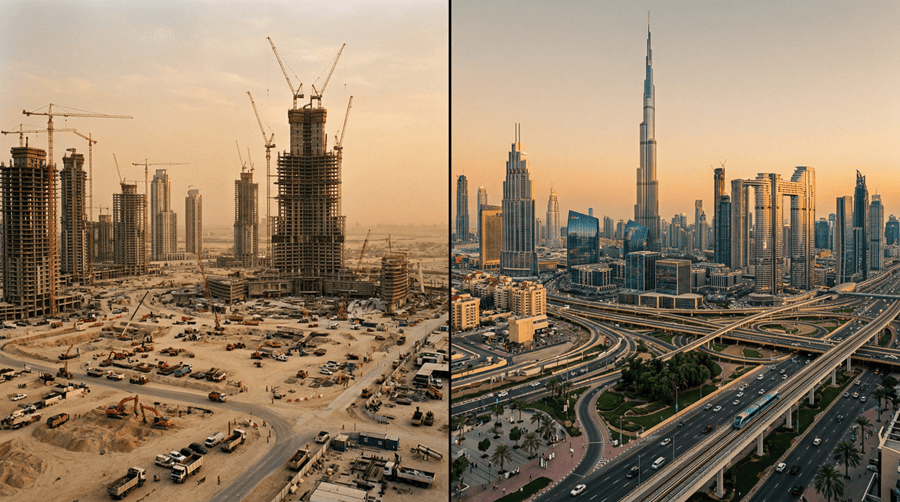
I remember standing on Sheikh Zayed Road in those years, with the skyline almost obscured by a sea of cranes. The pace of new project launches had become almost competitive among developers — each one trying to outdo the last in scale, ambition, and headline-grabbing design.
The assumption built into every project was that demand would always catch up. It didn’t. Vacancy rates in commercial real estate surged from around 2% in mid-2008 to approximately 20% within a year, and tens of thousands of residential units were coming into a market where demand had evaporated.
The globa lcredit crunch weakened confidence and tightened credit exactly as this supply wave was arriving. The result was a textbook oversupply crisis: developers who had pre-sold units to investors now faced those same investors walking away from commitments, leaving unsold inventory, cashflow shortfalls, and, in some cases, projects that would not be completed for years.
Another central cause of the 2008 Dubai property crash was the speculative culture that had taken over the market. A large proportion of buyers in the mid-2000s were not end-users — they were investors buying off-plan units with small deposits, sometimes re-selling those same units multiple times before the building was completed.
Hence, a significant portion of demand was driven by short-term investors seeking to flip properties for profit, contributing to the formation of an unsustainable real estate bubble.
This was enabled by easy credit and a regulatory framework that was still in its infancy. Banks extended generous mortgage terms based on rising valuations, and buyers committed to multi-year payment plans without fully understanding the downside risk.
The lack of strict regulations and focus on free market principles led to a situation where property buyers were paying developers in advance for projects that were not being appropriately developed. When the market turned, buyers had paid significant sums with limited recourse.
I saw this firsthand — clients who had ‘stacked’ multiple off-plan units across five or six projects, all bought on thin deposits, suddenly unable to service their commitments. When forced selling started, it fed the price decline, which triggered more forced selling. The negative feedback loop was brutal and fast.
Just as the market was beginning to absorb the initial shock of falling prices, a second blow landed. In November 2009, Dubai World — one of the emirate’s largest government-related entities — requested a ‘standstill’ on approximately 26 billion dollars of debt.
As CNN reported at the time, the announcement stunned global investors. Al Jazeera and Bloomberg both documented how international markets fell sharply on the news, with concerns about a potential sovereign default spreading rapidly.
The Dubai World standstill crystallised something important: the property boom had not just been about residential and commercial real estate. It had been financed, at least in part, by government-related entities borrowing heavily to fund infrastructure, hospitality, and master-planned community development.
Highly leveraged flagship companies found themselves struggling to repay their debt once cashflows from property sales collapsed. Property prices, already under severe pressure, declined further as confidence took another devastating blow.
Still reading
Need expert help on this subject?
The fourth cause — and in many ways the one with the most enduring legacy — was the relative immaturity of Dubai’s real estate regulatory framework at the time. RERA was established in 2007, but key protections for buyers were not yet fully implemented or enforced. There were no effective escrow requirements, meaning developer funds and buyer payments were commingled.
There were no robust project-progress milestones tied to payment disbursements. Developers could, in theory, receive substantial buyer deposits and then struggle to deliver.
After 2008, the major challenge was restoring investor confidence, and that Dubai’s response included mandatory escrow accounts for off-plan developers and the introduction of the interim real estate register (Oqood).
RERA was strengthened to include powers to cancel development projects with clear liquidation guidelines. These came too late to prevent the 2008 crash but proved critical in shaping a more resilient market for the cycles that followed.

Having been on the ground through every phase of the 2008 crash — the denial, the panic, the aftermath, and the long road to recovery — I find the comparisons being drawn with today’s market both understandable and, ultimately, overstated.
The conditions that made 2008 so catastrophic — unregulated speculation, reckless leverage, weak buyer protection, a global credit freeze, and government-related entities with dangerously over-extended balance sheets — are NOT the conditions we face in 2026.
The changes that led to the 2008 crash are no longer evident in the current market. Regulation is more robust. Escrow protections are in place. Bank lending is more conservative. Developers are better capitalised. And the UAE government has demonstrated, both in 2008 and in subsequent cycles, a willingness and capacity to intervene to prevent systemic collapse.
That does not make today’s market immune to correction — no market is. But understanding what actually caused the 2008 Dubai property crash is the essential starting point for assessing any new risk.
The important distinction is not that Dubai’s market is prone to collapse, but that unregulated speculation, excessive leverage, and unchecked supply introduce structural vulnerability. The degree to which those factors are present today determines the degree of risk. And on all three measures, today’s market is significantly more protected than it was in 2008.
Next step
Talk to Mitchells
Tell us what you are weighing up — a building, a project, an area, or a rule you need to get right — and we will come back with the specifics that apply to it.

Stephen James Mitchell is a licensed real estate broker with over 25 years of experience across finance, investment strategy, and real estate, including more than 19 years operating in Dubai. He specialises in advising investors on acquiring and optimising high-performing assets, with a focus on commercial and investment-grade real estate, combining strong financial expertise with deep, on-the-ground market knowledge of the UAE.
To connect directly with Stephen James Mitchell, please click here.
Published 3 April 2026 by Stephen James Mitchell MBA. Market figures quoted reflect the data available at that date.