Three separate readings of the Brent price crossed my desk this week, and none of them agreed. AGBI reported Brent settling at $104.61 a barrel on Friday, up more than 8% across the week, after Saudi Arabia shut its East-West pipeline following drone attacks in the Riyadh and Medina regions (AGBI). A separate AGBI report had Brent futures at $108.68 by 00:45 GMT on Friday 11 September, up 1% after a 6%-plus climb on Thursday (AGBI). A third account put Brent at $106.99, down 0.6% in early Asian trading the same morning (Profit). Intraday versus settlement explains most of the spread. The direction does not need reconciling: oil is above $100 and moving several dollars within a session.
The second number that matters this week is American. Fed funds futures moved to a 71.1% probability of a 25 basis point hike at the 16 September FOMC meeting, up from 61.2% the prior session, with the 10-year US Treasury yield at 4.957% (Profit). Not a cut. A hike. Because the dirham is pegged to the dollar, the UAE imports that decision in full, and it lands on every variable-rate mortgage and every development facility in the emirate.
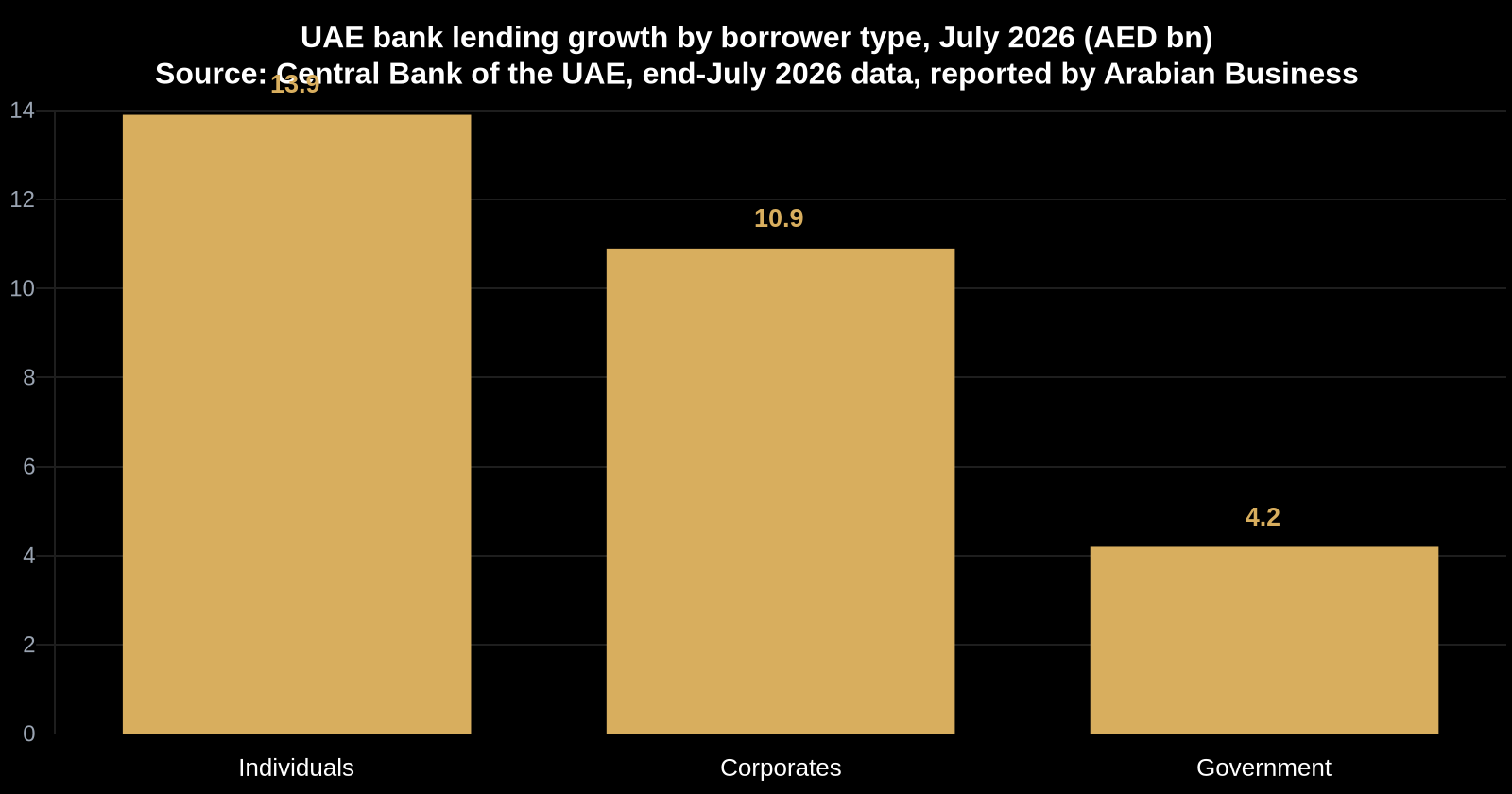
Set against that, the domestic data released this week points the other way. Credit to individuals in the UAE rose AED 13.9 billion in July alone, and Dubai registered 257,284 rental contracts across its freehold areas in the first eight months of the year. Households are borrowing and leasing at pace while the cost of money and the regional risk premium rise together. That divergence is the week's central tension, and it governs how everything below should be read.
If you're weighing entry points while this market reprices, I can show you where the risk-adjusted opportunities are emerging. Click here to speak with me directly.
Section 01
Saudi Arabia Shut a 7 Million Barrel-a-Day Pipeline and the Houthis Took Both Sides of Bab al-Mandab
Saudi Arabia closed its 1,200km East-West pipeline, which has capacity of up to 7 million barrels per day, after drone attacks on Thursday that the Energy Ministry said caused a number of injuries; the drones were said to have been launched from Iraqi territory (AGBI). That line exists precisely so that Saudi crude can bypass the Strait of Hormuz and reach the Red Sea at Yanbu. Yanbu exported an average of 4 million bpd in Q2 2026, nearly five times its pre-war level of roughly 763,000 bpd.
The redundancy has now been attacked from both ends. Houthi forces captured the port city of Mokha on Thursday and seized Perim Island, at the narrowest point of Bab al-Mandab, on Friday morning (AGBI). A Houthi-run coordination centre said Red Sea navigation remains safe for all shipping except Saudi vessels (AGBI). Houthi strikes this week on Abha, Khamis Mushait, Jazan and Najran injured 73 civilians.
There is a precedent for how quickly this reverses. An April attack on a pumping station knocked out about 700,000 bpd and was restored to full capacity within days. My working assumption is therefore that the pipeline outage is short-lived and the price premium is not about barrels lost but about the demonstrated reach of the attacks.
For a property investor the transmission is indirect but real. Triple-digit oil supports UAE fiscal revenue and domestic liquidity, which has historically been the single best predictor of Gulf real estate volume. Against that, OPEC cut its 2026 global oil demand growth projection to 380,000 bpd, its fifth consecutive downward revision (AGBI). A price held up by supply fear rather than demand strength is a weaker foundation for a five-year hold than the headline number suggests.
Energy and rates, week to 11 September 2026 (AGBI; Profit by Pakistan Today)
| Reading | |
|---|---|
| Brent, Friday settlement (AGBI) | $104.61 |
| Brent futures, 00:45 GMT Friday (AGBI) | $108.68, +1% |
| Brent, early Friday Asian trading (Profit) | $106.99, −0.6% |
| WTI, 00:45 GMT Friday | $103.45, +1% |
| US dollar index | 99.084 |
| US 10-year Treasury yield | 4.957% |
| Probability of 25bp Fed hike, 16 September | 71.1% |
Section 02
A September Fed Hike Is Now the Market's Base Case, and the Peg Passes It Straight Through
The dollar index sat at 99.084 in early Friday Asian trading, little changed after reaching its highest level since 7 September the previous session. US producer prices rose 0.4% in August, and markets were still awaiting Friday's CPI print (Profit).
The mechanism is worth restating in plain language, because it is the most under-appreciated variable in UAE underwriting. The Central Bank of the UAE maintains the dirham peg by moving its base rate in step with the Fed. If the Fed raises 25bp on 16 September, UAE base rates follow, EIBOR reprices, and every variable-rate mortgage and construction facility in the country costs more within weeks. There is no domestic policy discretion to soften it.
A 10-year Treasury yield within a fraction of 5% matters separately. It resets the risk-free rate against which every income-producing asset is measured. An office or retail unit underwritten at a 7% net yield offered a comfortable spread when the 10-year was at 3%. At 4.957% that spread is roughly two points, for an illiquid, single-tenant, single-jurisdiction asset. That is not a reason to avoid the market. It is a reason to insist on a yield that pays you properly for the illiquidity.
The practical action is unglamorous: if you are carrying variable-rate debt into the fourth quarter, model it at a rate one hike higher than today, and check whether your interest cover still works.
Central Bank of the UAE data for July shows credit to individuals up AED 13.9 billion ($3.78 billion), a 2.3% rise in one month (Arabian Business). Corporate lending rose AED 10.9 billion, or 1.1%, and government lending AED 4.2 billion, or 1.7%. Gross credit across the banking sector rose AED 41.2 billion, or 1.5%, to AED 2.7989 trillion ($762 billion). Total banking assets reached AED 5.6691 trillion ($1.54 trillion), up 1.3%.
The composition is the finding. Individual borrowing grew twice as fast in percentage terms as corporate borrowing in July. Household credit in the UAE is dominated by mortgages and personal facilities, so this is the closest monthly read available on housing demand funded by leverage rather than cash. It ran hot in the month immediately before the market began pricing a Fed hike.
Deposits rose 1.1% to AED 3.5098 trillion, from AED 3.4728 trillion at end-June. Deposit growth trailing credit growth by four-tenths of a point in a single month is not a liquidity problem at this scale, but it is the ratio to watch if credit keeps expanding at 1.5% a month while rates rise.
UAE banking sector, end-July 2026 (Central Bank of the UAE, via Arabian Business)
| Figure | |
|---|---|
| Total banking assets | AED 5.6691tn ($1.54tn), +1.3% |
| Gross credit | AED 2.7989tn ($762bn), +1.5% |
| Domestic credit | AED 2.206tn ($600.6bn), +1.4% |
| Foreign credit | AED 592.9bn ($161.4bn), +1.8% |
| Credit to individuals, monthly change | +AED 13.9bn (+2.3%) |
| Corporate credit, monthly change | +AED 10.9bn (+1.1%) |
| Deposits | AED 3.5098tn ($955.6bn), +1.1% |
Section 04
Dubai Registered 257,284 Rental Contracts in Eight Months, With August New Leases Up 19.4%
Analysis of Dubai rental registrations reported this week puts 257,284 contracts across freehold areas from January to August 2026, up 5.5% on the same period in 2025 (Arabian Business). Full-year 2025 set a record at 377,944 contracts. That eight-month figure works out at a run rate of roughly 32,160 contracts a month; carried forward on a straight line, the year lands a little under 386,000. On my arithmetic, that is a record — but a narrow one, and it depends on a fourth quarter behaving like the first three.
Two figures in this release need separating, because they cover different periods. The 19.4% year-on-year rise in new contracts, to 20,611, applies to August alone, not to the eight-month total. Renewals in August rose 4.4% to 19,034, and total August registrations were 39,645, up 3.79% month-on-month. The headline growth number is a single month's reading, and I would not extrapolate it.
The mix is more instructive than the total. One-bedroom units accounted for 41% of contracts (105,880), two-bedrooms 23% (59,420), studios 22% (55,336), three-bedrooms 10% (25,507) and four-bedrooms 3% (8,625). By area, Al Warsan First led with 23,894 contracts, followed by Jebel Ali First (21,687) and Al Barsha South Fourth (20,607).
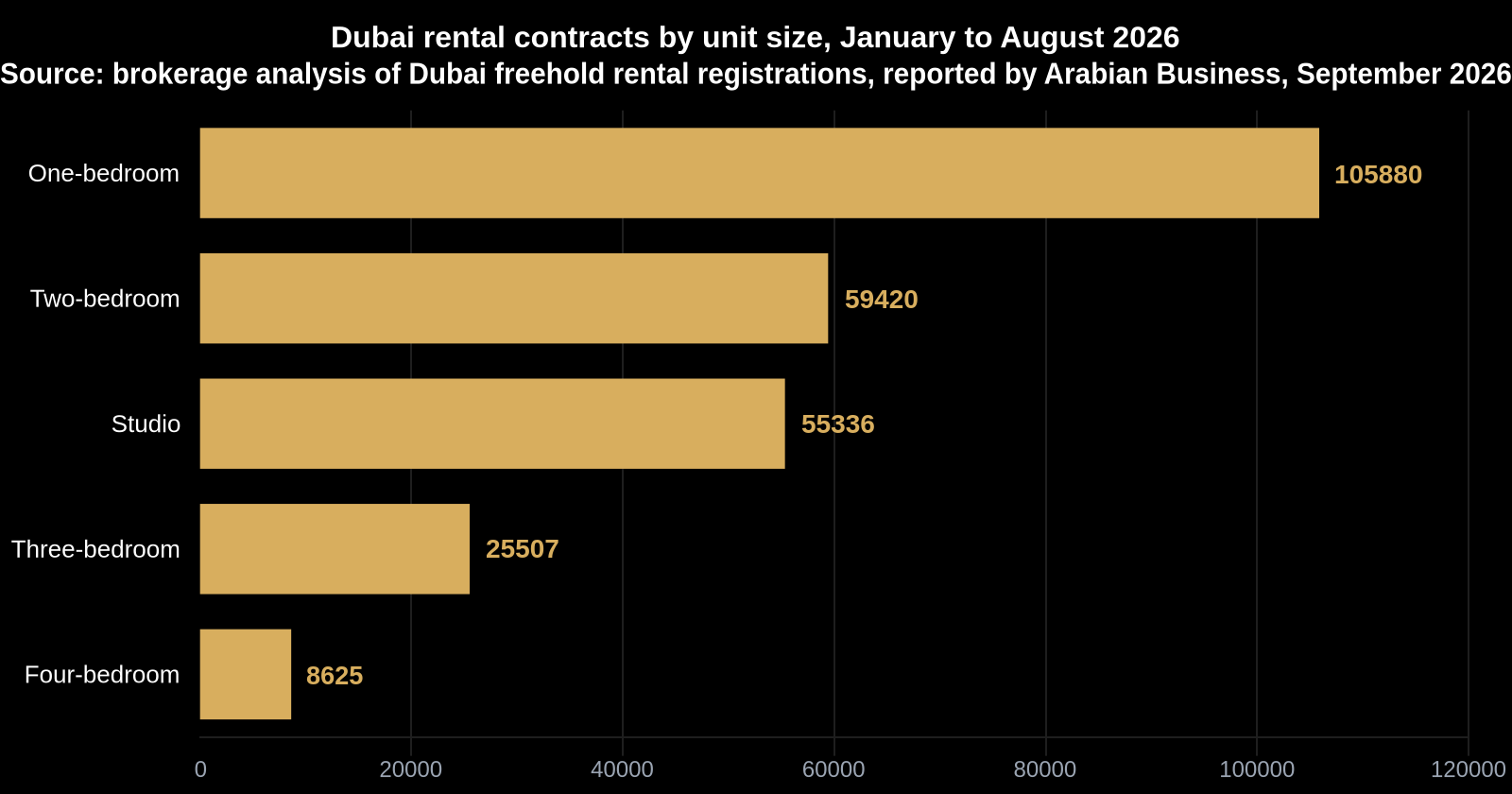
Nearly two-thirds of Dubai's leasing market is studios and one-beds, concentrated in mid-market communities. That is where household formation is happening, and it is the segment most exposed to the 2026-27 completion pipeline. Note also that this analysis originates with a brokerage rather than a government body. The underlying registrations are official; the aggregation and framing are not, and I read the promotional language accordingly.
Explore curated office and retail opportunities at Mitchell's Commercial Real Estate.
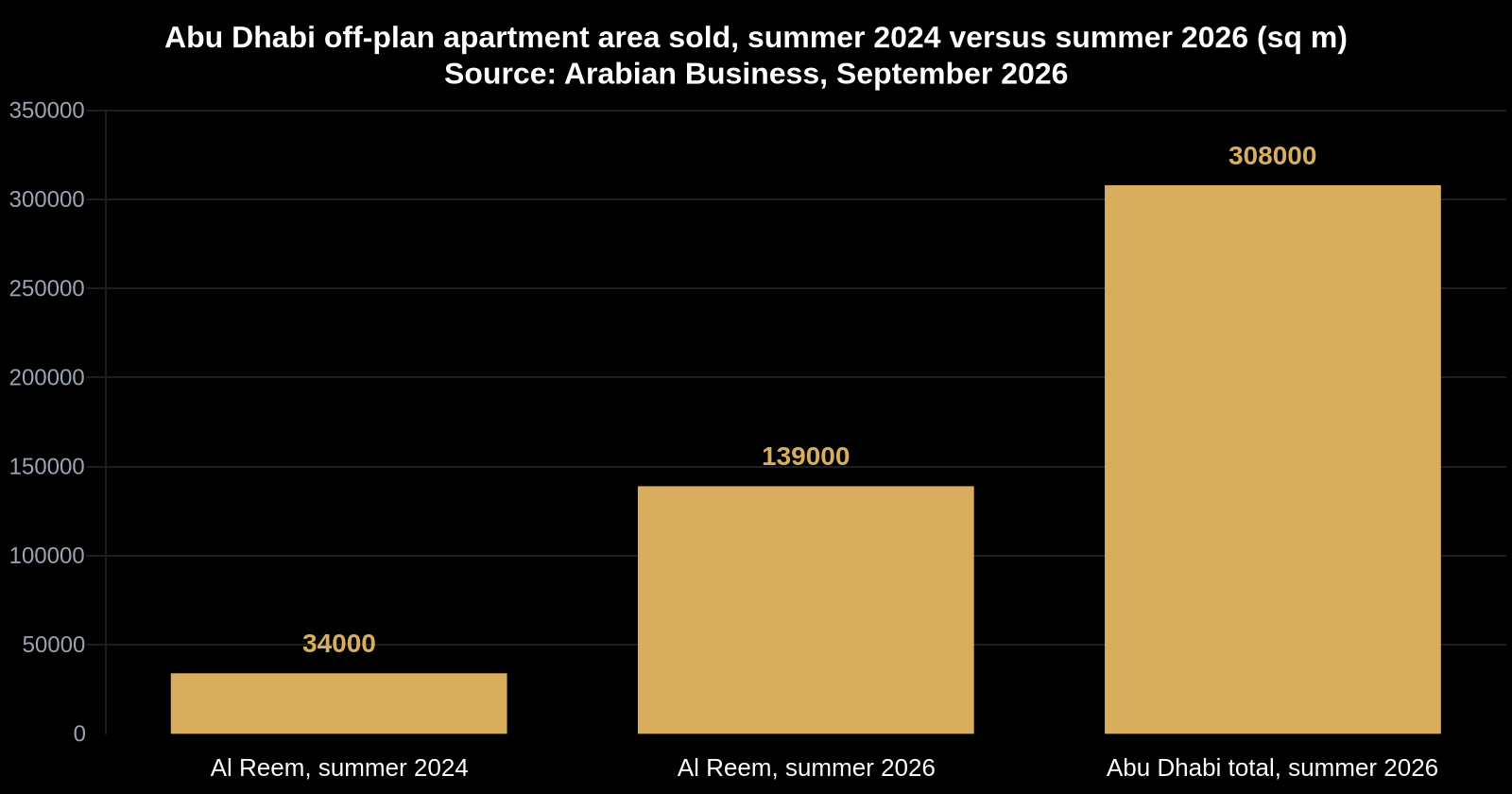
Al Reem Island accounted for 1,291 of 2,658 off-plan apartment transactions (49%) in Abu Dhabi over summer 2026 (Arabian Business). By floor area the concentration was similar: roughly 139,000 sq m sold on the island, against 34,000 sq m in summer 2024 — more than four times — out of approximately 308,000 sq m across Abu Dhabi, itself 2.4 times the summer 2024 total.
Average transacted off-plan apartment prices across Abu Dhabi rose 28% between summer 2024 and summer 2026, to approximately $7,070 per sq m. ADREC data for H1 2026 shows off-plan at 82% of residential deals and 89% of residential sales value in the capital.
Two things follow for investors comparing the emirates. First, Abu Dhabi's apartment market is now overwhelmingly a forward-sale market, which means buyers are taking completion and developer-counterparty risk on nearly nine-tenths of the value transacted. Second, half of that risk sits on one island. Concentration of that degree creates its own price behaviour: it is efficient on the way up and correlated on the way down. If you hold Al Reem exposure, you are not diversified within Abu Dhabi simply because you own several units there.
Abu Dhabi Global Market reported assets under management up 54% year-on-year in H1 2026, with active licences at 13,974 and 1,814 issued in the half (Arabian Business). Operational entities rose 34% to 3,986. Fund and asset managers rose 23% to 190, and funds managed rose 32% to 276. Financial services entities rose 27% to 392, with the FSRA issuing 50 In-Principle Approvals and 45 new Financial Services Permissions.
The employment figure is the one I would put in a leasing model. The workforce across Al Maryah Island and Al Reem Island reached 49,027, up 4,688 in the first half and 34% year-on-year. New asset managers registering in H1 2026 collectively oversee more than $2.1 trillion in global AUM, and ADGM-established entities hold more than $100 billion in AI-focused investment.
Nearly 4,700 additional financial-sector staff in six months, on two islands, is a direct input into both office absorption and high-end residential demand in the capital — and it is the same Al Reem where half of Abu Dhabi's off-plan apartment demand is landing. The two data sets corroborate each other, which is unusual enough to be worth noting.
Still reading
Need expert help on this subject?
Section 08
Dubai Holding Awarded AED 5 Billion for One Headquarters, and Creek Gardens Adds AED 3 Billion of Waterfront Supply
Dubai Holding awarded China State Construction Engineering Corporation Middle East a $1.3 billion (AED 5 billion) contract, described as the largest it has ever awarded, covering a new single headquarters due to open in 2029 and Jumeirah Residences Emirates Towers — 754 branded residences across two towers (Arabian Business). Dubai Holding says the group enables economic activity equivalent to 30% of Dubai's GDP; that is the company's own characterisation, not an audited statistic. The contractor has operated in the UAE since 2003 and delivered more than 110 large-scale Gulf projects.
Separately, Dubai Creek Gardens was launched at AED 3 billion ($817 million): more than 1,400 homes across more than 127,000 sq m in Dubai Healthcare City Phase 2, with 70% of the area given to landscaped and wellness space, and the UAE's first Westin and Renaissance branded residences developed with Marriott International. Completion is scheduled for 2030 (Arabian Business).
Both are developer-side releases and should be read as statements of intent rather than verified market data. The useful signal is timing. Capital is committing to 2029 and 2030 delivery in the same week that financing costs are rising and the region's export routes are under attack. Large balance sheets are underwriting a long recovery. A private investor with a three-to-five-year horizon is not taking the same bet, and should not borrow the same confidence from it.
Majid Al Futtaim reported H1 2026 net operating profit after tax up 25% to AED 1.8 billion ($490 million), EBITDA up 11% to a record AED 2.5 billion, on group revenue up just 1% to AED 17.5 billion (Arabian Business). Development revenue rose 38% year-on-year. The pipeline now exceeds AED 100 billion ($27.23 billion), with AED 2.8 billion of construction contracts awarded to date, including an AED 62 billion Dubai South mixed-use agreement covering 22 million sq ft. Total assets stand at roughly AED 73 billion, up 4%, against net borrowings of AED 13.2 billion.
The divergence inside the results is the point for landlords. Mall revenue rose 12% while retail revenue fell 6%. The landlord side of the business outperformed the shopkeeper side by eighteen percentage points. That pattern — rent capture growing while tenant trading softens — is comfortable for an owner of prime, high-footfall space and uncomfortable for an owner of secondary retail, where tenants have less margin to absorb rent increases. If you hold Dubai retail units outside the top schemes, read your tenants' trading figures before you read your own rent roll.
RAK Properties and Rakbank launched a financing product covering 12 named off-plan and under-construction developments in Ras Al Khaimah: Skai Quattro, Del Mar, Solera, NURA, Anantara Residences, Anantara Villas, ENTA, Lunara on The Strand, Mirasol 1, Mirasol 2, Beach Villas and The Edge (Arabian Business). The announcement is developer-originated and no rates, loan-to-value ratios or eligibility terms were disclosed in the material I have.
Without terms I cannot assess whether this is competitive. What it does tell you is directional: a UAE bank is extending structured credit into Northern Emirates off-plan at the same moment CBUAE data shows individual credit expanding 2.3% in a month. Leverage is becoming easier to obtain in the markets furthest from Dubai's core, which is exactly when purchase discipline matters most. Ask for the rate, the LTV, the construction-linked drawdown schedule and the position of the escrow account before the brochure.
In closing
Final View for Dubai Property Investors
Three things changed this week that should alter behaviour rather than opinion.
First, price your debt for a hike. A 71.1% market-implied probability of a 25bp Fed increase on 16 September, with the US 10-year at 4.957%, means the peg will transmit higher rates into UAE mortgages and development facilities before the fourth quarter is out. Re-run your interest cover one hike higher. If it fails, fix or reduce now rather than after the meeting.
Second, stop reading single-month growth rates as trends. The 19.4% rise in Dubai new leases is one August against one August. The eight-month total of 257,284 contracts, up 5.5%, is the number I would underwrite from — and it is meaningful growth, just a third of the headline pace. The same discipline applies to the July credit figures: 2.3% in a month is a data point, not a run rate.
Third, treat the week's announcements as supply, not validation. AED 30 billion in Sharjah, AED 3 billion at Dubai Creek, AED 5 billion at Dubai Holding, an AED 100 billion-plus pipeline at Majid Al Futtaim. These are 2029 and 2030 deliveries funded by balance sheets that can wait. If your holding period ends before theirs begins, the announcement is a competitor, not a confidence signal. Check what has been announced within a two-kilometre radius of anything you are about to buy, and price the absorption risk explicitly.
On concentration, two data sets now say the same thing about Abu Dhabi: Al Reem takes 49% of off-plan apartment demand while the ADGM workforce on Al Maryah and Al Reem grows 34% year-on-year. That is a genuine demand story, but 82% of the capital's residential deals are off-plan and 89% of its value. Counterparty quality, not location, is the variable that will decide those outcomes. Underwrite the developer before the postcode.
Next step
Let’s Talk
If you’d like to unpack where the most resilient opportunities are emerging — in stabilised residential areas or income-generating commercial zones — I’d be happy to share a focused, data-driven shortlist based on your investment goals.
📞 No pressure, no sales pitch—just a focused, informed conversation about your investment goals.
Published 12 September 2026 by Stephen James Mitchell MBA. Market figures quoted reflect the data available at that date.