There are two notices in Dubai, and which one applies depends on why you want the property back. If the tenant has done nothing wrong and you want possession when the lease ends, the notice period is 12 months. If the tenant is in breach, it is 30 days to put the breach right. Both run under Law No. 26 of 2007, as amended by Law No. 33 of 2008, and both end up at the Rental Dispute Settlement Centre if the tenant does not comply.
The same statute covers homes and commercial units, so the structure is common to both. The differences are narrow and specific, and three of them only ever work in a commercial landlord's favour. Knowing which notice you are serving, on what ground, and how it has to reach the tenant decides the outcome long before anyone goes to the Centre.
This is the notice for recovering a property at the end of a tenancy from a tenant who has done nothing wrong. It requires 12 months' written notice, and it exists because the law treats a tenancy as something that renews unless it is properly brought to an end. That is the part landlords tend to misread. The tenancy does not stop at the date on the contract. It carries on until a valid notice has run its course.
The notice is available on four grounds, and only four. You cannot use it because you would prefer a different tenant, because you want to raise the rent, or because the relationship has broken down. If the reason you want the property back is not on the list, this notice is not open to you.
Demolition or reconstruction
Where the building is to be demolished or completely rebuilt. Technical approval from Dubai Municipality is required, which means you need the approval before you serve the notice, not after. If you serve first and apply later, the Centre will see the gap.
Renovation or structural maintenance
Where extensive renovation or structural maintenance is planned. You need official technical reports, and they have to show the work cannot be done while the tenant is still there. That last part is what decides it. Redecorating, a refit between lettings, or work that could be done in stages around the tenant will not be enough.
Sale of the property
Where the owner intends to sell the asset. This is the most straightforward of the four, and it is also the one most likely to follow the property to a new owner, which is dealt with below.
Recovery for personal use
Where the owner wants the property for themselves or a first-degree relative. This ground needs the most proof of the four. You can only use it if you can show you own no other suitable property in the Emirate. If you own several properties, that is hard. If you own several of the same type, it is close to impossible.
It also costs the most if it works, because of the re-letting ban that follows. Use it last, not first.
Where the tenant is in breach, the route is different and much shorter. Non-payment of rent, unlawful subletting, and using the premises for unauthorised or unsafe activity are all breaches.
The landlord serves a formal 30-day notice to remedy. This gives the tenant a set period to fix the problem. Pay the arrears, end the sublet, or stop the unauthorised use. If the breach is put right inside the 30 days, the tenancy continues as before. If it is not, an eviction claim can then be filed with the Rental Dispute Settlement Centre.
What a landlord cannot do is treat the breach as having ended the tenancy. A tenant who owes you rent is still the lawful occupier until the Centre says otherwise. The 30-day notice is the step that turns a breach into a claim. Skipping it is how landlords with a clearly bad tenant still lose.
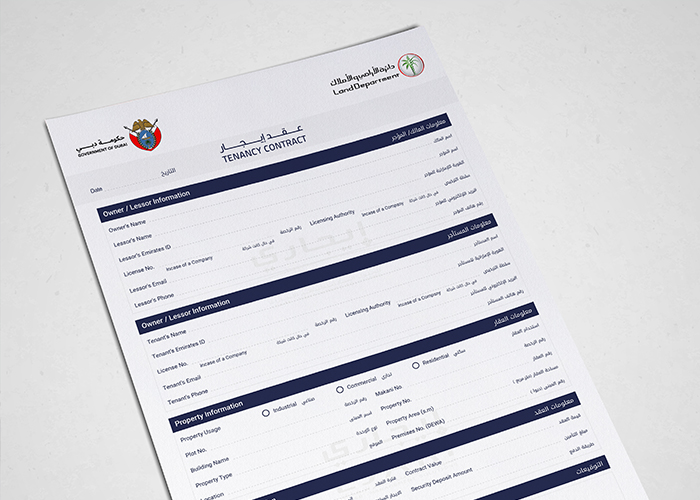
Service is where otherwise sound claims fail. An eviction notice in Dubai is served through the Notary Public, or by registered mail. A WhatsApp message, an email, a letter handed to the tenant at the door, or a conversation they clearly understood does not start the clock.
Two consequences follow, and both are expensive.
The first is timing. The 12-month notice has to expire at the right point. Serve it late, or serve it in a way that does not count, and the tenancy renews. You then wait another full year, with the tenant still in the property.
The second is proof. A notarised notice produces an independent record of what was served and when. That record is what you rely on twelve months later, when the tenant tells the Centre they were never told. A landlord with a sent message and a memory of the conversation is in a much weaker position. A notarised notice stands on its own. Both landlords may be telling the truth, and only one can prove it.
| Consideration | Residential | Commercial |
|---|---|---|
| Empty premises | Leaving the property empty is not a breach while the rent is being paid. | Under Article 25(1)(d), eviction can be pursued where a unit is vacated for 30 consecutive days or 90 non-consecutive days in a year without valid reason. |
| Re-letting after recovery for personal use | The property cannot be re-let for 2 years. | It cannot be re-let for 3 years, and a former corporate tenant may claim for loss of trade and relocation costs. |
| Agreed break clauses | Statutory protection almost always overrides a conflicting clause. | Corporate parties are treated as sophisticated actors, and negotiated break clauses and agreed penalties carry strong judicial weight. |
| Licensing and use | Occupancy caps, quiet enjoyment, community rules. | Tied to Department of Economy and Tourism activities, Civil Defence approval and planning use. |
| Ejari on exit | An administrative record, needed for utilities and residency visas. | Integrated with trade licensing, so an uncancelled record blocks the next tenant from licensing at that address. |
The commercial differences all point the same way. A commercial tenancy is treated as a deal between two businesses that knew what they were signing, so the written terms count for more. The unit is also treated as a trading asset, so the law protects its condition as a working shop or office.
This is the difference most landlords do not know they have. In a home, a tenant who pays the rent and is rarely there is not in breach, and there is nothing to act on. In a commercial unit, premises left dark can be recovered even though the rent is entirely current.
The thresholds are 30 consecutive days, or 90 non-consecutive days across a year, without a valid reason. The second is the one that catches people, because it does not need a single long closure. A unit that opens sporadically can cross 90 days across a year while appearing, month to month, to be trading.
The reason is commercial. A closed unit in a retail parade damages the value of everything around it. Footfall drops, the scheme looks like it is failing, and the tenants who are open carry the cost. The law treats that as real harm, whether or not the rent is being paid.
For a landlord with a multi-let asset, the practical consequence is that rent receipt is not a health check. A tenant can pay by post-dated cheque while the shutters have been down for two months. Checking whether units are open is the only way to know. Write down what you find at the time, because the Centre will ask whether there was a valid reason, and that is hard to prove later.
Still reading
Need expert help on this subject?
A notice that has run its course does not hand you the property. If the tenant does not leave, the matter goes to the Rental Dispute Settlement Centre as a claim, and the notice becomes the evidence that the process was followed properly. A good notice makes that claim simple. A faulty one turns it into an argument about procedure instead of about the property.
Recovery on the personal-use ground also carries a condition that outlasts the eviction itself. Succeed on it and the property cannot be re-let for two years on a home, or three years on a commercial unit. If you take a unit back on that ground and then let it to someone else, the tenant you removed can claim against you. On a commercial unit that claim can cover lost trade and the cost of moving the business.
So the personal-use ground is a commitment, not a tactic. If there is any chance you will want the unit back on the market inside three years, do not use it.
No self-help, in either asset class, at any stage, whatever the arrears. Changing the locks, cutting access codes, disconnecting services, or holding a tenant's stock against unpaid rent are not shortcuts.
They expose you to a criminal trespass complaint and a claim for damages, and they turn a case you could win into one you lose. A landlord who is owed money and follows the law is a creditor with a claim. A landlord who is owed money and changes the locks is a defendant. Recovering rent, and holding a tenant's assets against it, are ordered through the Centre. That is the only route.
Taking an office floor for your own business
You own a floor in Business Bay and want it for your own company. Personal use is a valid ground. You have to prove you own no other suitable commercial space in the Emirate, and the 12-month notice has to go through the Notary Public.
If it succeeds, the three-year re-letting bar runs from that point. The risk is what happens next. Plans change, a business moves, and a half-used floor is an obvious thing to let. Do that inside three years and the tenant you removed can claim against you, pointing at the ground you used. Decide on a three-year view before you serve.
A tenant who pays but has closed the doors
A retail tenant shuts the showroom during a cash-flow squeeze, dismisses the staff, and keeps paying by post-dated cheque. In a residential unit there would be nothing to act on. In a commercial one, the 30 consecutive days or 90 non-consecutive days threshold applies, and a 30-day notarised notice can be served although the rent is current.
The difficulty is proof. You are saying the unit was shut on particular dates. That is easy to know at the time and hard to prove a year later. Dated records, kept as it happens, are what make this ground usable.
A break clause against the statutory year
An industrial lease contains an express break: either party may end it on 90 days' notice, with a penalty of two months' rent. The landlord exercises it rather than serving 12 months.
Between two businesses, the Centre will usually enforce what was agreed. A residential tenant could normally fall back on the statutory 12 months to defeat a clause like that. This is the clearest case where a commercial tenancy gives an owner a faster way out. You only have it because someone wrote it into the lease at the start. You cannot create it once the relationship has gone wrong, which is when most landlords go looking for it.
Frequently asked questions
0601Can I evict a tenant to increase the rent?
No. Rent is not one of the four grounds for an eviction notice in Dubai. Rent increases are dealt with separately from possession, and the 12-month notice is available only for demolition or reconstruction, extensive renovation, sale, or recovery for personal use.
02Can a commercial tenant be evicted immediately if their business licence expires?
No. Trading without a valid licence is a regulatory breach, and the 30-day route still applies. The notice goes through the Notary Public. The tenant then has 30 days to put the licence right with the Department of Economy and Tourism, or with the relevant free zone authority. If they do not, an eviction case can be filed with the Centre.
03What happens if an outgoing commercial tenant refuses to cancel their Ejari?
An active Ejari stops the next tenant registering a trade licence at that address. The problem is immediate, and it is yours rather than theirs. Where the departed tenant will not cooperate, the landlord presents the eviction order, handover certificate, or expired tenancy documentation to obtain administrative cancellation of the record.
04Can a commercial landlord seize inventory for unpaid rent?
No. Locking the premises, changing access codes, or holding a tenant's assets are self-help measures that expose a landlord to criminal trespass complaints and civil damages. Recovery and attachment are ordered through the Rental Dispute Settlement Centre.
05Does a notice served by the previous owner survive a sale?
Say you buy a property and the seller had already served a 12-month notice on the sale ground. The Centre's panels have preferred that the new landlord either serves the notice again, or documents that the original ground still applies. Settle that during the transaction. A buyer who assumes an inherited notice is still running can find the twelve months starts again from the day they ask.
06Does the RERA Rental Calculator apply to commercial properties?
The calculator is built for residential property. Commercial rent adjustments come from a formula written into the lease, a sector-specific valuation certificate issued through the Dubai Land Department, or market evidence put directly to the Centre.
Most notices fail for one of two reasons. The wrong ground, or service you cannot prove. Both are decided before the notice goes out, and neither can be fixed afterwards.
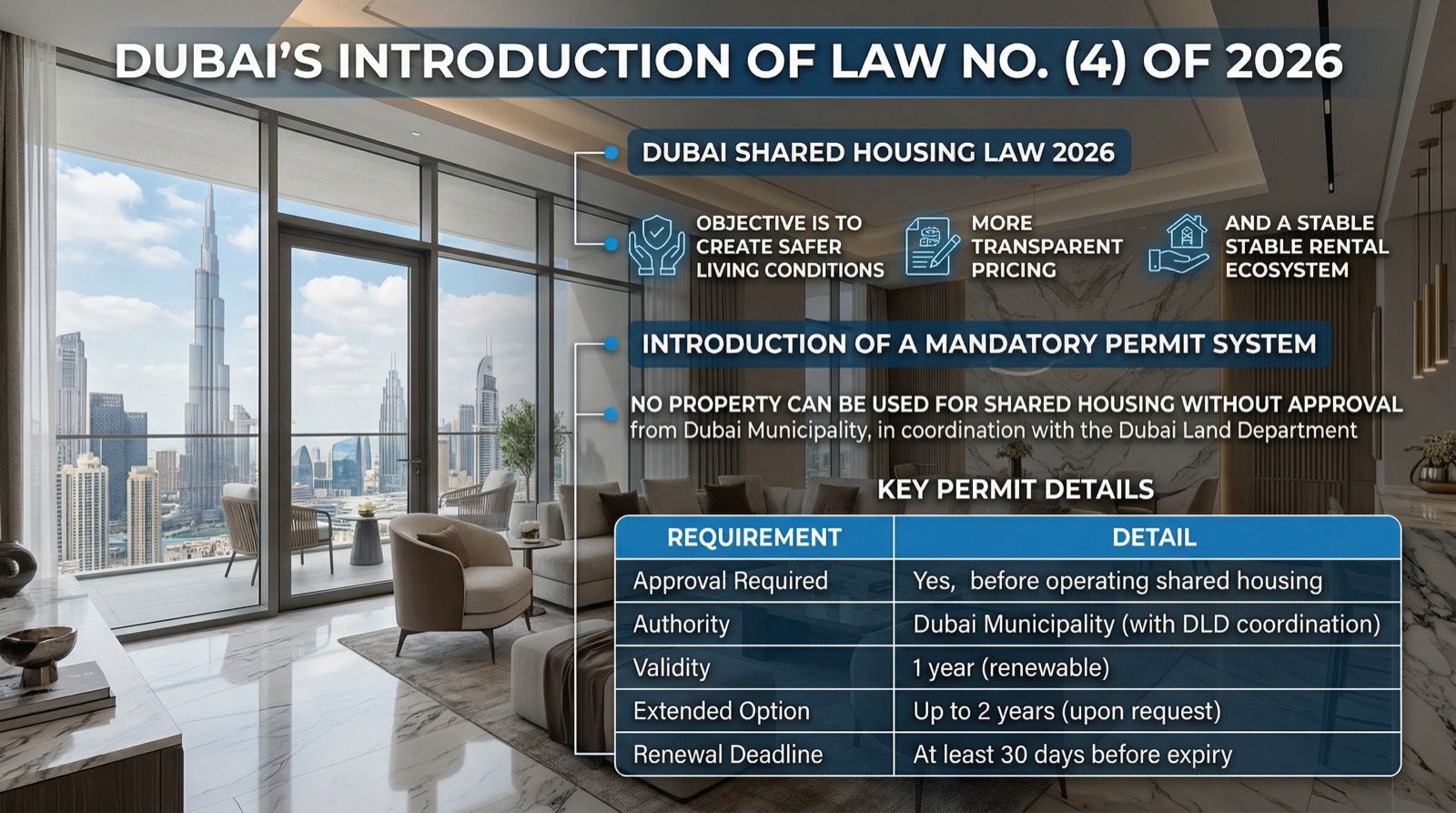
We act on commercial tenancies across offices, retail and the wider commercial market. The broader framework is covered in our guide to Dubai real estate regulation and the 2026 shared housing rules. If you are weighing a notice, or buying with a tenant in place, talk to us.
This article sets out the general position under the legislation cited and is not legal advice on a particular tenancy.
Next step
Talk to Mitchells
Tell us what you are weighing up — a building, a project, an area, or a rule you need to get right — and we will come back with the specifics that apply to it.
Published 5 October 2026 by Stephen James Mitchell MBA. Market figures quoted reflect the data available at that date.