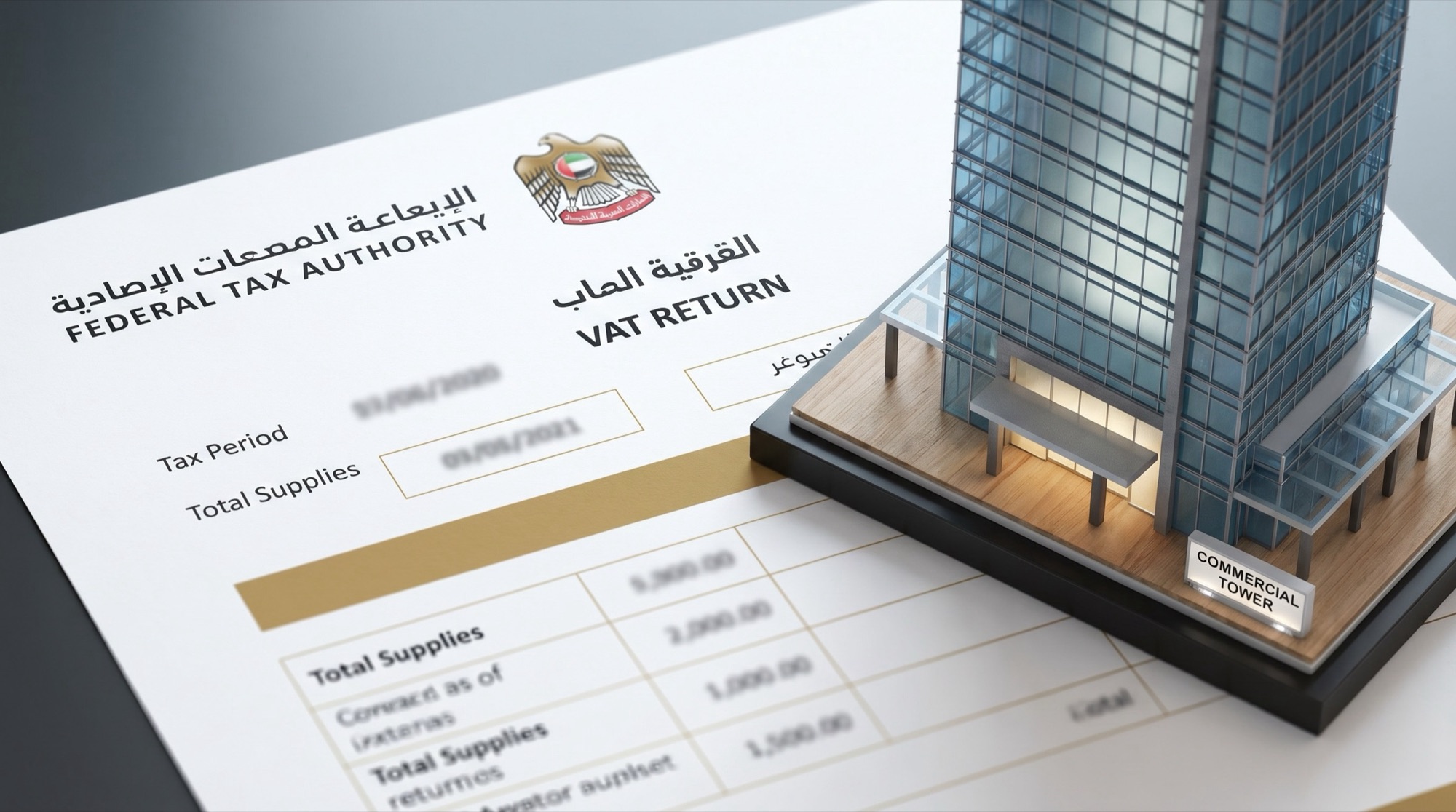
Since the UAE introduced VAT in 2018, one of the most common questions investors ask is how it applies to property. The short answer is simple: residential property is generally exempt, while VAT applies at 5% on most commercial property transactions — both sales and leases.
For anyone buying or selling an office, retail space, or warehouse in Dubai, it’s essential to understand when VAT is charged, who pays it, and how it can be reclaimed. The details differ between new properties purchased directly from developers and resales in the secondary market, so we’ll look at both sides.
When you buy a new commercial property directly from a developer, VAT is straightforward. It’s charged at 5% on the sale price, collected by the developer, and remitted to the Federal Tax Authority (FTA).
You’ll also pay the Dubai Land Department’s 4% transfer fee, but VAT and DLD fees are separate. The DLD never collects VAT — it’s paid directly to the developer.
When VAT Becomes Due
VAT becomes payable at the earlier of:
- The date ownership is transferred; or
- The date any payment is received.
So, even if the building isn’t handed over yet, VAT is still due once a payment is made.
Reclaiming VAT on a Primary Purchase
If you’re a VAT-registered business, you can usually reclaim the VAT as input tax through your FTA return, provided the property will be used for taxable business activities (for example, leasing commercial units with VAT-inclusive rents).
If you’re not VAT-registered, the VAT becomes part of your purchase cost and cannot be recovered.

The resale market introduces more nuance. When a commercial property changes hands between private owners, companies, or investors, VAT treatment depends on the nature of the transaction and whether both parties are registered with the FTA.
In most secondary market sales, the transaction is subject to 5% VAT. However, there’s one important exception known as a Transfer of a Going Concern (TOGC).
When the TOGC Exemption Applies
If the property is already leased and the buyer continues the same business activity — in other words, continues to lease it out — the sale can qualify as a TOGC.
In that case, the transaction is outside the scope of VAT, meaning no VAT is charged.
Both the buyer and seller must be VAT-registered, and the buyer must continue the same rental activity without interruption.
When VAT Must Be Paid
If the TOGC exemption doesn’t apply, the buyer is responsible for VAT:
- If the buyer is VAT-registered, the Reverse Charge Mechanism (RCM) can be used. Under RCM, the buyer accounts for VAT directly to the FTA, recording it as both output and input tax — effectively neutralising the payment.
- If the buyer isn’t VAT-registered, they must pay 5% VAT to the seller, who then remits it to the FTA in their next VAT return.
Example: How VAT Works on a Secondary Sale
Let’s say a VAT-registered company sells an office in Business Bay for AED 2 million.
| Description | Amount (AED) |
| Sale Price | 2,000,000 |
| VAT (5%) | 100,000 |
| Total Payable by Buyer | 2,100,000 |
| DLD Transfer Fee (4%) | 80,000 |
If both parties are VAT-registered and the reverse charge mechanism applies, no VAT is paid in cash — the buyer simply declares it on their FTA filing.
If the buyer is not registered, they must pay the AED 100,000 VAT to the seller, who will pass it on to the FTA.

VAT doesn’t end at the point of sale. All commercial leases are subject to 5% VAT on rent. The landlord must issue VAT invoices for each rental period, collect the VAT from the tenant, and remit it to the FTA.
For VAT-registered tenants, this is recoverable as input tax if the property is used for taxable business activities.
For landlords, proper VAT registration ensures they can reclaim VAT on their property purchase, fit-outs, and maintenance expenses.
A TOGC structure can be particularly useful for investors acquiring income-generating properties with existing tenants. It allows the transaction to proceed without the buyer paying 5% VAT upfront, preserving cash flow.
To qualify:
- Both parties must be VAT-registered.
- The property must be an ongoing rental business.
- The buyer must continue the same leasing activity immediately after transfer.
When handled correctly, this structure is entirely legitimate and commonly used in Dubai’s commercial market.
Still reading
Need expert help on this subject?
| Feature | Primary Market | Secondary Market |
| Seller | Developer | Individual or company |
| VAT Rate | 5% | 5% or exempt (TOGC) |
| Who Pays VAT | Buyer → Developer | Buyer → Seller or via RCM |
| Who Remits VAT | Developer | Seller (or buyer via RCM) |
| Reclaimable VAT | Yes, if VAT-registered | Yes, if VAT-registered |
| DLD Role | Collects 4% transfer fee only | Same |

Buyers should:
🗹 Confirm whether VAT applies or if the sale qualifies as a TOGC.
🗹 Check that the seller is VAT-registered.
🗹 Ensure the Sale and Purchase Agreement (SPA) clearly states whether the price is inclusive or exclusive of VAT.
🗹 Obtain a valid VAT invoice or TOGC declaration.
🗹 File and reclaim VAT promptly through the FTA if eligible.
Sellers should:
🗹 Confirm the correct VAT classification before marketing the property.
🗹 Verify the buyer’s VAT status.
🗹 Issue compliant invoices and retain documentation for at least five years.
🗹 Remit collected VAT to the FTA on time to avoid penalties.
Common Mistakes to Avoid
🗹 Assuming a sale price includes VAT when it doesn’t.
🗹 Forgetting to confirm the buyer’s or seller’s VAT registration.
🗹 Applying TOGC incorrectly and being assessed for unpaid VAT later.
🗹 Missing the reclaim deadline for input VAT.
A short conversation with a qualified advisor before signing can prevent costly surprises later.
Frequently asked questions
0601Is VAT charged on all commercial property transactions in Dubai?
In most cases, yes — 5% VAT applies on both sales and leases, unless the transaction qualifies as a Transfer of a Going Concern.
02Who pays the VAT when buying a commercial property?
The buyer pays the VAT. In primary sales it goes to the developer; in secondary sales it goes to the seller (unless the reverse charge applies).
03Can I recover the VAT I pay on a purchase?
Yes, if you are VAT-registered and using the property for taxable business purposes, you can recover it as input tax through your FTA filings.
04Does VAT apply to service charges and maintenance?
Yes. Management and maintenance services for commercial buildings are taxable at 5%.
05What happens if a property is leased out when sold?
If the lease continues and both parties are VAT-registered, the sale may qualify as a TOGC, meaning no VAT is payable on transfer.
06What if VAT is charged incorrectly?
The FTA can require corrections and impose penalties. Always ensure the sale structure and invoices are reviewed before transfer.
Next step
Let’s Talk
VAT can materially affect your acquisition cost, cash flow, and return on investment. If you’re planning to buy or sell a commercial property, I can help you structure the transaction strategically — ensuring compliance and protecting your bottom line.
📞 No pressure, no sales pitch—just a focused, informed conversation about your investment goals. Let’s talk.
Published 18 February 2026 by Stephen James Mitchell MBA. Market figures quoted reflect the data available at that date.