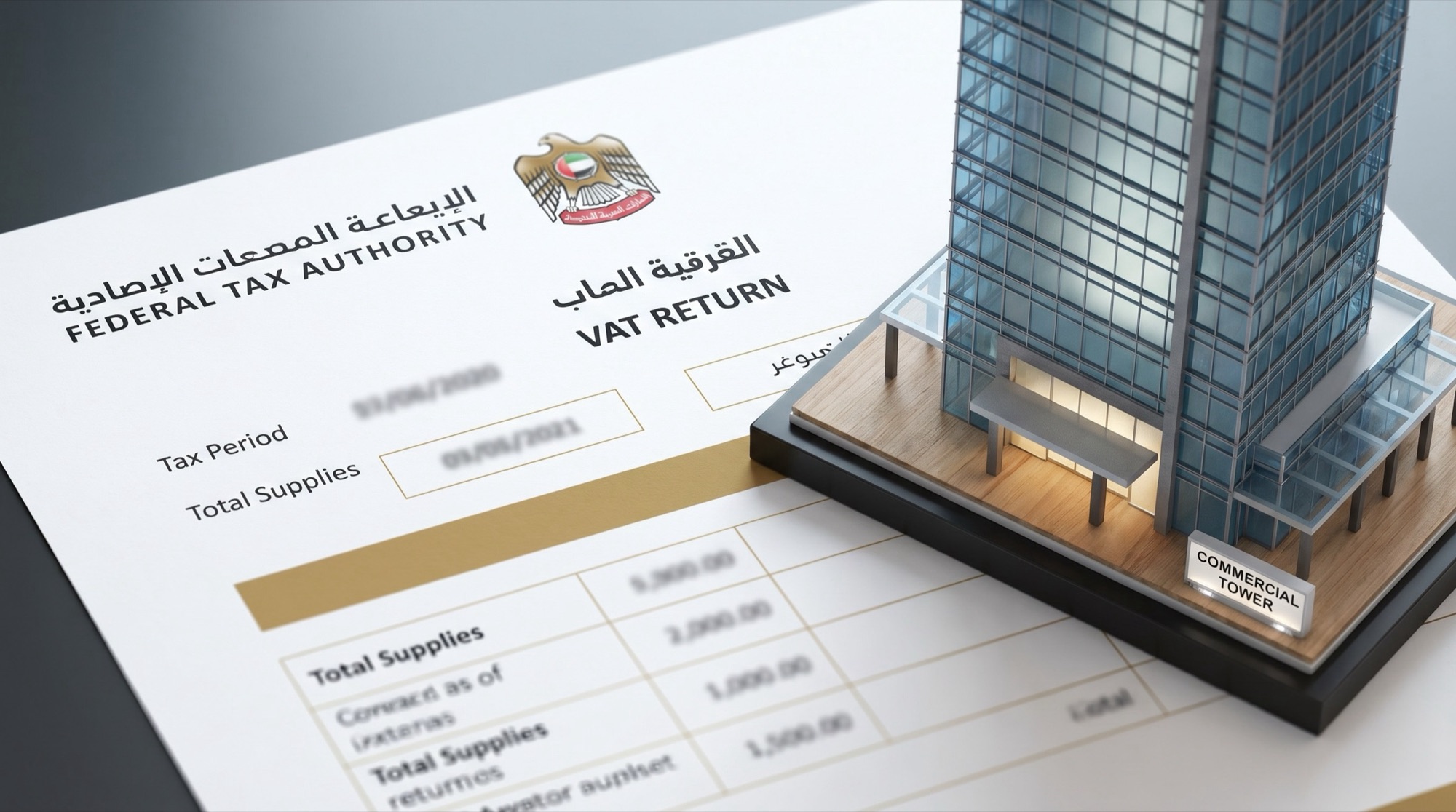
Sitting across the desk from ambitious founders and seasoned investors, I see a recurring theme play out almost every single week. When you are establishing a new corporate footprint in the United Arab Emirates, acquiring the right commercial premises is almost always your largest single upfront capital expenditure.
Whether you are looking for a sleek corporate headquarters, a functional warehouse, or a high-footfall retail front, the capital outlay is significant. And in my more than 19 years navigating the complexities of the local property landscape, I’ve noticed a very common, and frankly very costly, assumption made by entrepreneurs setting up a brand-new corporate entity.
They assume that without active, flowing revenue, their new company simply has to absorb all early-stage tax liabilities as permanent sunk costs. Specifically, there is a widespread myth that a zero-revenue startup cannot reclaim the 5% Value Added Tax (VAT) incurred on commercial property purchases until the business is fully operational, physically occupying the space, and actively generating income.
I am here to tell you that this is categorically false.
The UAE’s tax framework actually provides a highly pragmatic, structured approach that actively supports your early-stage business growth and capital efficiency from day one. You can absolutely reclaim VAT on commercial real estate long before your first dirham of revenue is ever booked. In my practice, I spend a lot of time unpicking these misconceptions.
Today, I want to walk you through a detailed breakdown of the specific mechanics of VAT recovery on off-plan commercial property in the UAE for startups. I will detail the strategic sequencing I use with my own clients to protect their cash flow, maintain strict regulatory compliance, and maximize their investment yields in the wider Dubai real estate market.
Grab a coffee, and let’s break down exactly how you can structure this tax recovery to your distinct advantage.
To reclaim any VAT in the UAE, your corporate entity must be formally registered with the tax authorities and possess an active Tax Registration Number (TRN). You might already be aware that standard VAT registration becomes strictly mandatory only when your business's taxable turnover exceeds AED 375,000 over a rolling 12-month period.
For a startup that hasn't even opened its doors yet, hitting that revenue milestone feels miles away, which is exactly why so many founders mistakenly write off their early VAT expenses.
However, what I always point out to new market entrants is that the Federal Tax Authority (FTA) accommodates startups through a brilliant mechanism known as voluntary registration. Under this specific rule, your business can voluntarily register for VAT if either its taxable supplies or its taxable expenses exceed AED 187,500.
For a startup buying commercial real estate, the initial down payment on the property purchase itself acts as the qualifying taxable expense. This allows you to secure immediate registration despite having absolutely zero revenue on your books.
I cannot overstate how much of a lifeline this is for your corporate cash flow. When you are purchasing an office space, 5% of the total purchase price represents a large sum of tied-up capital. By utilizing voluntary registration based on your startup expenses, you secure your TRN immediately.
This early registration status transforms that 5% VAT from a painful, unrecoverable sunk cost into a fully recoverable input tax. It ensures that your business is not unfairly penalized for simply being in its pre-revenue building phase. Instead of losing that vital capital to the tax authority, you can recover it and redirect it back into operational growth, hiring your core team, or funding further commercial property investment strategies.
To apply this strategy practically, I always advise my clients to first aggressively secure their mainland or freezone trade license and their corporate bank account. Once we have those foundational elements in place, your designated tax agent or internal finance director must submit a voluntary VAT registration application.
During this process, you must explicitly select the option to register based on "taxable expenses." You will be required to upload your formal Sale and Purchase Agreement (SPA) or the initial developer invoices alongside your financial projections. This proves beyond a shadow of a doubt that your corporate expenses have officially crossed the AED 187,500 threshold.
One of the very first conversations I have with a new corporate client revolves around asset classification, primarily because the UAE Government’s official VAT framework does not treat all real estate equally. Your ability to recover VAT is entirely dependent on the specific legal asset class you are acquiring.
Commercial properties—which are legally defined as any building or structure not intended for residential or charitable use—are subject to a standard VAT rate of 5%. Because the developer charges you this 5% upon purchase, your VAT-registered business can legally recover it as input tax.
Conversely, the rules for residential property are entirely different. The sale of an existing residential property on the secondary market is VAT-exempt, and the first supply of a newly constructed residential property (within three years of completion) is zero-rated. Furthermore, bare, undeveloped land is also entirely exempt from VAT.
Understanding this classification is vital because it dictates your entire financial modeling for the acquisition. If you are modeling your startup's cash flow projections based on a 5% tax recovery, you must be absolutely certain the asset is legally classified as commercial by the authorities.
I frequently see investors blur the lines between asset classes, particularly when looking at mixed-use developments, hotel apartments, or live-work lofts. I often see a business purchase a residential apartment with the intention of using it as a makeshift corporate office, assuming they can claim the VAT back simply because they are a registered corporate entity.
This claim will be rejected outright and heavily penalized, because the physical asset is classified as residential, meaning no standard VAT was legally applicable in the first place.
Furthermore, I spend a significant amount of time clarifying the dangerous confusion between federal taxes and municipal levies. The federal 5% VAT is recoverable for your business; however, the 4% transfer fee levied by the Dubai Land Department (DLD) is a local, emirate-level registration cost. It is not a tax.
Please, whatever you do, do not attempt to claim the 4% DLD fee on your VAT returns. I have seen companies try this, and it immediately triggers an FTA audit and steep financial penalties for non-compliance.

When dealing with off-plan commercial real estate in Dubai, properties are often purchased years before they are physically built, finished, and handed over to you. Let’s say you buy an off-plan unit today with a projected handover at the end of 2028. You won't actually be able to occupy that office until early 2029. How does this delayed timeline impact your tax situation?
Many investors incorrectly assume they have to wait until the building is completely finished before they can ask the government for their tax money back. Thankfully, the FTA addresses this through specific "Date of Supply" rules.
Under these rules, your VAT liability is not deferred until the building is completed. Instead, VAT becomes due whenever a payment is made, or a tax invoice is issued—whichever occurs first. Consequently, the developer will apply the 5% VAT proportionally to each individual construction milestone installment you pay over that multi-year build cycle.
I always highlight this timeline because it is the ultimate cash flow protector for an expanding enterprise. Because the VAT is charged incrementally with each installment, your recovery is also incremental. You do not have to wait until your 2028 or 2029 handover to claim back the VAT you paid today in 2026.
This pay-as-you-go system means the capital required to fund the VAT is only tied up for the duration of a single tax quarter. It dramatically lowers the required liquid capital reserves your startup needs to sustain the business through the property's lengthy construction phase.
To execute this seamlessly, I instruct my clients' internal finance teams to align their payment schedules tightly with their FTA tax periods. Every time your company pays a construction-linked milestone—say a 10% progress payment—you must demand a formally compliant, original tax invoice from the developer for that specific amount, clearly showing the 5% VAT and your company's TRN.
As soon as you hold that invoice and have made the payment, you log the input VAT on your standard monthly or quarterly FTA return. The VAT you pay in Q1 is claimed on your Q1 return, creating a rolling, highly efficient recovery cycle that tracks perfectly alongside the construction progress.
This brings us to a very logical puzzle. To recover VAT on any expense, your business must prove to the government that the expense is being used to generate taxable supplies. But when you are buying an off-plan property, the physical building literally does not exist yet. It is just a patch of sand and some scaffolding. Your company obviously cannot physically occupy a construction site to make taxable supplies.
The FTA bridges this logical gap through the legal principle of "Intended Use." This principle allows a business to claim input VAT during the construction phase based entirely on the documented, formalized intention that the completed, future premises will be used exclusively for the company's taxable commercial operations.
The Intended Use principle is the absolute legal foundation that makes early off-plan VAT recovery possible. Without it, the FTA would rightfully reject all of your early VAT claims on the grounds that the asset is not currently contributing to the business's taxable output. It shifts the burden of proof from physical, real-world occupation to strict corporate documentation.
Applying this principle is an exercise in meticulous corporate governance, which is a core part of effective corporate structuring in the UAE. You cannot simply rely on verbal intentions, casual assumptions, or promises made to an auditor. Your business must construct a bulletproof paper trail from day one.
This begins with your corporate board minutes explicitly detailing the strategic decision to acquire the specific off-plan unit to serve as your future operational headquarters or retail front. Your formal business plans, pitch decks, and financial projections must legally reflect this acquisition.
Investors routinely fail here by treating corporate governance as an administrative afterthought. They claim the VAT back on their quarterly returns but maintain absolutely zero internal documentation proving why the off-plan asset was purchased in the first place.
If the FTA decides to audit the company and asks for proof of intended use, a lack of board minutes or strategic planning documents will result in the immediate rejection of the VAT claim, followed by severe demands for repayment and associated fines.
I always warn my clients: the "we plan to use it eventually" defense holds zero legal weight without a contemporaneous, formalized paper trail created at the exact time of the property purchase.
Still reading
Need expert help on this subject?

For my clients acquiring mid-tier or premium commercial spaces, I always introduce them to a critical post-handover regulatory framework known as the Capital Asset Scheme. This is where things get slightly more complex, but knowing this rule will save you a significant headache down the line.
Under UAE VAT law, if the total purchase price of your commercial property exceeds AED 5 million (excluding the VAT), the property is legally classified as a "Capital Asset." Because your business successfully recovered the VAT during the off-plan construction phase based merely on your "intended use," the FTA requires the company to actively monitor and report on the actual, physical use of that Capital Asset for a mandatory period of 10 years following the property's completion.
This threshold matters immensely because crossing it introduces a decade-long compliance and administrative burden on your finance team. If your property is purchased for under AED 5 million, you claim the VAT, you occupy the space upon handover, and the transaction is essentially concluded from a tax tracking perspective.
However, if it exceeds AED 5 million, you are legally bound to that 10-year tracking period. If, during that decade, your business decides to pivot and lease the space out for an exempt purpose or utilizes it for non-business activities, your company must recalculate and repay a prorated portion of the originally recovered VAT back to the FTA.
I ensure my clients apply this knowledge during the initial property sourcing and tough negotiation phases. If a commercial unit is priced at AED 5.1 million, I will often aggressively advise that it is strategically brilliant to negotiate the price down to AED 4.99 million, specifically to avoid the Capital Asset classification altogether.
If you are intentionally purchasing an asset well above the AED 5 million mark, you must apply rigorous, long-term accounting practices. Your finance team must establish annual review protocols to track the exact square footage usage of the property every single year for ten years, ensuring any changes in use are immediately reflected in adjusted VAT returns to avoid devastating compliance breaches.
Executing an off-plan commercial real estate transaction requires navigating two entirely separate, yet parallel, timelines: the developer’s incredibly fast-paced sales cycle and the government’s highly methodical corporate licensing procedures. I define strategic sequencing as the art of perfectly aligning your legal entity formation with the developer's rigid payment milestones.
Here is the reality of the market: prime properties, especially high-yield commercial deals, sell out in a matter of hours. The developer demands an immediate booking deposit to secure the inventory. However, to claim your VAT back, the FTA mandates that the formal Sale and Purchase Agreement and all subsequent tax invoices be issued strictly in the name of your newly formed, VAT-registered corporate entity, not your individual name.
The market will absolutely not pause while you spend four weeks establishing your corporate structure and waiting for approvals from the Department of Economy and Tourism (DET).
Timing is quite literally the difference between a successful tax strategy and a total loss of your VAT recovery rights. If you sequence this incorrectly and panic, signing the binding legal documents in your personal name just to secure the unit because your company isn't ready yet, your corporate entity cannot legally claim the VAT back later. This results in a permanent loss of 5% of your total investment capital, completely eroding your initial commercial yields.
To execute strategic sequencing flawlessly, I guide my clients to utilize the administrative window between the initial booking and the formal contracting. First, we place the initial reservation deposit to lock in the unit. I personally negotiate with the developers to allow this initial booking form to be executed with a specific clause stating the final SPA will be issued to a "Company Under Formation."
We then utilize the 14 to 30-day window before the formal SPA signing to aggressively fast-track your trade license and get you registered on the [suspicious link removed]. By the time the developer requires the heavy SPA to be signed and the first major VAT-applicable milestone is due, your corporate entity is fully active, allowing the SPA and tax invoices to be generated perfectly in the company's legal name.
Frequently asked questions
0501Can I claim VAT back on commercial property if I buy it in my personal name?
No, you absolutely cannot. I see people try this all the time, but to recover VAT, the property must be purchased directly in the name of a VAT-registered corporate entity that intends to use the property for making taxable supplies. Individuals acting as private consumers cannot recover VAT on real estate purchases under any circumstances.
02How long does voluntary VAT registration actually take for a brand-new company?
Once we submit your application through the official tax portal with all the required supporting documents—like your SPA showing your taxable expenses are well over AED 187,500—the FTA typically processes the registration within 20 business days. However, missing or incorrect documents can significantly delay this timeline, which is why upfront preparation is critical.
03Do I really have to wait until the developer hands over the keys to claim VAT on my off-plan installments?
No, you do not. The UAE operates on a brilliant Date of Supply rule where VAT is due, and therefore fully recoverable, at the time each installment payment is made or the tax invoice is officially issued. You claim the VAT back incrementally on your regular tax returns during the entire multi-year construction phase.
04Does the 4% Dubai Land Department (DLD) fee get claimed on my VAT return?
Absolutely not. The 4% DLD transfer fee is a municipal registration cost specific to the Emirate of Dubai; it is not a federal tax. It is strictly a non-recoverable business expense. Attempting to claim it on your federal VAT return will result in immediate rejection, audits, and likely trigger heavy penalties.
05What happens if my commercial property, which costs over AED 5 Million, is left vacant after handover?
Under the Capital Asset Scheme, if a commercial property exceeding AED 5 million is completed but sits vacant while you actively search for tenants, finalize your fit-out, or prepare to occupy it, you do not immediately have to adjust your claimed VAT. However, I constantly advise my clients that they must maintain clear, documented, indisputable evidence of their active intention to use it for taxable business purposes during that vacancy period.
Next step
Talk to Mitchells
Tell us what you are weighing up — a building, a project, an area, or a rule you need to get right — and we will come back with the specifics that apply to it.

Stephen James Mitchell is a licensed real estate broker with over 25 years of experience across finance, investment strategy, and real estate, including more than 19 years operating in Dubai. He specialises in advising investors on acquiring and optimising high-performing assets, with a focus on commercial and investment-grade real estate, combining strong financial expertise with deep, on-the-ground market knowledge of the UAE.
To connect directly with Stephen James Mitchell, please click here.
Published 9 January 2026 by Stephen James Mitchell MBA. Market figures quoted reflect the data available at that date.