Oil spiking on renewed war risk should be bad news for a dollar-pegged economy that imports its financing costs from Washington. This week it was not. Brent rose 12% toward USD 100 as Hormuz attacks resumed.
In the same seven days, the UAE posted its largest first-half non-oil trade figure on record, at AED 1.937 trillion, and its two biggest banks, Emirates NBD and First Abu Dhabi Bank, both beat second-quarter profit estimates.
Blackstone, the world's largest alternative-asset manager, moved toward opening a Dubai office, and Aldar committed AED 100 billion to Abu Dhabi's largest waterfront district.
None of this resilience is manufactured. It shows up in official trade figures, in audited bank results, and in a developer's willingness to commit that sum during an active escalation.
The property data told a narrower story than the macro headlines. JLL's second-quarter residential figures and a fresh DLD-sourced commercial record arrived days apart, and neither describes a market that is cooling.
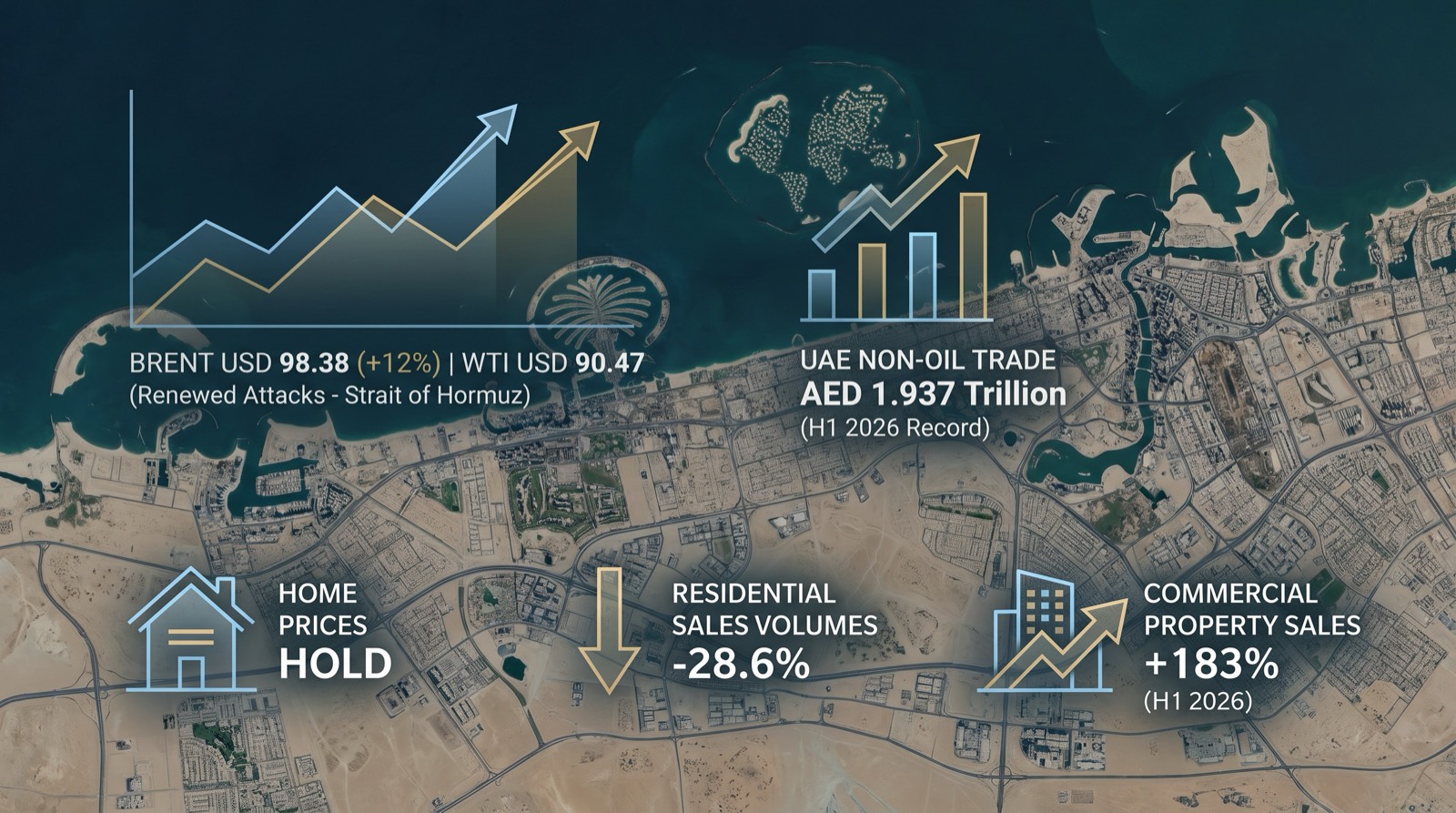
Residential volumes fell almost 29% year-on-year. Commercial sales nearly tripled in the first half.
For anyone underwriting the next twelve months rather than reacting to the last seven days, that split is the more useful piece of information.
If you're weighing entry points while this market reprices, I can show you where the risk-adjusted opportunities are emerging. Click here to speak with me directly.
Brent closed at around USD 98.38 on July 24, up roughly 12% on the week. WTI closed near USD 90.47. Both moves followed renewed attacks on vessels transiting the Strait of Hormuz, which escalated the supply disruption that has run since late February.
It's important to note that USD 100 was approached, not breached. "Near USD 100" and "above USD 100" are being used interchangeably in commentary this week, and they are not the same reading.
A structural warning underpins the price move. Speaking at the Aspen Security Forum, IEA Executive Director Fatih Birol was direct: "It is not months, it is weeks," he said, after which the strait needs to be "fully open, unconditionally open."
He repeated the warning at a Council on Foreign Relations event the following day, saying Asia and developing economies are absorbing the worst of the disruption. Both comments predate this reporting window by several days, so I treat them as background rather than fresh news this week.
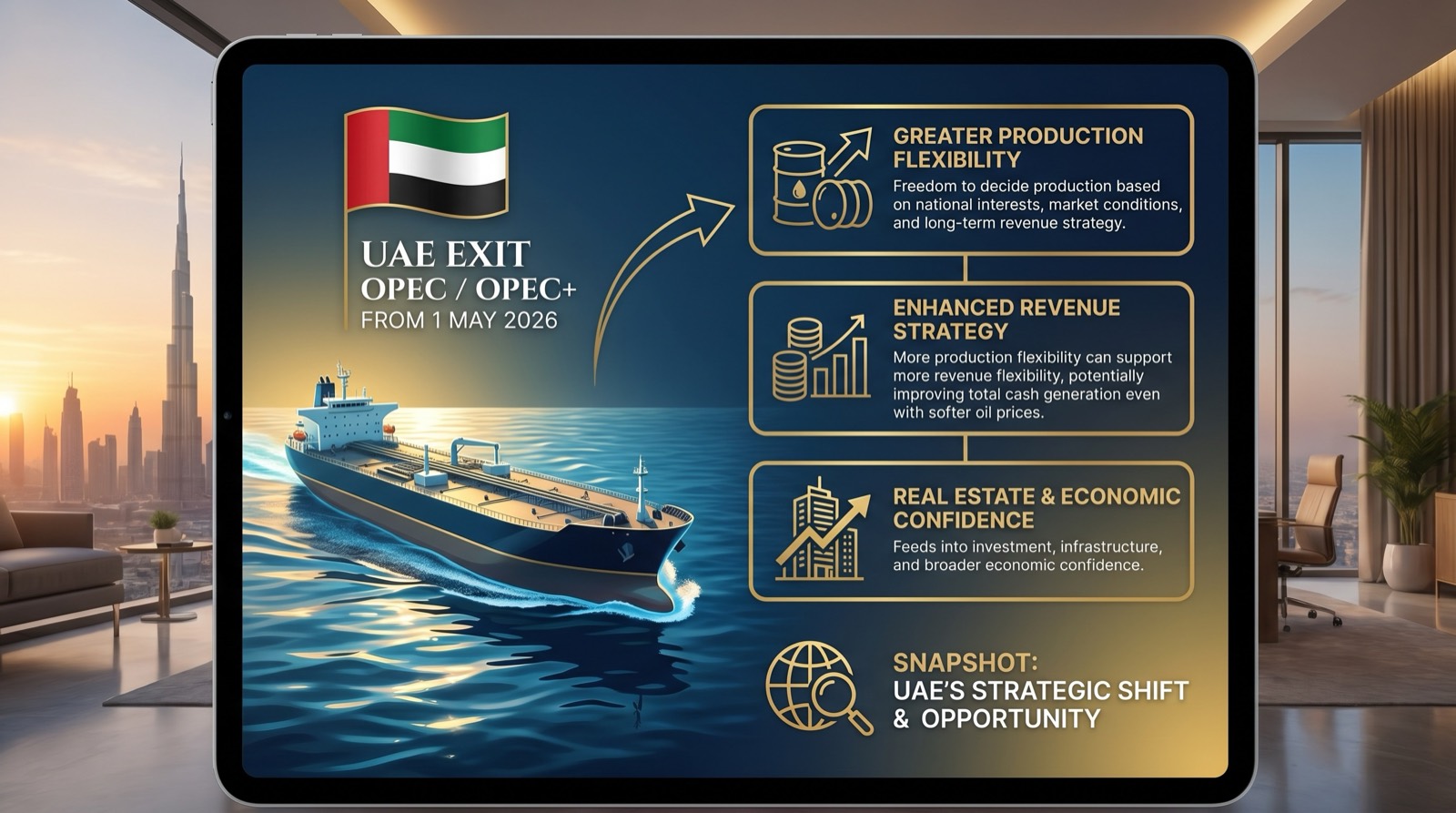
Some relevant context is often missed here. The UAE left OPEC and OPEC+ effective May 1, 2026. It retains spare capacity of roughly 4.5 million barrels per day against output nearer 3.6 million. It also holds the Fujairah pipeline, which moves a portion of its crude to the Gulf of Oman and bypasses Hormuz entirely.
The UAE is better insulated than most Gulf exporters, but full insulation does not exist — a prolonged closure would still reach its financing costs through the dollar peg.
That peg is the direct line to property. The dirham imports US monetary policy without adjustment, and the Federal Reserve meets on July 29. With energy prices climbing again, the case for near-term rate cuts weakens further.
Any second-half underwriting model that assumes lower financing costs before 2027 is working against what the market is currently pricing.

The most consequential domestic number of the week was official and large. UAE non-oil foreign trade reached a record AED 1.937 trillion in the first half of 2026, up 13.1% year-on-year. Non-oil exports grew 23.9% to a record AED 452.8 billion, according to data from the Ministry of Foreign Trade announced by Sheikh Mohammed bin Rashid on 19 July.
Non-oil exports now account for 23.4% of total non-oil trade, up from 21.3% a year earlier — a measure of what the country produces and sells, rather than what simply transits through it.
The composition shows where the economy is anchored. China led at AED 180.7 billion, followed by Switzerland at AED 138.4 billion and India at AED 107.5 billion — a spread across Asia and Europe that provides a buffer when any single corridor comes under pressure. Trade with the ten largest partners grew 12.6% in the half, while trade with the rest of the world expanded 13.6%, indicating that diversification is widening rather than concentrating.
A record trade half does not mean the residential market has stopped repricing — it clearly has not. What it does confirm is that the demand base underneath the correction continues to expand, driven by company formation, employment, and capital inflows that ultimately fill units and offices. That is the basis on which the current softness is best read as cyclical rather than structural.
Trade data is a rear-view measure. Bank earnings sit closer to live conditions, and both of the UAE’s largest lenders pointed in the same direction this week.
Emirates NBD reported second-quarter net profit of AED 6.4 billion, ahead of market expectations and broadly steady versus the first quarter. First-half net profit reached AED 12.9 billion, up 3% year-on-year, with total income climbing 16% and gross loans rising 17% to AED 771 billion.
Total assets crossed AED 1.3 trillion for the first time following the consolidation of RBL Bank in India. The cost-to-income ratio improved to 29.9%, while the non-performing loan ratio held steady at 2.1%.
First Abu Dhabi Bank posted second-quarter net profit of AED 5.72 billion, up 4% year-on-year. Profit before tax rose 6% annually and 16% sequentially to AED 7.08 billion — a quarter the bank itself described as a record. First-half profit before tax reached AED 13.2 billion, with return on tangible equity at 18.5% (above medium-term guidance) and the NPL ratio improving to 2.2%.
This is the part of the resilience picture that carries the most weight, because banks sit at the centre of the credit system that finances property. Two institutions holding AED 1.3 trillion and AED 1.41 trillion in assets, both delivering steady-to-rising profitability through a quarter that included a war escalation and a 12% oil move, indicate that the financial plumbing is functioning normally.
Deposits remain stable, lending books are expanding, and provisioning is contained. For leveraged buyers, that is what keeps mortgage availability and pricing orderly even when the macro headlines are not.
| Dubai residential, Q2 2026 (JLL) | Data |
| Total residential sales value | ~AED 87.9 billion |
| Transaction volumes (YoY) | −28.6% |
| Secondary-market volumes (YoY) | ≈ −41.8% |
| Off-plan volumes (YoY) | −23.1% |
| Sale prices, annual | +2% to +6% (villas leading) |
| Sale prices, quarterly | −2% to −3% (apartments weakest) |
The freshest institutional read on the property market came from JLL's Q2 2026 UAE report, which I weigh as global advisory rather than local commentary. JLL recorded Dubai residential sales of roughly AED 87.9 billion in the quarter, with the market recalibrating as prices and rents moderate together against rising supply.
Volumes are where the moderation is clearest. Transaction volumes fell about 28.6% year-on-year, with secondary-market activity down close to 41.8% annually and 30.3% on the quarter. Off-plan held up better, easing 23.1% year-on-year.
Prices held up better than volumes. JLL still shows annual growth of roughly 2% to 6%, with villas leading. Quarter-on-quarter, values slipped 2% to 3%, and apartment prices fell the most.
That combination — positive annually, negative quarterly — is the statistical profile of a market that peaked earlier in the year and has been easing since. The brokerage numbers diverge here, and the difference is worth flagging: JLL's AED 87.9 billion is JLL's own measure, while Betterhomes put the same quarter nearer AED 84.9 billion. Neither is wrong. They use different datasets, and they should not be quoted side by side as though they describe a discrepancy. I use JLL's here and keep it attributed.

While residential volumes fell 29% year-on-year, commercial property moved in the opposite direction.
Dubai commercial property sales totalled AED 19.5 billion across 3,415 transactions in the first half of 2026, according to Dubai Land Department data, up 183% in value from the same period a year earlier. This figure already surpasses full-year 2025 commercial sales of AED 18.1 billion by 7.7%.

Offices accounted for the bulk of that volume — AED 15.8 billion across 2,569 transactions, representing more than 81% of total commercial sales value. Retail contributed AED 3.7 billion across 846 deals. Within offices, off-plan sales reached AED 13 billion across 1,668 transactions, against AED 2.7 billion for completed stock. Business Bay led all locations at AED 8 billion across 814 transactions. The average commercial transaction value roughly doubled year-on-year, from AED 2.8 million to AED 5.7 million.
The off-plan share is the figure that tells you most about where demand is going. Buyers committing AED 13 billion to offices that do not yet exist are making multi-year bets on Dubai's corporate expansion.
That is a different type of buyer from the residential market, operating on a longer horizon — which is why commercial and residential are diverging so sharply in the same city, over the same half.
Explore curated office and retail opportunities at Mitchell's Commercial Real Estate.
Blackstone, which manages around USD 1.35 trillion, plans to open an office in the Dubai International Financial Centre. Reuters reported the plan on July 24, based on two sources with direct knowledge of the matter. The move would mark a return roughly six years after Blackstone relocated its regional base to Abu Dhabi in 2019.
A Blackstone spokesperson said the company does not comment on speculative reports, so I present this as sourced reporting rather than a confirmed corporate announcement.
The wider pattern behind the move is not speculative, though. The firm has expanded steadily in the Gulf through the disruption. It holds a stake in Dubai-based Property Finder and a joint aircraft leasing programme with Dubai Aerospace Enterprise. In March, it committed USD 250 million to an Abu Dhabi payments and compliance platform.
This month, it was reported to be bidding for a stake in Kuwait Petroleum Corporation's pipeline network. When the world's largest alternative-asset manager moves toward physical presence in DIFC in the same week oil spikes on war risk, that is a long-horizon commitment, not a reaction to the immediate environment.
Still reading
Need expert help on this subject?
Development commitments continued even as Brent climbed toward USD 100. On July 22, Abu Dhabi launched Marsa Al Saadiyat, an AED 100 billion (USD 27.2 billion) waterfront development on Saadiyat Island, with Aldar as master developer. Crown Prince Sheikh Khaled bin Mohamed bin Zayed Al Nahyan witnessed the launch and directed the renaming from Saadiyat Marina District.
The scheme spans 6.4 million square metres and eight kilometres of waterfront, including 5.6 kilometres of beaches and 140 kilometres of walking paths. It is planned for more than 58,000 residents and includes Abu Dhabi's largest marina, with 350 berths, plus an Etihad Rail underground station. Infrastructure works begin in the third quarter, with first residential sales in the second half.
This is an Abu Dhabi project, and the capital's cycle is running at a different point from Dubai's — a distinction this letter covered in detail last week and does not need restating. What belongs here is narrower. This is an AED 100 billion commitment made during an active war-escalation week, by a listed developer whose business is pricing exactly that risk.
Saadiyat is a designated freehold zone, so the residential release in H2 will be open to non-GCC buyers at full ownership.
Canada and the UAE concluded negotiations on a Comprehensive Economic Partnership Agreement on July 24, announced jointly in Toronto by UAE Minister of Foreign Trade Dr. Thani Al Zeyoudi and Canadian Minister of International Trade Maninder Sidhu. The National reports the deal concluded in 47 days — the fastest under the UAE's CEPA programme since its launch in September 2021.
The agreement is concluded, not yet signed or ratified, and enters force only after ratification.
PRYPCO MINT cut its minimum investment from AED 2,000 to AED 1,000, lowering the entry threshold for tokenised real estate in Dubai. The platform operates under a regulatory framework developed by the Dubai Land Department in partnership with VARA, the Central Bank, and the Dubai Future
Foundation through the Real Estate Sandbox.
Since launch in May 2025, the DLD has listed 10 tokenised properties through PRYPCO MINT, all fully funded within record times — in some cases under two minutes. A pilot should not be overstated. But regulated, fractional access to property income at AED 1,000 widens the buyer base structurally, and it is being built by the regulator rather than around it.
In closing
Final View for Dubai Property Investors
This week ran an unplanned stress test on capital confidence in the UAE. Oil spiked 12%, the IEA put the Hormuz window in weeks, and war risk returned to every screen. Long-horizon capital did not blink. Blackstone moved toward DIFC. Aldar committed AED 100 billion. Bank earnings held. A trade deal with Canada closed in 47 days. Short-horizon retail residential activity, by contrast, fell 29% on volumes and kept softening on price.
That split is the week's actual finding. It is not that some parts of the market are strong and others weak. It is that the capital still moving in this environment has a specific profile: institutional, income-focused, and largely indifferent to quarterly price indices. The capital that has slowed is shorter-horizon, leverage-dependent, and sensitive to financing costs that the peg ensures will not fall before 2027.
For an investor deciding where to position in the second half, the question is not whether Dubai property is up or down. It is which of those two profiles their own strategy resembles.
For investors with a patient, income-oriented, three-to-five year horizon, the commercial rotation and Abu Dhabi's development pipeline are where the data points. For those who are leverage-dependent with a shorter horizon, the picture is less constructive: the residential correction has not finished, financing costs are not falling, and the supply pipeline does not clear until 2027.
Next step
Let’s Talk
If you’d like to unpack where the most resilient opportunities are emerging — in stabilised residential areas or income-generating commercial zones — I’d be happy to share a focused, data-driven shortlist based on your investment goals.
📞 No pressure, no sales pitch—just a focused, informed conversation about your investment goals.
Next step
Ask us about this

Published 27 July 2026 by Stephen James Mitchell MBA. Market figures quoted reflect the data available at that date.