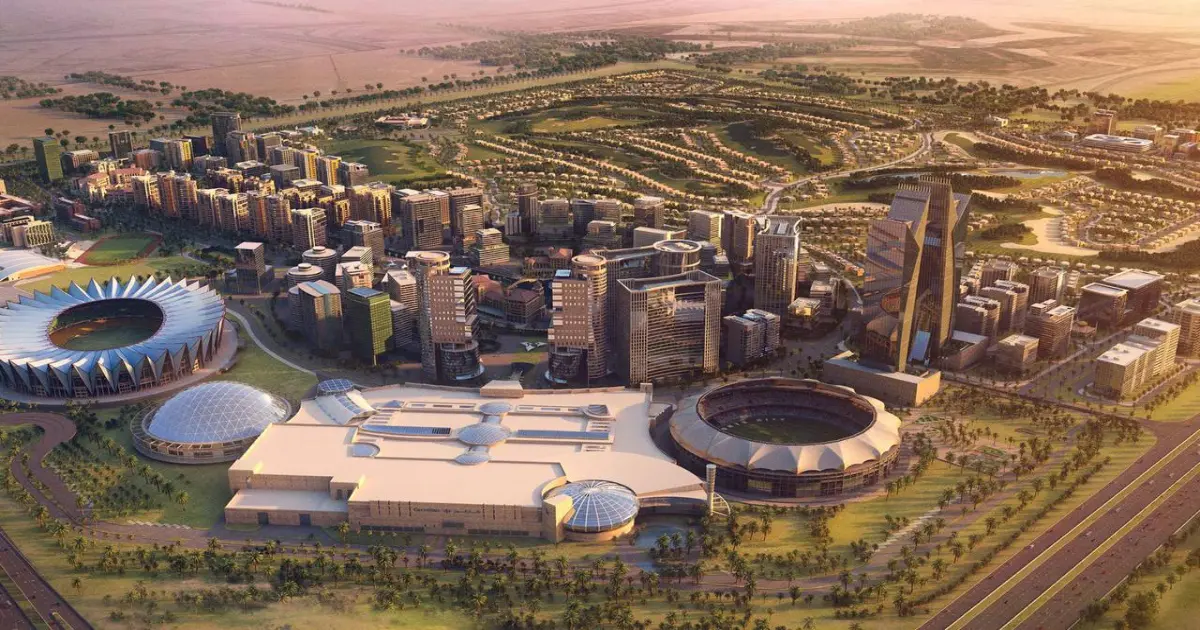
DUBAI SPORTS CITY: AFFORDABLE COMMUNITY INVESTING AND SPORTS DISTRICT DYNAMICS
The venues — the ICC cricket ground, the Els Club golf course, the Hamdan Sports Complex — are the amenity backdrop, not the demand driver. What Dubai Sports City actually represents is an affordable, well-built mid-market residential community in Dubailand, sitting at a price point that is accessible to first-time investors and those seeking high yield percentages on modest capital. The sports infrastructure creates a lifestyle differentiator that aids leasing, but the investment thesis is fundamentally about affordable entry, decent yield, and a patient hold in a community that has stabilised after a difficult post-2008 period.
Dubai Sports City was developed primarily by Dubai Properties Group as a components-of-lifestyle masterplan launched in the mid-2000s. The community covers approximately 50 million square feet in the Dubailand corridor along Sheikh Mohammed Bin Zayed Road (E311). Following the 2008–2009 market collapse, the district experienced significant price correction and prolonged stagnation, but has gradually recovered as completion levels increased and the resident population stabilised into a functioning community. The primary developer, Dubai Properties, retains a significant presence but multiple sub-developers have been active across the various zones within the masterplan.
Product mix in Dubai Sports City is predominantly apartments — studios, 1, 2 and 3-bedroom units in mid-rise buildings — with a smaller component of townhouses and villas in the Victory Heights gated community. Studios can be acquired from AED 350,000–500,000 and 1-bedroom apartments from AED 550,000–800,000 in most established buildings, making this one of the more affordable freehold communities in greater Dubai. The townhouse and villa component at Victory Heights targets a slightly different buyer profile — family occupiers and investors seeking villa yield — and trades at a meaningful premium over the apartment stock.
Price evolution in Dubai Sports City has been a story of recovery from deep distress. Launch prices during the 2006–2008 period were ambitious, and the subsequent correction took values down significantly. The community has seen gradual capital value improvement as completion and occupancy rates have risen, though pricing remains well below the wider Dubai market on a per-square-foot basis — which is precisely the entry opportunity. Units that launched at AED 400–650 per square foot have traded in a comparable range through the cycle, offering investors access to Dubai freehold at a fraction of premium district pricing.
In the sections that follow, I will examine the infrastructure connectivity picture — including the key E311 highway access and the community's internal road network — the rental market and the tenant profile that underpins occupancy, and the supply and portfolio positioning considerations investors need to understand before committing. I will close with a strategy framework for approaching Dubai Sports City across different investor objectives.
DUBAI SPORTS CITY: MARKET ANALYSIS AND INVESTMENT DYNAMICS
INFRASTRUCTURE AND CONNECTIVITY
Dubai Sports City's primary connectivity is via Sheikh Mohammed Bin Zayed Road (E311), which provides direct highway access to the broader Dubai road network. The community does not currently have metro connectivity — the nearest Red Line station is Mall of the Emirates, requiring private transport or bus connection. This lack of metro access is a genuine limitation compared to communities like JVC or Dubai South, and partially explains the yield premium Dubai Sports City offers. Internal road infrastructure within the community is well-developed and includes a comprehensive network serving the various residential clusters, the sports venues, and the commercial spine. The community is self-contained in terms of daily amenity provision, with a functioning retail mall, supermarkets, schools and medical facilities operating within walking distance of most residential buildings.
RENTAL MARKET AND TENANT PROFILE
The tenant profile in Dubai Sports City is predominantly mid-income working professionals — young singles and couples in the studio and 1-bedroom segments, and small families in the 2 and 3-bedroom apartments. Sports enthusiasts represent a secondary tenant segment; the golf course, cricket facilities and sports academies attract a genuine community of active residents who specifically seek the sporting lifestyle. This is worth noting for investors — the sports amenity does have real tenant appeal, even if it is not the primary driver. Studios achieve AED 35,000–50,000 per annum and 1-bedrooms AED 55,000–80,000, translating to gross yields of 7–9 per cent on current acquisition pricing. The absence of metro access means car ownership is effectively required, which subtly limits the tenant base and must be factored into vacancy risk assumptions.
SUPPLY DYNAMICS AND PORTFOLIO POSITIONING
Supply dynamics in Dubai Sports City are relatively benign compared to other affordable Dubai districts. The masterplan is largely built out in its core residential zones, with limited new launch activity in the established apartment clusters. New supply is primarily occurring in the peripheral areas of the Dubailand corridor rather than within the Sports City footprint itself. This relative supply containment supports rental stability and provides a degree of insulation against the yield compression that plagues more heavily supplied affordable areas. Portfolio investors who have acquired multiple units within established buildings have generally experienced better occupancy performance than those spread across different communities, with the self-contained community nature encouraging tenant retention. The key portfolio positioning question is whether to focus on the apartment sector — which offers higher yields but modest capital growth — or the Victory Heights villa segment, which is more illiquid but benefits from the family-occupier quality tenant profile.
DUBAI SPORTS CITY: INVESTMENT STRATEGY AND ENTRY POINTS
The optimal entry point in Dubai Sports City for yield-focused investors is a completed studio or 1-bedroom apartment in one of the established mid-rise buildings in the core residential cluster, acquired on the resale market rather than off-plan. The community's off-plan phase is largely complete, and resale units in buildings with strong occupancy track records offer the most predictable yield performance. Investors should target buildings with active homeowner communities, functional facilities management, and proximity to the retail spine and sports facilities — these buildings consistently outperform on occupancy. Studio yields of 7–9 per cent are achievable with careful building and unit selection, though due diligence on service charge levels is essential as higher charges can significantly erode net yield.
Capital growth positioning in Dubai Sports City is more speculative than in established districts, but there is a credible thesis built on valuation relative to the broader market. Dubai Sports City trades at a significant discount to comparable-quality established communities — the gap between Sports City pricing and JVC or Jumeirah Village Triangle pricing creates an arbitrage that may compress as the Dubailand corridor continues to develop. The Victory Heights villa segment offers the most compelling capital growth story within the district, as villa product in a sporting lifestyle community with a golf course commands genuine premium demand from the family-occupier segment and is undersupplied relative to that demand.
A complementary diversification strategy is to pair a Dubai Sports City apartment position with a Tier 1 Core Capital anchor in Dubai Marina, DIFC or Downtown Dubai, and a Tier 2 Yield & Volume position such as JLT or Jumeirah Village Triangle. This three-tier construction captures Sports City's high-yield cashflow leg alongside the premium capital growth of Tier 1 and the mid-market reliability of Tier 2. For investors building a genuinely diversified Dubai residential portfolio, Sports City fits naturally as the Tier 3 high-yield sleeve that amplifies portfolio cashflow.
If you are considering Dubai Sports City, the key is not deciding whether the area works — it is understanding precisely what you are optimising for and selecting the right product accordingly. The apartment sector delivers reliable yield at affordable entry prices, but capital growth will be modest without a catalyst. The villa sector delivers quality tenants and capital growth potential, but requires a longer hold horizon and greater capital commitment. Buy the discount, hold for yield, and let the community maturity story work in your favour over time, typically suiting portfolios at the AED 350,000–1,200,000 capital commitment level for apartments.
SUPPLY DYNAMICS
Dubai Properties master developer, multi-developer clusters, largely built out, limited new supply
TENANT PROFILE
Mid-income professionals, young families, sports-lifestyle tenants, Victory Heights family occupiers
KEY RISK FACTORS
No metro, car-dependent tenant pool, service charge erosion, modest capital growth without catalyst
KEY INFRASTRUCTURE
Dubai Sports City sits along Sheikh Mohammed Bin Zayed Road (E311) in the broader Dubailand corridor, with Hessa Street (D61) and Al Khail Road (E44) providing arterial access to Dubai Marina, Mall of the Emirates, Al Barsha and the business districts. The community is internally anchored by the ICC Academy and cricket ground, the 18-hole Els Club golf course, Hamdan Sports Complex, Dubai International Sports Academy, Sports City Mall, community retail strips, Victory Heights gated villa enclave, schools, nurseries, mosques, medical clinics and daily-service outlets. Nearby external anchors include Motor City, Arabian Ranches, Dubai Miracle Garden, Dubai Butterfly Garden, Jumeirah Golf Estates, Global Village, IMG Worlds of Adventure and Dubai Autodrome. Adjacent communities include Motor City, Jumeirah Golf Estates, Arjan and Dubai Production City, reinforcing Dubai Sports City's positioning in Dubai's mid-market yield corridor. The community is car-dependent with no direct metro connectivity.
Area fundamentals
- ASSET PROFILE
- Affordable sports-lifestyle mid-market yield community
- INVESTOR PROFILE
- Yield-focused apartment investor + first-time entry buyer
- TIER
- Tier 3 – Growth & Emerging
- MARKET TYPE
- Mid-market, apartments and villas, sports-lifestyle
- EST. POPULATION
- ~30,000–40,000
- LAND SIZE
- ~50m sq ft
Next step
Request a briefing
You will get Dubai Sports City as a brief: the buildings on this page, the register readings behind them, and our view on each.