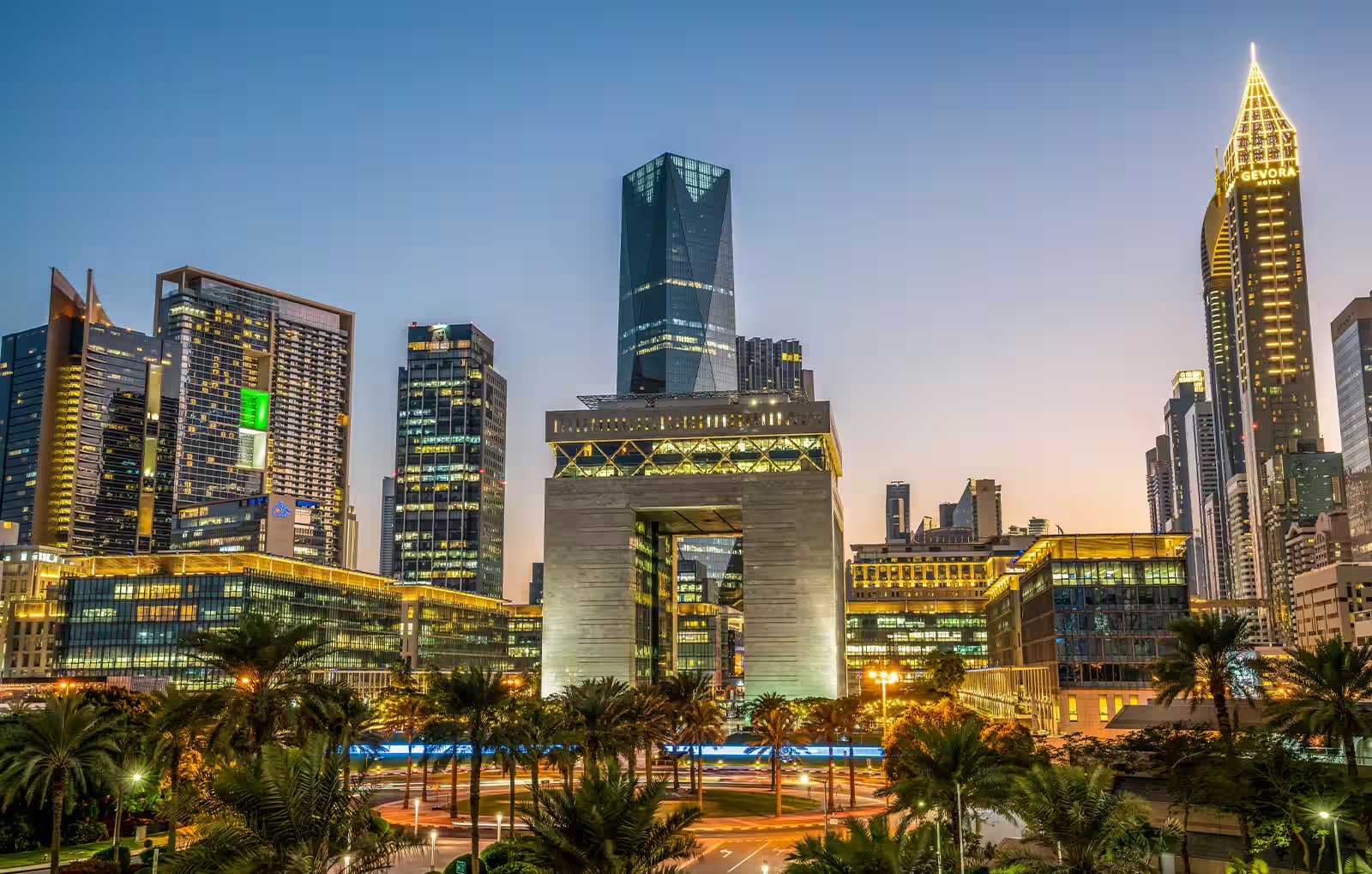
DIFC: DUBAI'S PREMIER FINANCIAL AND RESIDENTIAL DISTRICT
It is not the first district most people think of when they picture Dubai real estate, but among professionals who understand the city's property structure, it holds a unique position. DIFC is simultaneously a global financial free zone, a regulated legal jurisdiction, a luxury dining and lifestyle district, and a residential address. That combination of functions creates a rental market unlike anything else in Dubai — and understanding it is essential before committing capital here.
DIFC was established in 2004 as a financial free zone with its own regulatory authority, courts and legal system based on English common law. The residential component of the district is relatively compact — covering approximately 110 hectares in total — with a limited number of residential towers within the Gate precinct and the surrounding streets. The developer of record for the district infrastructure is DIFC Authority, and individual residential buildings have been delivered by a combination of institutional developers and major private developers. Unlike most Dubai districts, supply is genuinely constrained by planning and regulatory parameters.
The product mix in DIFC is predominantly high-specification apartments — 1, 2 and 3-bedroom units in towers with premium finishes, hotel-level concierge services, and direct access to the district's restaurant and retail circuit. Lofts and duplex units are available in some buildings, and service apartments with short-term rental licences operate within the district. The quality floor here is meaningfully higher than in adjacent Business Bay or Downtown Dubai, which is reflected directly in pricing and the profile of who actually lives and works here.
Prices in DIFC have tracked consistently at the premium end of the Dubai market since the district matured around 2008 to 2010. The post-pandemic cycle saw DIFC outperform broader Dubai benchmarks, driven by a surge in financial services hiring, the relocation of global fund managers and private equity professionals to Dubai, and the general tightening of premium product supply in the city. DIFC sits in a unique position within the city's price matrix — above Business Bay and Downtown for quality-comparable product, but below the ultra-premium waterfront addresses on Palm Jumeirah.
The DIFC jurisdiction itself is a differentiator worth weighing. Operating under English common law with its own regulatory authority and independent courts, DIFC provides a legal and contractual framework that sits outside the UAE federal civil code — a feature institutional investors, international law firms and private funds explicitly seek when establishing their Dubai operations. That regulatory architecture is not replicated anywhere else in the emirate, and it materially strengthens the demand profile for DIFC residential product from the professional tenant base working within those institutions.
In the sections that follow, I will cover the infrastructure and connectivity that makes DIFC function as a genuine live-work district, the rental market dynamics and the profile of tenants who choose to pay the DIFC premium, the supply environment and how constraint shapes the investment case, and the strategy considerations around entry point, product selection, and what realistic return expectations look like for this part of the market.
DIFC: MARKET ANALYSIS AND INVESTMENT DYNAMICS
INFRASTRUCTURE AND CONNECTIVITY
DIFC is served by the Financial Centre Metro station on the Red Line, which is among the most strategically located stations in the network — directly connecting the district to Dubai Mall, Business Bay, and the rest of the Sheikh Zayed Road corridor. The DIFC Gate Building connects pedestrian access across the precinct, and the Gate Village arts and dining area provides internal walkability that is largely weather-protected. Sheikh Zayed Road forms the western boundary of DIFC with direct on-ramp access, and Al Sa'ada Street connects the district to Downtown and the Trade Centre area. The DIFC streets are pedestrian-friendly by Dubai standards, and the concentration of restaurants, cafes, art galleries and financial services offices within the precinct means that many DIFC residents effectively live and work within walking distance of each other. This live-work dynamic is a key driver of the rental premium.
RENTAL MARKET AND TENANT PROFILE
The DIFC rental market is characterised by one of the most specific and high-quality tenant profiles in Dubai. The demand base is almost entirely financial services professionals — fund managers, investment bankers, private equity professionals, lawyers and senior executives at the institutions that have their regional headquarters within the DIFC free zone. These tenants have internationally benchmarked salary packages, corporate housing allowances, and a strong preference for living within or adjacent to where they work. This creates structural rental demand that is relatively insensitive to the broader Dubai rental market fluctuations. Gross yields in DIFC typically range between 4 and 6 per cent for well-positioned units, which is lower than yield-focused districts like Business Bay, but the quality of tenancy — low vacancy, stable tenants, strong renewal rates — compensates for the compressed yield figure.
SUPPLY DYNAMICS AND PORTFOLIO POSITIONING
Supply in DIFC is the single most important structural feature of the investment case here. Unlike Business Bay, which faces ongoing pipeline pressure, DIFC is a defined and largely built-out free zone with genuine planning constraints on residential development. New residential towers require DIFC Authority approval, and the regulatory structure of the free zone limits speculative development cycles. This supply constraint is the primary reason why DIFC has maintained its pricing premium relative to adjacent districts through multiple cycles, and it is the main reason why I regard DIFC residential exposure as fundamentally different from most other Dubai investment propositions. For investors who are building a portfolio focused on capital preservation and long-term appreciation, rather than maximising initial yield, a quality unit in DIFC has a defensible long-term hold thesis that very few Dubai districts can match.
DIFC: INVESTMENT STRATEGY AND ENTRY POINTS
The entry point decision in DIFC is primarily about product quality versus headline price per square foot. The district's limited residential stock means that secondary market availability is episodic rather than continuous, and investors who wait for a specific unit type in a specific building may wait a long time. For investors who are committed to DIFC exposure, the most reliable strategy is to purchase in one of the established residential towers — Index Tower, South Ridge, The Residences, or similar — at secondary market prices that reflect genuine quality rather than distressed or first-generation product. One and two-bedroom units represent the most liquid part of the DIFC market, and the rental demand from corporate tenants is deepest in this size range.
The capital growth case in DIFC rests primarily on the continued expansion of the free zone's financial services sector and the associated demand for premium residential accommodation. As Dubai has increasingly positioned itself as a global financial centre — evidenced by the relocation of major fund managers, private banks and fintech firms to the DIFC jurisdiction — the residential demand within the district has strengthened structurally rather than cyclically. The supply constraint means that this demand cannot be easily absorbed by new product, and the practical effect is that capital values in DIFC have shown consistent appreciation through cycles where broader Dubai markets were flat or declining.
A complementary diversification strategy is to pair a DIFC apartment position with a Tier 2 Yield & Volume income asset in Jumeirah Lake Towers or The Greens, and a Tier 3 Growth position in Dubai South, Dubai Creek Harbour or Expo City. DIFC provides the financial-district Tier 1 capital preservation leg of a three-tier Dubai portfolio, with the Tier 2 apartment supplementing cashflow and the Tier 3 leg providing long-duration growth upside. For investors seeking alternative Tier 1 exposure with different character, Downtown Dubai offers tower-living at comparable price points and Palm Jumeirah provides global-trophy beachfront at similar capital commitment scale.
If you are considering DIFC, the key is not deciding whether the area works — it does, and it has one of the most structurally sound investment cases of any residential district in Dubai. The question is whether the entry price and the yield profile align with your portfolio objectives. DIFC is not a yield-maximisation play. It is a premium capital preservation and long-term appreciation story with a high-quality tenant base and genuine supply constraint. Investors who understand that distinction and who have the patience to buy well in a thin secondary market will find that DIFC rewards a disciplined, long-term approach better than most of what the Dubai residential market offers, typically suiting portfolios at the AED 2,000,000–10,000,000 capital commitment level.
SUPPLY DYNAMICS
Multi-developer, DIFC Authority planning limits residential, genuinely constrained, thin resale
TENANT PROFILE
Fund managers, investment bankers, senior lawyers, DIFC institution executives, corporate housing
KEY RISK FACTORS
Compressed yields, thin liquidity, high entry PSF, financial sector sensitivity, availability
KEY INFRASTRUCTURE
DIFC sits along Sheikh Zayed Road (E11) in central Dubai, with Red Line metro access via the Financial Centre station directly connecting the district to Dubai Mall, Business Bay, Downtown Dubai and the wider emirate network. Al Sa'ada Street provides connectivity to Downtown Dubai and the Trade Centre district. The district is internally anchored by the Gate Building, Gate Village arts and dining precinct, DIFC Courts, DIFC Academy, 600+ registered financial institutions including international banks, law firms, private equity and fund management offices, Carrefour supermarket, premium restaurants and cafes, art galleries and the covered pedestrian connectivity between towers. Residential towers include Index Tower, South Ridge, The Residences and Sky Gardens. Nearby external anchors include Downtown Dubai, Dubai Mall, Burj Khalifa, Dubai Opera, Business Bay and the Za'abeel corridor. Adjacent communities include Downtown Dubai, Business Bay and Za'abeel, reinforcing DIFC's positioning as Dubai's flagship financial and residential live-work district.
Area fundamentals
- ASSET PROFILE
- Premier financial district; constrained premium supply
- INVESTOR PROFILE
- HNW institutional + financial sector professional buyer
- TIER
- Tier 1 – Core Capital
- MARKET TYPE
- Premium, apartments, free zone, supply-constrained
- EST. POPULATION
- ~8,000–12,000
- LAND SIZE
- ~11.8m sq ft
Next step
Request a briefing
You will get DIFC as a brief: the buildings on this page, the register readings behind them, and our view on each.