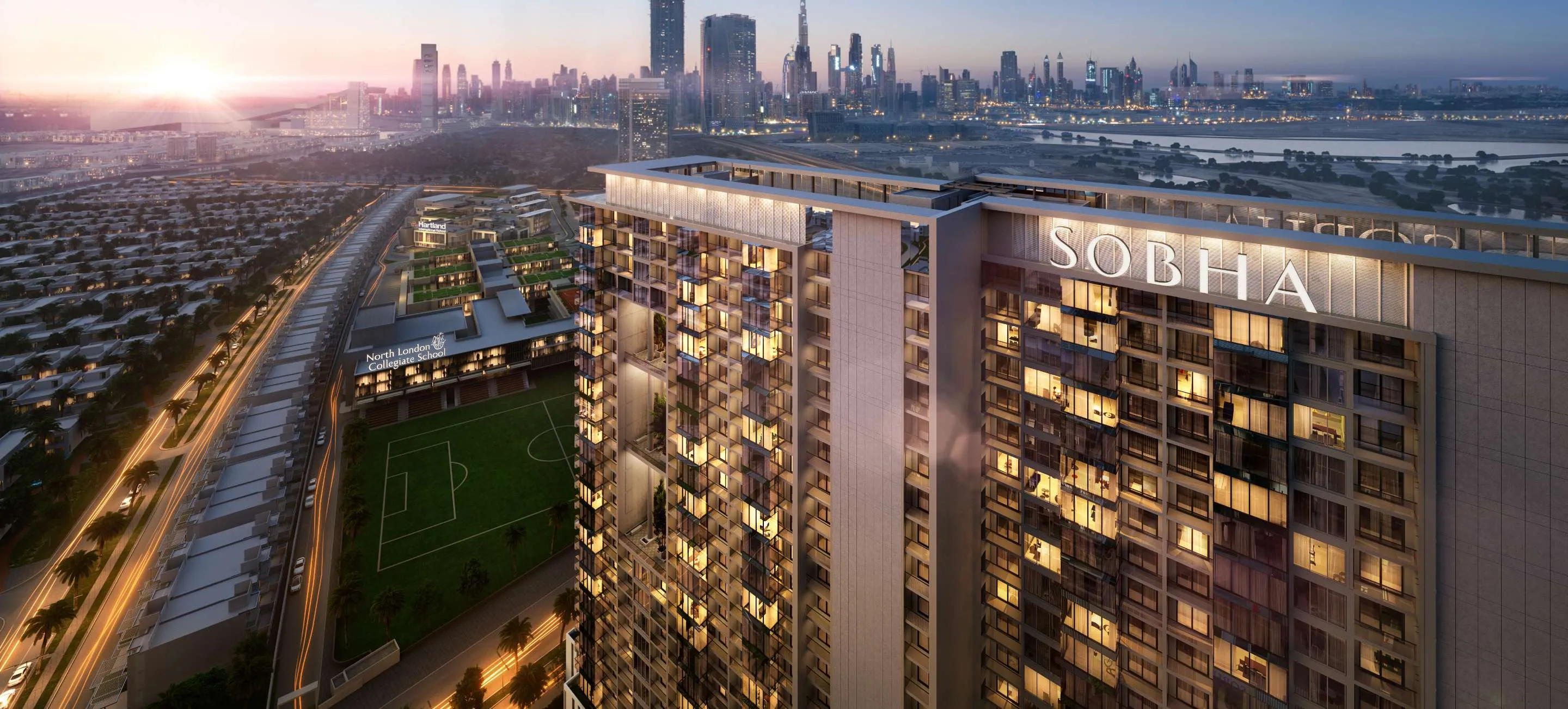
SOBHA HARTLAND: QUALITY-LED INVESTMENT IN MBR CITY
In a market where off-plan risk is often tied to developer execution, Sobha Realty's track record here removes one of the most significant variables from the investment equation.
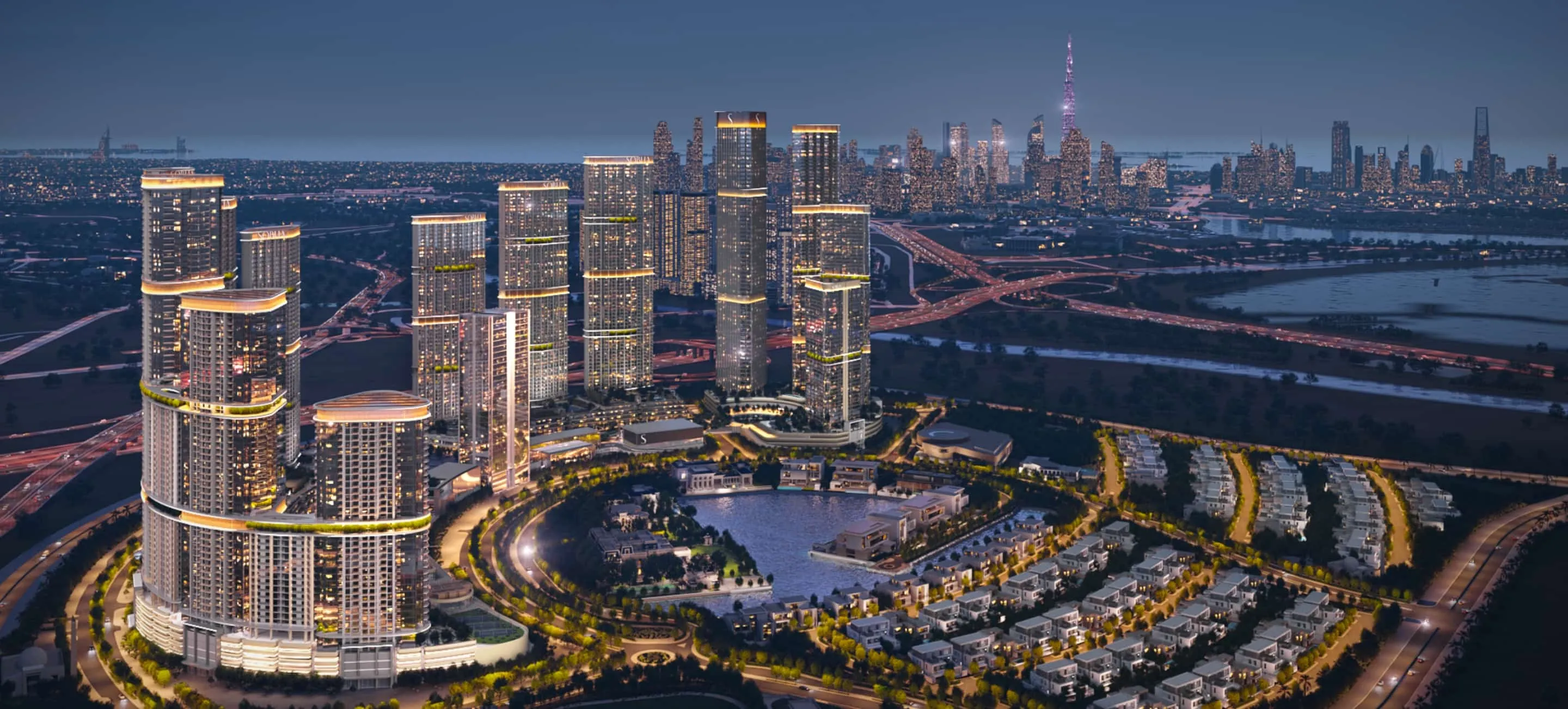
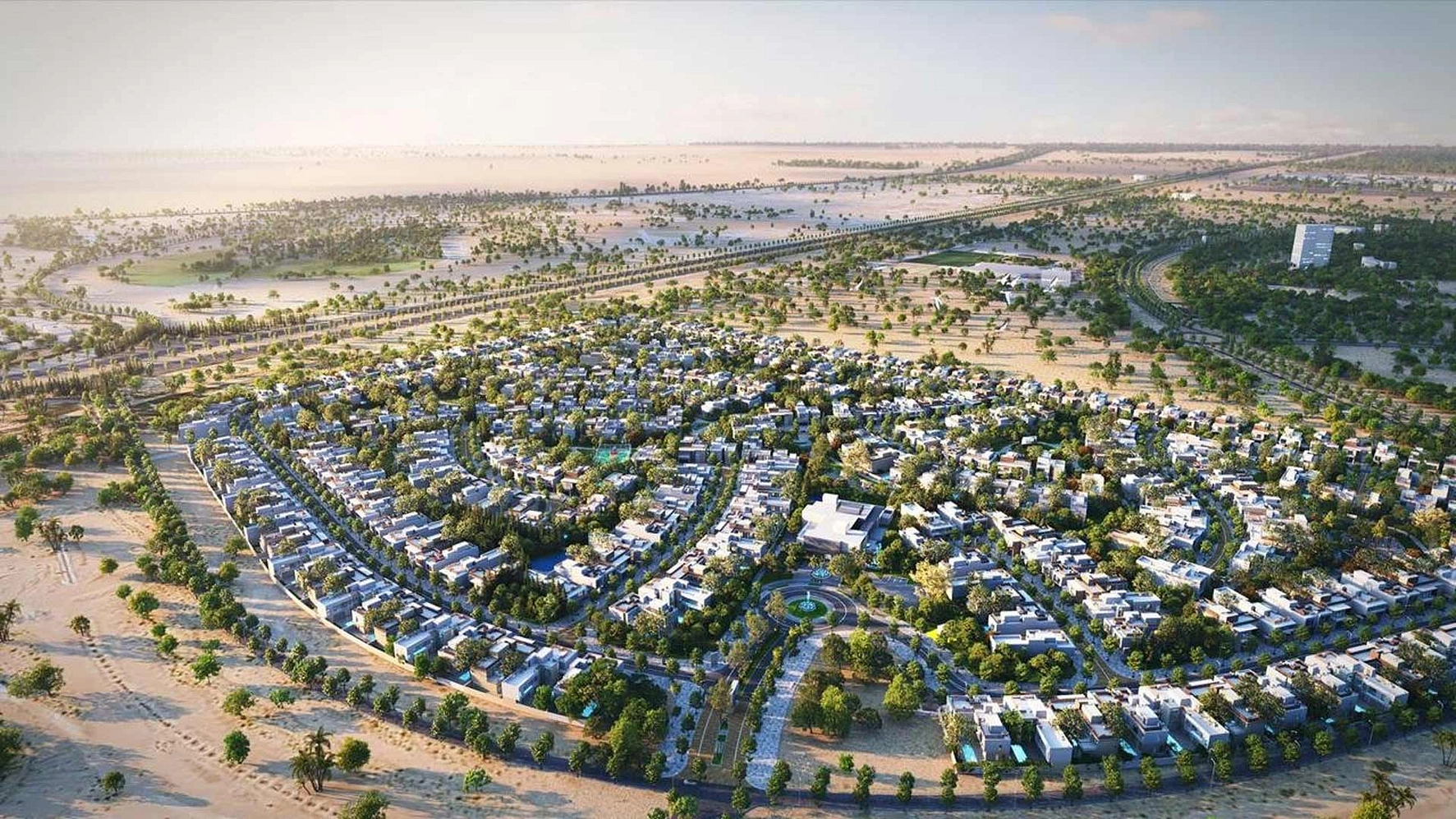
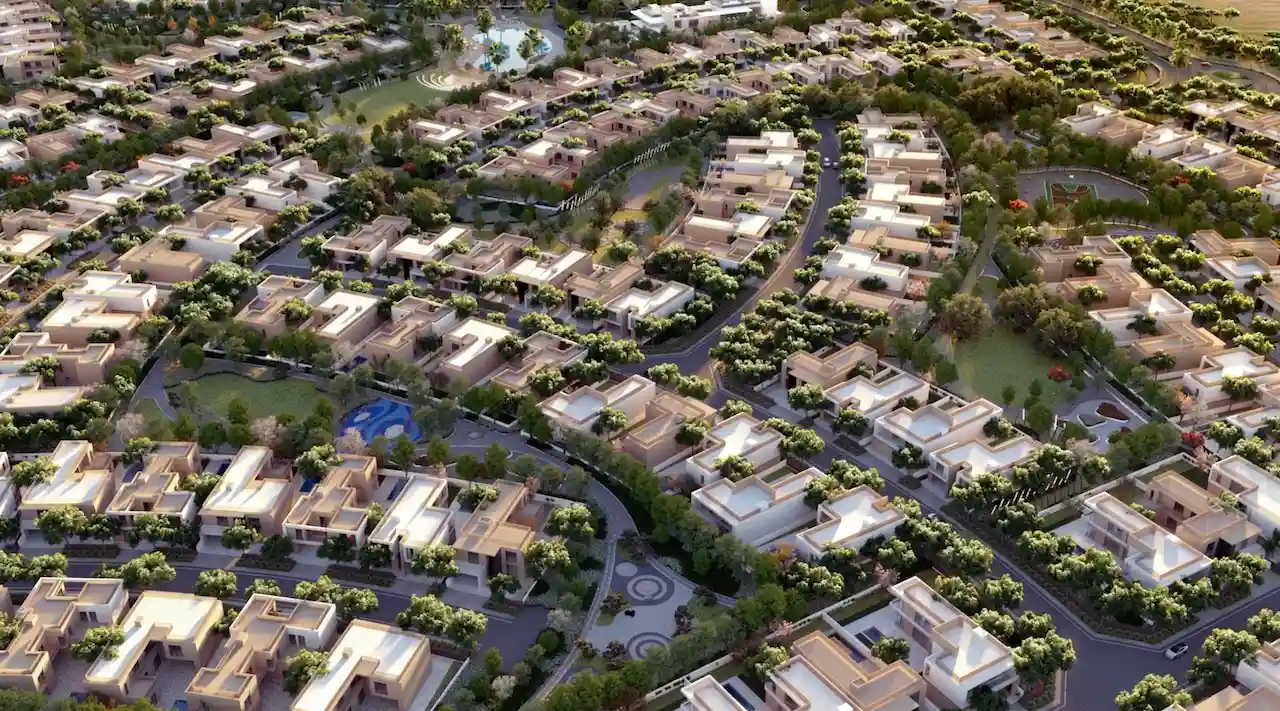
Sobha Hartland occupies an 8 million square foot freehold masterplan within Mohammed Bin Rashid City, directly bordered by the Dubai Canal and Meydan. Launched in 2014, the community spans a mix of low-rise apartment towers, townhouses and villas, with Hartland II representing the newer generation of the project. The positioning is premium mid-market — priced above JVC or Sports City, but more accessible than Palm Jumeirah or Downtown Dubai. The developer's commitment to greenery, with over 30 per cent landscaped space and two international schools within the community, has made it a genuinely liveable destination rather than a pure investor play.
The product mix across Sobha Hartland is intentionally varied. Studios and 1-bedroom apartments in Hartland towers represent the entry-level ticket for investors, typically acquired off-plan at AED 1,200–1,600 per square foot and now reselling at AED 1,500–2,000 per square foot in established towers. Townhouses and villas — 3 to 5 bedrooms, often garden-facing — attract a different buyer profile: families seeking long-term occupation and owners who value the canal-side lifestyle. The newer Hartland II phases have launched at higher per-square-foot levels, reflecting both market appreciation and Sobha's confidence in the brand premium it has established through consistent delivery quality.
Price evolution at Sobha Hartland has been one of the more consistent appreciation stories in the Dubai mid-market segment. Early investors who entered Phase 1 at launch-era pricing of AED 900–1,100 per square foot have seen substantial capital growth as the community matured, schools opened, and the Hartland brand gained recognition. The absence of competing developers within the masterplan — unlike a DMCC or Nakheel community where multiple brands compete — means Sobha controls both the supply cadence and the quality benchmark, which has historically supported resale pricing stability.
The Sobha brand differentiates meaningfully in the Dubai mid-market. Sobha Realty's vertically integrated construction model — the developer owns its own contracting arm and interior fit-out operations — has produced consistently higher build quality and more disciplined handover timelines than most competitors across the 11,000-unit masterplan. That quality signal translates into tangible market outcomes: the Hartland brand commands a meaningful per-square-foot premium over comparable MBR City and Meydan product, resale liquidity runs ahead of the peer set, and tenant retention sits above the Dubai apartment market average because end-user quality reduces turnover.
In the sections that follow, I will walk through the infrastructure and connectivity picture, the rental market dynamics and tenant profile, and the supply pipeline that investors need to understand before positioning in Sobha Hartland. I will then close with a strategy framework covering the most relevant entry points given where the community sits in its development cycle today.
SOBHA HARTLAND: MARKET ANALYSIS AND INVESTMENT DYNAMICS
INFRASTRUCTURE AND CONNECTIVITY
Sobha Hartland's internal connectivity has improved significantly since the community's initial phases. The primary access is via Al Khail Road and Ras Al Khor Road, with internal roads connecting to Meydan Bridge and the wider MBR City network. The community does not currently benefit from metro access — the nearest station is at Business Bay on the Green Line — making private vehicle ownership a practical necessity for residents. Proposed MBR City metro extensions are expected to address this gap over the 2027–2030 horizon. Within the community, two international schools (North London Collegiate and Hartland International) and a growing retail strip reduce the daily commute burden for families, which supports long-term occupancy stability. The canal promenade, green corridors and landscaped open spaces provide internal walkability that is uncommon in MBR City peripheral projects. Road access to Downtown Dubai, Business Bay and DIFC via Al Khail Road is the community's primary practical advantage.
RENTAL MARKET AND TENANT PROFILE
Sobha Hartland attracts a distinctive tenant base relative to most Dubai mid-market communities: families with school-age children represent a disproportionately large segment of renters, drawn by the on-site international schools and the green, low-density environment. This is not a young professional transient market — tenants here tend to sign longer leases and renew, creating lower turnover and stronger occupancy stability than communities that rely on single-occupant professionals. Studio and 1-bedroom apartment investors face a slightly different picture, where demand comes from young couples and individuals who value the canal-side lifestyle but may not be family-stage yet. Gross yields across the established apartment towers range from 5 to 7 per cent, with villa and townhouse yields sitting slightly lower at 4 to 5 per cent given the higher asset values, but the end-user demand base supports resale liquidity well.
SUPPLY DYNAMICS AND PORTFOLIO POSITIONING
Supply dynamics at Sobha Hartland are controlled by a single developer, which is both a strength and a risk worth understanding. Unlike master communities where dozens of developers compete, Sobha manages the launch cadence and pricing across both Hartland I and Hartland II. This means resale investors are not directly competing with deeply discounted secondary stock from distressed multi-developer launches — but it also means new Sobha launches at higher per-square-foot levels can reprice investor expectations and apply pressure to older towers with lower specifications. The Hartland II pipeline adds meaningful new supply but at a higher price point, which effectively creates a tiered market within the same brand. Investors holding established Phase 1 towers should position on yield stability and end-user demand rather than expecting significant short-term capital appreciation against the brand's own newer product.
SOBHA HARTLAND: INVESTMENT STRATEGY AND ENTRY POINTS
The most defensible entry point in Sobha Hartland today is the resale market in established Hartland I towers — specifically 1-bedroom and 2-bedroom apartments in buildings that are fully occupied, have a track record of rental performance, and carry yields in the 5.5 to 7 per cent range. These assets are now priced between AED 1,500 and 1,900 per square foot, which positions them at a discount to Hartland II launch pricing, providing a value differential that justifies resale acquisition for income-focused investors. Studios represent higher yield potential but lower tenant quality and shorter lease terms — suitable for investors who can manage actively but less appropriate for passive income positioning.
For capital growth, the villas and townhouses in Sobha Hartland — particularly 3 and 4-bedroom townhouses facing the green corridors or canal — offer compelling long-term appreciation potential. This product type has seen the strongest price growth within the community, driven by genuine family end-user demand that creates real competition in the resale market. The ticket size is higher, but the quality differentiation from standard Dubai townhouse communities is visible and defensible. Investors with a 5 to 8 year horizon who can absorb lower yields in exchange for end-user demand support and Sobha brand premium are best positioned in this segment.
A complementary diversification strategy is to pair a Sobha Hartland position with a Tier 1 Core Capital anchor in Downtown Dubai, Dubai Marina or Palm Jumeirah, and a Tier 3 Growth position such as Dubai South or Expo City. The Sobha Hartland apartment or townhouse delivers the Tier 2 yield-and-family leg of a three-tier portfolio, with the Tier 1 anchor capturing premium capital growth and the Tier 3 leg providing asymmetric long-duration upside. For investors building a genuinely diversified Dubai residential portfolio, Sobha Hartland sits naturally as the reliable income-and-family-demand sleeve.
If you are considering Sobha Hartland, the key is not deciding whether the area works — the fundamentals are clearly supportive and the Sobha delivery record removes the principal developer risk concern. The real decision is choosing the right product type and understanding which phase of the community aligns with your investment horizon. Hartland I resale apartments deliver today's income; Hartland II off-plan delivers tomorrow's brand premium. Villa and townhouse assets deliver capital growth anchored in real family demand. Avoid the temptation to chase headline yield in studio units — the stability of this community's returns comes from the family tenant segment, and that is where the most reliable long-term positioning lies, typically suiting portfolios at the AED 1,500,000–5,000,000 capital commitment level.
SUPPLY DYNAMICS
Sobha single developer, Hartland I complete, Hartland II new supply at higher PSF
TENANT PROFILE
Families with school-age children, canal-side lifestyle couples, long-lease stable tenants
KEY RISK FACTORS
No metro, Hartland II new PSF pressure, premium pricing spread, single-developer concentration
KEY INFRASTRUCTURE
Sobha Hartland sits along Al Khail Road (E44) and Ras Al Khor Road (E44) within Mohammed Bin Rashid City, with arterial access to Downtown Dubai, Business Bay, DIFC, Meydan and Dubai Hills Estate via Meydan Bridge and the wider MBR City road network. The community is internally anchored by the Dubai Canal frontage and canal promenade, North London Collegiate School Dubai, Hartland International School, community retail strip, community parks, swimming pools, landscaped green corridors and over 30 per cent landscaped open space across Hartland I and Hartland II phases. Nearby external anchors include Meydan Racecourse, The Track Meydan Golf, Ras Al Khor Wildlife Sanctuary, Dubai Mall, Downtown Dubai, DIFC and Business Bay. Adjacent communities include Meydan, District One, Al Jaddaf, Business Bay and the wider MBR City district, reinforcing Sobha Hartland's positioning as MBR City's flagship single-developer canal-side community.
Area fundamentals
- ASSET PROFILE
- Sobha canal-side premium family community in MBR City
- INVESTOR PROFILE
- Family end-user + yield-and-growth apartment investor
- TIER
- Tier 2 – Yield & Volume
- MARKET TYPE
- Premium, apartments, townhouses and villas, canal-side
- EST. POPULATION
- ~15,000–20,000
- LAND SIZE
- ~8m sq ft
Next step
Request a briefing
You will get Sobha Hartland as a brief: the buildings on this page, the register readings behind them, and our view on each.