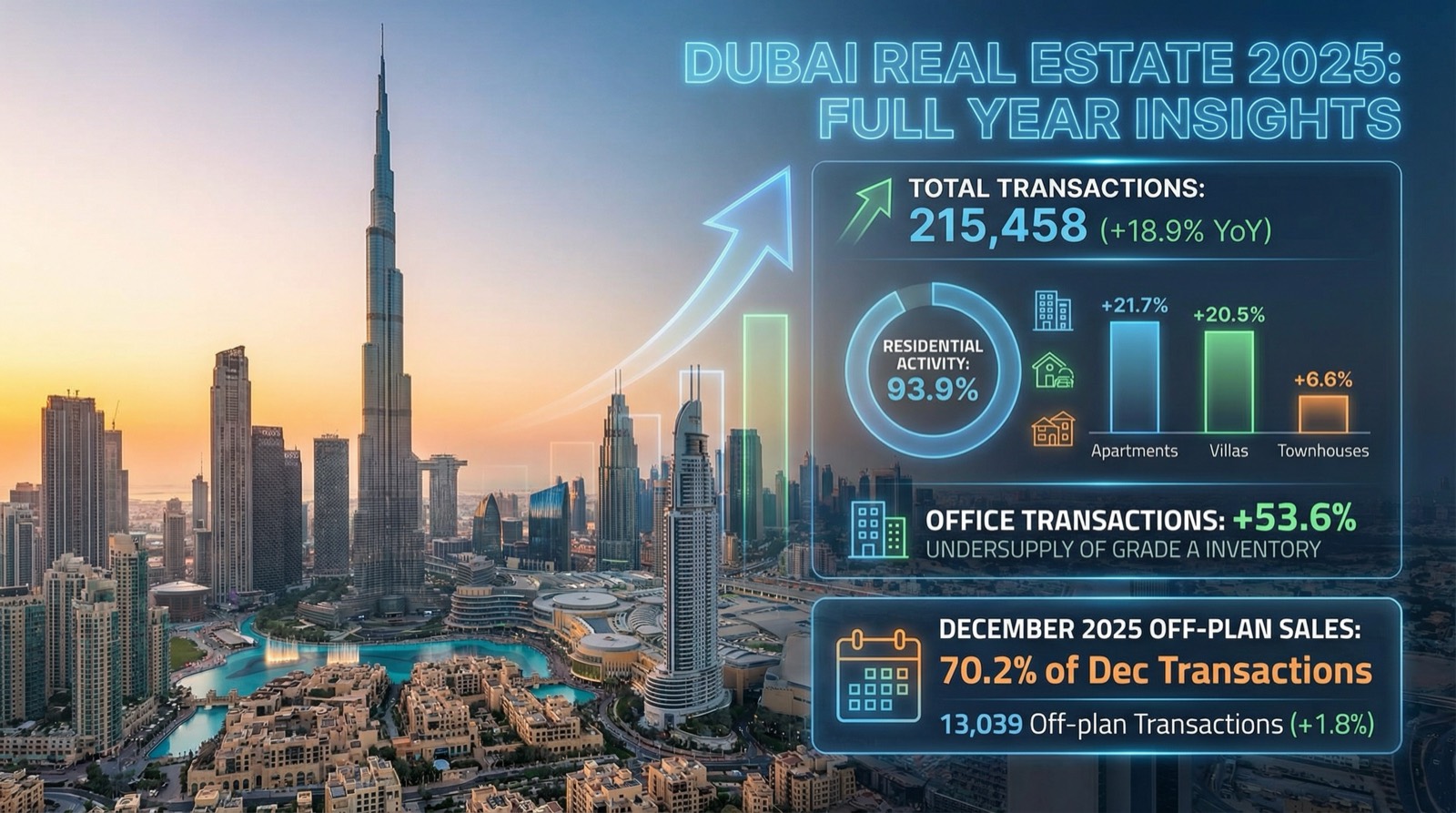
The UAE property market has shifted into a more complex phase over the past two weeks, where strong transactional activity is now being tested against rising geopolitical and financial pressures.
The data shows a clear divergence. Dubai recorded AED 50.6 billion in Ramadan transactions (+29.7% YoY) and AED 13.14 billion in the final week of March. At the same time, multiple real estate bonds have moved into distressed territory, and lending conditions are tightening.
Despite this, the physical market remains active—particularly at the top end, with $2.97 billion in luxury sales in March (+42% YoY).
Transactions are down from pre-conflict highs, but sophisticated investors are re-entering the market and they are looking for sellers to make risk adjustments in their pricing.
If you’re to leverage the situation to secure quality investments in this market, I can show you where risk-adjusted opportunities are emerging. Click here to speak with me directly.
Despite regional tensions, transaction volumes across Dubai and the wider UAE have held at strong levels.
Key Market Data
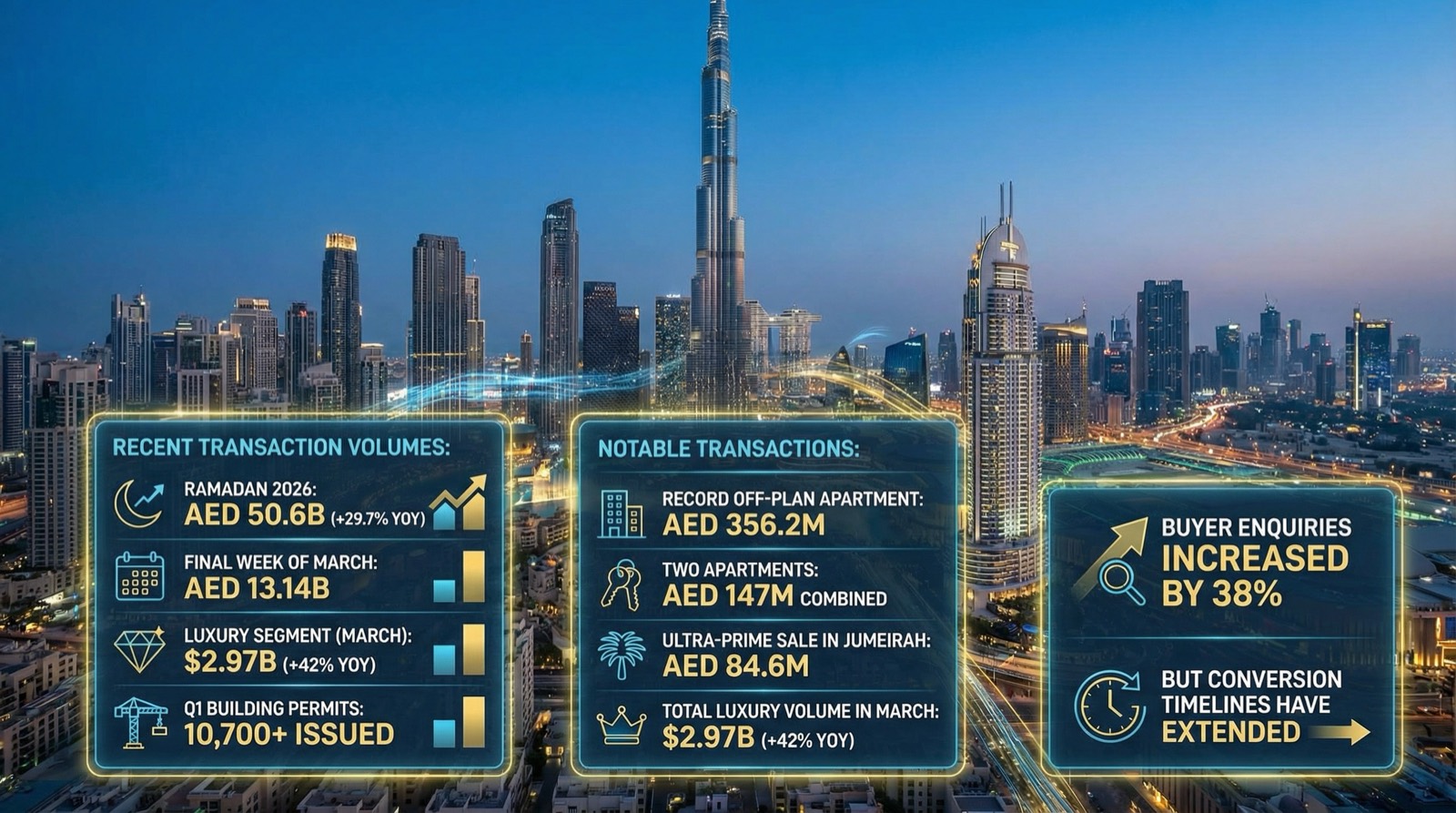
- Ramadan 2026: AED 50.6B in transactions (+29.7% YoY)
- Final week of March: AED 13.14B in transactions
- Luxury segment (March): $2.97B (+42% YoY)
- Q1 building permits: 10,700+ issued
Regional activity remains supportive:
- Sharjah: AED 4.6B in recent transactions
- Ajman: Record sale at AED 185M
While some reports point to short-term dips in housing volumes (25%–40% in certain segments), data from developers continues to show ongoing deal flow and project execution.
What This Actually Means
Transaction volumes at this level, particularly during a period of geopolitical stress, confirm that capital has not exited the market. Many seasoned real estate investors who had been waiting on the sidelines are now re-engaging as opportunities emerge.
Buyer profiles are evolving, but the market remains active. More experienced, well-capitalised investors are increasingly focused on identifying value opportunities.
This is already reflected in how more experienced capital is approaching the market:
- Decision timelines are longer and more deliberate
- Due diligence is more thorough and structured
- Negotiation has increased, particularly in mid-market segments
Strategic Insight: The market is not slowing down; it is becoming more selective.

The strongest signal this week comes from the continued performance of the luxury and off-plan segments.
Notable Transactions
- Record off-plan apartment: AED 356.2M
- Two apartments: AED 147M combined
- Ultra-prime sale in Jumeirah: AED 84.6M
- Total luxury volume in March: $2.97B (+42% YoY)
At the same time:
- Buyer enquiries increased by 38% week-on-week
- But conversion timelines have extended
This is a very specific type of market behaviour. Buyers are not stepping away—they are taking more time to select opportunities and deploy capital.
Demand Characteristics
- Predominantly cash-driven
- Limited reliance on leverage
- Focused on long-term capital preservation
Strategic Insight: In periods of uncertainty, high-net-worth capital tends to move away from financial instruments and into tangible assets. The data this week reflects exactly that shift.
A key development in the current market is the widening gap between financial market sentiment and physical real estate performance.
Credit Market Developments
- Six Dubai real estate bonds are now in distressed territory, reflecting higher refinancing risk
- Borrowing costs are rising, with banks tightening lending standards
- Credit markets are increasingly pricing in post-conflict recovery scenarios
- Central Bank support measures have been introduced to maintain liquidity and prevent forced credit tightening across the system
However:
- S&P confirms no immediate liquidity stress for top-tier developers
- Major developers (Emaar, Aldar, Omniyat) continue to operate normally
- Over 140 active construction sites remain underway
What This Means for Investors
The stress is real—but it is concentrated in financing conditions, not in the underlying demand for property.
In practical terms:
- Developers with strong balance sheets continue unaffected
- Weaker players may face funding pressure
- Buyers may see tighter mortgage conditions
Strategic Insight: This is a credit cycle adjustment, not a structural demand shock. Understanding the difference is key.
The Iran-related conflict continues to influence market sentiment and, more importantly, cost dynamics.
Key Developments
- Brent crude has risen to approximately $112 per barrel
- War-risk insurance premiums have increased to between 3.5% and 10%
- Shipping volumes through the Strait of Hormuz have declined by ~95% in March, materially disrupting supply routes
- UAE fuel prices are expected to increase in April
Market Impact
- Increased volatility across regional logistics and transport routes•
- Disruptions to shipping flows are affecting delivery timelines
- Elevated insurance and freight costs across supply chains
Government Response
- Strategic reserves remain at full capacity
- Over 8,000 inspections have been carried out to prevent price manipulation
- More than 200 penalties have been issued for illegal price increases
Impact on Real Estate
The primary transmission into the property market is not through demand, but through rising costs.
- Construction costs are increasing
- Logistics and freight expenses are rising
- Developer margins may come under pressure
Strategic Insight: The key risk is not a decline in demand, but sustained cost inflation influencing future pricing and project viability.

While retail sentiment has become more cautious, institutional activity remains decisive.
Key Indicators
- Blackstone has committed $250M to an Abu Dhabi platform
- Allocatte has raised $31M, reflecting growing interest in fractional ownership and tokenisation
- The Dubai Property Show has transitioned into a permanent exhibition centre
- Major developers continue to report acquisitions and construction milestones
These are not short-term decisions. Institutional capital is typically deployed over a multi-year horizon and supported by extensive due diligence.
Market Implication
Institutional investors are not reacting to headlines; they are positioning for long-term structural growth.
Strategic Insight: Institutional capital typically enters during periods of uncertainty, providing stability when sentiment is weaker.
Recent regulatory updates are quietly reinforcing market stability.
Key Changes
Abu Dhabi has strengthened real estate governance through updated DMT regulations
The corporate tax framework now clearly defines a 9% nexus for real estate income
Mandatory audits have been introduced for corporate tax groups and qualifying entities
All tax groups now require audited financials regardless of the AED 50M threshold
14% flat interest rate has been introduced on late tax payments
A new ADR law has been implemented, including:
- A 20-day mediation requirement
- A 30-day binding resolution process
These changes are not restrictive; they reflect a continued shift toward a more mature and regulated market structure.
Why This Matters
- Greater transparency for investors
- Faster dispute resolution
- Reduced systemic risk over time
Strategic Insight: Regulatory tightening is a sign of market maturity, not weakness.
Supply remains one of the most debated topics—and rightly so.
Current Pipeline
- 10,700+ permits issued in Q1
- 120,000–130,000 units expected in 2026
- 300,000–400,000 units projected by 2028
However:
- Only ~48% of the 2026 supply pipeline is expected to meet original handover timelines, due to logistics disruptions
- Supply is concentrated in outer-ring developments
Implications for Investors
- Prime, established areas remain supply-constrained
- Secondary locations face higher competition
- Developer quality becomes increasingly important
Strategic Insight: Oversupply is not a city-wide issue—it is a location-specific risk.
Still reading
Need expert help on this subject?
| Metric | Current Position | Investor Implication |
|---|---|---|
| Transaction Volume | Elevated | Liquidity remains strong |
| Luxury Segment | Expanding | UHNW demand intact |
| Credit Markets | Under pressure | Financing conditions tightening |
| Developer Activity | Stable | No systemic disruption |
| Enquiries | Mixed | More selective buyers |
| Supply Pipeline | Expanding | Risk is concentrated in select areas |
The key takeaway is straightforward: the market is adjusting, not reversing.

This is a market where broad exposure is no longer sufficient. Positioning matters more than ever.
Where to Focus Capital
- Prime, end-user driven locations with consistent liquidity
- Secondary market opportunities where sentiment is creating short-term discounts
- Income-producing commercial assets delivering 6%–9% yields
Explore specially-negotiated office and retail opportunities at Mitchell’s Commercial Realty.
Managing Risk
- Be more conservative on financing assumptions
- Stress-test off-plan exposure
- Monitor construction timelines and cost inflation
What to Avoid
- Projects dependent on speculative offshore demand
- Locations with heavy upcoming supply
- Developers with weaker balance sheets
Strategic Insight: This market favours careful capital deployment over momentum-driven buying.
The UAE property market is not losing strength—it is transitioning.
In summary:
- Transaction volumes remain high
- Institutional capital continues to enter
- Demand is becoming more deliberate
At the same time:
- Credit conditions are tightening
- Cost pressures are building
- Risk is being priced more carefully
This combination typically leads to more rational pricing and better entry opportunities for informed investors.
Next step
Let’s Talk
If you’d like to unpack where the most resilient opportunities are emerging — in stabilised residential areas or income-generating commercial zones — I’d be happy to share a focused, data-driven shortlist based on your investment goals.
📞 No pressure, no sales pitch—just a focused, informed conversation about your investment goals. Let’s talk!
Published 30 March 2026 by Stephen James Mitchell MBA. Market figures quoted reflect the data available at that date.