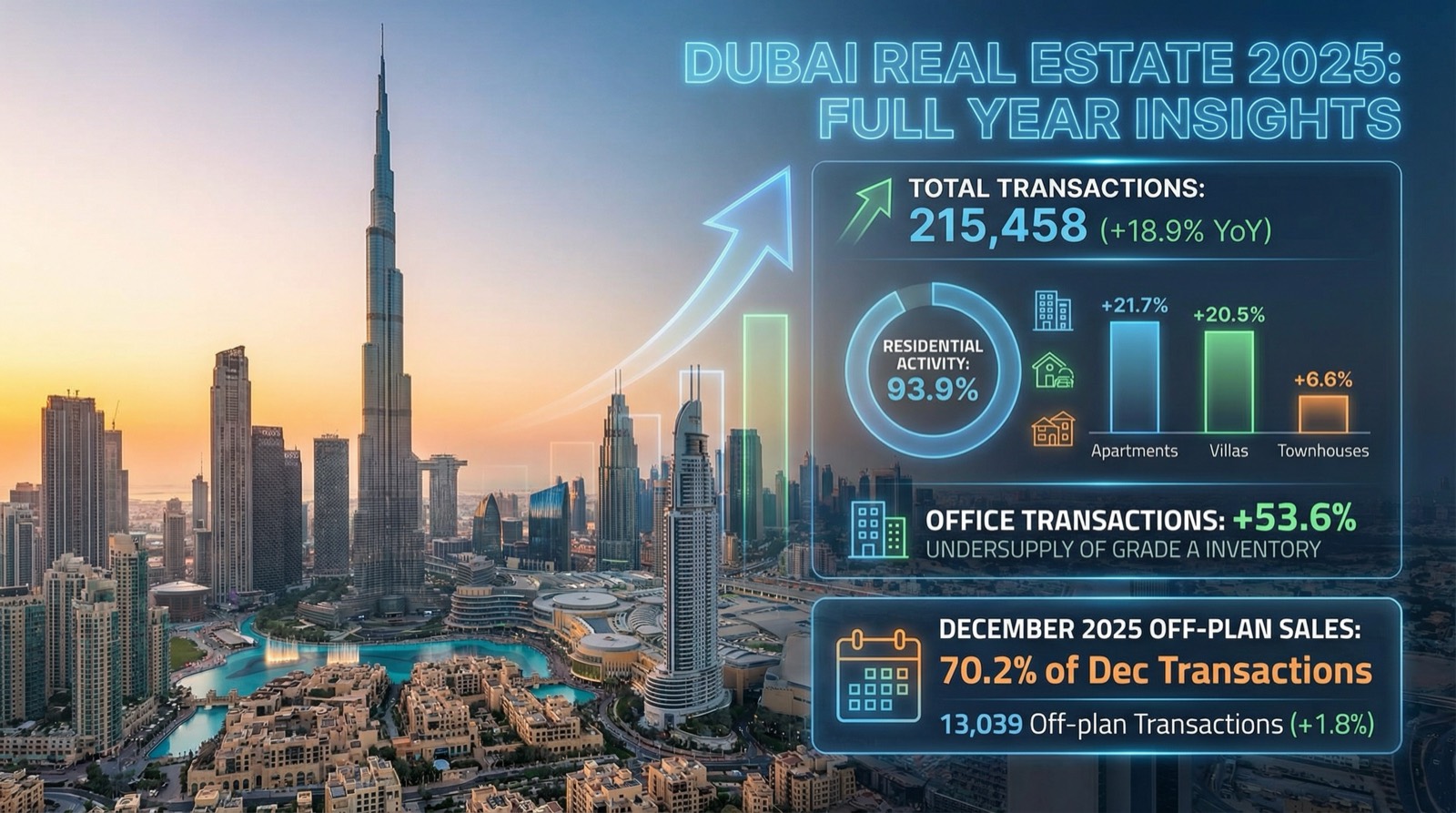
The UAE property market has moved from a record-setting February into its sharpest sentiment shock since 2020.
The system is absorbing both:
(1) a direct geopolitical escalation involving Iran, and
(2) a local market transitioning from boom-phase elasticity to mature-cycle selectivity.
This week’s data clarifies what has changed, what remains intact, and where risk is actually repricing.
If you’re reassessing positioning in light of geopolitical uncertainty, I can show you where risk-adjusted performance remains resilient. Click here to speak with me directly.
Iran’s strike on Gulf territory triggered an immediate regulatory and market response.
Capital-Market Reactions
- ADX and DFM closed for two days (2–3 March) to prevent disorderly trading.
- Developer equities fell ~5% on reopening, broadly in line with the wider GCC index.
- Bond markets were effectively shut for new developer issuance, with spreads widening during the period of heightened risk.
- A major capital-raising effort was paused, reflecting the higher regional risk premium at that time.
These movements show how capital markets initially repriced risk. Listed securities adjusted faster than the physical market, as typically occurs in periods of uncertainty.
Macro Stability Indicators
- S&P affirmed the UAE at AA/A-1+ (stable) with projected 2026 debt at ~27% of GDP.
- IMF reiterated that non-oil sectors now contribute ~80% of GDP, providing structural resilience.
- Ministry of Economy confirmed 4–6 months of strategic food reserves, relevant for logistics-disruption scenarios.
Cross-Asset Movements
Recent macro indicators show sharp moves across key hedging assets:
- Gold above $5,300/oz and Silver above $84/oz, reflecting sustained safe-haven demand.
- Brent crude fluctuating between $89–$120/bbl, driven by conflict-related supply risk.
- The USD/AED peg remains stable, maintaining the currency hedge that supports international capital flows into the UAE.
Investor Consideration: Risk is repricing financially, not structurally. The UAE’s macro buffers remain intact, but global allocators are temporarily holding liquidity in metals and USD rather than deploying fresh capital into real estate.

Before the March escalation, Dubai recorded one of its strongest monthly results on record.
Dubai Land Department (February 2026)
| Indicator | Value | YoY Change |
| Total Sales Value | AED 60.6bn | +18.14% |
| Total Transactions | 16,959 | +5% |
| Off-plan | 10,526 (62%) | ↑ market share |
| Ready | 6,437 (38%) | Stable |
Segment-Level Output
Commercial sales: AED 9.54bn (vs ~AED 1.2bn in 2025).
Apartments: AED 26.6bn.
Villas: AED 6.4bn.
Top performing areas:
- JVC (volume)
- Al Yelayiss 1 (value)
Ultra-prime transactions:
- Aman Residences Dubai: AED 422m apartment
- The Alba Residences: AED 226m
- EOME Palm Jumeirah: AED 115m
This was a broad-based expansion, not dependent on one segment.
Demand Composition
- Cash buyers continue to dominate → low forced-selling risk.
- Off-plan continues to carry the cycle → highest sensitivity to sentiment shocks.
The geopolitical event did not trigger immediate market-wide retrenchment, but it did reshape behaviour.
Observed Shifts
- 30% drop in site visits and enquiries since late February.
- Brokers report 60–80% of “on-hold” deals expected to close in Q2 if stabilisation occurs.
- Foreign investors are the decisive variable, with expatriates forming ~90% of the population. The level of offshore demand will guide Q2–Q3 outcomes.
- Developers, including Emaar Properties, continue to signal confidence, though their order books reflect past momentum and are not reliable forward-risk indicators.
Price Behaviour
- No evidence of broad price declines.
- Mid-market buyers (AED 1.5–4m) are now negotiating 3–7% discounts.
- UHNW demand remains intact, evidenced by a record AED 422m apartment sale completed even after tensions escalated.
Implication for Investors: The immediate impact is slower decision-making, not distressed selling or price deterioration.
End-User Shift
2026 is seeing elevated first-time homebuyer activity from long-term residents.
Drivers:
- Rent inflation since 2022 (+60% cumulative).
- Desire to lock in costs.
- Higher preference for unit functionality (layout, storage, light).
Areas with concentrated transaction activity:
- Bukadra
- Me’aisem Second
- Dubai South
Luxury and Ultra-Prime
- Liquidity has not weakened: multiple AED 100m+ transactions closed in early March.
- UHNW demand appears structural, motivated by long-horizon capital preservation rather than tactical timing.
Abu Dhabi
- ADREC is becoming a meaningful node for global institutional bridging, positioning the capital as a diversification outlet.
Investor Takeaway: Residential strength is not uniform, but demand depth in established communities remains resilient.

Commercial demand remains firm, supported by stable occupier activity and limited Grade A supply.
Recent Transactions
- Bukadra: 12,347 sq ft asset → AED 42m.
- Trade Center Second: deals near AED 34m.
Yield Environment
- 8% yields in Dubai.
- 2%–4% yields in London/New York.
The sector’s yield gap and steady absorption underpin its continued momentum despite wider macro uncertainty.
Market Direction
Institutional capital is becoming more selective in the short term, but operational demand for Grade A/near-core commercial assets remains robust.
Investor Takeaway: CRE is one of the few segments where current data still supports continued expansion, even funder elevated geopolitical risk.
Explore curated office and retail opportunities at Mitchell’s Commercial Realty.
Supply Pipeline
- 120,000–131,000 units scheduled for 2026.
- Analysts expect ~48% actual handover, mitigating sudden oversupply risk.
Oversupply Risk (2027–2028)
- JPMorgan and Fitch warnings: 300,000–400,000 units projected by 2028.
- Risk centres on outer-ring masterplans with heavy off-plan launches.
Construction Costs
- Rising due to UAE Energy Strategy 2050 (efficiency standards).
- Higher Brent readings (up to $120) → elevated logistics + materials cost index.
Investor Takeaway: Supply risk is concentrated in specific corridors, not market-wide. Developers with limited balance-sheet capacity will feel the impact of rising funding and construction costs sooner.
Still reading
Need expert help on this subject?
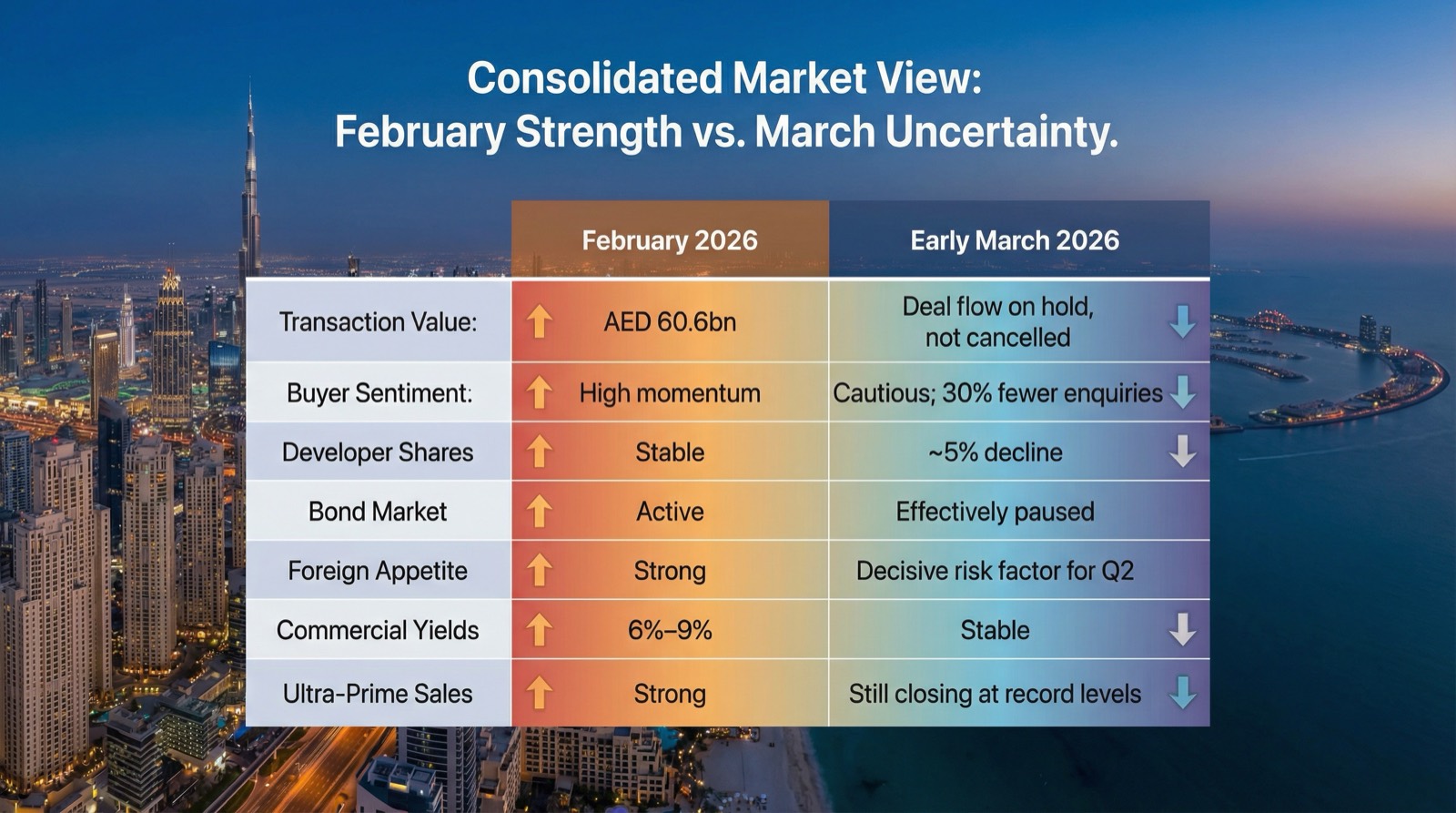
| Metric | February 2026 | Early March 2026 |
|---|---|---|
| Transaction Value | AED 60.6bn | Deal flow on hold, not cancelled |
| Buyer Sentiment | High momentum | Cautious; 30% fewer enquiries |
| Developer Shares | Stable | ~5% decline |
| Bond Market | Active | Effectively paused |
| Foreign Appetite | Strong | Decisive risk factor for Q2 |
| Commercial Yields | 6%–9% | Stable |
| Ultra-Prime Sales | Strong | Still closing at record levels |
Implication for Investors: The market is balancing robust recent performance with an elevated geopolitical risk premium that is being absorbed into pricing.

Base Case (Stabilisation in 4–8 Weeks)
- 2026 remains a strong but bifurcated market.
- Prime, supply-constrained areas outperform.
- Outer-ring, heavily marketed off-plan segments require pricing adjustments.
- Commercial yields remain attractive.
Downside Case (Extended Conflict)
- Further equity + bond market repricing.
- Reduced offshore demand → slower off-plan absorption.
- Developers relying on external funding face tighter liquidity.
- Selective segments may see repricing, not city-wide correction.
The environment now calls for selective deployment rather than momentum-driven buying, with priority given to assets backed by real end-user demand, stable liquidity, and controlled supply exposure.
1. Prioritise assets with durable end-user demand
Focus on communities with established occupancy, functional infrastructure, and a proven buyer base—areas that continue to transact even during external shocks. Avoid projects reliant on speculative turnover or narrow offshore buyer profiles.
2. Stress-test off-plan exposure more rigorously
Given the bond-market disruption and increased risk premium, assess:
- construction and handover timelines,
- resale liquidity under slower offshore inflows, and
- mortgage availability, if global rates remain elevated. Selective off-plan remains attractive, but price discipline and developer strength are now non-negotiable.
3. Reassess marginal or operationally weak assets
If holding stock with high service charges, poor maintenance, or exposure to heavy upcoming supply, this is a rational moment to test the market. Liquidity remains intact, but conditions may tighten if foreign demand softens.
4. Maintain exposure to commercial assets with stable yield profiles
The data continues to show resilient demand for income-producing commercial property, with yields in the 6%–9% range. These assets can outperform in higher-rate environments and remain less sentiment-sensitive than off-plan residential.
5. Avoid overreacting to short-term volatility
There is no evidence of distressed selling or structural demand erosion. If geopolitical tensions stabilise within 4–8 weeks, the market is positioned to resume activity with a more rational price curve. High-quality, low-leverage landlords should avoid selling into temporary noise.
6. Anchor decisions around the likely exit scenario
Identify your likely exit buyer—end-user, investor, or offshore purchaser—and assess whether that profile would still transact under tighter global risk appetite. This defines whether the asset is defensively positioned or exposed to sentiment cycles.
Next step
Let’s Talk
If you’d like to unpack where the most resilient opportunities are emerging — in stabilised residential areas or income-generating commercial zones — I’m happy to share a focused, data-driven shortlist based on your investment goals.
📞 No pressure, no sales pitch—just a focused, informed conversation about your investment goals. Let’s talk.
Published 9 March 2026 by Stephen James Mitchell MBA. Market figures quoted reflect the data available at that date.