Dubai’s commercial real estate cycle continues to accelerate, extending the momentum that has defined recent quarters. Office sales for 2025 closed at Dh13.1 billion — double the previous year — while Grade A industrial stock tightened to near-full occupancy.
Rental activity surpassed Dh126 billion, marking another record in a market increasingly driven by corporate expansion and institutional capital rather than residential speculation.
Against this backdrop, the first phase of 2026 is reinforcing a clear separation between asset classes. Commercial, logistics, and mixed-use districts are outperforming; mid-market residential is normalising; and land acquisition strategies are shifting in response to construction inflation and rising feasibility thresholds.
The cycle is maturing — and investors now face a market where precision outweighs momentum.
If you’re planning your next strategic allocation, I can share a targeted shortlist of high-performing options.Click here to speak with me directly.
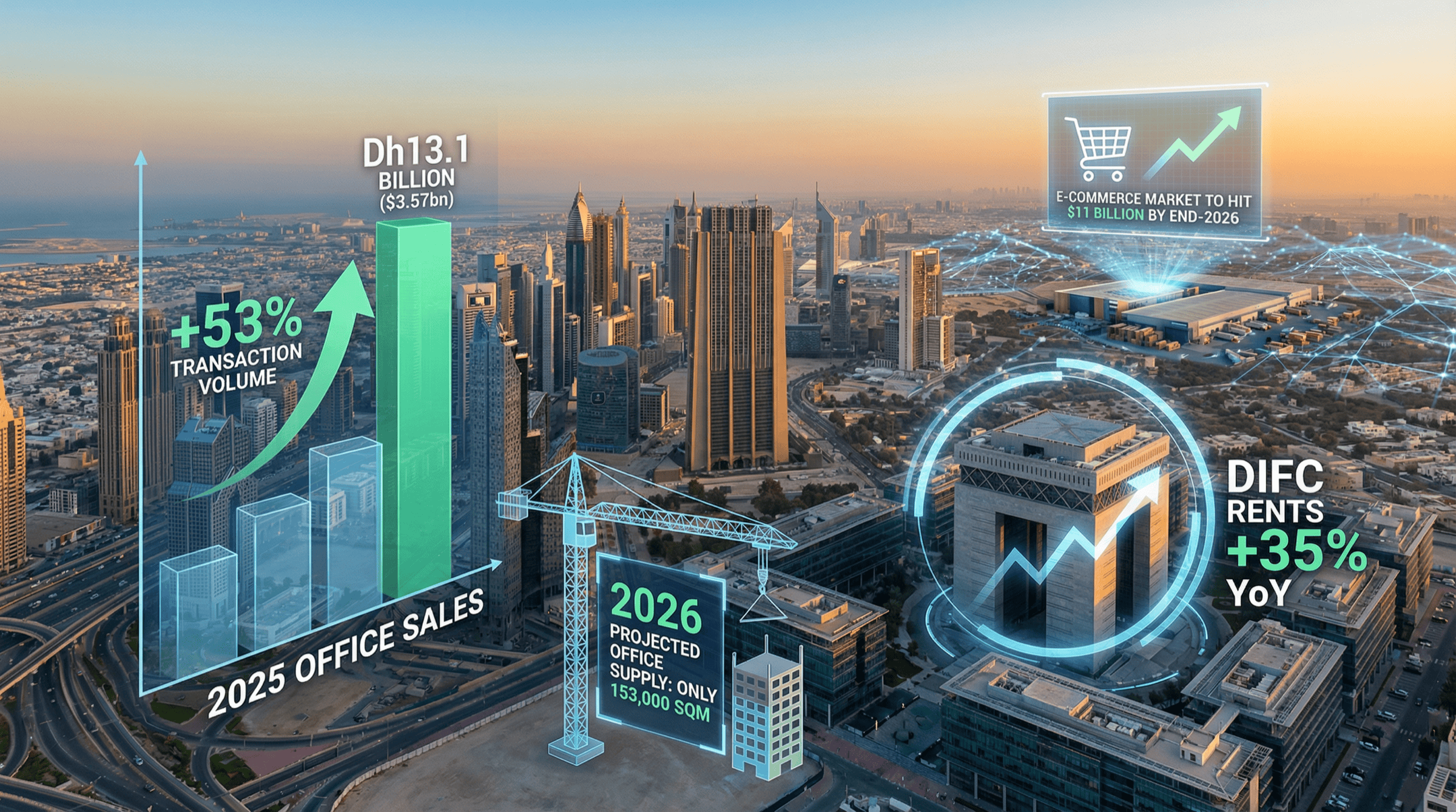
Dubai’s office sector has moved into a structurally different zone of performance. The city posted Dh13.1 billion ($3.57bn) in office sales during 2025 — more than double the 2024 figure and the strongest office performance in over a decade.
Transaction volumes increased 53%, driven by multinational relocations, the expansion of financial and professional services, and an influx of AI, defense, and advanced manufacturing firms.
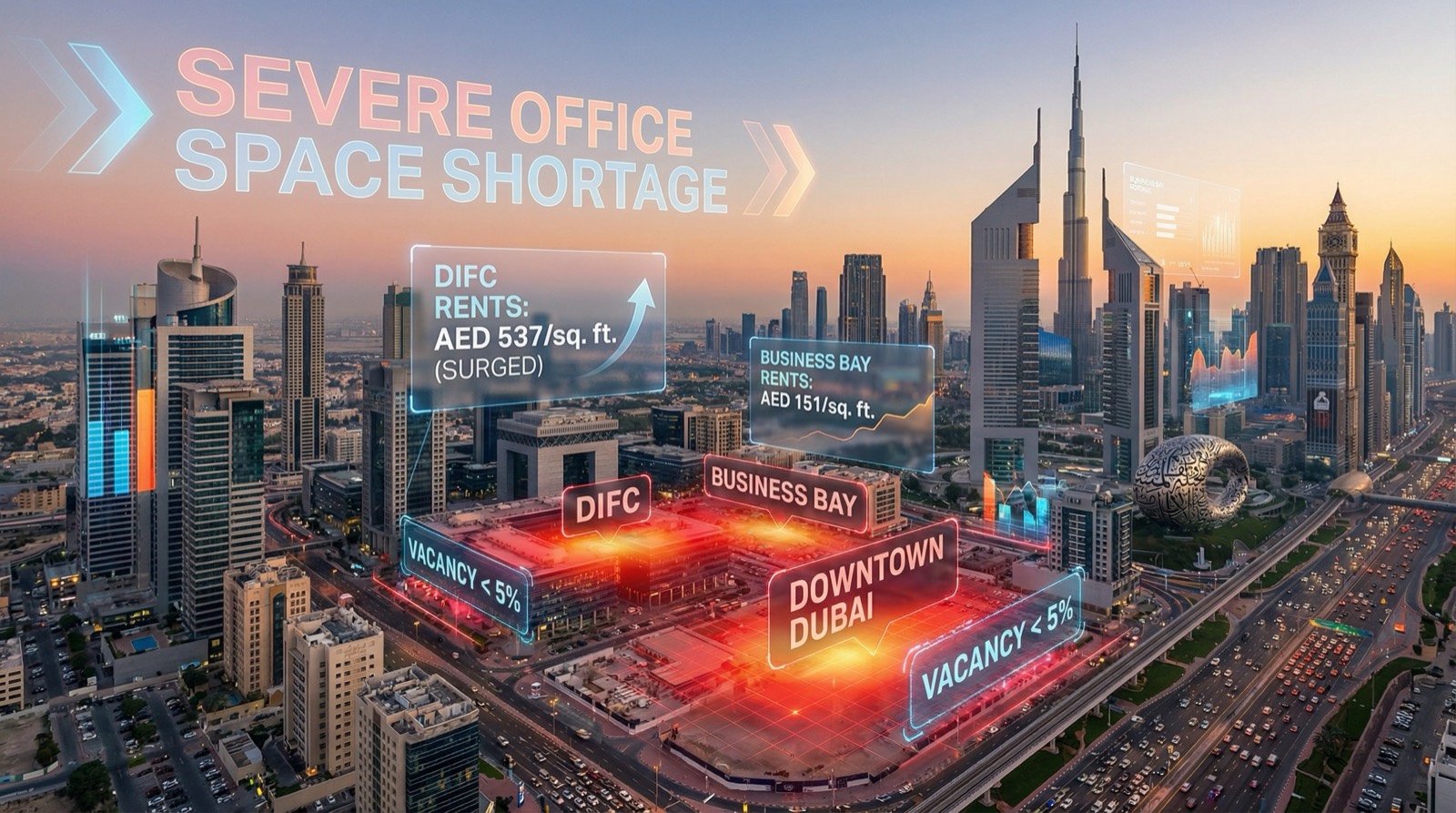
The story is not just demand; it is scarcity.
- Only 153,000 sqm of new office supply is projected for 2026
- DIFC rents increased 35% year-on-year
- Vacancy in core Grade A buildings remains close to zero
- Fit-out and service charges have risen, lifting effective costs for tenants but reinforcing landlord leverage
The AHS Tower — a 69-storey commercial high-rise on Sheikh Zayed Road — was fully sold out during development, generating $700 million+.
Commercial towers do not typically sell out pre-completion unless institutional demand is deep and confidence is long-term.

- Yield consistency is stronger in commercial assets than in residential at this stage of the cycle.
- Capital values for Grade A offices are expected to rise 10–15% in 2026, outperforming residential price growth.
- Investors should prioritize buildings with efficient floor plates, ESG compliance, and established tenant demand.
- Refurbished Grade B assets present emerging value: rental spreads between B and A classes have widened enough to justify repositioning strategies.
Dubai’s rental market provides a foundation that is now too large to ignore in investment strategy.
The Dubai Land Department recorded Dh126 billion ($34.4bn) worth of rental contracts across 1.1 million tenancies — the highest rental year ever documented.
Key data points:
- 6% growth in total contract registrations
- 10% rise in new rental contracts (indicating fresh population inflows)
- 17% rental value growth, led by prime and villa stock
- Commercial lease lengths have expanded as companies secure long-term operational certainty
A rental economy of this size supports:
- More stable mixed-use developments
- Longer-term leases in office and retail assets
- Higher absorption in decentralized business districts
- Institutional-grade underwriting for income-producing assets
As supply increases in certain residential zones, end-user absorption is expected to stabilize rental trajectories — a positive outcome for commercial tenants seeking predictable cost baselines.
Explore curated office and retail opportunities at Mitchell’s Commercial Realty.
The cycle’s next stage is defined by the emergence of new commercial hubs — not replacements for the core, but expansions that deliver new formats and better alignment with population distribution.
A large-scale commercial district is now planned for Motor City, aligned with the broader shift toward work-near-home ecosystems and multi-use business centres.
Motor City benefits from:
- Mature residential density
- Strong connectivity to key corridors
- Demand for mid-rise commercial stock outside the CBD
Expect this district to attract SME headquarters, logistics support, and professional services firms priced out of central office markets.
Nisus Finance deployed Dh110 million into Majan — a signal that mid-market commercial zones with strong transport adjacency are becoming institutional targets.
The district is strategically positioned between several established and emerging corridors, making it one of the more undervalued early-cycle commercial plays.
Developer activity remains strong, with Zabadani Real Estate recording Dh3 billion in land transactions for 2025.
Land is shifting from a speculative trade to a scarcity-driven asset — especially as construction inflation raises replacement costs.

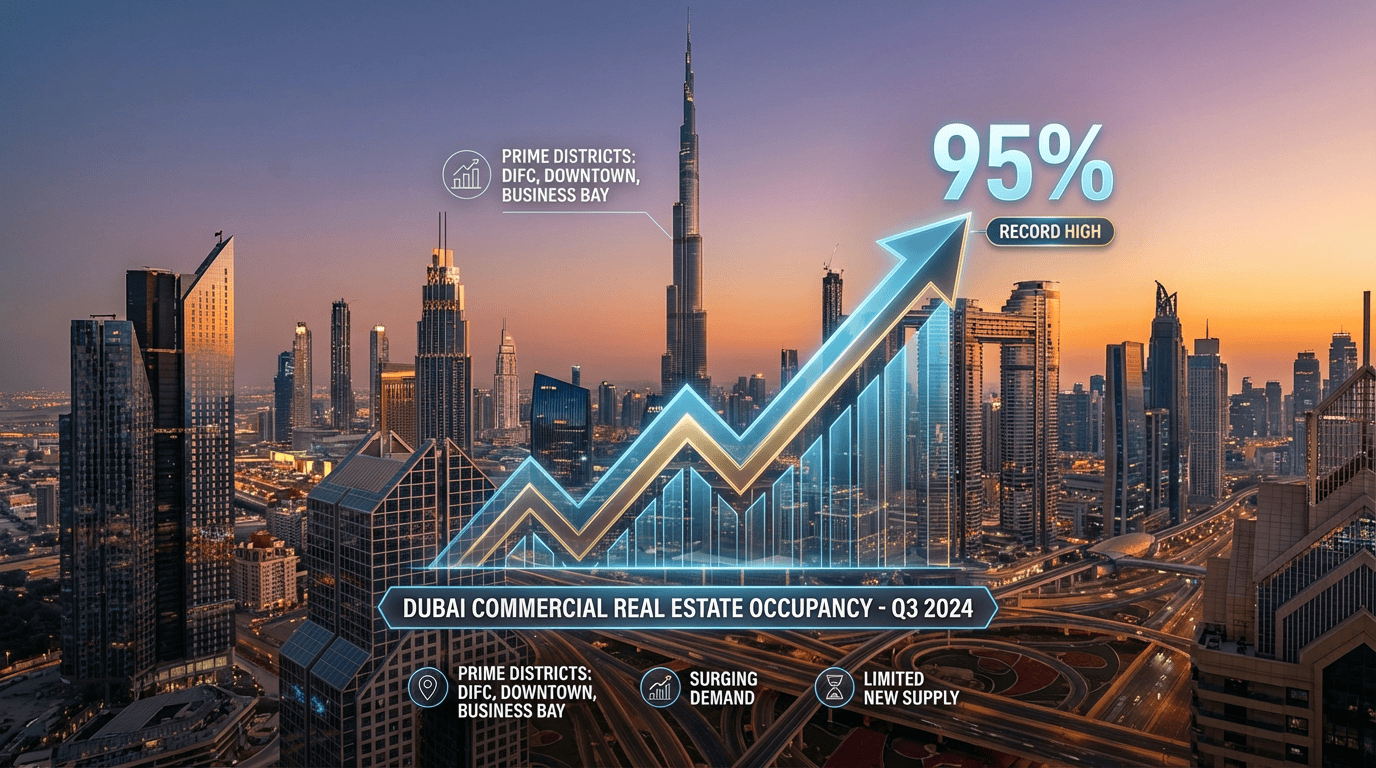
Logistics remains a standout performer. Grade A industrial space is now over 95% occupied, supported by e-commerce growth, rising trade volumes, and expanding cold-chain requirements.
Key demand drivers:
- UAE exports/re-exports up double digits
- E-commerce market expected to hit $11 billion by end-2026
- Pre-leasing is now standard — industrial stock is absorbed before completion
- Growing regional demand for pharmaceuticals, perishables, and specialty storage
Industrial yields sit at 7.25%–8.25%, outpacing global peers while maintaining low vacancy and long lease terms.
Still reading
Need expert help on this subject?
- Secure long-lease logistics boxes near Dubai South or JAFZA periphery.
- Prioritize cold storage — the fastest-growing subsector.
- Target institutional-grade warehouses with strong power capacity, optimized circulation, and automation-ready design.
Commercial real estate performance is underpinned by broader financial strength.
Islamic Treasury Sukuk Oversubscribed 6×
The UAE’s first 7-year sukuk, raising $150 million, drew demand six times higher than the available issuance.
This represents:
- A strong liquidity environment
- Investor appetite for UAE-backed instruments
- Increased fiscal confidence — a positive anchor for CRE lending conditions
Global Funds Strengthen Footprint
Madison Realty Capital launched a new office in Abu Dhabi Global Market (ADGM), adding to the list of institutional entrants establishing regional hubs.
More global funds with boots on the ground means:
- Greater competition for stabilized commercial assets
- More sophisticated underwriting
- Rising interest in logistics, hybrid office spaces, and develop-to-hold products
Company registrations continue to rise at a pace that exceeds new office delivery:
- 18,486 Indian-owned businesses joined Dubai Chamber in 2025 (up 11%)
- 37.6% of new members are in real estate, renting, and business services
- Consultants, tech firms, and financial services groups are migrating at scale
Implications
- CBD vacancy will remain below equilibrium for several years
- Mid-tier business districts (JLT, Barsha Heights, Arjan) offer strong rental uplift potential
- Hybrid offices — flexible layouts with high ESG ratings — will command the firmest demand
Dubai’s regulatory advancements are now materially reducing investor risk.
Enhanced Escrow Oversight
Developers must adhere to stricter milestone-based fund release structures, reducing completion risk for off-plan commercial assets.
Higher Transparency Standards
Increased global scrutiny and domestic reforms are improving governance. This shift makes Dubai more accessible for sovereign funds, pension funds, and family offices seeking clean, compliant markets.

Despite strong fundamentals, certain structural pressures are emerging.
Three areas in particular warrant closer attention:
1. Construction Cost Inflation
Costs are rising across cement, steel, labour, and MEP.
This will:
- Slow delivery timelines
- Increase replacement costs
- Benefit developers with existing land banks and pre-purchased materials
2. Two-Speed Market Behavior
Commercial assets are accelerating while certain residential pockets normalize due to heavy supply pipelines.
3. Developer Liquidity Divergence
Well-capitalized developers will widen their advantage as financing costs increase and feasibility margins tighten.
Based on current structural signals, the strongest segments are:
Top Opportunities
- Prime and Grade A offices in DIFC, SZR, and Dubai South
- Logistics and cold storage with long-term lease covenants
- Community retail anchored by daily-use tenants
- Mixed-use commercial districts in Motor City and Majan
Selective Opportunities
- Grade B refurbishments in undersupplied submarkets
- Office floors in Business Bay with efficient layouts
- Light industrial in transition corridors
Avoid / Approach Carefully
- Residential towers in oversupplied districts
- Off-plan from developers with weak liquidity
- Commercial assets without ESG alignment or competitive fit-out
In closing
Conclusion: A Commercial Cycle Defined by Scale and Quality
Dubai’s commercial real estate market has entered a phase that combines demand maturity, capital depth, and supply scarcity in ways rarely seen simultaneously. Office sales doubling, logistics hitting 95% occupancy, and tenancy contracts breaking Dh126 billion are not isolated achievements — they are indicators of a long-duration commercial expansion cycle.
For investors, the path forward centres on income-driven assets, structurally constrained districts, and partnerships with developers capable of managing rising construction and financing costs.
The commercial economy is now the centre of gravity in Dubai’s real estate cycle — and the smartest capital is already reallocating accordingly.
Next step
Let’s Talk
If you want a more precise understanding of Dubai’s commercial environment — from office demand to retail performance — I can break down the capital shifts that matter most for your strategy.
📞 No pressure, no sales pitch—just a focused, informed conversation about your investment goals. Let’s talk.
Next step
Ask us about this

Published 24 February 2026 by Stephen James Mitchell MBA. Market figures quoted reflect the data available at that date.