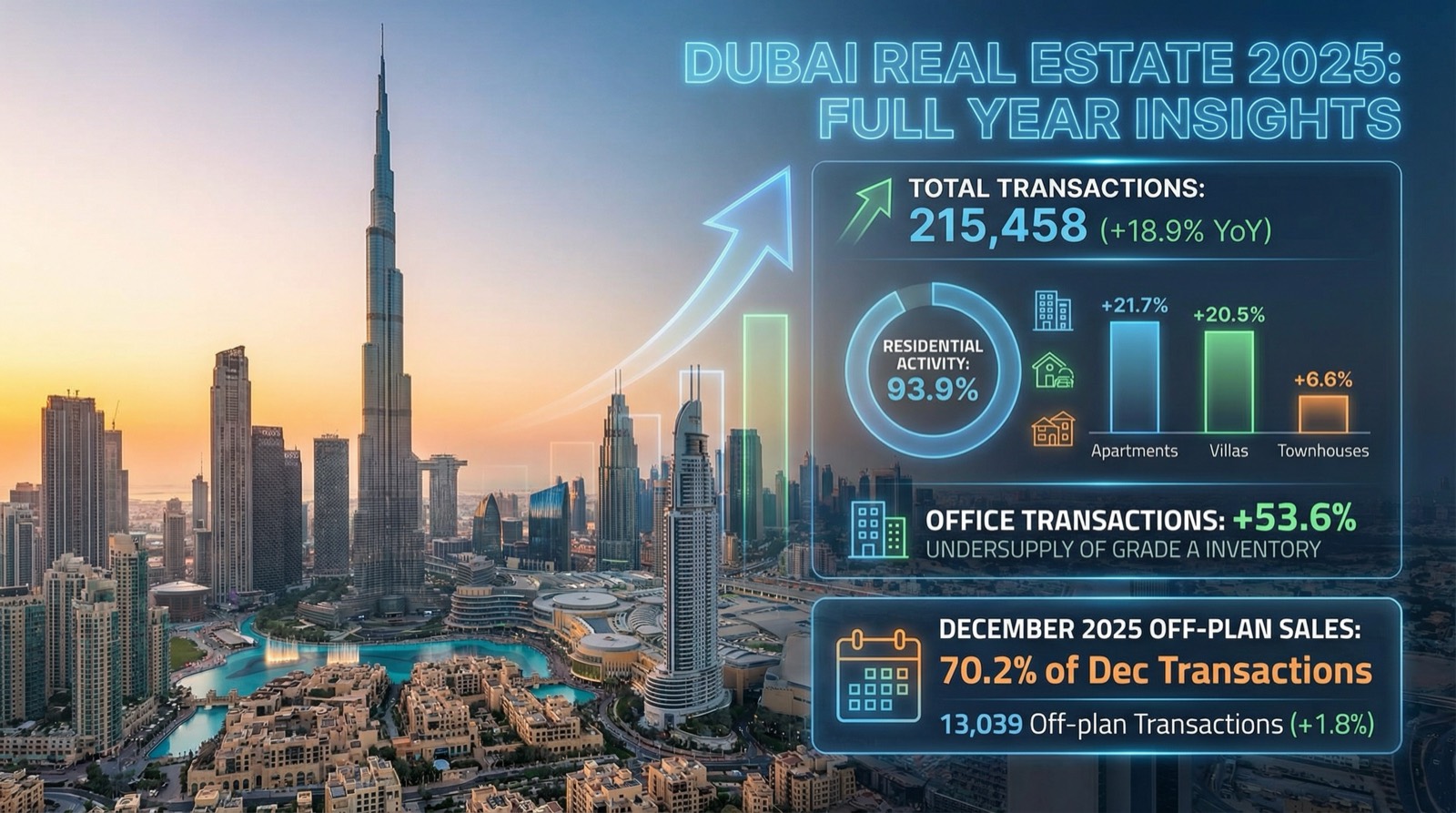
The Dubai property market has entered a period of adjustment. Financial markets have reacted quickly to geopolitical risk, while real estate activity has slowed at the margin but remains elevated relative to historical levels.
This divergence between sentiment and underlying data is the key feature of the current market.
If you’re reassessing your positioning in this market, I can show you where risk-adjusted opportunities are emerging. Click here to speak with me directly.
The broader economic framework remains stable.
The UAE Central Bank has introduced an AED 1 trillion liquidity support package, aimed at maintaining banking system stability and ensuring credit availability.
GDP growth for 2026 is projected at approximately 5.6%, supported by non-oil expansion and continued capital inflows.
At the sovereign level, the UAE has reaffirmed its $1.4 trillion investment commitment into the United States, signalling sustained global capital engagement despite regional volatility.
There are no indications of capital restrictions or systemic liquidity pressure.
Recent data shows a moderation in activity, but not a breakdown.
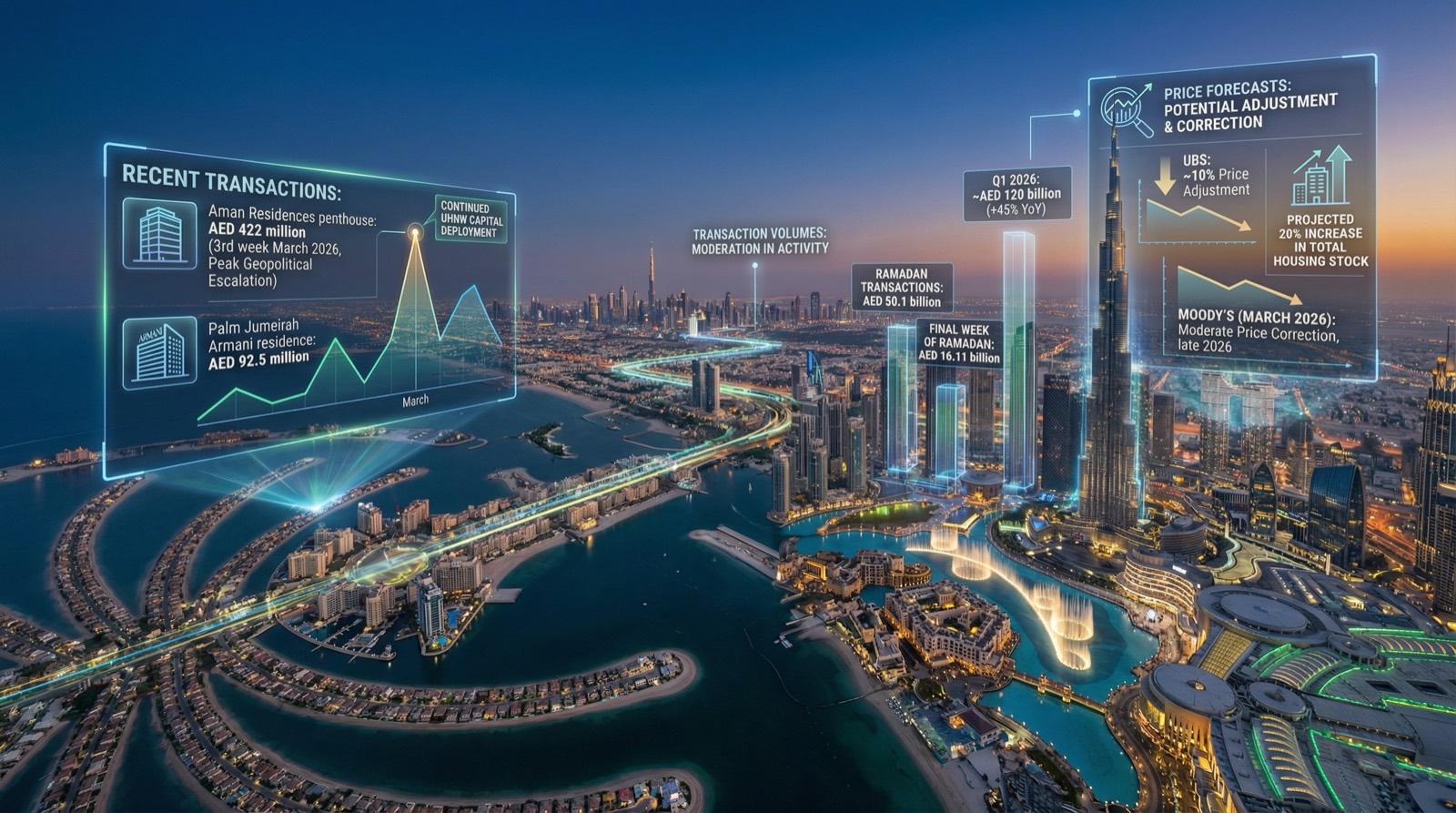
- Ramadan transactions: AED 50.1 billion
- Final week of Ramadan: AED 16.11 billion
- Q1 2026: ~AED 120 billion (+45% year-on-year)
Initial March data indicates a sharp 51% MoM value pullback, though Q1 2026 remains record-breaking at AED 120B+. This reflects delayed execution rather than cancelled demand.
The pattern is consistent with previous periods of uncertainty, where:
- Buyers pause decision-making temporarily
- Transactions resume once pricing expectations stabilise
Current volumes remain well above long-term averages.

Listed markets have repriced risk significantly.
- DFM Real Estate Index: down ~30–33%
- Real estate bonds: weaker, with higher yields
The physical property market has not adjusted at the same pace.
This is largely explained by market structure:
- Approximately 75% of transactions are cash-based
- Limited exposure to leverage reduces forced selling
- Rental income provides a stabilising floor for asset values
As a result, equities are reflecting forward-looking risk, while property continues to reflect current demand conditions.
High-value transactions continue to provide a reliable signal of capital confidence.
Recent transactions illustrate this clearly:
- Aman Residences penthouse: AED 422 million
- Palm Jumeirah Armani residence: AED 92.5 million
These transactions occurred during peak geopolitical tension. The Aman Residences transaction occurred during the third week of March, at the peak of geopolitical escalation, reinforcing continued UHNW capital deployment.
Data from Knight Frank shows that short-term resale activity has declined to approximately 4% of transactions, compared to ~25% during the 2008 cycle. This indicates a market dominated by long-term capital rather than speculative positioning.
Supply remains the primary variable influencing pricing over the medium term.
- Estimated 2026 pipeline: ~110,000–120,000 units
Institutional assessments differ slightly:
- S&P Global does not anticipate a systemic correction
- UBS highlights the potential for a ~10% price adjustment if delivery timelines are met in full
However, historical completion rates are typically 45–55%, meaning effective supply is lower than headline figures suggest.
Moody’s (March 2026) now forecasts a moderate price correction beginning in late 2026 due to a projected 20% increase in total housing stock.
Current data also indicate early pressure in the mid-market apartment segment, with median prices in this niche declining approximately 3% year-on-year in early March, whereas the villa segment remains more resilient.
Developers are maintaining pricing discipline. Adjustments are being made through:
- Fee waivers
- Extended payment plans
- Non-cash incentives
There is limited evidence of broad-based price reductions at this stage.

Investor behaviour has shifted toward caution without indicating withdrawal.
Observed trends include:
- Partial reallocation of liquid capital to other global markets
- Increased preference for liquidity
- Greater selectivity among buyers
Indian investors, who remain the largest buyer group, are becoming more selective, with some capital being reallocated back into opportunities within India.
The shift is from speculative activity toward longer-term positioning.
Institutional investment activity remains active.
- UAE sovereign wealth participation in real estate secondaries platforms
- New Grade A office supply launched in Barsha Heights — 26-storey commercial tower valued at AED 500 million ($136 million)
- Logistics and industrial assets are maintaining yields of 7.25%–8.25%
This indicates continued demand for income-generating and strategically located assets.
Explore curated office and retail opportunities at Mitchell’s Commercial Realty.
Still reading
Need expert help on this subject?
The broader UAE market continues to expand.
- Abu Dhabi residential sales: AED 76.1 billion (2025)
- Housing support package: $1.15 billion
- Sharjah Ramadan transactions: AED 4.6 billion (+71.8%)
Sharjah also recorded a broader Ramadan transaction surge of AED 12.5 billion (+26.7%), indicating capital rotation toward more affordable emirates.
Growth is not limited to Dubai, reinforcing the depth of demand across the federation.
Financing conditions remain relatively tight.
- Mortgage rates: ~6.1%
- Construction costs: +2.5%
Developers are managing these pressures through structured incentives rather than price adjustments.
Margins may compress moderately, but there is no evidence of distress.
If you’re looking to access distress and discounted opportunities as pricing adjusts, click here to check out available deals.

The current environment is less about market timing and more about positioning within it.
Income is becoming more important than appreciation.
With rental yields in the 7–9% range across several segments, income provides a buffer while pricing stabilises.
Quality is being repriced at a lower rate than volume.
Prime assets—particularly branded residences, waterfront locations, and Grade A offices—are holding value more effectively than large-scale mid-market inventory.
Negotiation is returning in selective segments.
Early signs of 3–7% flexibility are emerging in parts of the mid-market, particularly where sellers are time-sensitive.
Supply exposure needs to be managed.
Segments with the largest delivery pipelines—especially standard apartment stock—are more likely to experience pricing pressure as units are completed.
Leverage should remain controlled.
With mortgage rates around 6%, returns must be sustainable without relying on aggressive financing assumptions.
The opportunity in this phase is not broad-based. It sits in selectivity, pricing discipline, and income-backed assets.
In closing
Conclusion: A Period of Price Discovery
The market is undergoing a recalibration.
Key characteristics of the current phase:
- Financial markets have adjusted rapidly
- Property markets are adjusting gradually
- Supply is increasing but not fully materialising
- Demand is becoming more selective
There are no indicators of systemic instability. The adjustment remains contained within specific segments, particularly mid-market inventory.
The underlying structure—cash-driven demand, strong liquidity, and institutional participation—remains intact.
Next step
Let’s Talk
If you’d like to unpack where the most resilient opportunities are emerging — in stabilised residential areas or income-generating commercial zones — I’d be happy to share a focused, data-driven shortlist based on your investment goals.
📞 No pressure, no sales pitch—just a focused, informed conversation about your investment goals. Let’s talk!
Published 23 March 2026 by Stephen James Mitchell MBA. Market figures quoted reflect the data available at that date.