This week, the books officially closed on the first half of 2026, and the final numbers confirmed what transaction data had been showing for some time. The Dubai Land Department reported AED 286.4 billion (USD 77.9 billion) in property sales for the first six months — an undeniably large figure, but roughly 12% below the AED 326.6 billion recorded in the same period of 2025.
It was the second-largest first half on record, and the first in three years to post a year-on-year decline. Both matter, and the tension between them defines the week's analysis.
The macro data told a similar story. The Central Bank of the UAE lowered its 2026 growth forecast to 1.7%, its non-oil momentum indicator hit a five-year low, and the labour market recorded its first job losses in four years. Taken in isolation, these numbers suggest a market in retreat.
Yet the same week delivered some of the clearest recovery signals we’ve seen this cycle. Oil exports rebounded to levels not seen since 2017. The government cut fuel prices for the first time since the conflict, and the Central Bank now forecasts a 9.8% growth rebound in 2027. Buyers kept committing to scarce commercial assets — a record half-year for off-plan offices, an AED 3 billion tower on DIFC's last remaining plot, and steady institutional buying.
The H1 numbers confirm a contraction. Below, I examine what they actually mean for positioning — and why the forward indicators may matter more than the half-year verdict.
If you're weighing entry points while this market reprices, I can show you where the risk-adjusted opportunities are emerging. Click here to speak with me directly.
Dubai Land Department data shows the emirate recorded AED 286.4 billion (USD 77.9 billion) in property sales across 86,005 transactions in the first half of 2026. Including mortgages and gifts, total real estate activity reached AED 419.94 billion across 112,850 transactions. This makes H1 2026 the second-strongest half in Dubai’s recorded history.
The more relevant comparison is with last year. H1 2025 delivered AED 326.6 billion in sales, meaning H1 2026 came in roughly 12% lower year-on-year — the first half-year decline since the 2023 upswing began.
This aligns with the monthly trends seen since March: a conflict shock at the end of February, a sharp drop in May transactions, and a market gradually working through an orderly price correction.
A 12% pullback from an all-time peak — during a half-year that included a regional war — counts as moderation, not breakdown. For perspective, AED 286 billion in six months still surpasses the total annual sales Dubai recorded in any year before 2021. The frenzied conditions of 2024 and early 2025 have passed, and with them the pressure to overpay. High transaction volumes paired with softer prices is exactly the environment in which disciplined buyers tend to do well.
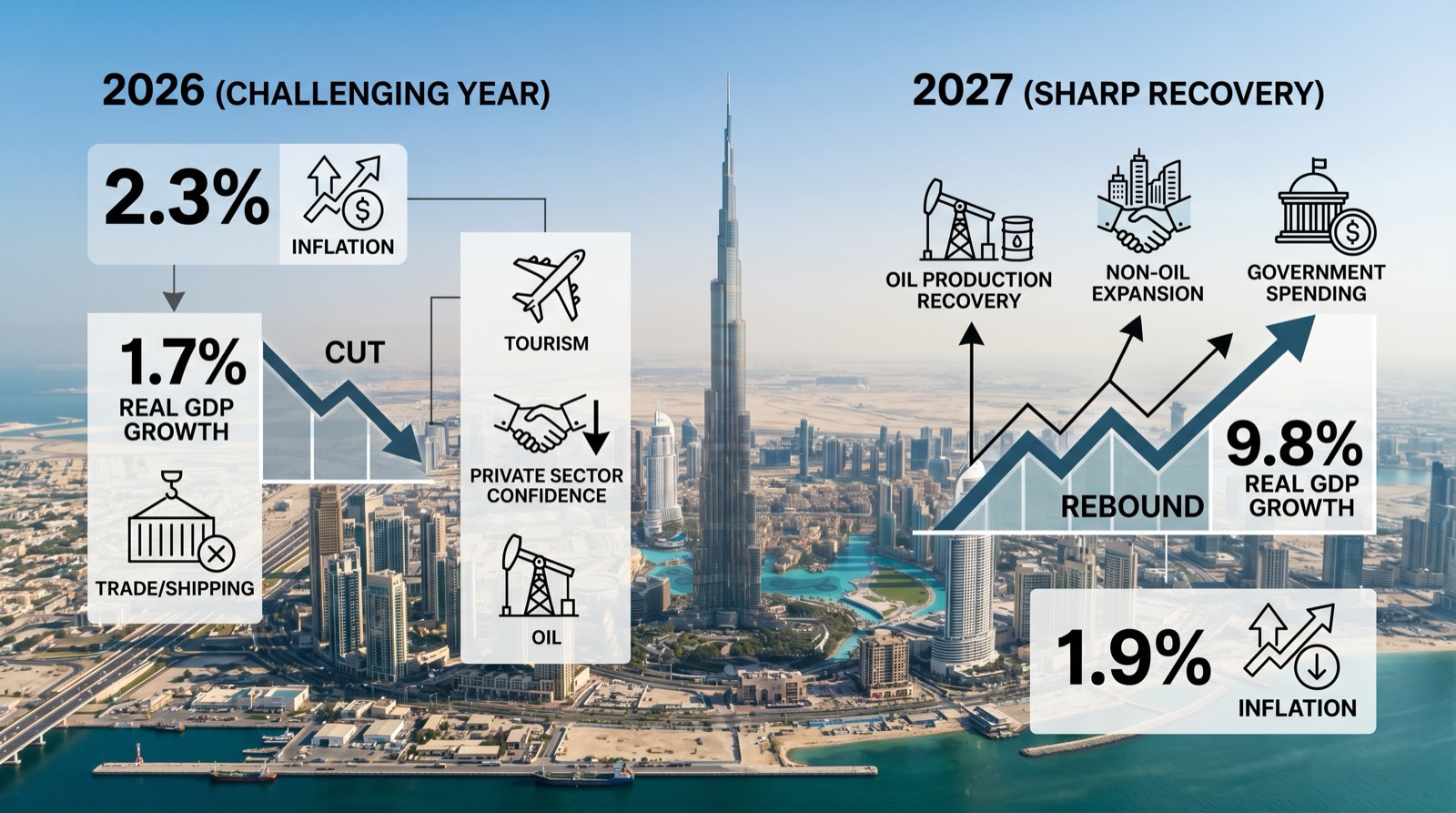
In its latest quarterly review, the Central Bank of the UAE cut its 2026 real GDP growth forecast to 1.7%, citing the direct impact of the second-quarter conflict on trade, shipping, tourism, and private-sector confidence. Inflation is projected at 2.3% for the year.
The more important figure in the same report is the rebound. The Central Bank now expects growth to accelerate to 9.8% in 2027, supported by recovering oil production, continued non-oil expansion, and government spending, with inflation easing to 1.9%. This matches the shape many institutional forecasters have been outlining all quarter: a challenging 2026 followed by a sharp recovery.
For property investors, 1.7% growth is modest but still positive — especially when paired with nearly 10% growth expected the following year. The Central Bank is not signalling a structural decline. It is describing a temporary contraction in an economy it expects to rebound strongly.
Buyers who price deals purely on 2026 conditions, rather than factoring in the 2027 recovery, risk buying into the weakness instead of positioning for the upside.
Section 03
UAE Non-Oil Activity Falls to a Five-Year Low as Hiring Drops for the First Time Since 2020
The S&P Global UAE Purchasing Managers’ Index fell to 50.8 in June, down from 52.6 in May. That marks the weakest reading in more than five years and leaves the index only just above the 50 level that separates expansion from contraction. Employment in the non-oil private sector declined for the first time in over four years, and at the fastest pace since August 2020.
A PMI of 50.8 still points to modest expansion rather than outright contraction — the non-oil economy is growing, albeit slowly. The direction is what matters: new orders, output and hiring all weakened as the conflict affected demand and confidence. The jobs data and transaction numbers are telling the same story.
This has clear implications for the property market. Non-oil private-sector employment underpins Dubai’s end-user housing demand. One quarter of weaker hiring does not erase the long-term strength of that base — the emirate has added jobs steadily for years — but it does call for conservative underwriting of rental demand through the second half of the year, especially in mid-market segments that rely heavily on salaried tenants.
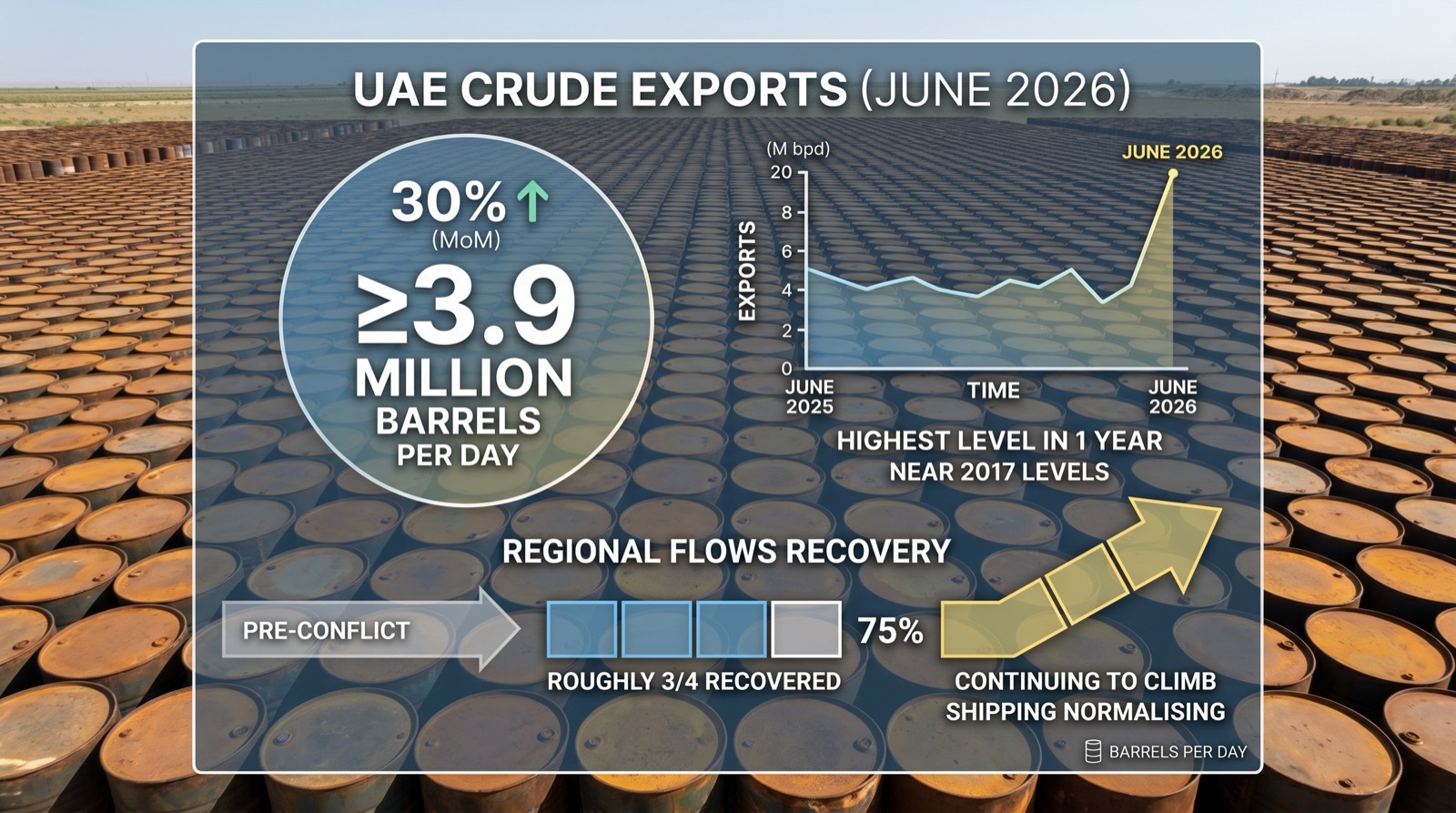
UAE crude exports rose around 30% month-on-month in June to more than 3.9 million barrels per day, according to tanker-tracking data from Bloomberg, Vortexa and Kpler. That represents the highest level in a year and levels close to those last seen in 2017. Regional flows through the Gulf have recovered to roughly three-quarters of their pre-conflict average and are continuing to climb as shipping normalises.
On the consumer side, the UAE Fuel Price Committee cut July petrol prices for the first time since the conflict. Super 98 dropped to AED 3.40 per litre from AED 3.95 in June, while diesel dropped to AED 3.60 from AED 4.33, as global oil prices eased back toward pre-war levels near USD 70 a barrel.
Neither development moves the property market directly. But rising oil output feeds the fiscal reserves that fund government spending, and falling fuel costs ease the inflation pressure that built through the second quarter. Both are conditions the Central Bank's 9.8% rebound forecast depends on — and both started moving in the right direction this week.
Explore curated office and retail opportunities at Mitchell's Commercial Realty.
Section 05
Dubai Off-Plan Office Sales Hit AED 13.1 Billion in H1 — More Than the Previous Seven Years Combined
| Commercial Office Segment | Data |
| Dubai off-plan office sales, H1 2026 | AED 13.1bn (1,668 transactions) |
| Previous seven years combined (2019–25) | ~AED 5.48bn |
| Business Bay share | AED 6.8bn (~52%) |
| DIFC Heights contract (final plot) | AED 3bn / USD 817m, 366 homes |
Analysis by Cavendish Maxwell, based on Land Department data, shows Dubai off-plan office sales reached AED 13.1 billion across 1,668 transactions in the first half of 2026. That figure exceeds the combined total for the previous seven years (2019–2025), which stood at roughly AED 5.48 billion. Business Bay alone accounted for AED 6.8 billion, or around 52% of the half-year total.
On the construction side, DIFC awarded the main construction contract for DIFC Heights — an AED 3 billion (USD 817 million) tower on the centre’s last remaining plot in the original masterplan. The project will deliver 366 luxury residences and premium offices, with completion targeted for 2029.
When investors pour record amounts into off-plan office space while pulling back from residential, they are signalling where they see scarcity and durable pricing power.
Dubai’s Grade A commercial market remains undersupplied and income-producing, and it is moving on a noticeably tighter cycle than mid-market residential — making it an increasingly attractive destination for buyers seeking Dubai exposure without the correction currently playing out in the apartment segment.
Source: Cavendish Maxwell
Still reading
Need expert help on this subject?
Abu Dhabi residential sales reached AED 84.49 billion in the first half of 2026, a 173.9% increase in value year-on-year across 16,585 transactions. Off-plan sales accounted for 78% of activity, with apartment values up about 22.5% and villa values up about 41%. Yas Island and Saadiyat Island are driving the bulk of demand.
These figures come from a private analytics provider rather than the official regulator, so the exact magnitude should be viewed as directional rather than definitive. But the direction is clear.
Abu Dhabi's outperformance reflects structural differences rather than a temporary swing. The capital is earlier in its supply cycle than Dubai, more anchored by domestic and institutional demand, and less exposed to the speculative correction playing out in parts of Dubai's residential market.
For portfolios heavily concentrated in Dubai, these results strengthen the argument for cross-emirate diversification — not as a bet against Dubai, but as a way to capture the part of the UAE recovery that is currently performing strongest.
Dubai Residential REIT, the largest residential REIT in the GCC, acquired 220 townhouses at Jebel Ali Village for AED 894 million (USD 243 million). The deal is expected to add around AED 75 million in annual revenue once stabilised and brings the trust’s acquisitions this year to 276 units.
Income-focused institutional buyers do not add stabilised rental stock at this scale into a market they expect to keep weakening.
On the trade front, the UAE–Ukraine Comprehensive Economic Partnership Agreement took effect on 1 July. It immediately exempts 99% of Ukraine’s imports of UAE goods from customs duties — the eighteenth such agreement the UAE has put into effect as it expands its non-oil trade network.
Deals like this broaden the flows of business, people, and capital that support long-term housing demand, even if the impact on any single quarter is hard to measure.
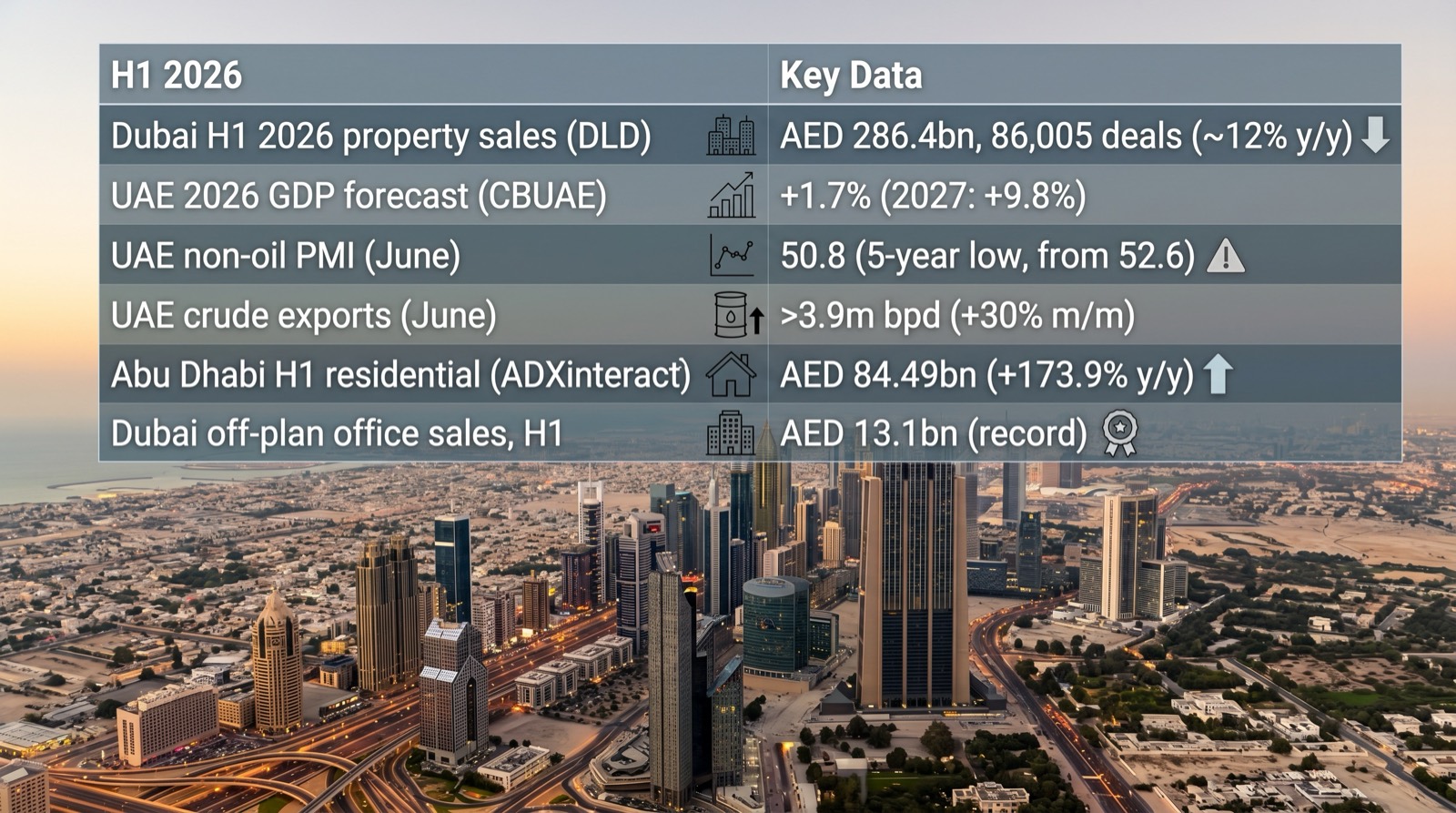
The key figures from the first half of 2026 and the most recent monthly readings, drawn from official and institutional sources across the UAE.
| H1 2026 | Key Data |
| Dubai H1 2026 property sales (DLD) | AED 286.4bn, 86,005 deals (~-12% y/y) |
| UAE 2026 GDP forecast (CBUAE) | +1.7% (2027: +9.8%) |
| UAE non-oil PMI (June) | 50.8 (5-year low, from 52.6) |
| UAE crude exports (June) | >3.9m bpd (+30% m/m) |
| Abu Dhabi H1 residential (ADXinteract) | AED 84.49bn (+173.9% y/y) |
| Dubai off-plan office sales, H1 | AED 13.1bn (record) |
In closing
Final View for Dubai Property Investors
The first half of 2026 is now on record, and it looks exactly as a conflict-driven trough should: large in absolute terms, down year-on-year, orderly rather than distressed. The more important question is what the second half will show.
If the leading indicators — oil output, institutional buying, and commercial demand — continue to run ahead of the lagging ones — residential prices, transaction volumes, and hiring — the gap between them should narrow from both sides. Prices typically stop falling before they begin to rise. That inflection point is difficult to time and easy to misread.
The data calls for precision, not urgency. The assets best positioned for the recovery are already identifiable: undersupplied, income-generating properties in markets supported by structural rather than speculative demand. The correction has brought more of them within reach than at any point in the past two years.
Next step
Let’s Talk
If you’d like to unpack where the most resilient opportunities are emerging — in stabilised residential areas or income-generating commercial zones — I’d be happy to share a focused, data-driven shortlist based on your investment goals.
📞 No pressure, no sales pitch—just a focused, informed conversation about your investment goals.
Published 6 July 2026 by Stephen James Mitchell MBA. Market figures quoted reflect the data available at that date.