For the past two months, the picture has been consistent: a softer first half, a growth downgrade, and a labour market shedding jobs for the first time in four years. This week, the tone shifted. The official and institutional readings released between July 6 and July 10 delivered the most constructive set of numbers we’ve seen in this cycle.
Dubai's economy grew 2.4% in Q1 2026, and UAE crude output reached an all-time high of 4.1 million barrels per day in June. Separately, the UAE's 2025 foreign direct investment figures were confirmed at a record AED 177.3 billion (USD 48.3 billion), placing it among the world's top ten destinations — the base the economy is drawing on as it works through the 2026 contraction.
The qualification is important. The gains are concentrated at the top end and in segments least exposed to the residential slowdown — institutional capital inflows, oil production, advanced technology, and ultra-prime property. Knight Frank reported a record 296 homes sold above USD 10 million in the first half of the year, worth USD 5.1 billion.
Beneath that, the broader rental and mid-market picture continues to soften. Abu Dhabi's rent freeze remains in place, and across both emirates the delivery pipeline keeps expanding — over 18,000 units handed over in Dubai in the first five months of 2026 alone.
The correction is not over. What has changed this week is the evidence that the recovery running alongside it is gathering pace — in specific markets, specific asset classes, and specific price bands. The analysis below covers where that recovery is showing up, what the technology and capital story behind it looks like, and what the widening gap between prime and mainstream means for how investors should position through the second half.
If you're weighing entry points while this market reprices, I can show you where the risk-adjusted opportunities are emerging. Click here to speak with me directly.
Drawing on UNCTAD's World Investment Report 2026, the UAE Ministry of Investment confirmed the country attracted a record AED 177.3 billion (USD 48.3 billion) in foreign direct investment inflows during 2025 — a 6% year-on-year rise and the fourth consecutive record. That lifted the UAE to ninth globally among FDI recipients, with total inward FDI stock now above AED 1.17 trillion, as announced by Sheikh Mohammed bin Rashid.
One point of precision on the period: these are settled 2025 figures, not a 2026 reading. They say nothing about how the current year is unfolding. What they confirm is the base. The demand that ultimately underpins Dubai housing — company formation, job creation, the arrival of capital and the people who follow it — was still expanding at record pace as recently as last year's close. The AED 177.3 billion figure is also a much larger and more diversified number than the AED 32.4 billion of Dubai-specific FDI covered two weeks ago.
For property, this is a foundation story rather than a timing one. A market can be repricing at the margin — as Dubai residential clearly is — while its structural demand base keeps widening underneath. That is the distinction between a cyclical correction and a structural one, and this record sits firmly on the cyclical side of it.
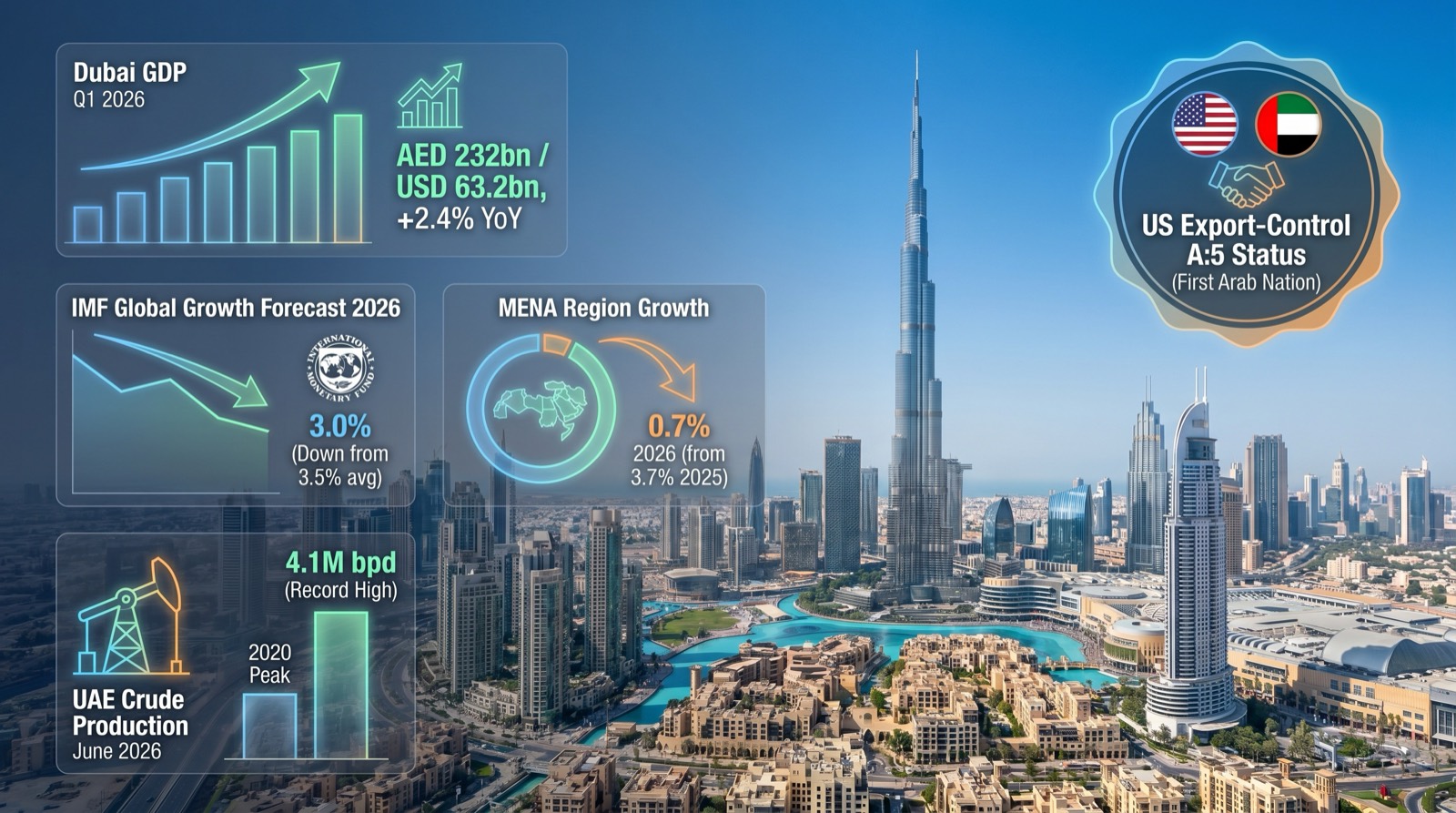
Dubai’s GDP expanded 2.4% year-on-year in Q1 2026, reaching AED 232 billion (USD 63.2 billion), according to official figures released this week. Non-oil sectors led the growth, with wholesale and retail, financial and insurance services, and real estate among the key contributors — all while the regional conflict continued.
This stands in clear contrast to the transaction data we’ve seen in recent months. The property numbers — a roughly 12% softer half, three consecutive monthly price declines, and cooling rents — reflect one side of the economy. The GDP reading captures another: real output still grew 2.4% through the same period.
A repricing property market and a growing economy are not the same thing, and mixing them up is where many misreadings of this cycle begin.
The practical takeaway for investors concerns the tenant and end-user base. Growth driven by services and finance supports the salaried, professional demand that fills apartments and offices. An economy that continued expanding even as its housing market adjusted means rental income has more underlying support than the headline price moves suggest.
This is exactly the environment where conservative underwriting and income-focused strategies tend to perform best.
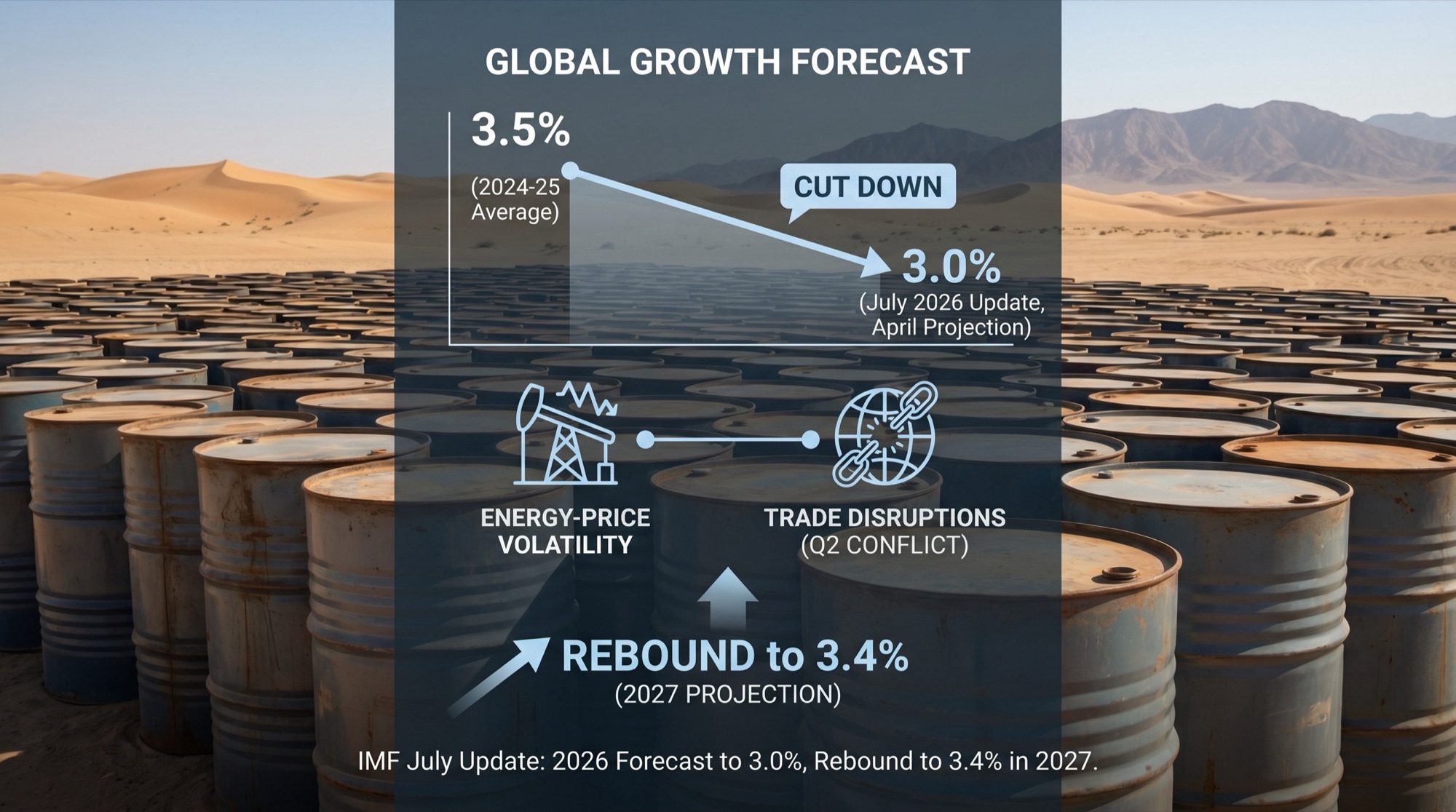
The International Monetary Fund cut its 2026 global growth forecast to 3.0% in its July update, down from the 2024–25 average of around 3.5% and broadly in line with its April 2026 projection. The IMF cited energy-price volatility and trade disruptions from the second-quarter conflict, while projecting a rebound to 3.4% in 2027.
For the Middle East and North Africa region, growth is expected to slow sharply to around 0.7% in 2026 from 3.7% in 2025. That is a significant deceleration, but still positive rather than a contraction.
This broader picture mirrors the UAE's own trajectory: a softer 2026 followed by a firmer 2027. A slower global economy limits upside for tourism, trade, and the flow of internationally mobile capital that has supported Dubai's prime segment. It is a real constraint and should be taken seriously.
At the same time, the same MENA slowdown forms the backdrop against which Dubai delivered 2.4% growth in the first quarter, and the UAE pushed oil output to a record high. The emirate is slowing from a stronger base and with more diversified engines than most of its regional peers. The IMF's downgrade calls for realistic return expectations through the second half — not for stepping away from the market.
UAE crude production reached a record 4.1 million barrels per day in June, according to the International Energy Agency’s monthly report. This new all-time high surpassed the previous 2020 peak as Abu Dhabi ramped up supply. Combined with the roughly 3.9 million barrels of exports reported last week, it confirms the sector has not only normalised but moved to fresh records.
On the diversification front, Saeed Al Hajeri, UAE Minister of State at the Ministry of Foreign Affairs, stated that the non-oil economy now makes up roughly 79% of GDP, with about 98% of foreign investment remaining unaffected by regional tensions. These are official statements rather than independently audited figures, but they align directionally with the Q1 GDP numbers released this week.
For property investors, the relevance lies in government finances rather than oil prices themselves. Record output helps rebuild fiscal surpluses that support infrastructure and population growth — both key drivers of housing demand. A non-oil share of 79% also means the part of the economy that generates tenant demand is far less vulnerable to oil price swings than headline energy figures imply. Overall, the UAE’s balance sheet looks stronger this week than it did a month ago.
Section 05
The US Moves the UAE Into Its Top Technology Export Tier — the First Arab Nation to Reach It
The United States upgraded the UAE to its top-tier A:5 export-control classification — the first Arab nation to achieve this status. This gives approved Emirati government and commercial entities streamlined access to advanced AI chips, servers, and related technology from US suppliers such as Nvidia and AMD. The UAE had previously been grouped in more restricted categories alongside countries like Yemen and Libya.
To be precise, this is a significant status upgrade rather than the complete removal of all restrictions. Through the Strategic Trade Authorization mechanism, approved entities now benefit from expanded license exceptions. Military goods and certain other sensitive items remain under separate controls. The direction, however, is clear: the UAE now sits alongside the UK, India, and South Korea in terms of US technology access.
For real estate, this is a multi-year structural positive rather than an immediate catalyst. Data centres, the power and connectivity infrastructure needed to support them, and the high-income technical talent required to run them all create sustained property demand — across commercial, logistics, and prime residential segments. It strengthens the long-term case for assets in Dubai and Abu Dhabi tied to the knowledge economy: sectors that remain undersupplied, income-generating, and largely insulated from the current residential correction.
Explore curated office and retail opportunities at Mitchell's Commercial Realty.
Section 06
USD 5.1 Billion in Ultra-Prime Dubai Sales in H1 — While Mainstream Prices Soften Up to 20%

According to Knight Frank, Dubai recorded 296 home sales above USD 10 million in the first half of 2026 — a record USD 5.1 billion in ultra-prime transactions. This represents a 14% increase in value and a 16% rise in volume compared to the same period last year.
The first quarter saw 165 deals, while the second quarter added 131, including a record 26 transactions above USD 25 million. Dubai Hills Estate led with 51 sales, followed by Palm Jumeirah with 50 and Palm Jebel Ali with 40.
One important caveat: much of the first-half data reflects deals agreed before the second-quarter conflict, given the usual four-to-six-week lag between agreement and formal registration. Buyer interest has nevertheless continued since then.
Set against the mainstream market, Knight Frank's Nicholas Spencer estimates residential price softening of between 5% and 20% depending on location. The firm also notes that average Dubai residential values remain 82.9% above their level from five and a half years ago — the base from which the current correction is running.
Ultra-prime properties, supported by global wealth and limited trophy stock, continue to perform strongly. Mid-market apartments, more exposed to salaried tenants and rising supply, are where the softening is concentrated. The current 4% short-term resale rate — compared to one in four homes before 2008 — further shows a buyer base that has shifted toward longer-term owners rather than speculators. Knowing exactly which segment any given asset belongs to is the key discipline this cycle requires.
Still reading
Need expert help on this subject?
The Abu Dhabi rent freeze — now in its sixth week — sits within a fragmenting UAE rental market. AGBI analysis indicates Dubai is cooling while the Northern Emirates are heating up, as tenants priced out of the two major emirates seek more affordable options further afield. Though the AGBI framing is more editorial than data-driven, the direction aligns with existing supply trends and Flexi Rent indicators.
The more analytically significant distinction lies in the mechanisms at play. Dubai is moderating rental growth through increased supply and its market-led Flexi Rent programme. Abu Dhabi, by contrast, has imposed a direct administrative cap.
Both aim to deliver tenant relief, yet the approaches carry materially different implications for income modelling. In Dubai, rents retain flexibility to respond to market conditions within the new framework. In Abu Dhabi, renewal income is frozen by regulation until the Abu Dhabi Real Estate Centre (ADREC) reverses its decision.
For portfolios spanning multiple emirates, this divergence calls for differentiated underwriting: more conservative rental growth assumptions in Abu Dhabi through the second half of the year. At the same time, Dubai’s market-driven dynamics allow for greater nuance.
DAMAC announced the handover of 8,800 residential units across Dubai in 2026, spanning DAMAC Hills, Lagoons, and several towers, after awarding approximately AED 10 billion in construction contracts in the first half. In Abu Dhabi, Aldar unveiled Yas Point — an AED 6 billion (USD 1.63 billion) waterfront development on Yas Island featuring around 1,600 branded residences. Both figures stem from developer announcements and should be treated as directional rather than independently verified.
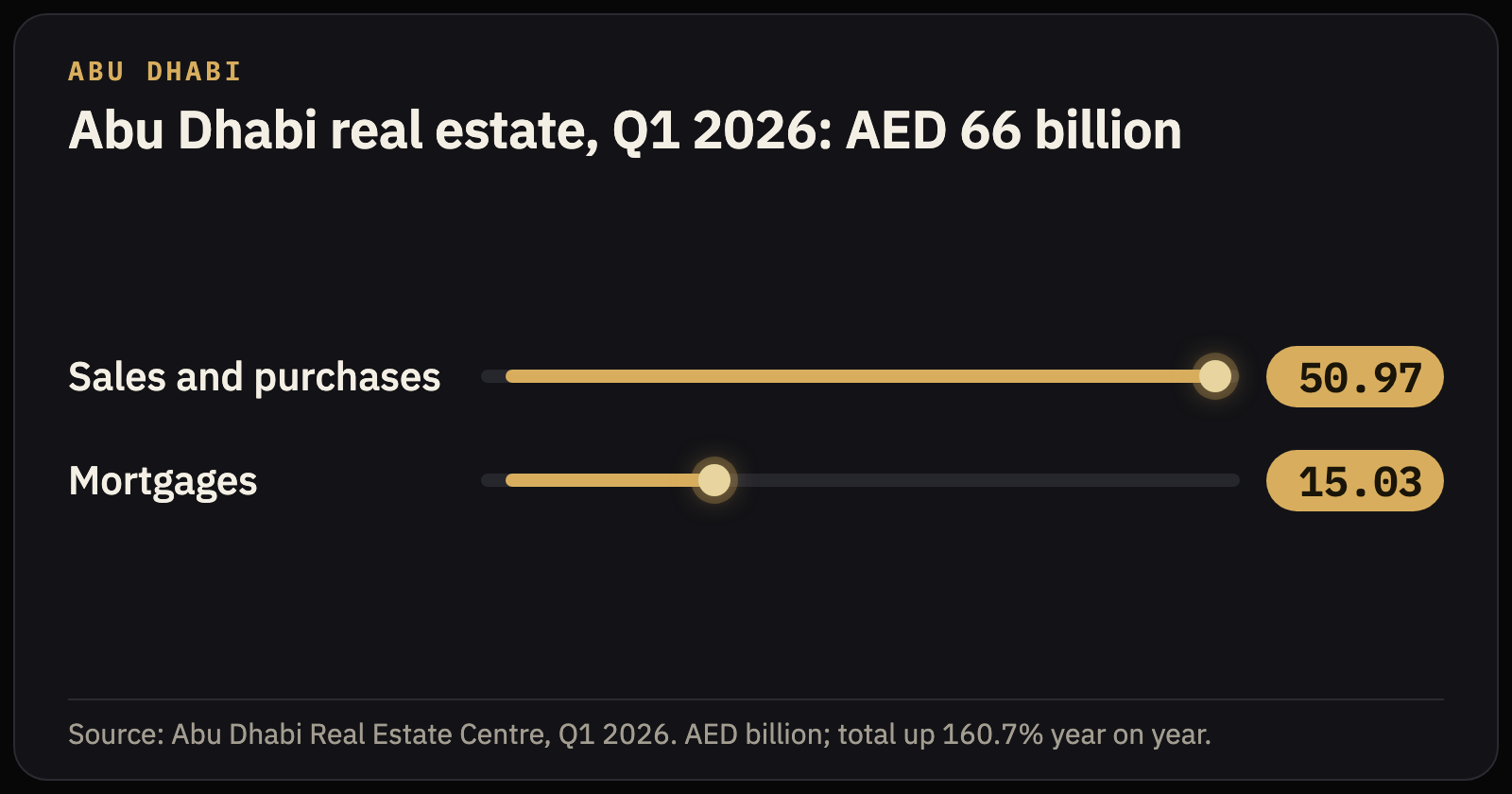
The transaction backdrop remained robust. According to Springfield Properties’ Q2 report, Dubai recorded AED 108.1 billion (USD 29.4 billion) in total property transactions, with off-plan sales contributing roughly AED 59 billion of the AED 84 billion residential total. This sustained off-plan dominance is the mechanism driving the future supply wave — today’s sales become tomorrow’s delivery pressure.
Taken together, the data reinforces supply discipline. Record off-plan volumes and a strong launch pipeline point to intense competition at handover, particularly between 2027 and 2029. The primary risk is not missing the market, but overpaying for assets that will face substantial comparable inventory upon delivery.
In this environment, strong entry pricing, reputable developer track records, and genuine product scarcity remain the key protections for returns through a high-volume delivery cycle.
The figures below span official government releases, institutional research and brokerage reporting. The source tier column reflects the level of independent verification behind each number — a distinction that matters when drawing conclusions from any single data point.
| This Week in Numbers | Data | Source Tier |
|---|---|---|
| UAE inbound FDI, 2025 | AED 177.3bn / USD 48.3bn (record, 9th globally) | Official / UNCTAD |
| Dubai GDP, Q1 2026 | AED 232bn, +2.4% y/y | Official |
| IMF world growth, 2026 (f) | 3.0% (MENA ~0.7%) | Institutional |
| UAE crude output, June | 4.1m bpd (record) | Institutional / IEA |
| Dubai ultra-prime (USD 10m+), H1 | 296 sales, USD 5.1bn (record) | Institutional / Knight Frank |
| Abu Dhabi rental cap (from June 2026) | 0% (full freeze) | Official / ADREC |
| Dubai transactions, Q2 (Springfield) | AED 108.1bn, off-plan led | Brokerage |
Official figures come from government statistical bodies and regulators and carry the highest verification standard. Institutional figures — from bodies such as the IMF, IEA and Knight Frank — are independently researched but involve modelling and estimation. Brokerage figures are market-participant data, useful for direction and composition but not independently audited.
In closing
Final View for Dubai Property Investors
The most useful thing the week's data did was separate what is structural from what is cyclical. Record FDI, record oil output, a top-tier technology classification, and 2.4% GDP growth through a regional war are structural. Cooling mid-market rents, three months of price declines, and a growing delivery pipeline are cyclical. Both are real. The mistake is treating either as the whole picture.
The assets that sit on the structural side of that divide — undersupplied commercial space, ultra-prime residential, knowledge-economy locations — have performed differently from the ones that sit on the cyclical side throughout this correction. That divergence is becoming more pronounced, not less.
Positioning with that distinction in mind, rather than making a broad call on the market, is what the data keeps pointing toward.
Next step
Let’s Talk
If you’d like to unpack where the most resilient opportunities are emerging — in stabilised residential areas or income-generating commercial zones — I’d be happy to share a focused, data-driven shortlist based on your investment goals.
📞 No pressure, no sales pitch—just a focused, informed conversation about your investment goals.
Published 13 July 2026 by Stephen James Mitchell MBA. Market figures quoted reflect the data available at that date.