The second week of April marked a period where the market conversation shifted from shock to a phase of strategic recalibration. The temporary Iran ceasefire stabilized energy markets and improved general sentiment throughout the week, though global forecasts remained cautious.
At the same time, Q1 transactional data across the UAE showed sustained capital deployment, which created a nuanced environment for investors. The week demonstrated that the primary question was not merely market strength, but rather where resilience was holding and where conditions were beginning to tighten.
If you’re reassessing your positioning in this market, I can show you where risk-adjusted opportunities are emerging. Click here to speak with me directly.
Data from the Dubai Land Department confirmedthat transactional momentum remained intact through Q1 2026, even as the composition of demand evolved
This shift was characterized by a move away from speculative flipping toward yield-driven end-user activity, a 70% dominance in off-plan sales due to ready-inventory shortages, and a heavy concentration of cash-led deals targeting the AED 1M–3M mid-market segment.
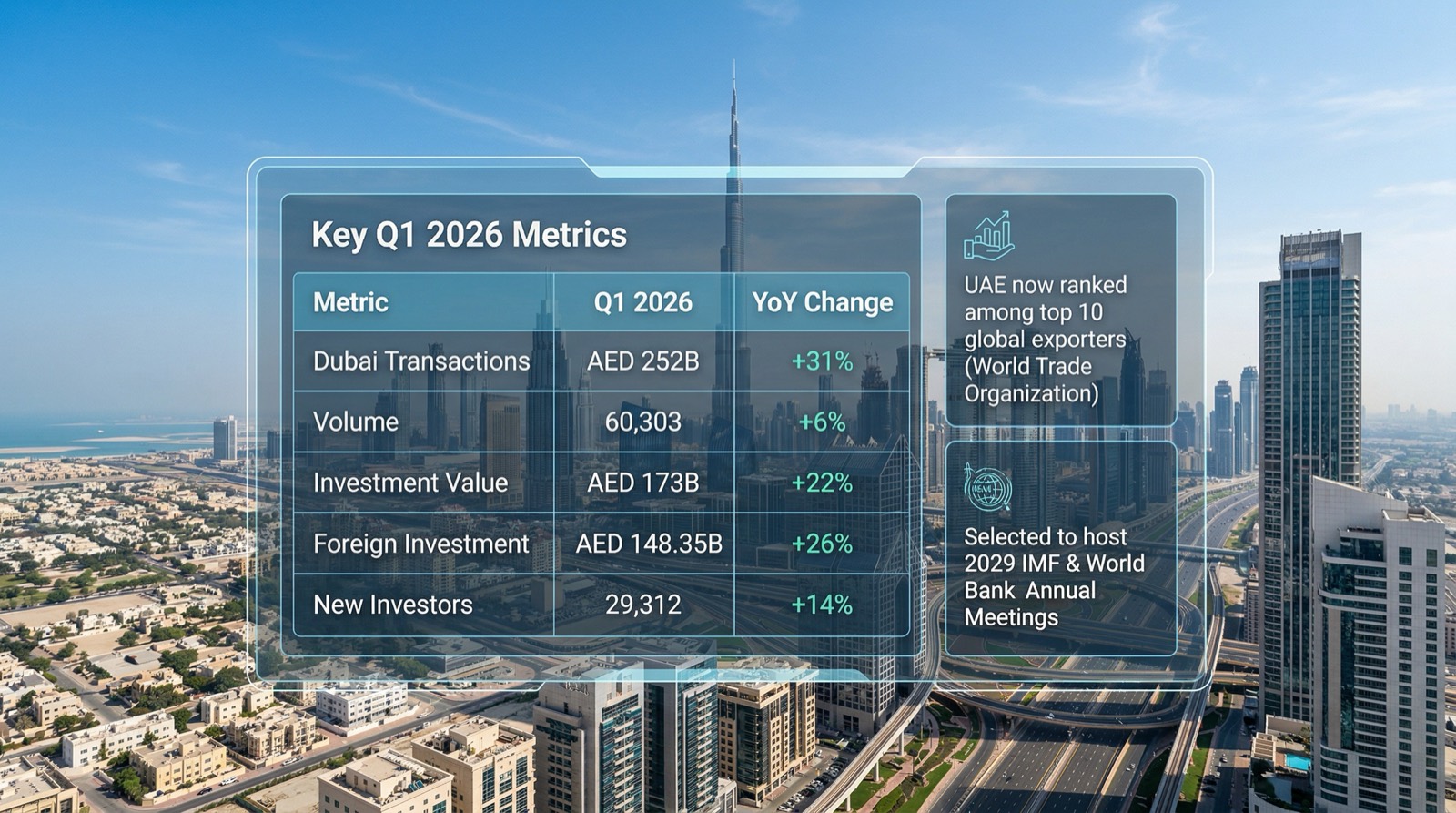
Key Q1 2026 Metrics
| Metric | Q1 2026 | YoY Change |
|---|---|---|
| Dubai Transactions | AED 252B | +31% |
| Volume | 60,303 | +6% |
| Investment Value | AED 173B | +22% |
| Foreign Investment | AED 148.35B | +26% |
| New Investors | 29,312 | +14% |
Additional structural indicators:
- Off-plan sales: AED 125.3B (+44.4% YoY)
- Cash transactions: ~67% of total market activity
- Residential deals: ~44,100 transactions
Geographically, demand remains broad:
- Dubai (by value): Al Yelayiss 1, Me’Aisem Second, Business Bay
- Dubai (by volume): Al Barsha South Fourth, Dubai South
- Abu Dhabi: AED 66B (+160% YoY), led by Al Reem Island and Hudayriyat
- Ajman: AED 484M in Q1 activity
Investor takeaway: Transaction volumes have remained strong. The 67% cash share is the key metric, indicating a market less dependent on leverage and therefore less sensitive to global rate cycles.
While the ceasefire removed immediate supply shock risks during the week, it did not fully reset the broader macro environment.
- Commodities: Oil declined ~15% post-ceasefire.
- Monetary Policy: US rates remain elevated (~3.75%).
- Global Outlook: The IMF and World Bank maintained their downward revisions for UAE growth expectations.
At the same time, the Central Bank of the UAE (CBUAE) has maintained its projection of 5.6% GDP growth for 2026, underpinned by 7.3% hydrocarbon expansion and 5.1% non-oil growth recorded in the previous year.
- 7.3% hydrocarbon expansion (2025 growth, OPEC+ quotas)
- 5.1% non-oil growth (2025)
This reflects a clear gap between global growth concerns and UAE economic expectations.
Source: CBUAE
Investor takeaway: Domestic fundamentals continue to outperform global forecasts, yet the high-interest-rate environment remains a constraint. Investors should anticipate sustained demand but expect capital to flow primarily toward high-quality assets that can withstand global macro volatility.

The data shows that demand remains intact, but capital deployment has become significantly more selective. Activity levels have remained strong, but investor behaviour has shifted, with more deliberate decision-making and longer conversion timelines.
This is reflected in the following metrics:
- Foreign investment: AED 148.35B (+26%)
- Investor base growth: +14% new entrants
- Luxury transactions: AED 87.7B (+26%)
- Enquiries: rising, but with longer conversion timelines
At the same time, buyer behaviour is shifting toward:
- Greater focus on ready and income-generating assets
- More selective off-plan participation
- Increased emphasis on developer track record
Investor takeaway: Demand is not retreating, but it is becoming more disciplined and value-driven. This typically leads to slower, more sustainable price growth.
Recent changes are materially improving market accessibility while tightening oversight.
Key Updates
- Golden Visa:Bank guarantees are now accepted instead of 50% upfront payment
- System integration:DLD + GDRFA unified platform for property and residency
- Enforcement: Increased action against unlicensed brokerage activity
- Shared housing regulation: Formalising co-living rental structures
Supporting data:
- Golden Visa approvals:+34.7% in early 2026
- New companies registered (March): 2,709 (Dubai Chamber)
Investor takeaway: Entry into the market is becoming easier, but execution standards are rising. This supports long-term stability but raises the bar for developer quality and delivery.

Capital deployment remains active, but increasingly targeted.
- Al Habtoor Group: AED 5B commercial tower investment
- BNW Developments: Expanding its Dubai footprint with the launch of Michel Adam branded residences in Al Furjan
- Mered: Fast-tracked waterfront development (Abu Dhabi)
- Sharjah: AED 3.5B Al Tay Hills nearing sell-out
At the same time:
- DAMAC: AED 3.12B in March sales across 1,106 transactions
- Palm Jumeirah sale: AED 65.4M (ultra-prime segment)
Investor takeaway: Capital is still deploying at scale, but it is concentrated in proven locations and product types. This reinforces the importance of asset selection.
Still reading
Need expert help on this subject?
The UAE continues to strengthen its broader economic position.
- Fiscal surplus: AED 61.7B
- Banking assets: AED 5.4T
- Private credit growth: ~18%
- Non-oil trade: AED 2.53T (+24.6%)
Global positioning:
- UAE now ranked among top 10 global exporters (World Trade Organization)
- Selected to host 2029 IMF & World Bank Annual Meetings
- UAE investing globally (e.g., $1.88B DRC tourism project)
Policy response:
- “Economic Shield” plan to support tourism and SMEs
- Measures to maintain supply chain continuity
Investor takeaway: While the UAE’s fiscal buffers and "Economic Shield" provide a structural floor, these are crisis-management tools. High liquidity does not eliminate heightened execution risks or the potential for segment-specific corrections if regional volatility continues to strain supply chains and investor confidence.
The PropTech 2033 roadmap is now moving into the execution phase, signaling a fundamental transition in how the market operates.
- Potential AED 53B in annual productivity gains identified.
- Expansion of AI-driven valuation and property registries.
- DIFC Zabeel District: A dedicated ~1M sq. ft. innovation hub.
At the same time, Digital Dirham development is accelerating to improve the speed and security of cross-border transaction settlements.
Investor takeaway: Modernizing market infrastructure acts as a structural shift, not a hedge against immediate volatility. While these tools improve transparency, they also compress margins and eliminate the arbitrage opportunities that historically rewarded speculative, less-informed capital.
A shift in behavior is already visible as investors move to mitigate immediate risks.
Current Positioning Trends
- Increased allocation to secondary and ready assets to bypass construction uncertainty.
- Selective participation in off-plan launches, favoring Tier-1 developers with proven delivery records.
- Preference for income-generating commercial property over speculative residential plays.
Explore curated office and retail opportunities at Mitchell’s Commercial Real Estate.
Risk Areas
- Projects with execution risk
- Locations with concentrated future supply
- Assets reliant on speculative demand
Market Implications
- Projects with high execution risk due to potential supply chain strain.
- Locations with concentrated future supply facing potential occupancy pressure.
- Assets reliant purely on speculative demand rather than end-user utility.
Strategic insight: This is not a standard market cycle; it is a transition toward disciplined capital allocation. Growth is now secondary to capital preservation and proof of delivery.
In closing
Final View for Dubai Property Investors
While Q1 data did not support a purely bearish narrative, the market has transitioned into a period of heightened risk sensitivity.
- Strong transaction data confirmed that capital was flowing, but these figures now act as lagging indicators.
- Macro conditions remain volatile and require constant, real-time monitoring.
- Investor behavior is becoming survival-oriented and highly selective.
The market is no longer being driven by momentum alone. In the current environment, outcomes depend entirely on entry price, asset quality, and the ability to execute amidst regional instability.
Next step
Let’s Talk
If you’d like to unpack where the most resilient opportunities are emerging — in stabilised residential areas or income-generating commercial zones — I’d be happy to share a focused, data-driven shortlist based on your investment goals.
📞 No pressure, no sales pitch—just a focused, informed conversation about your investment goals.
Next step
Ask us about this

Published 13 April 2026 by Stephen James Mitchell MBA. Market figures quoted reflect the data available at that date.