When people ask how I have remained committed to the Dubai property market through over 19 years of cycles — the 2008 crash, the oil price correction, Covid-19, and now the geopolitical shock of 2026 — my answer has always been the same: I invest based on long-term structural fundamentals, not short-term conditions. In Dubai, those fundamentals are defined more clearly than in almost any other global city by a deliberate, government-backed economic agenda. The current iteration of that agenda is D33.
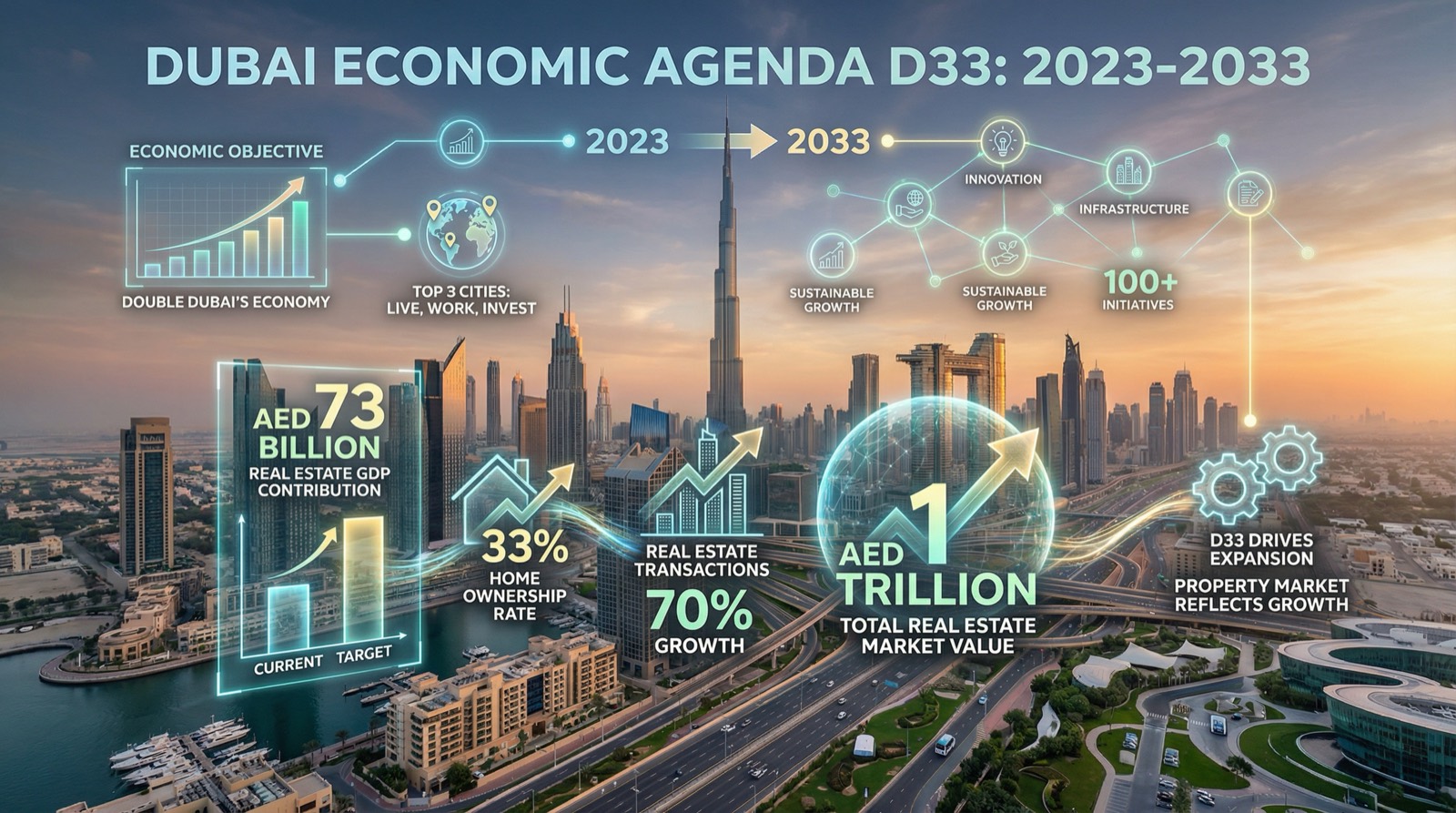
The Dubai Economic Agenda D33 is a ten-year strategy launched in 2023 by Sheikh Mohammed bin Rashid Al Maktoum, with the objective of doubling Dubai’s economy by 2033 and positioning the emirate among the world’s top three cities to live, work, and invest. Built around more than 100 initiatives spanning innovation, infrastructure, and sustainable growth, D33 provides a clear and structured framework for long-term economic expansion.
For real estate investors and brokers, D33 is not a peripheral policy initiative. It is a primary structural driver of long-term property demand.
D33 is built around a set of ambitious economic targets that directly translate into real estate demand. The agenda aims to double Dubai’s GDP contribution from real estate to approximately AED 73 billion, increase home ownership rates to 33%, grow real estate transactions by 70%, and raise the total market value to AED 1 trillion. These targets form part of the Dubai Real Estate Sector Strategy 2033 and provide a clear indication of the scale of growth being planned.
These are not aspirational statements — they are defined targets backed by policy, investment, and institutional execution. The scale of momentum is already visible in the data: Dubai’s real estate sector recorded approximately AED 761 billion in transactions in 2024, a 20% year-on-year increase, alongside the entry of around 110,000 new investors. This growth has taken place well before the midpoint of the D33 timeline.
The relationship between the D33 plan and the Dubai property market is clear: one drives the expansion, the other reflects it.

The most direct channel through which D33 supports the Dubai property market is job creation. The agenda targets economic expansion across AI, fintech, clean energy, advanced manufacturing, logistics, healthcare, and education — all sectors that require physical space and attract skilled workers who need housing.
D33 envisions the creation of approximately one million new jobs over its ten-year horizon. This scale of employment growth translates directly into demand for hundreds of thousands of residential units across all market segments.
For property investors, this is critical. Employment-driven housing demand is the most durable form of real estate demand. It is far less sensitive to shifts in sentiment or geopolitical headlines than purely speculative capital, because it is anchored in people needing a place to live as a result of work.
Each increment of D33-driven economic growth that converts into real jobs and new residents adds to the structural demand underpinning Dubai’s housing market.
D33 is not a single homogeneous plan — it is a cluster of sector-specific strategies that translate into geographically distinct real estate opportunities. Dubai South, which sits adjacent to Al Maktoum International Airport and is designed to become the world’s largest airport and logistics hub, is one of the most direct real estate investment opportunities arising from D33.
The expansion of aviation, e-commerce, and logistics under D33 means Dubai South is likely to see sustained demand for warehousing, last-mile logistics, and workforce accommodation over the next decade.
Similarly, D33’s emphasis on fintech, AI, and innovation districts is already attracting global technology companies and digital economy businesses to areas like DIFC and Dubai Internet City, driving demand for grade-A office space and executive residential properties nearby.
Healthcare clusters and education zones generate their own mixed-use demand ecosystems. In each case, D33-linked investment is driving a revaluation of land along emerging corridors and shaping the next generation of established communities across Dubai’s expanding geography.
The D33 plan explicitly acknowledges that Dubai’s housing stock needs to grow significantly to accommodate its population targets. The Dubai 2040 Urban Master Plan, which is aligned with D33, identifies the need for approximately 800,000 new residential units by 2033 to house the emirate’s projected population growth.
This breaks down into roughly 300,000 affordable units, 350,000 mid-market, and 150,000 luxury — a demand profile that spans every segment of the Dubai property market.
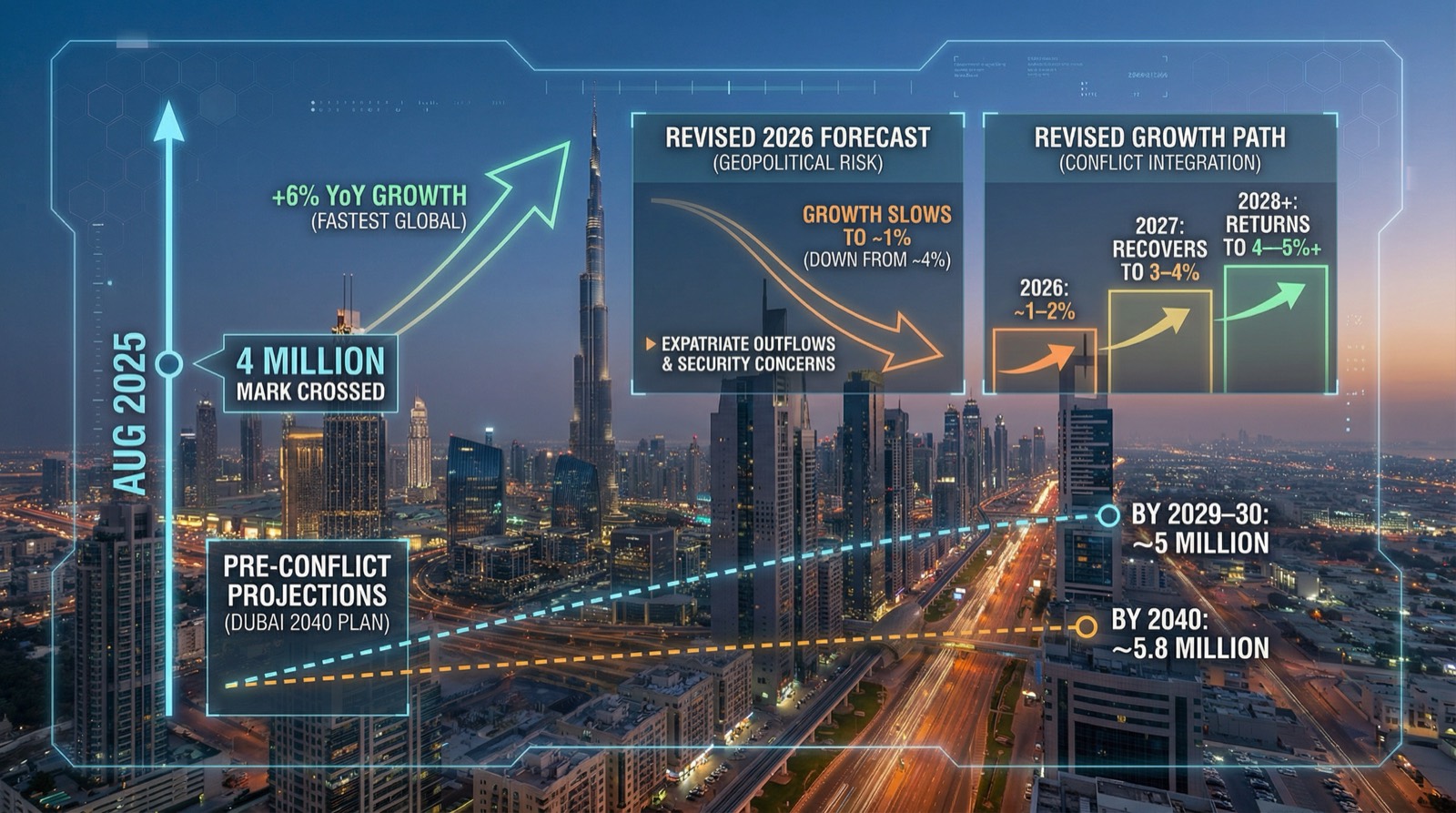
This long-term demand pipeline is the primary reason I remain structurally bullish on Dubai property despite near-term volatility. Even if 2026 sees a 10–15% correction in some segments — which I believe is plausible given supply and geopolitical pressures — the 5–10 year outlook remains one of the strongest demand environments among major global property markets.
The current geopolitical backdrop is creating its own set of discounted entry opportunities, particularly in quality assets and the right locations — exactly the kind of conditions that define long-term wealth creation.
Still reading
Need expert help on this subject?
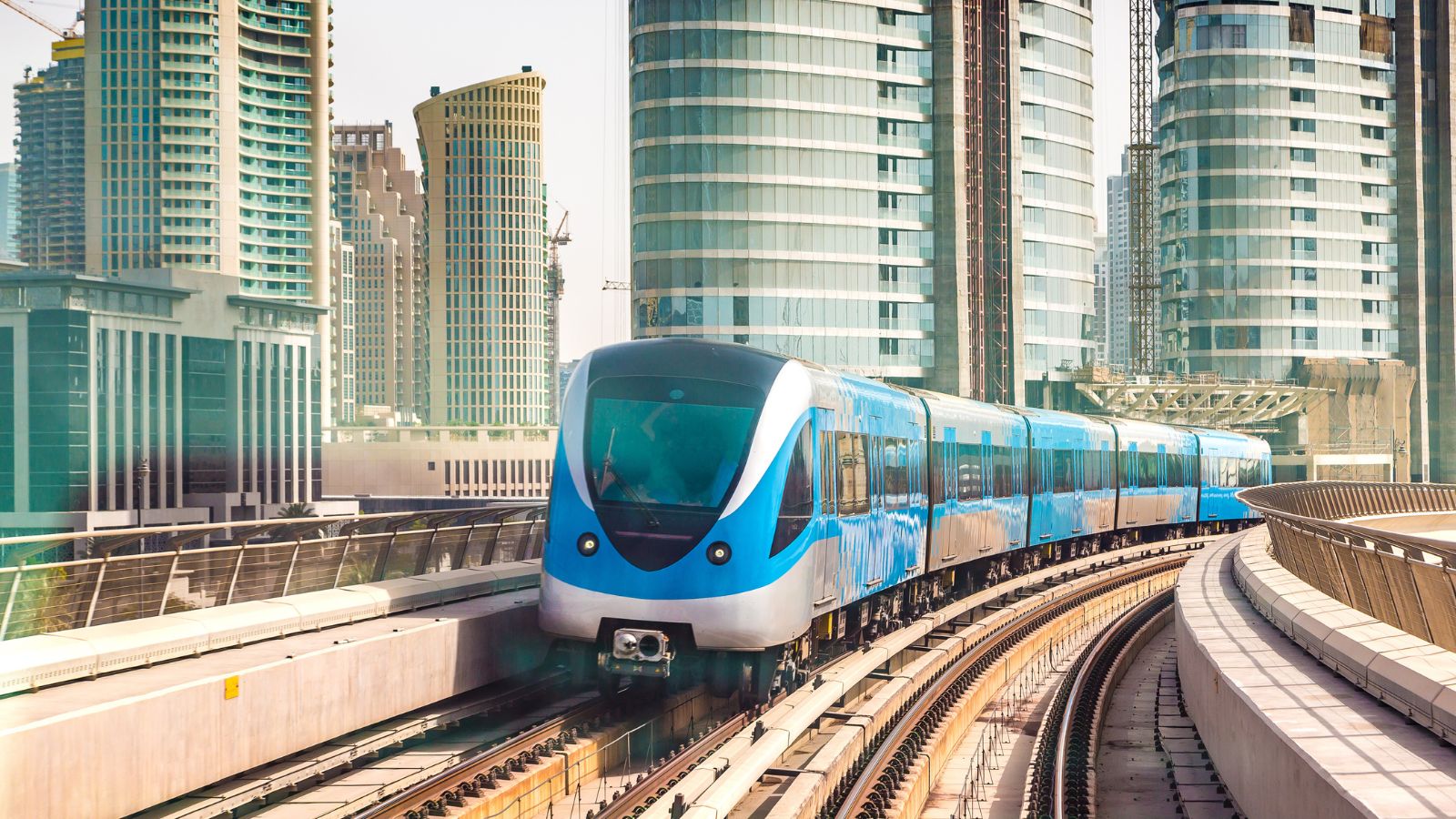
One of the most reliable relationships in real estate is the connection between infrastructure investment and property value appreciation. Areas served by new metro lines, improved roads, and high-quality amenities reliably attract residents and businesses, and property values follow.
D33 is funding approximately 140 kilometres of new metro lines, major road improvements, smart-city infrastructure, and a generation of new public amenities. Each of these investments is a forward indicator of future property value appreciation in the communities they serve.
For investors evaluating infrastructure pipelines, D33 effectively provides a roadmap of where Dubai’s property market is likely to outperform over the next decade. Communities positioned along planned metro extensions, adjacent to new airport infrastructure, or within emerging urban clusters are where I would be focusing today — not despite the volatility of 2026, but because of it. Short-term sentiment shocks create the entry points that long-term infrastructure-backed demand then validates.
Perhaps the most important function of D33 in the current market environment is as a counterweight to short-term geopolitical shocks. The Iranian strikes have introduced a degree of near-term uncertainty, and I would not minimise that. But D33 represents a ten-year, government-backed economic commitment that does not stop because of regional conflict.
The infrastructure projects continue. The visa programmes continue. The business licensing reforms continue. The investment promotion continues.
As a broker and wealth manager who has operated in this market for over 19 years — and who lives here with his family and has no intention of relocating — I see D33 as the clearest expression of where Dubai is going.
The 2026 noise is real. But it is noise layered over a structural signal that remains compelling. Those who look back on 2026 as a missed opportunity will be the investors who allowed international headlines to obscure the structural trajectory defined by D33. I am not one of them, and I do not think you should be either!
Next step
Talk to Mitchells
Tell us what you are weighing up — a building, a project, an area, or a rule you need to get right — and we will come back with the specifics that apply to it.

Stephen James Mitchell is a licensed real estate broker with over 25 years of experience across finance, investment strategy, and real estate, including more than 19 years operating in Dubai. He specialises in advising investors on acquiring and optimising high-performing assets, with a focus on commercial and investment-grade real estate, combining strong financial expertise with deep, on-the-ground market knowledge of the UAE.
To connect directly with Stephen James Mitchell, please click here.
Published 21 March 2026 by Stephen James Mitchell MBA. Market figures quoted reflect the data available at that date.