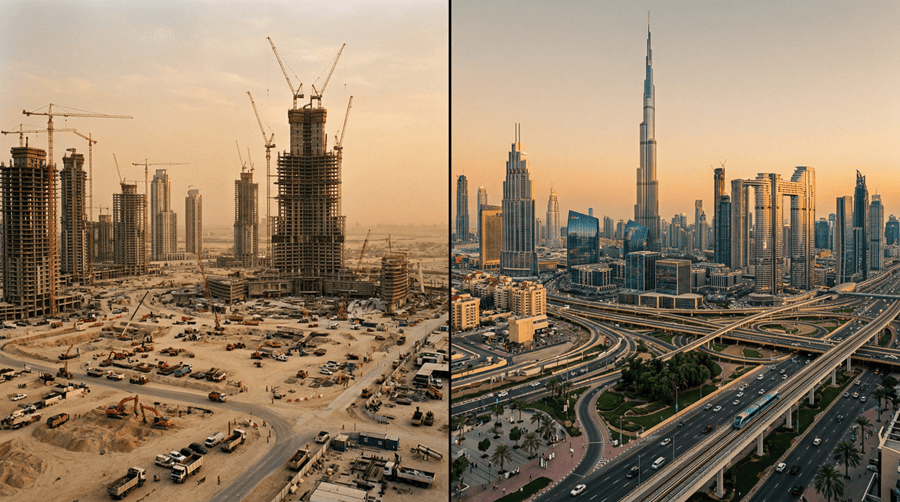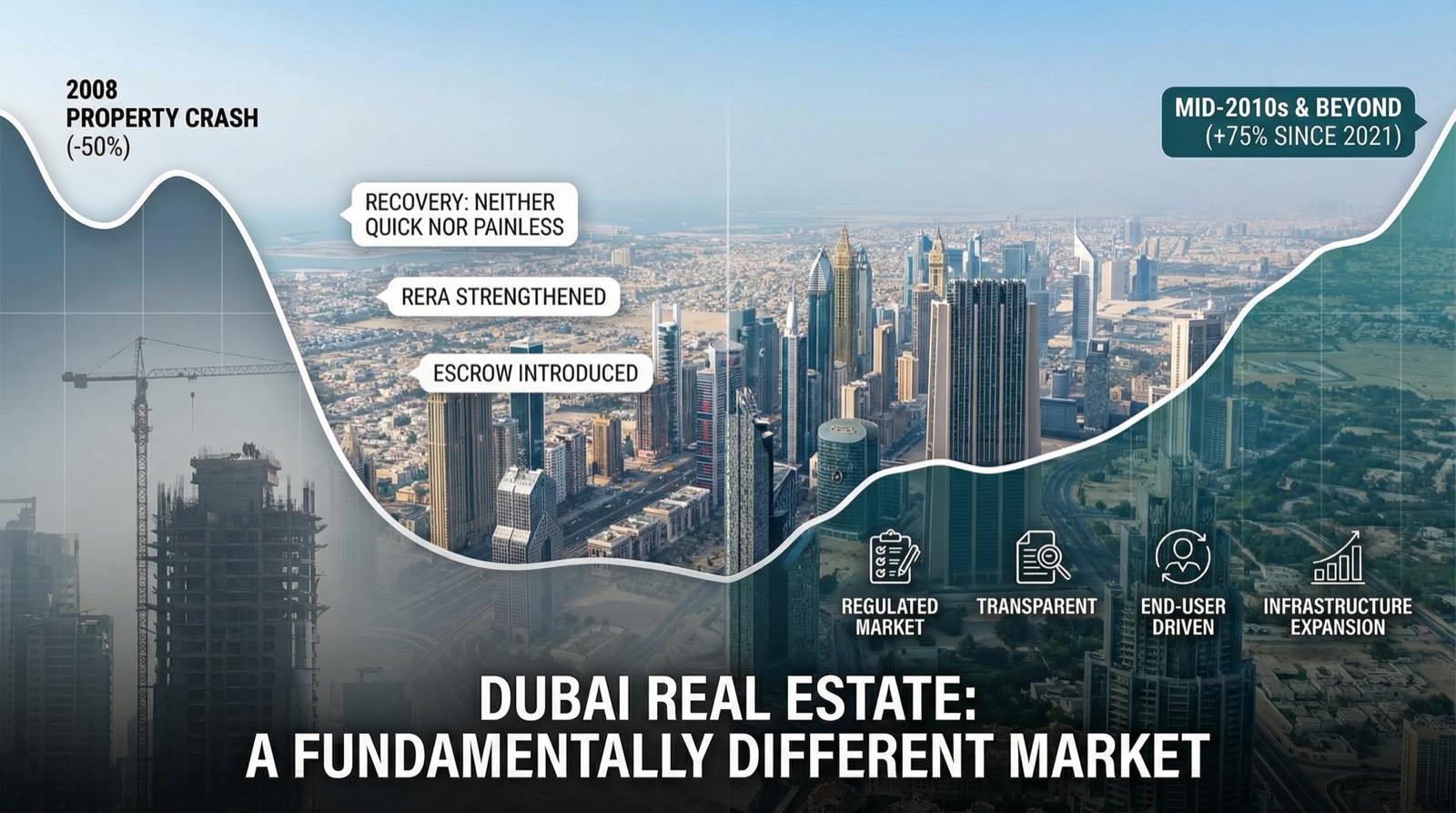
I was here during the worst of it. I watched the 2008 Dubai property crash unfold from the inside — the frozen projects, the emptying offices, the expatriates leaving, the developers scrambling, and the government navigating a crisis of a scale this city had never faced before. And then, over the years that followed, I watched something equally instructive: the market recover, rebuild, and eventually surpass every pre-crash record.
Understanding which Dubai 2008 property crash recovery measures actually worked — and why — is one of the most important analytical frameworks for assessing market conditions today.
The recovery was neither quick nor painless. Prices fell roughly 50% from their 2008 peaks before reaching a point of stabilisation. The Dubai World debt standstill in November 2009 added a second layer of shock just as confidence was beginning to cautiously return. But from approximately 2011 onwards, a combination of deliberate government intervention, structural regulatory reform, economic diversification, and banking-sector adjustment began to lay the foundations for a sustained and durable recovery.
By the mid-2010s, many areas were approaching or exceeding their pre-crash peaks, and by 2025, average prices had risen approximately 75% since February 2021 alone.
Section 01
Dubai 2008 Property Crash Recovery Measures: Immediate Stabilisation and the Dubai World Resolution
The first and most urgent task after the crash was preventing a disorderly collapse of the major government-related entities at the centre of the boom. Dubai World’s request for a debt standstill on approximately 26 billion dollars in November 2009 sent shockwaves through international markets,. But what followed was ultimately a demonstration of the UAE’s capacity to manage a systemic crisis.
Abu Dhabi provided crucial financial support, including bond purchases and direct aid, which underpinned confidence that Dubai’s obligations would eventually be honoured.
Over the following 18 months, Dubai World and its subsidiaries — including Nakheel, whose debt restructuring was one of the most complex in regional history — negotiated multi-year repayment plans with creditors.
These restructurings extended maturities, reduced immediate cashflow pressure, and gave affected entities time to stabilise their operations. The recovery required significant government intervention and policy reform, with many stringent regulations and policies developed to enhance transparency and restore investor confidence.
What struck me at the time, and what I still reflect on today, was the speed and decisiveness with which the UAE government acted once the scale of the crisis was clear.
There was no paralysis. There was coordinated intervention, debt management, and a clear signal to global markets that the emirate stood behind its obligations. That institutional response was itself one of the most important recovery measures of all.

The second, and arguably most transformative, pillar of Dubai’s 2008 property crash recovery was a comprehensive overhaul of the real estate regulatory framework.
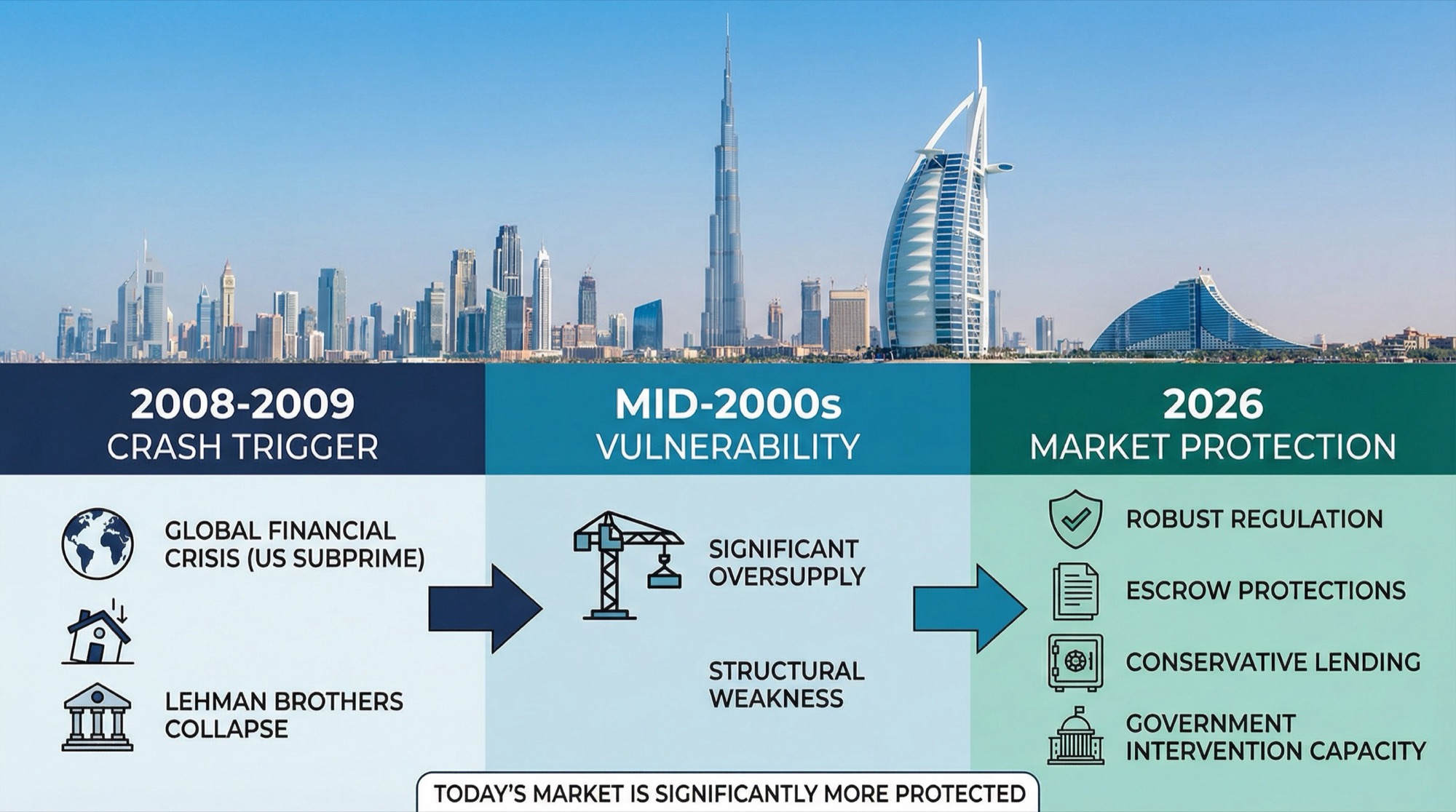
The post-2008 reforms were both wide-ranging and structural: RERA was strengthened, escrow regulations were introduced, and mandatory project registration was enforced. Construction financing became more closely tied to project funding milestones, stricter mortgage eligibility criteria were implemented, and major infrastructure developments — including metro expansion — were accelerated.
The UAE Central Bank’s Circular 31/2013 on Mortgage Loans Regulations introduced caps on bank lending as a percentage of property value — the Loan-to-Value (LTV) ratio. For UAE nationals, the cap was set at 80% for properties valued at or below AED 5 million, and 70% for higher-value assets, while more conservative limits were applied to expatriate buyers. This fundamentally changed the character of demand, reducing leverage available to speculative buyers and shifting the market toward end-users and long-term investors.
The escrow account requirement — mandating that off-plan buyer deposits be held in ring-fenced accounts and released to developers only upon verified construction milestones — was arguably the most important structural reform. It directly addressed the earlier regulatory gap that had allowed developers to collect funds up front with limited buyer protection.
At the same time, RERA was granted enhanced authority to cancel stalled or non-compliant projects under clearly defined liquidation frameworks, giving buyers enforceable rights that had previously been absent.
Regulatory reform alone could not rebuild the market. Demand had to return, and for demand to return, Dubai needed to rebuild its case as a place where people wanted to live, work, and invest. This is where the emirate’s economic diversification strategy proved crucial.
Throughout the recovery period, Dubai doubled down on its positioning as a global hub for trade, tourism, finance, logistics, and — increasingly — technology and media. Expo 2020 Dubai was announced in 2013 and ultimately held in 2021–22, serving as both a catalyst for growth and a symbol of that ambition.
The introduction and expansion of long-term residency programmes — culminating in the Golden Visa scheme — marked a significant structural shift in demand. By offering investors, entrepreneurs, and skilled professionals a pathway to 10-year renewable UAE residency, the policy fundamentally changed the risk-reward equation for international buyers.
Homeownership in Dubai was no longer purely an investment decision, but also a route to long-term residency in one of the world’s most business-friendly and tax-efficient environments.
I saw this shift in investor behaviour materialise clearly. Clients who had previously viewed Dubai as a transactional market — buy, hold, sell — began to see it as a long-term base. The transition from speculative investor to committed resident-investor fundamentally improved the quality of demand underpinning the recovery.
At the same time, the delivery of major developments and tourism infrastructure broadened the investor base and contributed to a more diversified and resilient demand profile.
A fourth pillar of recovery — and one that receives less attention than it deserves — was the shift in UAE banking-sector behaviour. In the pre-2008 boom, real estate exposure accounted for a significant share of total lending. During the recovery, lending standards became more conservative, with tighter LTV ratios and stricter credit criteria applied across the board.
This included more disciplined project financing for developers, as well as enhanced documentation requirements and stress-testing for individual mortgage borrowers.
As a result, the systemic risk of a property downturn triggering a banking crisis was significantly reduced. When subsequent market corrections occurred — as they did in 2015–16, when oil prices fell, and rents declined — the banking system absorbed the impact without a systemic shock. Structural changes to the market, including tighter regulation and a reduced presence of speculative demand, resulted in a far more controlled adjustment than in 2008.
Having watched the full arc — from boom to crash, through a difficult recovery, and into the post-pandemic cycle — what stands out most is how comprehensively the 2008 experience reshaped Dubai’s real estate infrastructure.
The market that emerged was fundamentally different in character: more regulated, more transparent, more end-user driven, and more firmly anchored in real economic fundamentals rather than speculation and leverage.
Stricter regulation, tighter controls on speculative activity, and stronger enforcement around project delivery were central to that transformation. These reforms are precisely why today’s market — despite facing geopolitical headwinds — is unlikely to experience a systemic repeat of 2008. The recovery measures worked. They fundamentally and permanently reshaped the market.
The transformation from the depths of 2009 to the record-breaking January 2026, when AED 72.4 billion in transactions were recorded in a single month, represents one of the clearest examples of urban economic resilience.
Dubai did not just recover from the 2008 crash. It emerged with a fundamentally more robust and structurally resilient market. That is, in my view, the most important recovery measure of all.
Next step
Discuss what this means for your position
Tell us what you are weighing up — a building, a project, an area, or a rule you need to get right — and we will come back with the specifics that apply to it.

Stephen James Mitchell is a licensed real estate broker with over 25 years of experience across finance, investment strategy, and real estate, including more than 19 years operating in Dubai. He specialises in advising investors on acquiring and optimising high-performing assets, with a focus on commercial and investment-grade real estate, combining strong financial expertise with deep, on-the-ground market knowledge of the UAE.
To connect directly with Stephen James Mitchell, please click here.
Published 12 March 2026 by Stephen James Mitchell MBA. Market figures quoted reflect the data available at that date.