The current market is being shaped by multiple forces moving at the same time. Energy prices, capital flows, and geopolitical risk are no longer acting independently. They are reinforcing each other, and that is changing how risk is being priced across asset classes.
What stands out is the divergence. Financial markets have adjusted quickly. Dubai’s property market, so far, has not.
For investors, the focus now is not just direction, but understanding where pricing has already moved—and where it has not.
If you’re reassessing your positioning in this market, I can show you where risk-adjusted opportunities are emerging. Click here to speak with me directly.
The disruption in the Strait of Hormuz has moved beyond an energy story and is now influencing global financial conditions.
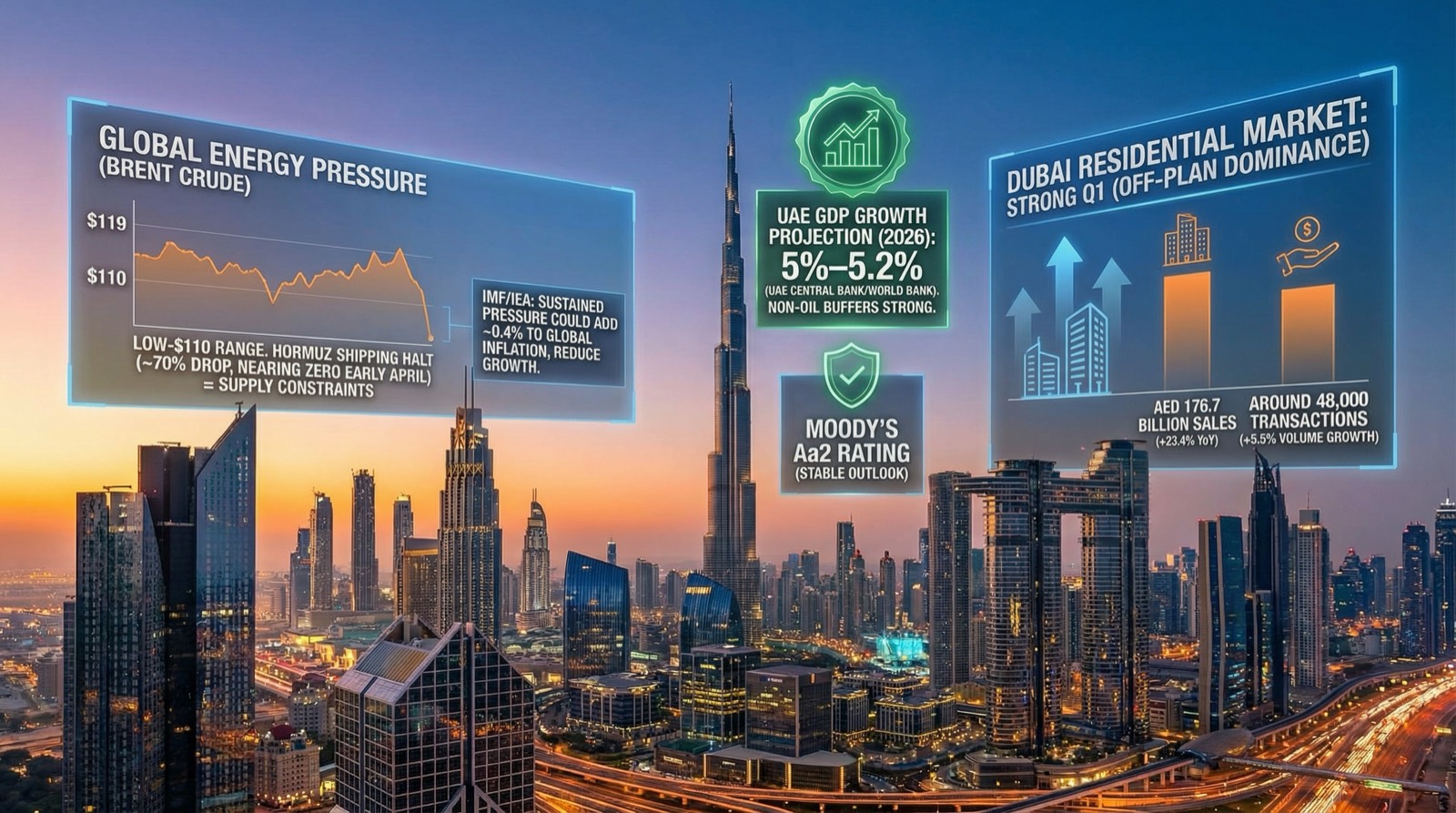
Brent crude moved above $119 and remains in the low-$110 range. With roughly 20% of global oil and LNG flows passing through Hormuz, the effective halt in shipping traffic—dropping by approximately 70% initially and nearing zero for major tankers by early April—has created immediate supply constraints.
The effects are now visible across markets:
- Inflation expectations are moving higher
- Credit spreads are widening
- Equity markets are pricing slower growth
The IMF and IEA estimate that sustained energy pressure at these levels could add around 0.4% to global inflation while reducing growth if disruption continues.
At the same time, the Central Bank of the UAE (CBUAE) in its March 2026 report projects GDP growth of around 5.6% for 2026, indicating that non-oil sectors are expected to act as a buffer against external shocks despite rising geopolitical risk.
Source: CBUAE
Investor Takeaway:The environment has shifted. Higher energy costs and tighter liquidity are now the base case, which typically leads to more selective capital allocation.

The UAE has seen a sharp adjustment in listed markets, but this has not translated directly into property activity.
- Around $120 billion has been erased from UAE equity markets in roughly a month
- Dubai’s index is down about 16% since late February
- Aviation disruption resulted in over 18,000 cancelled flights
This is shaping external sentiment.
However, real estate data continues to show resilience:
- AED 176.7 billion in sales (+23.4% YoY)
- Approximately $1.63 billion in Abu Dhabi sales
- Sharjah transactions up 71.8% year-on-year
- Ongoing project launches and construction remain uninterrupted, with major developers like Danube confirming timelines despite disruption
This divergence reflects how different assets respond to risk. Equities price forward expectations immediately. Property markets adjust through transactions, which move more gradually.
Strategic Insight: Public markets are pricing downside risk more aggressively than the property market is indicating.
Q1 performance confirms that demand remains intact.
- AED 176.7 billion in sales (+23.4% YoY)
- Around 48,000 transactions (+5.5% volume growth)
On a run-rate basis, the market remains on track toward approximately AED 700 billion annually if momentum holds.
Market Structure
The composition of transactions is critical, as demand is concentrated in off-plan (future supply), which shapes both current pricing and future supply risk.
- Off-plan accounts for approximately 71% of total transaction value
- March recorded over 10,300 off-plan deals worth AED 31.2 billion
- Off-plan apartment sales reached AED 17.5 billion (+12.9% YoY)
Pricing reflects this structure:
- Market average: ~AED 1,949 per sq. ft.
- Off-plan apartments: ~AED 2,100 per sq. ft.
- Secondary villas: ~AED 2,354 per sq. ft., with primary villa median prices rising 35.3% YoY to approximately AED 4.1 million
Luxury Segment
- Approximately $2.97 billion in March transactions
- Around 42% growth in volume
The buyer profile remains a stabilising factor. A larger share of demand is driven by end-users and long-term capital relocation rather than speculative activity.
This reduces turnover pressure and supports pricing during periods of uncertainty.
Commercial real estate is showing strong value growth, but this is being driven by pricing rather than broad transaction activity.
| Metric | Q1 2026 |
| Transaction Value | AED 10.2B (+69.1% YoY) |
| Transaction Volume | -0.6% YoY |
| Price Growth (Feb–Mar window) | ~+28% YoY |
| Off-Plan Office Pricing | ~AED 3,242 psf |
The data points to a clear shift:
- Value is rising sharply despite flat volumes → larger, higher-quality deals dominating
- Price growth is concentrated → not a broad market repricing
- Off-plan offices are outperforming → forward demand for Grade A supply
This has direct implications for returns. Prices are moving ahead of rents, compressing yields and increasing reliance on rental growth.
Demand remains supported by multinational occupiers, but it is concentrated in prime assets.
Insight for Investors:The commercial market is tightening at the top end. Capital is concentrating into institutional-grade assets, while weaker stock is not participating in the same pricing momentum.
Explore curated office and retail opportunities at Mitchell’s Commercial Realty.
Policy measures remain supportive and focused on stability.
- AED 1 billion stimulus package introduced in Dubai
- Approximately $8 billion injected into the banking system
- Moody’s reaffirmed the UAE’s Aa2 rating with a stable outlook
Business activity continues to expand:
- 2,709 new firms joined Dubai Chamber in March
- 41.2% concentrated in real estate and business services sectors
At the same time, regulation is tightening to improve transparency:
- Property sale proceeds must be paid into UAE bank accounts in the owner’s name
- Power of Attorney requirements have been strengthened
- Abu Dhabi has introduced stricter escrow and compensation frameworks
Digital infrastructure is also advancing through unified government platforms and PropTech integration.
These changes strengthen investor protection while improving market transparency.
Still reading
Need expert help on this subject?
The market remains strong, but several pressure points are developing.
Supply
- Around 110,500 units expected in 2026
- However, historical materialisation rates of 45–50% suggest actual deliveries will likely fall between 33,000 and 50,000 units
This gap between announced and delivered supply remains a key stabilising factor.
Cost Environment
- Diesel prices increased 72.4% to AED 4.69 per litre
- Super 98 petrol rose 30.9% to AED 3.39 per litre
This will increase logistics and construction costs, potentially compressing developer margins and feeding into service charges.
Demand Signals
- Tourism disruption has impacted short-term activity
- Some sectors are showing early signs of employment pressure
- Capital rotation toward alternative regional markets remains limited but visible
Rental Market Signals
A record AED 12M/year penthouse lease was recorded at the top end
Broader market showing:
- More negotiation
- Flexible payment terms
- Slower renewals
Strategic insight: Supply and cost pressures are not weakening demand, but they are increasingly differentiating stronger assets from weaker ones.

The current environment requires discipline and selectivity.
- Off-plan: Prioritise developer strength, escrow protection, and delivery timelines (Abu Dhabi now requires ~20% project completion before escrow disbursement, improving investor protection)
- Secondary market: Use macro-driven sentiment to negotiate selectively in established, liquid communities (e.g., JVC and Dubai Marina, which recorded ~7% and ~26% price growth in March)
- Commercial: Focus on tenant quality, lease structure, and rental growth potential
- Portfolio structure should remain liquid and conservatively leveraged
Decisions should be anchored in transaction data, rental performance, and financing conditions—not short-term market sentiment.
Section 08
Market Outlook for Dubai Property Investors: Adjustment Phase With Structural Support Intact
The market is entering a phase of adjustment rather than reversal.
Financial markets have repriced risk quickly. Property markets are adjusting more gradually.
If conditions stabilise, transaction momentum is likely to remain strong.
If disruption persists, activity may soften, but the underlying drivers remain intact.
These include:
- A high proportion of cash transactions
- Continued population growth and capital inflows
- Strong infrastructure investment
- A regulatory framework focused on transparency and stability
Dubai has navigated multiple external shocks over the past two decades.
The current environment is best understood as a stress test—one that the market is, so far, absorbing without a breakdown in core demand.
Next step
Let’s Talk
If you’d like to unpack where the most resilient opportunities are emerging — in stabilised residential areas or income-generating commercial zones — I’d be happy to share a focused, data-driven shortlist based on your investment goals.
📞 No pressure, no sales pitch—just a focused, informed conversation about your investment goals. Let’s talk!
Published 6 April 2026 by Stephen James Mitchell MBA. Market figures quoted reflect the data available at that date.