If you’re looking at how to buy off-plan property in Dubai, this is where I see the biggest gap between expectation and reality—particularly with international investors.
On the surface, off-plan looks attractive. Lower entry prices, structured payment plans, and the potential to benefit from price appreciation before completion. That’s what drives most of the demand.
In practice, off-plan is not simply about buying early. It’s about structuring your position correctly from the outset. The outcome of the investment depends far more on your entry price, developer selection, and exit strategy than on the marketing around the project.
Moving into 2026, I’ve seen a clear shift. Off-plan is still a viable strategy, but it has become more selective. The margin for error—particularly for short-term investors—has reduced. If you approach it correctly, it can work very well. If you don’t, it becomes speculative.
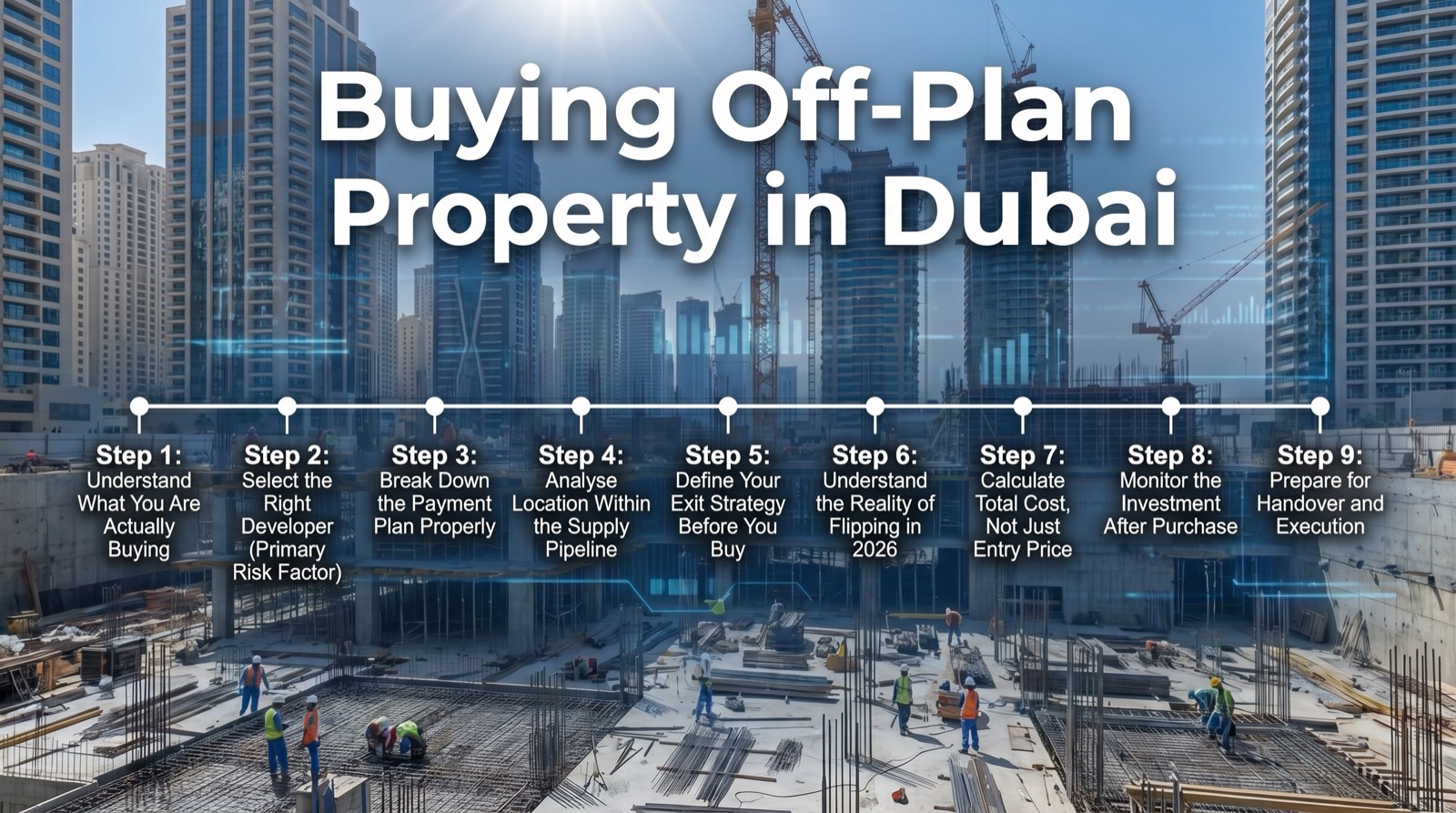
When you buy off-plan in Dubai, you are purchasing a property that has not yet been completed. You are entering into a contract with the developer, committing to a future asset rather than a finished one.
Your ownership is recorded through the Oqood system.
Oqood is effectively your interim ownership record. It confirms your interest in the property until the project is completed and a title deed is issued.
What I always make clear to clients is this: you are not buying a physical asset yet—you are buying into a timeline, a developer’s ability to deliver, and a future market environment.
That distinction changes how you should evaluate the investment.
If you get one thing right with off-plan, it should be this.
The developer you choose directly impacts:
- Delivery timelines
- Build quality
- Market perception at handover
- Your ability to exit
The first step is to verify that the project is registered with the Dubai Land Department.
The second is to ensure all payments are made into a regulated escrow account. This means your funds are protected and released in stages as construction progresses.
You should also verify the project using the Dubai REST platform.
What I look for beyond that is a track record. Has the developer delivered similar projects? Do their completed assets hold value? How do they perform in the resale market?
In my experience, investors who ignore the developer and focus purely on price are the ones who encounter issues later.

The payment plan is one of the main attractions of off-plan, but it’s also where a lot of misunderstandings happen.
Most developers structure payments across:
- Initial booking deposit
- Instalments during construction
- Final payment at handover or post-handover
This allows you to spread capital deployment over time.
What I focus on here is alignment with your financial position.
You need to ask:
Are you committing too much capital to one project? Will you need liquidity before completion? Are you relying on resale to complete the plan?
These questions matter more than the headline payment terms.
A flexible payment plan is only beneficial if it fits your overall capital strategy.
Not all off-plan opportunities are equal—even within the same area.
One of the key risks in 2026 is supply concentration. Certain areas have a high volume of projects completing within similar timeframes.
When that happens, you can see:
- Pressure on resale pricing
- Increased competition for tenants
- Slower absorption rates
What I typically assess is:
- How many units are being delivered in that location
- Whether those units target the same tenant or buyer profile
- How the area has historically absorbed supply
This doesn’t mean you avoid these areas entirely. It means your entry price and strategy need to reflect the supply dynamics.
This is the most important step—and the one most often overlooked.
With off-plan, your exit options are typically:
- Selling before completion (assignment)
- Holding and renting after handover
- Refinancing and holding long-term
The critical point is that this decision should be made before you commit, not after.

Short-term flipping—selling before handover—has historically been a popular strategy in Dubai.
However, this is where I need to be very clear. In 2026, flipping has become riskier and more selective.
What has changed is:
There is more supply in the pipeline. More investors are trying to exit at similar stages. Buyers are more price-sensitive. Transaction timelines have extended.
What I’m seeing in the market now is that deals are still happening, but:
- They take longer
- Margins are tighter
- Pricing has to be realistic
If you’re entering an off-plan deal with the intention of flipping, you need to be very precise on your entry price and unit selection.
More importantly, you need a fallback plan.
What I advise most clients now is simple:
Do not rely solely on flipping as your exit strategy. Structure the deal so it still works if you need to hold and rent.
That shift alone significantly reduces risk.
Beyond the purchase price, you need to factor in:
- The 4% transfer fee payable to the Dubai Land Department
- Registration and administrative costs
- Developer-related fees
- Service charges post-handover
Service charges are particularly important because they directly affect your net rental yield.
This is where I see projections become unrealistic. Investors focus on gross returns without properly accounting for ongoing costs.
Still reading
Need expert help on this subject?
Once you’ve committed, the process doesn’t stop.
I always advise clients to:
- Track construction progress
- Monitor pricing in the secondary market
- Stay aware of competing supply
You can monitor project updates through the Dubai REST platform.
This allows you to adjust your strategy if necessary, particularly if you’re considering exiting before completion.
As the project approaches completion, your focus shifts to execution.
At this stage, I typically work with clients to decide:
- Do we exit now?
- Do we hold and rent?
- Do we refinance?
If your plan is to rent, tenancy must be registered through Ejari.
This ensures the lease is legally enforceable and protects your income stream.
The same patterns repeat.
Relying entirely on flipping without a fallback strategy is the biggest issue I see in 2026.
The second is overpaying at launch based on marketing rather than evaluating the deal objectively.
The third is ignoring supply dynamics and assuming demand will absorb everything.
Off-plan works, but only when it is approached with structure and discipline.
In closing
Final Thoughts
Buying off-plan property in Dubai can be an effective strategy, but it requires a different mindset compared to buying completed assets.
You are making a forward-looking decision, and your outcome depends on how well you structure your entry, manage your exposure, and plan your exit.
If you approach it correctly, it can form a strong part of a broader investment strategy. If you don’t, it becomes speculative.
That distinction is where I focus my advice.
Frequently asked questions
0601Is off-plan property safe in Dubai?
Yes, due to escrow regulations, but developer selection is critical.
02Can I sell before completion?
Yes, subject to developer terms and market conditions.
03Is flipping still viable?
Yes, but more selective and higher risk in 2026.
04What is Oqood?
It is the system used for registering off-plan ownership.
05What happens at handover?
You receive the title deed and can rent, sell, or refinance.
06What is the biggest risk?
Poor entry price combined with weak exit planning.
Next step
Talk to Mitchells
Tell us what you are weighing up — a building, a project, an area, or a rule you need to get right — and we will come back with the specifics that apply to it.

Stephen James Mitchell is a licensed real estate broker with over 25 years of experience across finance, investment strategy, and real estate, including more than 19 years operating in Dubai. He specialises in advising investors on acquiring and optimising high-performing assets, with a focus on commercial and investment-grade real estate, combining strong financial expertise with deep, on-the-ground market knowledge of the UAE.
To connect directly with Stephen James Mitchell, please click here.
Published 21 January 2026 by Stephen James Mitchell MBA. Market figures quoted reflect the data available at that date.