
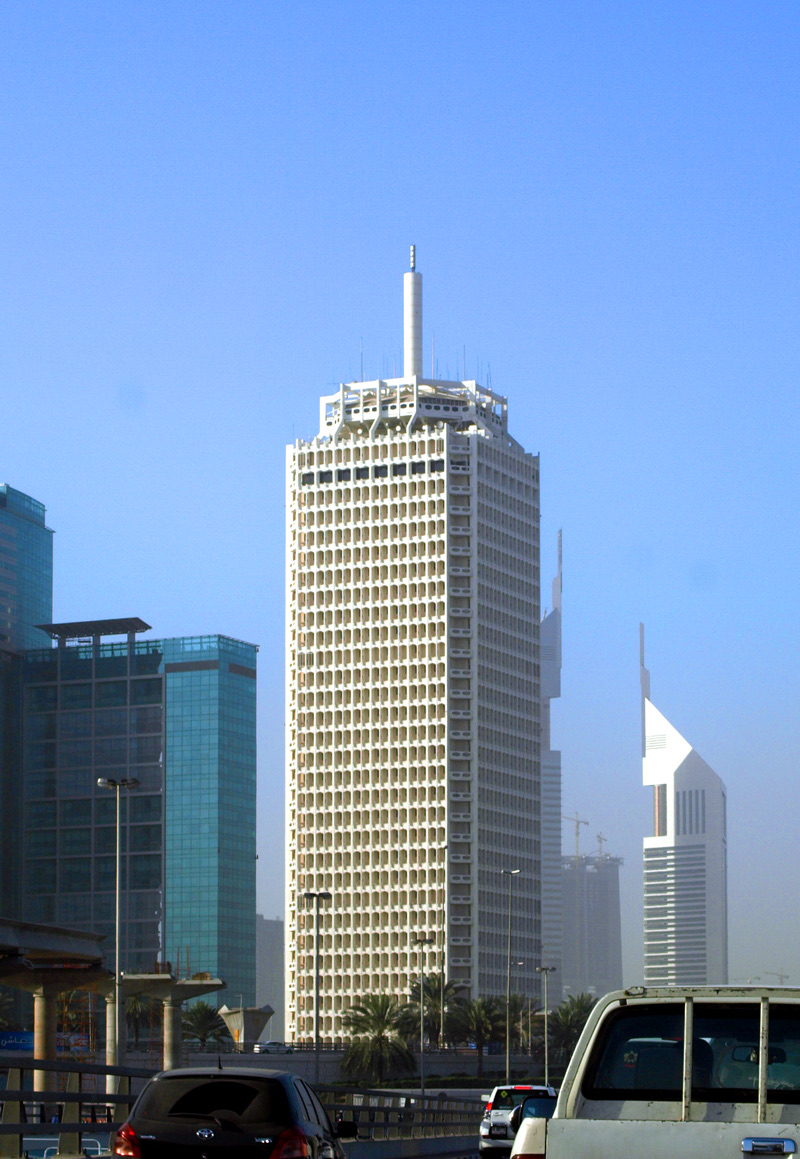
Dubai World Trade Centre was inaugurated in 1979, designed by British architect John R. Harris and commissioned under the direction of the late Sheikh Rashid bin Saeed Al Maktoum. The 39-storey Trade Centre Tower, standing approximately 149 metres, was the tallest building in the Middle East at the time of its completion and served as the catalyst for Dubai's commercial development along Sheikh Zayed Road. The wider DWTC campus today encompasses the tower, the Dubai International Convention and Exhibition Centre, and associated office and retail facilities, all under single government-linked institutional ownership. No other building on the SZR corridor carries equivalent institutional heritage or the specific operational adjacency to Dubai's primary convention and exhibition venue.
Sheikh Zayed Road
Dubai World Trade Centre
39-storey single-ownership landmark office tower, opened 1979.
- Floors
- 39
- Grade
- B+ to A
Commercial Building
Overview
Office stock
The Trade Centre Tower provides Grade B+ to Grade A office accommodation within a building that carries historic address recognition unmatched by any other asset on the SZR corridor. The DWTC campus attracts a mix of government entities, trade organisations, professional services firms, and businesses seeking proximity to the convention and exhibition facilities that host major international events including GITEX and Arab Health. The building's heritage status and government management structure make it distinct from newer freehold or speculative Grade A towers on the corridor, and its tenant community reflects this institutional and sectoral character.
Rental rates
DWTC offers a distinct rental value proposition: historic address recognition, direct adjacency to the exhibition campus, and competitive pricing relative to newer Grade A towers on SZR and in DIFC. It appeals particularly to trade, government-linked, and exhibition-dependent occupiers for whom physical proximity to the exhibition halls is a primary operational requirement. Lease structures are managed directly through the DWTC Authority on commercial terms aligned with government-linked institutional practice. Occupiers transacting with the DWTC Authority should factor longer procedural lead times into their planning relative to private-landlord alternatives.
Sales prices
Dubai World Trade Centre is a government-linked institutional asset under the DWTC Authority and is not available for individual unit purchase. At the whole-campus level, the asset's strategic significance to Dubai's commercial and exhibition infrastructure means it is unlikely to transact in any conventional investment market context. The DWTC Authority's mandate is to operate the campus as a public commercial institution rather than to maximise returns for private investors. Its value lies in its institutional and heritage significance rather than conventional investment yield metrics, making it categorically different from the investable freehold or single-ownership commercial buildings on the SZR corridor.
Location and access
Dubai World Trade Centre is located on Sheikh Zayed Road at the junction of the Trade Centre roundabout, with direct frontage on the main arterial highway. The World Trade Centre Metro Station (Red Line) provides on-site rapid transit access directly integrated into the campus. The campus is approximately 3 to 4 kilometres from DIFC and Downtown Dubai, with strong road and metro connectivity across the broader SZR corridor. The Trade Centre roundabout is one of Dubai's most recognisable civic landmarks, reinforcing the address recognition value for occupiers and visitors at this location.
Risks
The principal risk for occupiers is the building's 1970s vintage, which constrains floor plate size, ceiling heights, and the range of building systems upgrades possible within a heritage structure. The convention and exhibition campus creates significant traffic and access pressure during major events — GITEX, Arab Health, The Big 5, and others — which is a material consideration for occupiers requiring consistent unobstructed access throughout the year. Government management processes for maintenance approvals and fit-out works are typically more procedural than equivalent private landlord timelines. Occupiers should build realistic lead times into fit-out and operational planning when engaging with the DWTC Authority.
Perspective
Dubai World Trade Centre is a one-of-a-kind asset in the Dubai commercial market. No other building carries the same historic address weight on SZR, and no other building offers direct operational adjacency to Dubai's primary convention and exhibition infrastructure. For occupiers who specifically need proximity to the exhibition campus, or who value the government-linked institutional credibility of the DWTC address, it remains highly relevant and practically irreplaceable within the SZR submarket. For general Grade A office requirements prioritising modern specification and operational flexibility, the 1970s vintage and institutional management structure will limit its appeal relative to newer product. It serves a specific and defined occupier profile rather than a general-purpose office demand base.
Location
Dubai World Trade Centre — Sheikh Zayed Road, Dubai